1

Hunting Guide Jobs (NOW HIRING)

Senior Threat Hunter - Boston

Boston, MA · On-site

$145K - $192K/yr

At Bank of America, we are guided by a common purpose to help make financial lives better through ... Join us! Our Cyber Threat Hunting, Intelligence & Defense team within Bank of America ...

Senior Threat Hunter - Boston

Boston, MA · On-site

$145K - $192K/yr

At Bank of America, we are guided by a common purpose to help make financial lives better through ... Join us! Our Cyber Threat Hunting, Intelligence & Defense team within Bank of America ...

First Peoples Buffalo Jump hosts numerous field trips for students from across the state as well as many special events including an art show, kite festival, mammoth hunt, guided hikes, guest ...

Showing results 41-60

Hunting Guide information

See salary details

$6

$10

$15

How much do hunting guide jobs pay per hour?

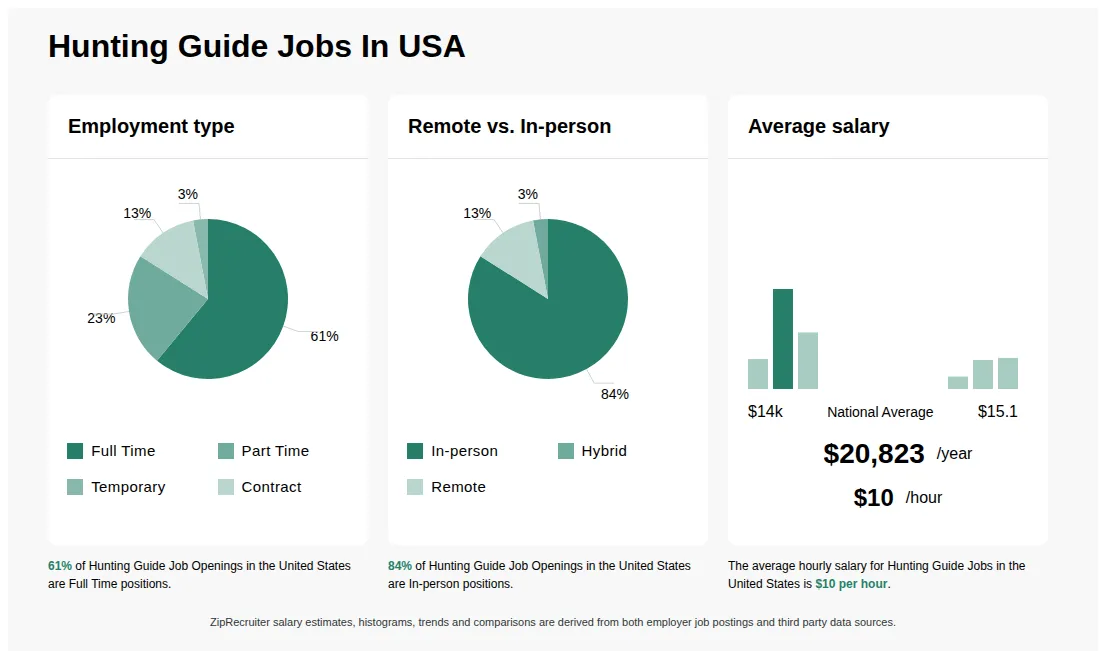
As of Sep 14, 2026, the average hourly pay for hunting guide in the United States is $10.01, according to ZipRecruiter salary data. Most workers in this role earn between $7.69 and $13.94 per hour, depending on experience, location, and employer.

What is a hunting guide?

Hunting guides are professionals who assist individuals or groups in planning and conducting hunting trips. They possess extensive knowledge of local wildlife, hunting laws, safety protocols, and the terrain in which they operate. Hunting guides provide guidance on tracking, identifying game, and proper hunting techniques, often supplying necessary equipment and ensuring compliance with regulations. Their goal is to help hunters have a successful, ethical, and safe hunting experience. Many hunting guides are also skilled in outdoor survival and first aid.

What does a hunting guide do?

A hunting guide plans and executes outdoor adventure trips for hunting enthusiasts. For this job, your responsibilities include locating the best and legal places for hunting and obtaining any permissions or licenses necessary to bring a group there to hunt. Additionally, you may arrange purchase and delivery of any required equipment from a hunting guide outfitter, hunt alongside the individual or group, and assist with preparing and processing the animals when a kill is successful. Qualifications for a career as a hunting guide include a valid hunting license, planning skills, and familiarity with the proposed hunting area, as well as the game in that area. You should also have a vast understanding of gun safety and the different kinds of ammunition needed for a variety of targets.

What are the key skills and qualifications needed to thrive as a hunting guide, and why are they important?

To thrive as a Hunting Guide, you need expertise in wildlife tracking, outdoor survival, navigation, and a thorough understanding of local hunting regulations, often supported by hunter safety certifications or guiding licenses. Familiarity with GPS devices, firearms, and communication equipment is typically required. Strong leadership, communication, and customer service skills set exceptional guides apart. These competencies ensure client safety, legal compliance, and a rewarding outdoor experience for guests.

What are some common challenges faced by hunting guides during a typical season?

Hunting guides often navigate unpredictable weather conditions, varied client skill levels, and remote terrain, which can all impact trip success and safety. Additionally, balancing guest expectations with ethical and legal hunting practices requires strong communication and leadership skills. Guides must also be prepared to handle emergencies and adapt plans on the fly to ensure both client satisfaction and wildlife conservation.

What is the difference between Hunting Guide vs Fishing Guide?

AspectHunting GuideFishing Guide
Required CredentialsHunter safety courses, state licensesFishing licenses, certifications (if applicable)
Work EnvironmentForests, wilderness areas, hunting groundsLakes, rivers, coastal waters
Employer & Industry UsageOutdoor adventure, tourism, conservationRecreation, tourism, outdoor sports

Both Hunting Guides and Fishing Guides work outdoors, often require specific licenses or certifications, and serve the outdoor recreation industry. The main difference lies in their focus: Hunting Guides specialize in guiding clients on hunting expeditions in wilderness areas, while Fishing Guides focus on fishing trips in lakes, rivers, or coastal waters. Understanding these distinctions helps clients choose the right guide for their outdoor adventure.

What cities are hiring for Hunting Guide jobs?

Cities with the most Hunting Guide job openings:

What are the most commonly searched types of Hunting Guide jobs?

The most popular types of Hunting Guide jobs are:

Who are the top companies hiring for Hunting Guide jobs?

The top employers for Hunting Guide jobs are:

What states have the most Hunting Guide jobs?

States with the most job openings for Hunting Guide jobs include:

What are popular job titles related to Hunting Guide jobs?

For Hunting Guide jobs, the most frequently searched job titles are:

Infographic showing various Hunting Guide job openings in the United States as of September 2026, with employment types broken down into 1% Internship, 1% As Needed, 77% Full Time, 17% Part Time, and 4% Contract. Highlights an 88% Physical, 2% Hybrid, and 10% Remote job distribution, with an average salary of $20,823 per year, or $10 per hour.

Cybersecurity Threat Hunter II

Colorado Springs, CO • On-site

Invictus International Consulting
Guided Missile and Space Vehicle Manufacturing • 11 - 50 employees

$109K - $148K/yr

Full-time

Posted 5 days ago


Job description

Title: Cybersecurity Threat Hunter II

Location: Colorado Springs, CO

Clearance: TS/SCI with the ability to obtain and maintain a CI polygraph

Job Details:

  • Independently conduct hypothesis-driven threat hunts across available enterprise telemetry to identify malicious or anomalous activity not detected by automated controls
  • Proactively analyze security telemetry to identify indicators of compromise, anomalous behavior, and adversary activity that has not met an incident threshold or has evaded automated security controls
  • Assess and correlate data from multiple sources, including network, endpoint, identity, SIEM, threat intelligence, vulnerability, and other available security data
  • Document hunt activity, findings, evidence, and recommended follow-on actions in authorized systems and initiate or support incident-response processes when malicious activity is identified
  • Provide relevant findings and trends for SOC operational reporting, significant-activity reporting, and defensive awareness
  • Develop hunt hypotheses based on threat intelligence, adversary TTPs, environmental observations, emerging threats, and known detection gaps
  • Use MITRE ATT&CK and other threat-informed methodologies to characterize observed behavior and guide analytical pivots
  • Identify patterns, relationships, and potential adversary activity across users, hosts, network segments, and time periods
  • Recommend new or improved detections, data collection, enrichment, and defensive controls based on hunt outcomes

Requirements:

  • Bachelor's degree from an accredited institute in a technical discipline applicable to the position; an additional 4 years of may be substituted in lieu of a degree
  • Minimum four (4) years of relevant experience in addition to education level
  • Hands-on experience with threat hunting, security analysis, incident investigation, threat intelligence analysis, or comparable proactive cyber defense work
  • Working knowledge of adversary TTPs, MITRE ATT&CK, network and endpoint telemetry, and analytical search techniques
  • Experience using SIEM, network-security monitoring, endpoint telemetry, or other large-scale security data sources
  • Must possess current DoD 8570 IAT II or IAM II certification
  • Experience working in a DoD or IC environment
  • Current active TS/SCI clearance, with the ability to obtain and maintain a CI polygraph

Equal Opportunity Employer/Veteran/Disabled