1

Human Movement Science Jobs (NOW HIRING)

next page

Showing results 1-20

Human Movement Science information

See salary details

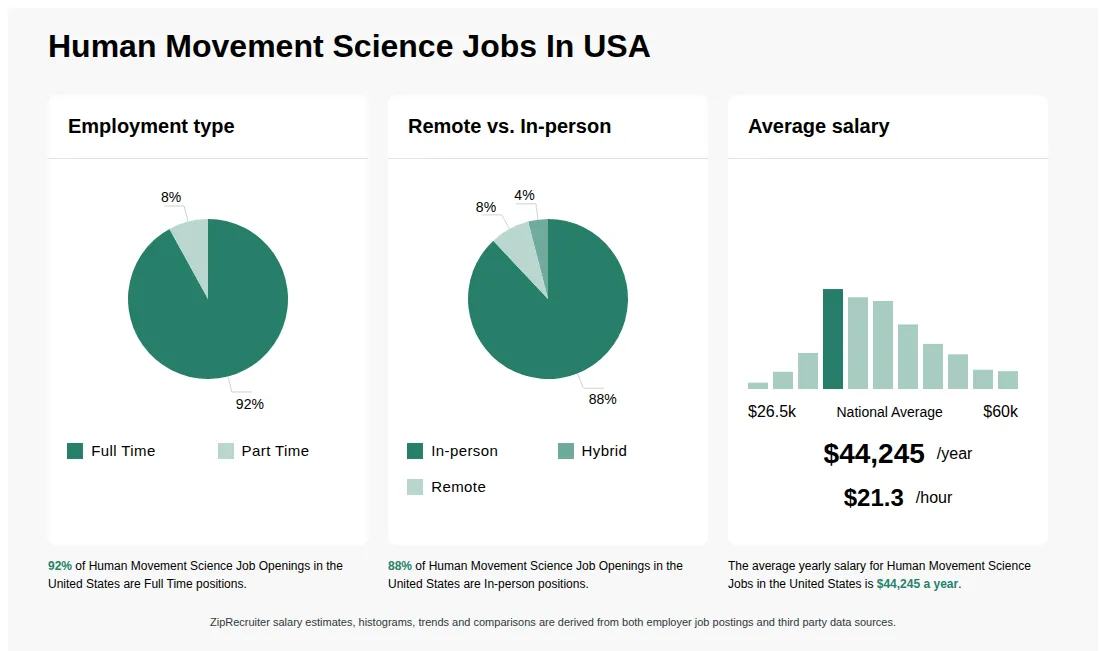
$26.5K

$44.2K

$60K

How much do human movement science jobs pay per year?

As of Jun 10, 2026, the average yearly pay for human movement science in the United States is $44,245.00, according to ZipRecruiter salary data. Most workers in this role earn between $37,500.00 and $48,000.00 per year, depending on experience, location, and employer.

What is a human movement scientist?

A human movement scientist studies how humans move, focusing on biomechanics, motor control, and physical activity. They often work in research, rehabilitation, or sports science, using tools like motion analysis and requiring knowledge of anatomy and physiology.

What are the key skills and qualifications needed to thrive in the Human Movement Science position, and why are they important?

To succeed in Human Movement Science, you generally need a strong background in kinesiology, biomechanics, anatomy, and physiology, often supported by at least a bachelor's or master's degree in a related field. Experience with motion analysis software, gait analysis systems, and certifications such as Certified Strength and Conditioning Specialist (CSCS) are highly valuable. Excellent interpersonal skills, problem-solving abilities, and clear communication help professionals work effectively with clients, patients, or athletes. These competencies are crucial for accurately assessing movement, designing individualized interventions, and fostering successful client outcomes.

What is a Human Movement Science job?

A Human Movement Science job focuses on analyzing and optimizing human motion to improve health, performance, and injury prevention. Professionals in this field work in healthcare, sports, rehabilitation, and research settings, applying biomechanics, physiology, and psychology principles. Careers include roles such as physical therapists, athletic trainers, ergonomists, and strength coaches. These professionals assess movement patterns, develop training or recovery programs, and enhance physical function. Their expertise helps individuals recover from injuries, improve athletic performance, and prevent musculoskeletal issues.

What types of organizations hire professionals with a background in Human Movement Science, and what is the typical work environment like?

Professionals in Human Movement Science can find employment in a range of settings, including healthcare clinics, sports performance centers, rehabilitation facilities, research institutions, and universities. The work environment may involve collaborating with physical therapists, physicians, athletic trainers, and researchers to develop and implement programs that improve human movement and functional performance. Depending on the specific role, you might work with patients recovering from injuries, athletes seeking performance enhancement, or contribute to research studies. Teamwork is often essential, and many positions require a combination of hands-on client interaction and data analysis or reporting. This diversity allows for varied career paths and the ability to specialize further within the field.

More about Human Movement Science jobs
What cities are hiring for Human Movement Science jobs? Cities with the most Human Movement Science job openings:
What are the most commonly searched types of Human Movement Science jobs? The most popular types of Human Movement Science jobs are:
What states have the most Human Movement Science jobs? States with the most job openings for Human Movement Science jobs include:
What job categories do people searching Human Movement Science jobs look for? The top searched job categories for Human Movement Science jobs are:
Associate Director, Engineering Sciences - BioMechanics

Associate Director, Engineering Sciences - BioMechanics

Secretariat

Atlanta, GA โ€ข On-site

Full-time

Posted 13 days ago


Job description

Chart Your Journey at Secretariat
From a collaborative culture to teammates who will always be by your side, find a career that will grow with you. Deliver your impact at Secretariat.
ABOUT THE FIRM
Secretariat professionals are trusted in the highest-stakes legal, risk, and regulatory matters around the world.
When you join Secretariat, you become part of a rapidly growing elite team of bright minds and passionate problem-solvers. Your skills and expertise will be utilized on day one - working with the world's most renowned law firms, leading corporations, and influential institutions to answer complex questions that shape critical financial, economic, and strategic business decisions.
Our globally integrated teams are united by the ambition, energy, and commitment they bring to every challenge. We inspire and empower an open, collaborative culture that embraces ongoing professional development, recognition, diversity, and - most importantly - you.
Make your impact at Secretariat.
ABOUT OUR ENGINEERING SCIENCES TEAM
As part of our expanding Global Engineering and Scientific consulting team, you will work at the forefront of today's most complex engineering challenges. You will be engaged in analyzing failures of a myriad of products from a variety of industries, but with a heavy focus on large industrial facilities like power plants, Oil & Gas facilities, chemical processing plants, construction, and similar. Outside of that work, you will be engaged in automotive, consumer products, consumer electronics, and medical devices.
Secretariat leverages our diverse technical expertise and industry knowledge of a variety of structures and products to provide clients with world-class value to identify solutions that drive performance and safety.
Secretariat is a diversified international expert services firm with more than 500 professionals in 20+ cities around the globe. Furthermore, Secretariat was recently ranked as the #1 firm in Global Arbitration Review's prestigious GAR 100 Expert Witness Firms' Power Index, and more than 90% of Secretariat's leading experts are recognized as leading experts in their field by the independent Lexology rankings.
RESPONSIBILITIES
  • Design and develop analytical pipelines for acquisition, synchronization, fusion, processing, and analysis of multimodal wearable and biomechanical sensor data.
  • Collect, process, analyze, and interpret biomechanical and physiological data from both laboratory and real-world study environments as they pertain to human gait and locomotion, motor control, and predictive musculoskeletal and human movement modeling.
  • Develop algorithms, software tools, and analytical workflows for wearable sensor and biomechanics applications.
  • Work extensively with wearable sensing modalities including:
    • inertial measurement units (IMUs)
    • photoplethysmography (PPG)
    • galvanic skin response (GSR/EDA)
    • electromyography (EMG)
    • wearable force and pressure sensing systems
    • flexible and emerging wearable sensor technologies
  • Apply signal processing, sensor fusion, statistical modeling, and AI/ML methodologies to derive meaningful insights from complex multimodal datasets.
  • Develop and apply machine learning and AI approaches including:
    • predictive analytics
    • classification and pattern recognition
    • anomaly detection
    • time-series analytics
    • human activity recognition
    • computer vision and movement tracking
  • Support development and validation of wearable sensing technologies and associated algorithms against laboratory-based gold-standard systems.
  • Develop technical reports, visualizations, dashboards, and presentations to communicate analytical findings and study outcomes.
  • Collaborate closely with multidisciplinary teams including engineers, data scientists, clinicians, researchers, and product development teams.
  • Contribute to technical publications and client-facing technical activities as appropriate.

QUALIFICATIONS
  • Ph.D. in Biomechanics, Biomedical Engineering, Mechanical Engineering, Kinesiology, Bioengineering, Data Science, Electrical Engineering, or a related technical discipline.
  • Strong background in biomechanics, human movement analysis, signal processing, and advanced data analytics.
  • Experience working with wearable biomechanical, physiological, and integrated clinical sensing technologies.
  • Experience developing analytical pipelines, algorithms, or software tools for integrated wearable and laboratory-based sensor data processing and analysis.
  • Strong understanding of multimodal wearable sensing technologies and associated signal characteristics.
  • Experience conducting or supporting human-subject/participant studies.
  • Experience processing and analyzing large-scale time-series datasets generated from diverese sensing systems.
  • Experience applying statistical analysis, machine learning, or AI methodologies to biomechanics, physiological monitoring, or other human movement datasets.
  • Strong programming and scientific computing skills using Python, MATLAB, R, and/or C/C++.
  • Strong written and verbal communication skills.

A rewarding career above all
There are a lot of fine consulting firms out there. But when everything is on the line, it takes a unique combination of skill and savvy to succeed under pressure.
Our culture and people are driven by passion, pride, and performance. Passion for the clients we serve, the work we deliver, and the communities we live in. Pride in our cohesive team recognized for excellence and trusted to perform in the most challenging situations. And our track record of outstanding performance across all of our disciplines speaks for itself.
Our people are motivated to be the best in everything they do - from our approach to making the complex simple to the way we mentor our up-and-coming talent to become trusted experts early in their careers.
To learn how Secretariat collects, uses, and protects your personal information during the recruitment process, please review our Privacy Policy