1

Health Informatics Data Analyst Jobs in California

Research Data Analyst 2

Stanford, CA · On-site

$108K - $128K/yr

... for data management and analysis work focused on population health. The Stanford Center for ... The center employs various methodologies, including health informatics, predictive analytics, and ...

Data Analyst Job ID: KAISJP00230764 Location: Pasadena, Ca 91101 Minimum three (3) years' of ... Familiarity with Kaiser Permanente health care system Experience using SAS Experience with ...

... Health Informatics, Information Systems, Data Management, or a related field • In lieu of the ... analysis and critical thinking skills • Excellent communication and interpersonal skills • ...

Be Seen First

Are you a rockstar data analyst?! Do you see stories where others only see spreadsheets? We're ... informatics tools, including eClinicalWorks, Cognos/EBO, various third party population health ...

next page

Showing results 1-20

Health Informatics Data Analyst information

See California salary details

$41.9K

$84.5K

$123.4K

How much do health informatics data analyst jobs pay per year?

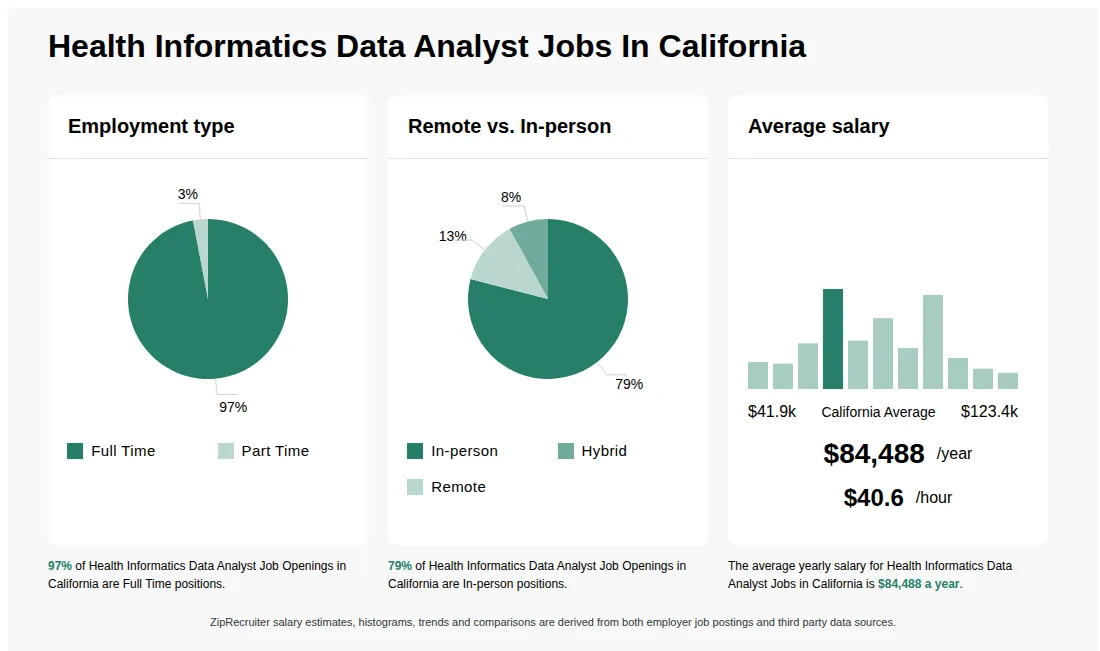
As of Jul 14, 2026, the average yearly pay for health informatics data analyst in California is $84,488.00, according to ZipRecruiter salary data. Most workers in this role earn between $68,100.00 and $98,700.00 per year, depending on experience, location, and employer.

What are typical daily responsibilities for a Health Informatics Data Analyst?

As a Health Informatics Data Analyst, your typical day involves gathering, cleaning, and analyzing health data from multiple sources, such as electronic health records and clinical systems. You'll frequently collaborate with healthcare professionals and IT teams to understand data requirements, identify trends, and present findings through reports and data visualizations. Tasks may also include developing and maintaining dashboards, supporting quality improvement initiatives, and ensuring data complies with privacy regulations. This role requires balancing technical tasks with regular communication across interdisciplinary teams.

What are the key skills and qualifications needed to thrive in the Health Informatics Data Analyst position, and why are they important?

Health Informatics Data Analysts need strong analytical skills, a foundational understanding of healthcare systems, and a background in statistics or information management, often supported by a relevant degree. Proficiency with data analysis tools such as SQL, Python, R, as well as experience with EHR systems and certifications like CAHIMS are highly valued. Attention to detail, problem-solving abilities, and strong communication skills are essential soft skills for excelling in this role. These skills enable analysts to extract meaningful insights from complex healthcare data, ensuring quality improvements and informed decision-making within healthcare organizations.

What is a Health Informatics Data Analyst job?

A Health Informatics Data Analyst collects, analyzes, and interprets healthcare data to improve patient outcomes, operational efficiency, and decision-making. They work with electronic health records (EHRs), databases, and analytics tools to identify trends and support evidence-based practices. Their role bridges healthcare, IT, and data science, ensuring that data-driven insights enhance care quality and efficiency.

What are the most commonly searched types of Health Informatics Data Analyst jobs in California? The most popular types of Health Informatics Data Analyst jobs in California are:
What are popular job titles related to Health Informatics Data Analyst jobs in California? For Health Informatics Data Analyst jobs in California, the most frequently searched job titles are:
What job categories do people searching Health Informatics Data Analyst jobs in California look for? The top searched job categories for Health Informatics Data Analyst jobs in California are:
Infographic showing various Health Informatics Data Analyst job openings in California as of July 2026, with employment types broken down into 1% Locum Tenens, 1% Internship, 83% Full Time, 8% Part Time, 2% Temporary, and 5% Contract. Highlights an 82% Physical, 5% Hybrid, and 13% Remote job distribution, with an average salary of $84,488 per year, or $40.6 per hour.
Research Data Analyst 2

Research Data Analyst 2

Stanford University

Stanford, CA • On-site

$108K - $128K/yr

Full-time

Re-posted 7 days ago


Stanford University rating

7.8

Company rating: 7.8 out of 10

Based on 24 frontline employees who took The Breakroom Quiz

201st of 553 rated colleges and universities


Job description

The Center for Population Health Sciences at Stanford University School of Medicine is seeking a Research Data Analyst 2 for data management and analysis work focused on population health. The Stanford Center for Population Health Sciences (PHS) is dedicated to improving population health by harnessing the power of interdisciplinary research and data analytics. PHS promotes collaboration among researchers, clinicians, and community partners to facilitate innovative research and practical solutions aimed at enhancing health at a population level. The center employs various methodologies, including health informatics, predictive analytics, and community-engaged research, to address pressing public health issues like chronic diseases and mental health. In addition to research, PHS is committed to education, providing training and mentorship for emerging public health and medical professionals to equip them with the necessary skills to tackle contemporary health challenges. Through its comprehensive approach, the center seeks to inform health policies and clinical practices, striving to influence both local and global health initiatives while fostering a culture of health-conscious innovation and collaboration within the community.
This position will be primarily responsible for cleaning, managing, and analyzing large databases, including programming using statistical packages, as well as communicating results both orally and in writing to internal and external researchers and stakeholders. This position will also be expected to create new databases and data management procedures, with a critical focus on data security, as well as train and update other researchers and staff on these procedures. In addition, the position requires project management skills helping to move projects along for internal and external collaborators and assisting in the design and management of new projects.
The majority of work will focus on data from the American Family Cohort. The American Family Cohort project aims to revolutionize primary care data systems to enhance health outcomes across the United States, particularly addressing urban and rural disparities. Recognizing the current shortcomings in health data collection and accessibility, the initiative seeks to establish a comprehensive data platform based on national primary care electronic health records (EHRs). Key objectives include linking EHR data with social and environmental factors that influence health, and validating this data through external datasets. The project intends to innovate data access technologies while providing diverse users the tools to develop effective health strategies. It aims to mitigate current limitations such as urban-centric data collection, privacy concerns around restricting data sharing, incomplete information on health drivers, and underutilized qualitative insights. The focus on validation through both quantitative and qualitative sources aims to better understand gaps in current datasets. Furthermore, the initiative plans to ensure broad accessibility through free synthetic data and a tiered pricing system for real data, emphasizing equity and preventing data misuse. Ultimately, by addressing fundamental barriers in health data collection, the American Family Cohort project seeks to provide actionable insights that will lead to improved health interventions, reversing adverse trends in life expectancy and promoting better mental health and well-being across the U.S. population.
Duties include:
• Prioritize and extract data from a variety of sources such as notes, survey results, medical reports, and laboratory data, and maintain its accuracy and completeness.
• Determine additional data collection and reporting requirements.
• Design and customize reports based upon data in the database. Oversee and monitor regulatory compliance for utilization of the data.
• Use system reports and analyses to identify potentially problematic data, make corrections, and eliminate root cause for data problems or justify solutions to be implemented by others.
• Create complex charts and databases, perform statistical analyses, and develop graphs and tables for publication and presentation.
• Serve as a resource for non-routine inquiries such as requests for statistics or surveys.
• Test prototype software and participate in approval and release process for new software.
• Provide documentation based on audit and reporting criteria to investigators and research staff.
* - Other duties may also be assigned
The expected pay range for this position is $108,002 to $128,138 per annum.
Stanford University provides pay ranges representing its good faith estimate of the salary or hourly wage the university reasonably expects to pay for a position upon hire. The pay offered to a selected candidate will be determined based on factors such as (but not limited to) the scope and responsibilities of the position, the qualifications of the selected candidate, departmental budget availability, internal equity, geographic location and external market pay for comparable jobs. At Stanford University, base pay represents only one aspect of the comprehensive rewards package.
The Cardinal at Work website (https://cardinalatwork.stanford.edu/benefits-rewards) provides detailed information on Stanford's extensive range of benefits and rewards offered to employees. Specifics about the rewards package for this position may be discussed during the hiring process.
Consistent with its obligations under the law, the University will provide reasonable accommodations to applicants and employees with disabilities. Applicants requiring a reasonable accommodation for any part of the application or hiring process should contact Stanford University Human Resources at stanfordelr@stanford.edu. For all other inquiries, please submit a contact form.
Stanford is an equal employment opportunity and affirmative action employer. All qualified applicants will receive consideration for employment without regard to race, color, religion, sex, sexual orientation, gender identity, national origin, disability, protected veteran status, or any other characteristic protected by law.
DESIRED QUALIFICATIONS:
• Expertise in SQL for data management and data analysis.
• Expertise in Python and its data analysis packages.
• Minimum, 1-2 years of experience conducting statistical analyses.
• Experience using cloud environment such as Google Cloud.
• Experience working with large health datasets is a plus.
• Academic or practical training in public health epidemiology, health research methodology, health database construction, or biostatistics is a plus.
• Experience in a quantitative discipline such as medicine, public health, economics, finance, statistics or engineering.
• Excellent organizational skills and demonstrated ability to complete detailed work accurately.
• Demonstrated oral and written communication skills.
EDUCATION & EXPERIENCE (REQUIRED):
Bachelor's degree and three years of relevant experience or combination of education and relevant experience. Experience in a quantitative discipline such as economics, finance, statistics or engineering.
KNOWLEDGE, SKILLS AND ABILITIES (REQUIRED):
• Substantial experience with MS Office and analytical programs.
• Excellent writing and analytical skills.
• Ability to prioritize workload.
CERTIFICATIONS & LICENSES:
None
PHYSICAL REQUIREMENTS*:
• Sitting in place at computer for long periods of time with extensive keyboarding/dexterity.
• Occasionally use a telephone.
• Rarely writing by hand.
* - Consistent with its obligations under the law, the University will provide reasonable accommodation to any employee with a disability who requires accommodation to perform the essential functions of his or her job.
WORKING CONDITIONS:
Some work may be performed in a laboratory or field setting.

What Stanford University employees say

Pay

Benefits

Hours and flexibility

Workplace

Get the full story on Breakroom