1

Health Informatics Data Analyst Jobs in California

... Health Informatics Supervisor is responsible for the administration and management of the ... The Supervisor blends a strong clinical lens with a passion for data, compliance, and system ...

... Health Informatics Supervisor is responsible for the administration and management of the ... The Supervisor blends a strong clinical lens with a passion for data, compliance, and system ...

Informatic Consultant

Los Angeles, CA · On-site

$14.50 - $20/hr

The Informatics Data Analyst will possess knowledge and experience in basic statistical concepts; identifying the trends, business opportunities, and relevant issues; commonly-used demographics and ...

Informatic Consultant

Los Angeles, CA · On-site

$14.50 - $20/hr

The Informatics Data Analyst will possess knowledge and experience in basic statistical concepts; identifying the trends, business opportunities, and relevant issues; commonly-used demographics and ...

Showing results 21-40

Health Informatics Data Analyst information

See California salary details

$41.9K

$84.5K

$123.4K

How much do health informatics data analyst jobs pay per year?

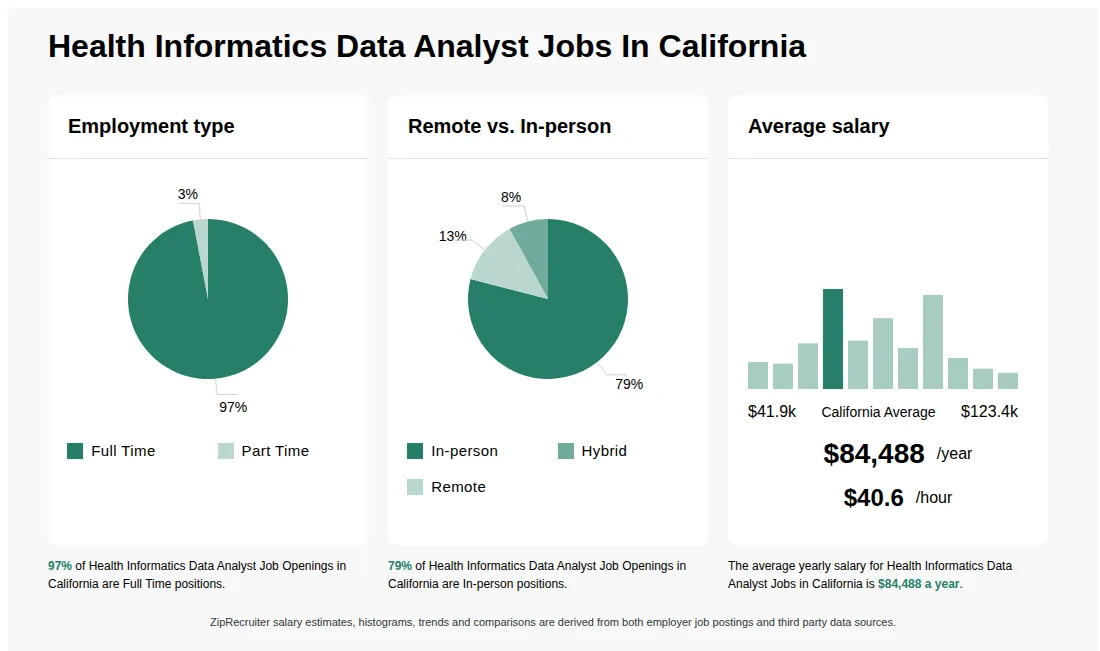
As of Sep 13, 2026, the average yearly pay for health informatics data analyst in California is $84,488.00, according to ZipRecruiter salary data. Most workers in this role earn between $68,100.00 and $98,700.00 per year, depending on experience, location, and employer.

What is a health informatics data analyst?

A Health Informatics Data Analyst collects, analyzes, and interprets healthcare data to improve patient outcomes, operational efficiency, and decision-making. They work with electronic health records (EHRs), databases, and analytics tools to identify trends and support evidence-based practices. Their role bridges healthcare, IT, and data science, ensuring that data-driven insights enhance care quality and efficiency.

What are typical daily responsibilities for a health informatics data analyst?

As a Health Informatics Data Analyst, your typical day involves gathering, cleaning, and analyzing health data from multiple sources, such as electronic health records and clinical systems. You'll frequently collaborate with healthcare professionals and IT teams to understand data requirements, identify trends, and present findings through reports and data visualizations. Tasks may also include developing and maintaining dashboards, supporting quality improvement initiatives, and ensuring data complies with privacy regulations. This role requires balancing technical tasks with regular communication across interdisciplinary teams.

What are the key skills and qualifications needed to thrive as a health informatics data analyst?

Health Informatics Data Analysts need strong analytical skills, a foundational understanding of healthcare systems, and a background in statistics or information management, often supported by a relevant degree. Proficiency with data analysis tools such as SQL, Python, R, as well as experience with EHR systems and certifications like CAHIMS are highly valued. Attention to detail, problem-solving abilities, and strong communication skills are essential soft skills for excelling in this role. These skills enable analysts to extract meaningful insights from complex healthcare data, ensuring quality improvements and informed decision-making within healthcare organizations.

How do I become a health informatics data analyst?

To become a health informatics data analyst, you typically need a bachelor's degree in health informatics, computer science, or a related field. Gaining skills in data analysis tools like SQL, Excel, and statistical software, along with understanding healthcare systems and data privacy regulations, is essential; some roles may also require certification such as Certified Health Data Analyst (CHDA).

Is healthcare data analytics a good career?

Healthcare data analytics is a growing field within health informatics, involving analyzing medical data to improve patient outcomes and operational efficiency. It requires skills in data management, statistical tools, and knowledge of healthcare systems, making it a promising career with increasing demand and opportunities for advancement.

What does a health informatics data analyst do?

A health informatics data analyst collects, analyzes, and interprets healthcare data to improve patient outcomes and operational efficiency. They use tools like SQL, Excel, and data visualization software, and often work with electronic health records (EHR) systems to support clinical and administrative decision-making.

What are the most commonly searched types of Health Informatics Data Analyst jobs in California?

The most popular types of Health Informatics Data Analyst jobs in California are:

What are popular job titles related to Health Informatics Data Analyst jobs in California?

For Health Informatics Data Analyst jobs in California, the most frequently searched job titles are:

What job categories do people searching Health Informatics Data Analyst jobs in California look for?

The top searched job categories for Health Informatics Data Analyst jobs in California are:

Infographic showing various Health Informatics Data Analyst job openings in California as of September 2026, with employment types broken down into 2% As Needed, 74% Full Time, 18% Part Time, and 6% Contract. Highlights an 92% Physical, 1% Hybrid, and 7% Remote job distribution, with an average salary of $84,488 per year, or $40.6 per hour.

Senior Data Analyst

Mission Viejo, CA • On-site

$100K - $125K/yr

Full-time

Re-posted 16 days ago


Job description

Description:

Position Summary

The Senior Data Analyst is responsible for supporting organizational decision-making through the development of reliable reporting, data analysis, and documentation of systems and data structures. This role works across clinical, operational, and financial datasets to produce accurate, actionable insights and maintain a clear understanding of how data flows across systems.

The position requires strong technical skills in SQL and Tableau, along with the ability to work with complex relational data environments, including behavioral health EHR systems. A key focus of this role is ensuring data clarity and consistency by documenting existing data sources, reporting logic, and system relationships, enabling more effective and scalable analytics across the organization.

This role partners with stakeholders across Marketing, Customer Care, Finance, Clinical Operations, and IT to deliver reporting and analysis that supports day-to-day operations and ongoing performance improvement.

Requirements:

Key Responsibilities

Data Analysis and Reporting

  • Develop, maintain, and enhance Tableau dashboards and reports supporting referral tracking, intake performance, clinician activity, and program metrics.
  • Write and optimize SQL queries to extract, join, and transform data from complex relational databases.
  • Produce recurring and ad hoc reports to support operational and strategic decision-making.
  • Ensure accuracy and consistency of reported data through validation and reconciliation processes.

Data Systems Documentation and Structure

  • Document current data systems, including data sources, table structures, field definitions, and relationships across systems.
  • Maintain clear documentation of reporting logic, metric definitions, and calculation methodologies.
  • Identify gaps or inconsistencies in data structures and escalate opportunities for improvement.
  • Support the development and maintenance of data dictionaries and internal documentation resources.

Data Quality and Integrity

  • Perform regular audits to identify data inconsistencies, missing values, or reporting discrepancies.
  • Partner with IT and operational teams to investigate and resolve data quality issues.
  • Ensure alignment between source system data (e.g., EHR, CRM, billing systems) and reporting outputs.

Cross-Functional Support

  • Collaborate with stakeholders to understand reporting needs and translate business questions into data queries and visualizations.
  • Support multiple departments including Marketing, Finance, Customer Care, and Clinical Operations with data requests and analysis.
  • Present findings in a clear, concise manner appropriate for both technical and non-technical audiences.

EHR and Data Environment Support

  • Work with behavioral health EHR data to support reporting and analysis needs.
  • Assist in extracting and validating data from EHR and connected systems.
  • Develop familiarity with system workflows and data capture processes to improve reporting accuracy.

Qualifications

Required

  • Bachelor’s degree in quantitative fields such as data analytics, statistics, mathematics, health informatics, or related discipline.
  • Minimum 3–5 years of experience in a data analyst or similar role.
  • Strong proficiency in SQL, including complex joins, aggregations, and data transformation.
  • Experience building dashboards and visualizations in Tableau or a similar BI tool.
  • Experience working with complex relational databases and multi-source data environments.
  • Demonstrated ability to document data systems, reporting logic, and workflows clearly and accurately.
  • Strong attention to detail and commitment to data accuracy and integrity.

Preferred

  • Experience working in healthcare or behavioral health environments.
  • Familiarity with EHR systems and healthcare data structures.
  • Understanding of basic financial or operational metrics in a service-based organization.
  • Experience supporting cross-functional teams with reporting and analytics.

Work Environment

This role operates in a hybrid environment with occasional on-site presence in Southern California. The position involves access to sensitive data and requires adherence to HIPAA and organizational data security standards.

EOE, INCLUDING DISABILITY/VETS We are an equal opportunity employer and consider all qualified applicants for employment without regard to race, color, religion, sex, sexual orientation, gender identity, national origin, ancestry, age, disability, medical condition, genetic information, marital status, veteran status, or any other protected characteristic under California law.

Management reserves the right to add, change, delete or rescind duties or responsibilities of positions within the job classification at any time.