Among us are specialty-care physicians, nurse practitioners, pharmacists, engineers, data ... The Genetic Counselor Review Associate will be responsible for conducting routine and simple ...
Among us are specialty-care physicians, nurse practitioners, pharmacists, engineers, data ... The Genetic Counselor Review Associate will be responsible for conducting routine and simple ...

Post Doctoral Fellow
Atlanta, GA · On-site
$47K - $64K/yr
This position will involve mass spectrometry-based analyses alongside cell culture, molecular biology, and genetic engineering approaches in mammalian systems. Primary responsibilities will include ...
Post Doctoral Fellow
Atlanta, GA · On-site
$47K - $64K/yr
This position will involve mass spectrometry-based analyses alongside cell culture, molecular biology, and genetic engineering approaches in mammalian systems. Primary responsibilities will include ...
Genetic Counselor Review Associate Carelon Medical Benefits Management Schedule: 9:30-6 Central ... Among us are specialty-care physicians, nurse practitioners, pharmacists, engineers, data ...
Genetic Counselor Review Associate Carelon Medical Benefits Management Schedule: 9:30-6 Central ... Among us are specialty-care physicians, nurse practitioners, pharmacists, engineers, data ...
Seed Warehouse and Shipping Technician
Urbana, IL · On-site
$18 - $21/hr
Department Overview The Field Operations Team is responsible for conducting a wide range of research activities, namely in the areas of trait discovery and validation, crop genetic engineering, crop ...
Quick apply
Seed Warehouse and Shipping Technician
Urbana, IL · On-site
$18 - $21/hr
Department Overview The Field Operations Team is responsible for conducting a wide range of research activities, namely in the areas of trait discovery and validation, crop genetic engineering, crop ...

Colossal is a breakthrough bioscience and genetic engineering company that builds radical new technologies to advance the field of genomics. Colossal creates disruptive technologies for extinct ...
Colossal is a breakthrough bioscience and genetic engineering company that builds radical new technologies to advance the field of genomics. Colossal creates disruptive technologies for extinct ...
Genetic Counselor Review Associate Carelon Medical Benefits Management Schedule: 9:30-6 Central ... Among us are specialty-care physicians, nurse practitioners, pharmacists, engineers, data ...
Genetic Counselor Review Associate Carelon Medical Benefits Management Schedule: 9:30-6 Central ... Among us are specialty-care physicians, nurse practitioners, pharmacists, engineers, data ...
Among us are specialty-care physicians, nurse practitioners, pharmacists, engineers, data ... The Genetic Counselor Review Associate will be responsible for conducting routine and simple ...
Among us are specialty-care physicians, nurse practitioners, pharmacists, engineers, data ... The Genetic Counselor Review Associate will be responsible for conducting routine and simple ...
Among us are specialty-care physicians, nurse practitioners, pharmacists, engineers, data ... The Genetic Counselor Review Associate will be responsible for conducting routine and simple ...
Among us are specialty-care physicians, nurse practitioners, pharmacists, engineers, data ... The Genetic Counselor Review Associate will be responsible for conducting routine and simple ...
Among us are specialty-care physicians, nurse practitioners, pharmacists, engineers, data ... The Genetic Counselor Review Associate will be responsible for conducting routine and simple ...
Among us are specialty-care physicians, nurse practitioners, pharmacists, engineers, data ... The Genetic Counselor Review Associate will be responsible for conducting routine and simple ...
Genetic Counselor Review Associate Carelon Medical Benefits Management Schedule: 9:30-6 Central ... Among us are specialty-care physicians, nurse practitioners, pharmacists, engineers, data ...
Genetic Counselor Review Associate Carelon Medical Benefits Management Schedule: 9:30-6 Central ... Among us are specialty-care physicians, nurse practitioners, pharmacists, engineers, data ...
Seed Warehouse and Shipping Technician
Altoona, IA · On-site
$18 - $21/hr
Department Overview The Field Operations Team is responsible for conducting a wide range of research activities, namely in the areas of trait discovery and validation, crop genetic engineering, crop ...
Quick apply
Seed Warehouse and Shipping Technician
Altoona, IA · On-site
$18 - $21/hr
Department Overview The Field Operations Team is responsible for conducting a wide range of research activities, namely in the areas of trait discovery and validation, crop genetic engineering, crop ...
Genetic Counselor Review Associate Carelon Medical Benefits Management Schedule: 9:30-6 Central ... Among us are specialty-care physicians, nurse practitioners, pharmacists, engineers, data ...
Genetic Counselor Review Associate Carelon Medical Benefits Management Schedule: 9:30-6 Central ... Among us are specialty-care physicians, nurse practitioners, pharmacists, engineers, data ...
Genetic Counselor Review Associate Carelon Medical Benefits Management Schedule: 9:30-6 Central ... Among us are specialty-care physicians, nurse practitioners, pharmacists, engineers, data ...
Genetic Counselor Review Associate Carelon Medical Benefits Management Schedule: 9:30-6 Central ... Among us are specialty-care physicians, nurse practitioners, pharmacists, engineers, data ...

POSTDOCTORAL RESEARCHER - Pathology - Akbay Lab - Req#: 943355, Position#: 131756
Dallas, TX · On-site
$48K - $65K/yr
Experience inin vivo cancer models, flow cytometry, western blots, genetic engineering, and cell biology techniquesleading to first author publications in peer-reviewed journals is highly recommended.
POSTDOCTORAL RESEARCHER - Pathology - Akbay Lab - Req#: 943355, Position#: 131756
Dallas, TX · On-site
$48K - $65K/yr
Experience inin vivo cancer models, flow cytometry, western blots, genetic engineering, and cell biology techniquesleading to first author publications in peer-reviewed journals is highly recommended.
Among us are specialty-care physicians, nurse practitioners, pharmacists, engineers, data ... The Genetic Counselor Review Associate will be responsible for conducting routine and simple ...
Among us are specialty-care physicians, nurse practitioners, pharmacists, engineers, data ... The Genetic Counselor Review Associate will be responsible for conducting routine and simple ...

Genetics Counselor
Philadelphia, PA · On-site
Important duties of the genetic counselor include, but are not limited to: providing risk ... Engineering and Commerce, dates back to 1824 and today comprises 10 colleges and three schools ...
Genetics Counselor
Philadelphia, PA · On-site
Important duties of the genetic counselor include, but are not limited to: providing risk ... Engineering and Commerce, dates back to 1824 and today comprises 10 colleges and three schools ...
Genetics Counselor
Philadelphia, PA · On-site
Important duties of the genetic counselor include, but are not limited to: providing risk ... Engineering and Commerce, dates back to 1824 and today comprises 10 colleges and three schools ...
Genetics Counselor
Philadelphia, PA · On-site
Important duties of the genetic counselor include, but are not limited to: providing risk ... Engineering and Commerce, dates back to 1824 and today comprises 10 colleges and three schools ...

Researcher/Scientist III, Department of Translational Cardiovascular Research Center (TCRC)(Phoenix)
Phoenix, AZ · On-site
Genetic Engineering & Viral Vectors * Construct Design: Engineer sophisticated DNA expression constructs for functional genomics studies. * Viral Production: Oversee the development, packaging, and ...
Researcher/Scientist III, Department of Translational Cardiovascular Research Center (TCRC)(Phoenix)
Phoenix, AZ · On-site
Genetic Engineering & Viral Vectors * Construct Design: Engineer sophisticated DNA expression constructs for functional genomics studies. * Viral Production: Oversee the development, packaging, and ...

R&D Scientist
Saint Cloud, MN · On-site
$86K - $107K/yr
Extensive hands-on experience in molecular biology, including genetic engineering and molecular characterization, with the ability to design and interpret experiments at both gene- and systems-level ...
R&D Scientist
Saint Cloud, MN · On-site
$86K - $107K/yr
Extensive hands-on experience in molecular biology, including genetic engineering and molecular characterization, with the ability to design and interpret experiments at both gene- and systems-level ...
An affiliate of Colossal is seeking a Developmental Biologist with background in craniofacial development that will work to design and conduct experiments that will inform genetic engineering for ...
An affiliate of Colossal is seeking a Developmental Biologist with background in craniofacial development that will work to design and conduct experiments that will inform genetic engineering for ...
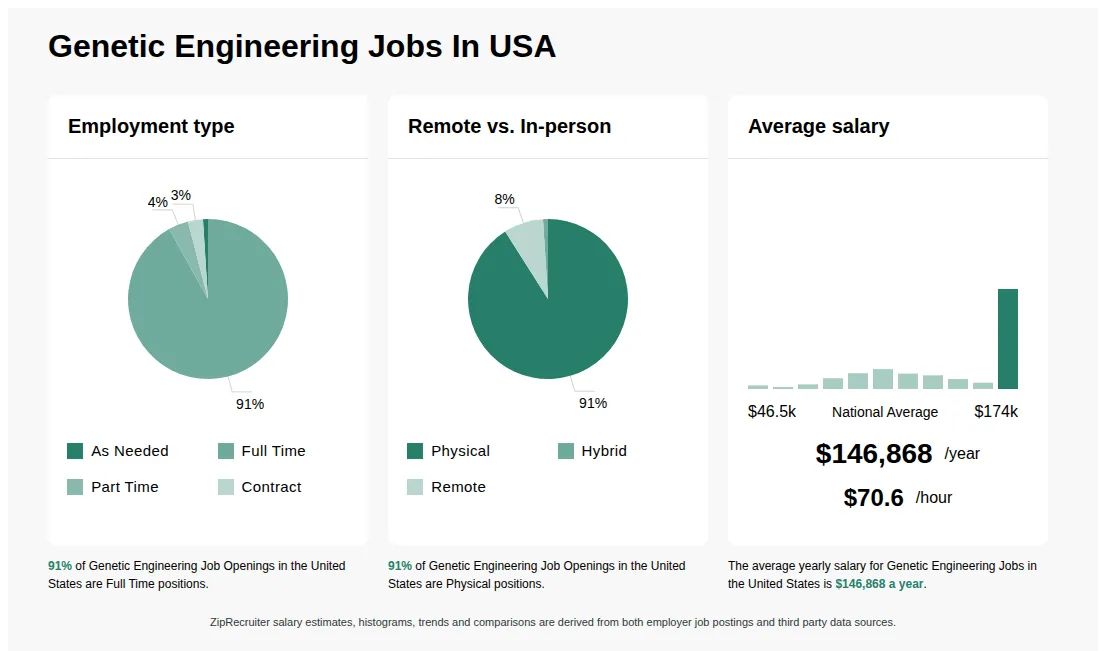
Genetic Engineering information
See salary details
$46.5K - $58.1K
1% of jobs
$58.1K - $69.7K
1% of jobs
$69.7K - $81.3K
2% of jobs
$81.3K - $92.9K
5% of jobs
$92.9K - $104.5K
7% of jobs
$114.1K is the 25th percentile. Wages below this are outliers.
$104.5K - $116K
10% of jobs
$116K - $127.6K
7% of jobs
$127.6K - $139.2K
6% of jobs
$139.2K - $150.8K
4% of jobs
$150.8K - $162.4K
3% of jobs
The median wage is $162.9K / yr.
$162.4K - $174K
52% of jobs
$46.5K
$146.9K
$174K
How much do genetic engineering jobs pay per year?
As of Sep 3, 2026, the average yearly pay for genetic engineering in the United States is $146,868.00, according to ZipRecruiter salary data. Most workers in this role earn between $116,500.00 and $173,000.00 per year, depending on experience, location, and employer.
What is genetic engineering?
Genetic engineering is a branch of biotechnology that involves directly manipulating an organism's DNA to alter its characteristics or introduce new traits. Scientists use various techniques, such as CRISPR or recombinant DNA technology, to add, remove, or modify specific genes within an organism. This technology is widely used in agriculture to create genetically modified crops, in medicine for gene therapy, and in research for understanding gene functions. Genetic engineering has the potential to address challenges in food production, disease treatment, and industrial biotechnology, but it also raises ethical and safety concerns.
What are the qualifications to get a genetic engineering job?
The qualifications needed for a genetic engineering job include at least a bachelor’s degree in genetics, biochemistry, or a related field. Many employers prefer several years of experience and a Ph.D., particularly for positions in research and development. Many individuals start their careers as members of a team working on a long-running experiment. To find a job at a university, you may need to publish your research in the scientific literature first to demonstrate your expertise. Excellent analytical and critical thinking skills are imperative. You also need patience and perseverance. Computer proficiency and a strong background in biostatics are essential for fulfilling your publishing responsibilities. Your duties also involve staying current by attending and presenting at conferences.
What are the key skills and qualifications needed to thrive as a genetic engineer, and why are they important?
To thrive as a Genetic Engineer, you need a solid background in molecular biology, genetics, and biotechnology, often supported by a degree in a related field. Familiarity with laboratory techniques such as CRISPR, PCR, DNA sequencing, and bioinformatics software is typically required. Strong analytical thinking, attention to detail, and effective communication are essential soft skills for interpreting data and collaborating with multidisciplinary teams. These skills and qualities are crucial for advancing research, ensuring experiment accuracy, and developing innovative solutions in genetic science.
What are some common challenges faced by professionals in genetic engineering roles?
Professionals in genetic engineering often face challenges such as staying updated with rapidly evolving technologies, adhering to strict regulatory and safety protocols, and troubleshooting unexpected experimental results. Collaboration is key, as genetic engineers frequently work with multidisciplinary teams including biologists, chemists, and bioinformaticians to achieve successful project outcomes. Additionally, balancing lab work with documentation and compliance requirements is essential for advancing both research and product development.
What is the difference between Genetic Engineering vs Molecular Biologist?
| Aspect | Genetic Engineering | Molecular Biologist |
|---|---|---|
| Required Credentials | Typically a Bachelor's or Master's in Genetics, Biotechnology, or related fields | Usually a Bachelor's, Master's, or Ph.D. in Molecular Biology or related disciplines |
| Work Environment | Laboratories, biotech companies, research institutions | Research labs, academic institutions, healthcare settings |
| Employer & Industry Usage | Biotech firms, pharmaceutical companies, agricultural companies | Universities, research institutes, healthcare organizations |
Genetic engineers focus on modifying DNA to develop new products or improve existing ones, often working on practical applications. Molecular biologists study the molecular mechanisms of biological processes, conducting fundamental research. While both roles require similar educational backgrounds and work environments, genetic engineering is more application-driven, whereas molecular biology emphasizes understanding biological systems.
Do genetic engineers make a lot of money?
Genetic engineers typically earn a competitive salary, with median annual wages in the biotechnology and pharmaceutical industries often exceeding the national average for science and engineering roles. Salaries can vary based on experience, education, location, and the complexity of projects, with advanced degrees and specialized skills increasing earning potential.
Is genetic engineering a good career?
Genetic engineering is a growing field that offers opportunities in research, biotechnology, and healthcare, often requiring strong backgrounds in biology, chemistry, and laboratory skills. Careers in this area can be rewarding but typically demand advanced degrees and continuous learning due to rapid technological advancements.
More about Genetic Engineering jobs
What cities are hiring for Genetic Engineering jobs?
Cities with the most Genetic Engineering job openings:
What are the most commonly searched types of Genetic Engineering jobs?
The most popular types of Genetic Engineering jobs are:
What states have the most Genetic Engineering jobs?
States with the most job openings for Genetic Engineering jobs include:
What job categories do people searching Genetic Engineering jobs look for?
The top searched job categories for Genetic Engineering jobs are:

Full-time
Medical, Dental, Vision, Life, Retirement, PTO
Posted 9 days ago
Elevance Health rating

7.5
Based on 354 frontline employees who took The Breakroom Quiz
217th of 315 rated insurance
Job description
Anticipated End Date:
2026-09-08Position Title:
Associate Genetic Counselor ReviewerJob Description:
Genetic Counselor Review Associate
Carelon Medical Benefits Management
Schedule: 9:30-6 Central time
Virtual: This role enables associates to work virtually full-time, with the exception of required in-person training sessions, providing maximum flexibility and autonomy. This approach promotes productivity, supports work-life integration, and ensures essential face-to-face onboarding and skill development.
Please note that per our policy on hybrid/virtual work, candidates not within a reasonable commuting distance from the posting location(s) will not be considered for employment, unless an accommodation is granted as required by law.
Carelon, a proud member of the Elevance Health family of companies, is a healthcare services organization that takes a whole-health approach to making care more integrated, personalized, and affordable. We put people at the center-connecting physical, behavioral, social, and pharmacy services, along with clinical expertise, research, operations, and advanced technology to help care work better, together.
Among us are specialty-care physicians, nurse practitioners, pharmacists, engineers, data scientists, and other dedicated and caring health professionals. While our roles may differ, our purpose is shared: to make a positive impact on whole health.
TheGenetic Counselor Review Associate will be responsible for conducting routine and simple reviews for genetic testing cases by following policies and procedures. Partners with senior reviewers and leaders to support complex pre-authorization, out of network, and appropriateness reviews by utilizing appropriate policies, clinical standards, and department guidelines. Learns to conduct medical necessity clinical screenings of preauthorization requests to assess the medical necessity of diagnostic imaging procedures, out of network services, and appropriateness of treatment.
How you will make an impact:
- Receives pre-authorization requests from front-line intake.
- Conducts initial medical necessity clinical screening for simple and routine review cases.
- Determines if initial clinical information presented meets medical necessity criteria or requires additional medical necessity review for simple and routine cases.
- Works closely with medical directors to review and make recommendations regarding medical necessity of genetic test requests.
- Works closely with senior reviewers and leaders on complex cases for utilization management, out of network, and appropriateness of treatment.
- Coordinates with providers about the process and updates on cases.
- Notifies ordering physician or rendering service provider office of the pre-authorization decision.
- Documents the results of the initial clinical review and determination in the pre-certification computer system.
- Conducts initial medical necessity review of out of network pre-authorization requests for services requested outside of the client health plan network.
- Conducts review of grievance and appeals requests to provide to Medical Directors.
- Maintains confidentiality of patient and provider specific information.
- Develops telephone service standards to meet departmental performance metrics.
Minimum Requirements:Requires MA/MS from an ACGC (Accreditation Counsel for Genetic Counseling) accredited program. ABGC (American Board of Genetic Counseling) board certification required.
Preferred Skills, Capabilities and Experiences:
- Experience and/or familiarity with reimbursement coding for genomic testing (e.g. CPT, ICD-10_CM) as relevant to testing preferred.
- Experience working in a cross functional team environment preferred.
Job Level:
Non-Management Non-ExemptWorkshift:
Job Family:
MED > Licensed/Certified - OtherPlease be advised that Elevance Health only accepts resumes for compensation from agencies that have a signed agreement with Elevance Health. Any unsolicited resumes, including those submitted to hiring managers, are deemed to be the property of Elevance Health.
Who We Are
Elevance Health is a health company dedicated to improving lives and communities - and making healthcare simpler. We are a Fortune 25 company with a longstanding history in the healthcare industry, looking for leaders at all levels of the organization who are passionate about making an impact on our members and the communities we serve.
How We Work
At Elevance Health, we are creating a culture that is designed to advance our strategy but will also lead to personal and professional growth for our associates. Our values and behaviors are the root of our culture. They are how we achieve our strategy, power our business outcomes and drive our shared success - for our consumers, our associates, our communities and our business.
We offer a range of market-competitive total rewards that include merit increases, paid holidays, Paid Time Off, and incentive bonus programs (unless covered by a collective bargaining agreement), medical, dental, vision, short and long term disability benefits, 401(k) +match, stock purchase plan, life insurance, wellness programs and financial education resources, to name a few.
Elevance Health operates in a Hybrid Workforce Strategy. Unless specified as primarily virtual by the hiring manager, associates are required to work at an Elevance Health location at least once per week, and potentially several times per week. Specific requirements and expectations for time onsite will be discussed as part of the hiring process.
The health of our associates and communities is a top priority for Elevance Health. We require all new candidates in certain patient/member-facing roles to become vaccinated against COVID-19 and Influenza. If you are not vaccinated, your offer will be rescinded unless you provide an acceptable explanation. Elevance Health will also follow all relevant federal, state and local laws.
Elevance Health is an Equal Employment Opportunity employer, and all qualified applicants will receive consideration for employment without regard to age, citizenship status, color, creed, disability, ethnicity, genetic information, gender (including gender identity and gender expression), marital status, national origin, race, religion, sex, sexual orientation, veteran status or any other status or condition protected by applicable federal, state, or local laws. Applicants who require accommodation to participate in the job application process should submit the following form: Accessibility Accommodation Request Form and a member of the team will be in contact. Qualified applicants with arrest or conviction records will be considered for employment in accordance with all federal, state, and local laws, including, but not limited to, the Los Angeles County Fair Chance Ordinance and the California Fair Chance Act.
Prospective employees required to be screened under Florida law should review the education and awareness resources at HB531 | Florida Agency for Health Care Administration.
NOTE: Workday keeps job postings active through 11:59:59 PM on the day before the listed end date. Example: If the end date is 3/13, the posting will automatically come down on 3/12 at 11:59:59 PM. In other words - the job is posted until 3/13, not through 3/13.
What Elevance Health employees say
Pay
Benefits
Hours and flexibility
Workplace
Get the full story on Breakroom

About Elevance Health
Sourced by ZipRecruiter
Elevance Health is a health company dedicated to improving lives and communities - and making healthcare simpler. A Fortune 20 company with a longstanding history in the healthcare industry, we are looking for leaders at all levels of the organization who are passionate about making an impact on our members and the communities we serve. You will thrive in a complex and collaborative environment where you take action and ownership to solve problems and lead change. Do you want to be part of a larger purpose and an evolving, high-performance culture that empowers you to make an impact?
Industry
Health care and social assistance
Company size
10,000+ Employees
Headquarters location
Indianapolis, IN, US
Year founded
2004