Posting Details Job Posting Information Posting Number F176 Position Title Assistant Professor of Genetic Engineering Rank Assistant Professor 9115 Regular (PIN) or Long Term Contractual Faculty ...
Posting Details Job Posting Information Posting Number F176 Position Title Assistant Professor of Genetic Engineering Rank Assistant Professor 9115 Regular (PIN) or Long Term Contractual Faculty ...

This role sits at the intersection of mouse genetic engineering, B cell biology, and therapeutic antibody discovery, and contributes across the full arc of in vivo model innovation - from concept and ...
This role sits at the intersection of mouse genetic engineering, B cell biology, and therapeutic antibody discovery, and contributes across the full arc of in vivo model innovation - from concept and ...
This role sits at the intersection of mouse genetic engineering, B cell biology, and therapeutic antibody discovery, and contributes across the full arc of in vivo model innovation - from concept and ...
This role sits at the intersection of mouse genetic engineering, B cell biology, and therapeutic antibody discovery, and contributes across the full arc of in vivo model innovation - from concept and ...
This role sits at the intersection of mouse genetic engineering, B cell biology, and therapeutic antibody discovery, and contributes across the full arc of in vivo model innovation - from concept and ...
This role sits at the intersection of mouse genetic engineering, B cell biology, and therapeutic antibody discovery, and contributes across the full arc of in vivo model innovation - from concept and ...
This role sits at the intersection of mouse genetic engineering, B cell biology, and therapeutic antibody discovery, and contributes across the full arc of in vivo model innovation - from concept and ...
This role sits at the intersection of mouse genetic engineering, B cell biology, and therapeutic antibody discovery, and contributes across the full arc of in vivo model innovation - from concept and ...

This role sits at the intersection of mouse genetic engineering, B cell biology, and therapeutic antibody discovery, and contributes across the full arc of in vivo model innovation - from concept and ...
This role sits at the intersection of mouse genetic engineering, B cell biology, and therapeutic antibody discovery, and contributes across the full arc of in vivo model innovation - from concept and ...

Postdoctoral Research Fellow
Cambridge, MA · On-site
$70K - $86K/yr
Research activities will include the design and implementation of genetic engineering strategies in erythroid cells, development of cell culture and differentiation systems, functional ...
Postdoctoral Research Fellow
Cambridge, MA · On-site
$70K - $86K/yr
Research activities will include the design and implementation of genetic engineering strategies in erythroid cells, development of cell culture and differentiation systems, functional ...

Postdoctoral Fellow - Genomic Medicine
$64K - $76K/yr
To realize this vision, we are building the genetic toolkits necessary to enable precise and scalable engineering of non-model, tumor-associated microbes. This includes development of transformation ...
Postdoctoral Fellow - Genomic Medicine
$64K - $76K/yr
To realize this vision, we are building the genetic toolkits necessary to enable precise and scalable engineering of non-model, tumor-associated microbes. This includes development of transformation ...
Postdoctoral Fellow - Genomic Medicine
Houston, TX · On-site
$64K - $76K/yr
To realize this vision, we are building the genetic toolkits necessary to enable precise and scalable engineering of non-model, tumor-associated microbes. This includes development of transformation ...
Postdoctoral Fellow - Genomic Medicine
Houston, TX · On-site
$64K - $76K/yr
To realize this vision, we are building the genetic toolkits necessary to enable precise and scalable engineering of non-model, tumor-associated microbes. This includes development of transformation ...
Postdoctoral Fellow - Genomic Medicine
Houston, TX · On-site
$64K - $76K/yr
To realize this vision, we are building the genetic toolkits necessary to enable precise and scalable engineering of non-model, tumor-associated microbes. This includes development of transformation ...
Postdoctoral Fellow - Genomic Medicine
Houston, TX · On-site
$64K - $76K/yr
To realize this vision, we are building the genetic toolkits necessary to enable precise and scalable engineering of non-model, tumor-associated microbes. This includes development of transformation ...
Postdoctoral Fellow - Genomic Medicine
$64K - $76K/yr
To realize this vision, we are building the genetic toolkits necessary to enable precise and scalable engineering of non-model, tumor-associated microbes. This includes development of transformation ...
Postdoctoral Fellow - Genomic Medicine
$64K - $76K/yr
To realize this vision, we are building the genetic toolkits necessary to enable precise and scalable engineering of non-model, tumor-associated microbes. This includes development of transformation ...

Generation of reagents, such as CRISPR/Cas9 sgRNA, targeting vector, and bacterial artificial chromosome, to be used for genetic engineering in mice. Validation of reagents using in vitro cleavage ...
Generation of reagents, such as CRISPR/Cas9 sgRNA, targeting vector, and bacterial artificial chromosome, to be used for genetic engineering in mice. Validation of reagents using in vitro cleavage ...

D. in immunology, genetic engineering, or related fields. * Great fund of knowledge of tumor immunology principles. * Ability to assess scRNAseq datasets and highly parametric flow cytometry.
D. in immunology, genetic engineering, or related fields. * Great fund of knowledge of tumor immunology principles. * Ability to assess scRNAseq datasets and highly parametric flow cytometry.

IP Portfolio Manager
Cambridge, MA · On-site
... genetic engineering, medical device, biomanufacturing, biomaterials and/or drug discovery technologies. Find the full here.
IP Portfolio Manager
Cambridge, MA · On-site
... genetic engineering, medical device, biomanufacturing, biomaterials and/or drug discovery technologies. Find the full here.
Postdoctoral Associate - Cell and Gene Therapy
Houston, TX · On-site
$63K - $64K/yr
D. in immunology, genetic engineering, or related fields. * Great fund of knowledge of tumor immunology principles. * Ability to assess scRNAseq datasets and highly parametric flow cytometry.
Postdoctoral Associate - Cell and Gene Therapy
Houston, TX · On-site
$63K - $64K/yr
D. in immunology, genetic engineering, or related fields. * Great fund of knowledge of tumor immunology principles. * Ability to assess scRNAseq datasets and highly parametric flow cytometry.
Senior Scientist, Cell Therapy Genetic Regulation
Reading, PA · On-site
$72K - $99K/yr
The ideal candidate will combine deep technical expertise in genetic engineering with the ability to work independently in the lab and collaborate across cross-functional teams. This role is an ...
Senior Scientist, Cell Therapy Genetic Regulation
Reading, PA · On-site
$72K - $99K/yr
The ideal candidate will combine deep technical expertise in genetic engineering with the ability to work independently in the lab and collaborate across cross-functional teams. This role is an ...
Senior Scientist, Cell Therapy Genetic Regulation
Spring House, PA · On-site
$87K - $119K/yr
The ideal candidate will combine deep technical expertise in genetic engineering with the ability to work independently in the lab and collaborate across cross-functional teams. This role is an ...
Senior Scientist, Cell Therapy Genetic Regulation
Spring House, PA · On-site
$87K - $119K/yr
The ideal candidate will combine deep technical expertise in genetic engineering with the ability to work independently in the lab and collaborate across cross-functional teams. This role is an ...
Senior Scientist, Cell Therapy Genetic Regulation
Spring House, PA · On-site
$87K - $119K/yr
The ideal candidate will combine deep technical expertise in genetic engineering with the ability to work independently in the lab and collaborate across cross-functional teams. This role is an ...
Senior Scientist, Cell Therapy Genetic Regulation
Spring House, PA · On-site
$87K - $119K/yr
The ideal candidate will combine deep technical expertise in genetic engineering with the ability to work independently in the lab and collaborate across cross-functional teams. This role is an ...

Projects will utilize novel pre-clinical models of cancer, genetic engineering, adoptive transfer studies, gene expression analysis, flow cytometry, immunohistochemistry, and biospecimens (tissue ...
Projects will utilize novel pre-clinical models of cancer, genetic engineering, adoptive transfer studies, gene expression analysis, flow cytometry, immunohistochemistry, and biospecimens (tissue ...

Genetic Counselor
Manhattan, NY · On-site
Sudden death in living family members can be prevented when a genetic cause of death is found in ... engineering field. 2. For Assignment to Assignment Level I - B In addition to meeting the ...
Genetic Counselor
Manhattan, NY · On-site
Sudden death in living family members can be prevented when a genetic cause of death is found in ... engineering field. 2. For Assignment to Assignment Level I - B In addition to meeting the ...
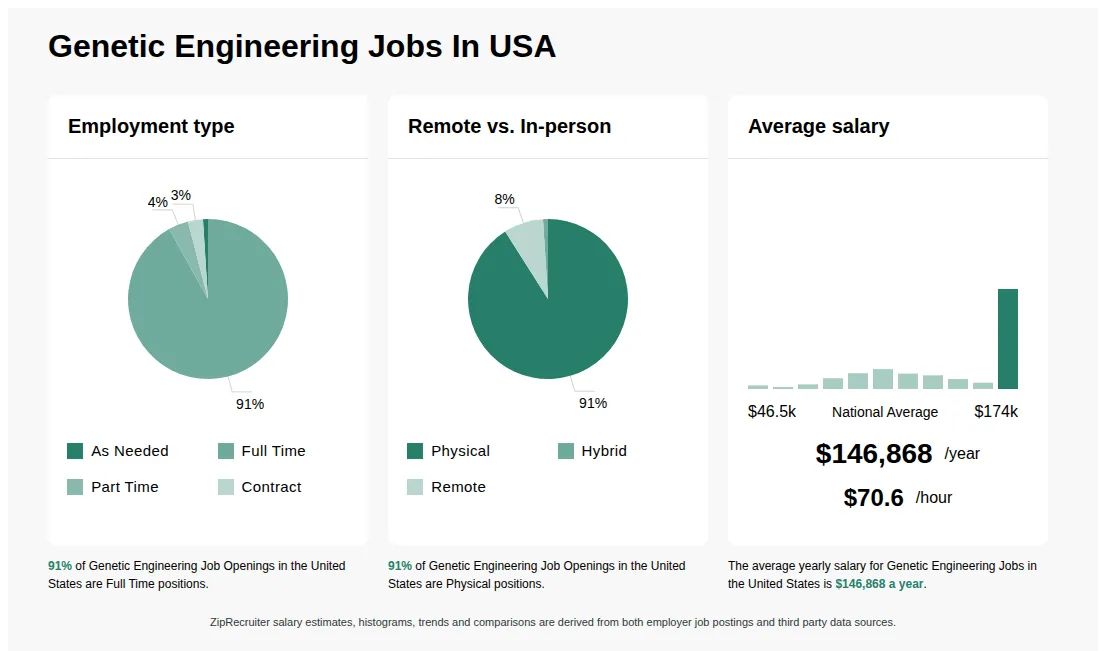
Genetic Engineering information
See salary details
$46.5K - $58.1K
1% of jobs
$58.1K - $69.7K
1% of jobs
$69.7K - $81.3K
2% of jobs
$81.3K - $92.9K
5% of jobs
$92.9K - $104.5K
7% of jobs
$114.1K is the 25th percentile. Wages below this are outliers.
$104.5K - $116K
10% of jobs
$116K - $127.6K
7% of jobs
$127.6K - $139.2K
6% of jobs
$139.2K - $150.8K
4% of jobs
$150.8K - $162.4K
3% of jobs
The median wage is $162.9K / yr.
$162.4K - $174K
52% of jobs
$46.5K
$146.9K
$174K
How much do genetic engineering jobs pay per year?
As of Sep 2, 2026, the average yearly pay for genetic engineering in the United States is $146,868.00, according to ZipRecruiter salary data. Most workers in this role earn between $116,500.00 and $173,000.00 per year, depending on experience, location, and employer.
What is genetic engineering?
Genetic engineering is a branch of biotechnology that involves directly manipulating an organism's DNA to alter its characteristics or introduce new traits. Scientists use various techniques, such as CRISPR or recombinant DNA technology, to add, remove, or modify specific genes within an organism. This technology is widely used in agriculture to create genetically modified crops, in medicine for gene therapy, and in research for understanding gene functions. Genetic engineering has the potential to address challenges in food production, disease treatment, and industrial biotechnology, but it also raises ethical and safety concerns.
What are the qualifications to get a genetic engineering job?
The qualifications needed for a genetic engineering job include at least a bachelor’s degree in genetics, biochemistry, or a related field. Many employers prefer several years of experience and a Ph.D., particularly for positions in research and development. Many individuals start their careers as members of a team working on a long-running experiment. To find a job at a university, you may need to publish your research in the scientific literature first to demonstrate your expertise. Excellent analytical and critical thinking skills are imperative. You also need patience and perseverance. Computer proficiency and a strong background in biostatics are essential for fulfilling your publishing responsibilities. Your duties also involve staying current by attending and presenting at conferences.
What are the key skills and qualifications needed to thrive as a genetic engineer, and why are they important?
To thrive as a Genetic Engineer, you need a solid background in molecular biology, genetics, and biotechnology, often supported by a degree in a related field. Familiarity with laboratory techniques such as CRISPR, PCR, DNA sequencing, and bioinformatics software is typically required. Strong analytical thinking, attention to detail, and effective communication are essential soft skills for interpreting data and collaborating with multidisciplinary teams. These skills and qualities are crucial for advancing research, ensuring experiment accuracy, and developing innovative solutions in genetic science.
What are some common challenges faced by professionals in genetic engineering roles?
Professionals in genetic engineering often face challenges such as staying updated with rapidly evolving technologies, adhering to strict regulatory and safety protocols, and troubleshooting unexpected experimental results. Collaboration is key, as genetic engineers frequently work with multidisciplinary teams including biologists, chemists, and bioinformaticians to achieve successful project outcomes. Additionally, balancing lab work with documentation and compliance requirements is essential for advancing both research and product development.
What is the difference between Genetic Engineering vs Molecular Biologist?
| Aspect | Genetic Engineering | Molecular Biologist |
|---|---|---|
| Required Credentials | Typically a Bachelor's or Master's in Genetics, Biotechnology, or related fields | Usually a Bachelor's, Master's, or Ph.D. in Molecular Biology or related disciplines |
| Work Environment | Laboratories, biotech companies, research institutions | Research labs, academic institutions, healthcare settings |
| Employer & Industry Usage | Biotech firms, pharmaceutical companies, agricultural companies | Universities, research institutes, healthcare organizations |
Genetic engineers focus on modifying DNA to develop new products or improve existing ones, often working on practical applications. Molecular biologists study the molecular mechanisms of biological processes, conducting fundamental research. While both roles require similar educational backgrounds and work environments, genetic engineering is more application-driven, whereas molecular biology emphasizes understanding biological systems.
Do genetic engineers make a lot of money?
Genetic engineers typically earn a competitive salary, with median annual wages in the biotechnology and pharmaceutical industries often exceeding the national average for science and engineering roles. Salaries can vary based on experience, education, location, and the complexity of projects, with advanced degrees and specialized skills increasing earning potential.
Is genetic engineering a good career?
Genetic engineering is a growing field that offers opportunities in research, biotechnology, and healthcare, often requiring strong backgrounds in biology, chemistry, and laboratory skills. Careers in this area can be rewarding but typically demand advanced degrees and continuous learning due to rapid technological advancements.
More about Genetic Engineering jobs
What cities are hiring for Genetic Engineering jobs?
Cities with the most Genetic Engineering job openings:
What are the most commonly searched types of Genetic Engineering jobs?
The most popular types of Genetic Engineering jobs are:
What states have the most Genetic Engineering jobs?
States with the most job openings for Genetic Engineering jobs include:
What job categories do people searching Genetic Engineering jobs look for?
The top searched job categories for Genetic Engineering jobs are:

Full-time
Re-posted 7 days ago
Job description
Posting Details
Job Posting Information
Posting Number
F176
Position Title
Assistant Professor of Genetic Engineering
Rank
Assistant Professor 9115
Regular (PIN) or Long Term Contractual Faculty
Regular
Desired Start Date
Open Date
02/09/2024
Close Date
Open Until Filled
Yes
Duties and Responsibilities
The Department of Natural Sciences is seeking excellent candidates for a tenure track position for the Assistant Professor rank in Genetic Engineering for the Applied Biotechnology and Molecular Biology (ABMB) program. Our student-focused department requires a candidate with a strong commitment to excellence in teaching who can also engage in research that leads to scholarly articles and grants. The successful candidate will have extensive knowledge and research experience in genetic manipulation, gene cloning (eukaryotic preferred), eukaryotic gene editing (CRISPR-Cas9), RNA silencing and tissue culture. The candidate is expected to establish an extramurally funded research program on fundamental or applied sciences on research areas of candidate's expertise.
The candidate will support departmental core course instruction for the graduate students in the Applied Biotechnology and Molecular Biology (ABMB) program and teach core courses and would assist develop new courses for the program. The candidate will also teach undergraduate courses in the department of Natural Sciences.
The successful candidate is expected to engage graduate and undergraduate students in research and develop a vibrant student-based research program. The scholarly research activities will provide mentorship to both graduate and undergraduate students in research activities. The candidate will also support various departmental services such as active contributions to student advisement and student recruitment for the master's program. The candidate must be ready to be an active participant in departmental and university-wide committees.
DUTIES & RESPONSIBILITIES:
Conditions of Employment
Offer of employment is contingent upon successful completion of due diligence background check and verification of credentials. Proof of US citizenship or eligibility for U.S. employment will be required prior to employment (Immigration Control Act of 1986).
Please be advised, COVID-19 vaccinations are not required but encouraged for all eligible students, faculty and staff returning to USM institutions. This protocol is subject to change.
Bowie State University is an equal opportunity/affirmative action employer.
Experience
Education
Ph.D. in Biological Sciences or related field(s) required.
Knowledge Skills and Abilities
Minimum Qualifications
Posting Detail Information
Special Instructions to Applicant
Job Posting Information
Posting Number
F176
Position Title
Assistant Professor of Genetic Engineering
Rank
Assistant Professor 9115
Regular (PIN) or Long Term Contractual Faculty
Regular
Desired Start Date
Open Date
02/09/2024
Close Date
Open Until Filled
Yes
Duties and Responsibilities
The Department of Natural Sciences is seeking excellent candidates for a tenure track position for the Assistant Professor rank in Genetic Engineering for the Applied Biotechnology and Molecular Biology (ABMB) program. Our student-focused department requires a candidate with a strong commitment to excellence in teaching who can also engage in research that leads to scholarly articles and grants. The successful candidate will have extensive knowledge and research experience in genetic manipulation, gene cloning (eukaryotic preferred), eukaryotic gene editing (CRISPR-Cas9), RNA silencing and tissue culture. The candidate is expected to establish an extramurally funded research program on fundamental or applied sciences on research areas of candidate's expertise.
The candidate will support departmental core course instruction for the graduate students in the Applied Biotechnology and Molecular Biology (ABMB) program and teach core courses and would assist develop new courses for the program. The candidate will also teach undergraduate courses in the department of Natural Sciences.
The successful candidate is expected to engage graduate and undergraduate students in research and develop a vibrant student-based research program. The scholarly research activities will provide mentorship to both graduate and undergraduate students in research activities. The candidate will also support various departmental services such as active contributions to student advisement and student recruitment for the master's program. The candidate must be ready to be an active participant in departmental and university-wide committees.
DUTIES & RESPONSIBILITIES:
- Provide instruction in Biology/Genetic engineering/Biotechnology/Molecular Genetics/SystemBiology courses and related advanced-level electives with a strong commitment to curriculum transformation and excellence in teaching.
- Establish a productive, student-centered, graduate and undergraduate research program with anemphasis on research tools development.
- Incorporate learning activities into the research program.
- Actively write scientific research grants to secure funding.
- Active participant in scholarly activities, advisement, and mentorship of students, with active service on comm
Conditions of Employment
Offer of employment is contingent upon successful completion of due diligence background check and verification of credentials. Proof of US citizenship or eligibility for U.S. employment will be required prior to employment (Immigration Control Act of 1986).
Please be advised, COVID-19 vaccinations are not required but encouraged for all eligible students, faculty and staff returning to USM institutions. This protocol is subject to change.
Bowie State University is an equal opportunity/affirmative action employer.
Experience
- Postdoctoral fellowship experience in recombinant DNA technology/transgenics research required.
- Experience in teaching undergraduate and graduate courses in biotechnology preferred.
- Successful candidates should have experience in developing transgenics using multiple genetic engineering approaches with published research outcomes both at doctoral and post-doctoral level.
- Experience in protein expression and purification is a plus.
- The successful candidate should have experience in writing grants.
- Candidates should have teaching experience in genetic engineering, genetics, molecular biology or related courses under university settings. Experience with experiential teaching methodologies such as CURE, PBL etc. will be preferred.
- Postdoctoral fellowship experience in Molecular Genetics/Genomics/Genetic Engineering is preferred.
- Experience in teaching Introductory as well as advanced Biology/Molecular Genetics/Genetic Engineering/Biotechnology courses are preferred.
- Experience working with various stakeholders, such as students, faculty, staff, and administrators.
- Experience working with underrepresented minorities in STEM preferred but not required.
- Experience in obtaining funded grants is preferred.
Education
Ph.D. in Biological Sciences or related field(s) required.
Knowledge Skills and Abilities
- The course based undergraduate research experiences (CURE) based teaching is preferred.
- Excellent communication and interpersonal skills, and demonstrated ability to work in teams.
- Evidence of strong commitment to excellence in teaching, technology application in the classroom, and capable of establishing collaborative research programs involving undergraduate students is preferred but not required.
- Strong candidates will be a team player and possess leadership potential.
Minimum Qualifications
Posting Detail Information
Special Instructions to Applicant

About Bowie State University
Sourced by ZipRecruiter
Industry
Colleges, universities, and professional schools
Company size
11 - 50 Employees
Headquarters location
Bowie, MD, US
Year founded
1865