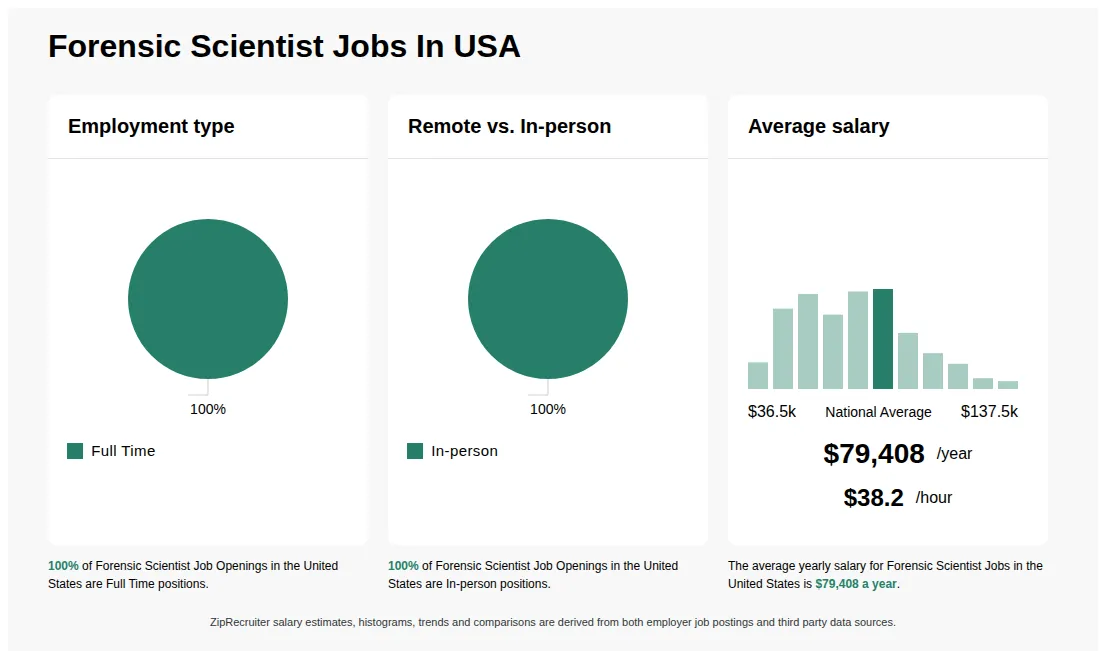
Salary: $25.03 - $43.01 Hourly
Location : Northville, MI
Job Type: Permanent Full Time
Job Number: 5501-26091-AA
Department: State Police
Opening Date: 07/08/2026
Closing Date: 7/23/2026 11:59 PM Eastern
Bargaining Unit: SCIENTIFIC AND ENGINEERING (SEIU)
Job Description
**Recruitment is for two vacancies**
This position is responsible for examining forensic evidence in connection with criminal cases in the areas of Body Fluid ID and DNA for the Forensic Science Division. Duties also include testifying in court, crime scene investigations, and support the validation of new methods, equipment and instruments. This position will receive direct training by a senior-level scientist or manager until fully competent. This position is required to perform all duties in a bias free manner.
The Michigan State Police is committed to fostering a diverse, inclusive workplace that accepts, respects, and values the unique contributions of everyone. We are actively looking for individuals who share our commitment to equity and inclusion, and who reflect the communities we serve. Our members are expected to perform their tasks and duties in a bias-free manner, ensuring all persons are treated with dignity, fairness, and respect. Join us as we help build a Michigan where everyone feels safe and secure.
The Michigan State Police (MSP) is a full-service policing agency with statewide jurisdiction, providing over 60 different services either directly to Michigan residents or in support of other law enforcement agencies. The MSP personnel most visible to the public are the uniform troopers whose primary responsibilities include traffic enforcement, crime prevention and investigation, and community engagement and service.
Required Education and Experience
Education
Possession of a bachelor's degree in forensic science, natural science, or a related pure or applied science.
Chemical/Biological Specialty: Positions in the State Police Laboratory biology, controlled substances, trace evidence or toxicology areas require possession of a bachelor's degree in forensic science, chemistry, biochemistry, biology, microbiology, or a related pure or applied science.
Experience
Forensic Scientist 9
No specific type or amount is required.
Forensic Scientist 10
One year of professional experience working in a crime laboratory carrying out a variety of tests, analyses or production and research activities involving chemical, biochemical, biological or physical evidence samples, specimens, or products equivalent to a Forensic Scientist 9.
Forensic Scientist P11
Two years of professional experience working in a crime laboratory carrying out a variety of tests, analyses or production and research activities involving chemical, biochemical, biological or physical evidence samples, specimens, or products equivalent to a Forensic Scientist, including one year equivalent to a Forensic Scientist 10.
Alternate Education and Experience
Special Requirements, Licenses, and Certifications
Positions in this class are test-designated and subject to pre-appointment, random-selection, and post accident drug and alcohol testing.
Chemical/Biological Specialty: Positions in the State Police Laboratory biology, controlled substances, trace evidence or toxicology areas require possession of a bachelor's degree in forensic science, chemistry, biochemistry, biology, microbiology, or a related pure or applied science.
Additional Requirements and Information
This position will be filled as either a
Specialist Trooper 11 or a
Forensic Scientist 9-11.
As a condition of employment, the selected applicant is required to submit a DNA sample for inclusion into the DNA Staff Index.
This position requires passing a pre-employment screening, including passing a drug screen, criminal history background check and a fingerprint check by the Michigan State Police.
Please attach a cover memo, resume and a copy of your official college transcripts to your application. Unofficial transcripts will not be accepted. Please upload each document separately.
Please note: Applicants will be screened out for failure to attach the required resume and cover letter to their application.
View the entire job specification at:
Accommodations
If you require a reasonable accommodation to participate in the application or selection processes, please contact the for the agency that posted this position vacancy.
State employment also offers rewarding careers where you can help Michiganders enjoy better lives. Many State of Michigan jobs offer alternate work schedules and remote-work options that can help give the flexibility you need. The State of Michigan has been recognized as a leading U.S. employer by new graduates from 2021-2023 and a best large U.S. and state employer. Recognized on the international stage for fostering positive employee engagement, the State of Michigan is a past recipient of a North America Government Agency Employees Engagement Award.
More details on benefits for our new hires are below:
Rewarding Work: State of Michigan jobs allow you to serve Michiganders in many different ways depending on your interests and skills. Help preserve and protect our environment and the public health; enforce state laws and regulations; advocate for children, families, and victims of discrimination; support our state's military and veterans; rebuild our state's infrastructure; or support other state agencies through our fiscal, IT, and HR systems.
Insurance Benefits: The State of Michigan offers health, mental health, dental, and vision insurance to eligible career employees, their spouses, and their children. The state also covers a life-insurance benefit of two times employees' annual salary (up to $200,000). The state also offers long-term-disability insurance that can provide continuing benefits if an injury or illness prevents employees from working. More information is available at www.mi.gov/employeebenefits.
Retirement Programs: The State of Michigan offers 401(k) and 457 plans for new hires to save for retirement. The state will automatically contribute an amount equal to 4% of your pay to a 401(k) account. The state will also match up to 5% of your pay if you contribute to your 401(k) account. Your contributions vest immediately, and the state's contributions fully vest after just 4 years. More information is available at http://www.mi.gov/orsstatedc.
Vacation and Sick Leave: Eligible full-time employees receive between
15 and 35 personal days and
13 sick days per year that may be rolled over to the following year if not used. Eligible employees also receive an additional day each year for community service or school functions.
Paid Parental Leave: Eligible employees can take
12 weeks of paid leave immediately after a birth or adoption to allow needed time together at home with a new child.
Paid Holidays: Eligible employees receive 13 or 14 paid holidays each year including New Year's Eve and Day, Martin Luther King Jr. Day, Presidents' Day, Memorial Day, Juneteenth, the Fourth of July, Labor Day, Election Day, Veterans Day, Thanksgiving, Thanksgiving Friday, Christmas Eve and Day.
Bonus Programs: Eligible employees with five years of service also receive annual longevity bonuses that grow as seniority increases. Some positions also may qualify for recruitment, retention, and performance bonuses or other special pay premiums.
Military Pay Differential: Employees in the guard or reserves may also qualify for supplemental pay benefits if miliary pay during qualifying duty is less than normal state pay. Prior military service may also allow seniority credits to accelerate eligibility for longevity bonuses and additional personal leave accrual.
Tax-Advantaged Programs: In addition to 401(k) and 457 retirement accounts, the state also offers flexible spending account (FSA), health savings account (HSA), and qualified transportation fringe benefit (QTFB) programs that can help you save money by reducing your taxable income.
Student Loan Forgiveness: Working for the State of Michigan may allow you to participate in programs that forgive the balance of qualifying student loans. Please view Student Loan Information to help determine if you could qualify is available from the U.S. Department of Education.
Tuition Reduction: Some colleges and universities offer savings to eligible employees and family members to further their education while working for the State of Michigan.
Professional Development: To help develop your career, programs are available to apply for reimbursement of up to $2,000 a year for education and training for college course credits and non-degree programs.
Alternative and Remote Work Schedules: Depending on the nature of their duties, many state jobs offer flexible work schedules and remote or hybrid telecommuting options that can help obtain the work-life balance that you seek.
Great Lakes and Great Times: Michigan boasts four Great Lakes, 11,000 inland lakes, 36,000 miles of rivers and streams, 20 million acres of forests, 100 state and national parks and recreation areas, 1,300 miles of bike trails, 6,500 miles of snowmobile trails, the second-most ski areas in the nation, 650 public golf courses, 600 campgrounds, and an international dark-sky park-just for starters. Our cities offer concerts and cultural events, storied sports teams, education hubs, vibrant downtowns, one-of-a-kind craft beverages, and renowned restaurants for every appetite. From urban centers to beach towns to the great outdoors, the opportunities are endless. With your state salary and benefits and Michigan's affordable cost of living, you can explore all that Michigan has to offer.
Updated: 2/28/24
01
FORNSCI - Please select your level of experience.
- None to one year of post-degree professional experience working in a crime laboratory carrying out a variety of tests, analyses or production and research activities involving chemical, biochemical, biological or physical evidence samples, specimens, or products.
- One to two year of post-degree professional experience working in a crime laboratory carrying out a variety of tests, analyses or production and research activities involving chemical, biochemical, biological or physical evidence samples, specimens, or products.
- Two to three years of post-degree professional experience working in a crime laboratory carrying out a variety of tests, analyses or production and research activities involving chemical, biochemical, biological or physical evidence samples, specimens, or products.
- At least three years of post-degree professional experience working in a crime laboratory carrying out a variety of tests, analyses or production and research activities involving chemical, biochemical, biological or physical evidence samples, specimens, or products.
02
FORNSCI-CHEM - Do you possess a bachelor's degree or higher in forensic science, chemistry, biochemistry, biology, microbiology, or a related pure or applied science? If so, please attach a copy of your official college transcripts.
03
Do you have a master's degree or higher-level degree in Forensic Science or a related field?
04
If you answered yes to the above question, please list your awarded degree.
05
MSPCRIMHST - Please check all that apply.
- Convicted of a felony (provide date, offense, location and disposition below)
- Convicted of a misdemeanor (provide date, offense, location and disposition below)
- Felony criminal charges are pending (please explain below)
- None
06
MSPCRIMHST1 - If "Yes," please describe each with the respective date, offense, location, and disposition. If not applicable, please indicate N/A.
07
MSPNEP - Please review the For this selection, is there a potential to violate the policy?
08
MSPNEP1 - If you responded yes to potentially violating the , please provide the name and relationship of the individual. If none, please respond N/A.
09
Have you successfully completed a minimum of four courses covering the topics of Biochemistry, Genetics, Molecular Biology, and Statistics or Population Genetics?
10
Please select the courses(s) you have taken.
- Statistics
- Population Genetics
- Biochemistry
- Genetics
- Molecular Biology
- Forensic Science Coursework
11
Please list the corresponding college, course number, course title, and number of credits earned for courses completed above.
12
Do you have post-educational, paid work experience in a laboratory setting?
13
If you answered yes, please explain your experience. If you answered no, please indicate N/A.
14
Are you currently trained to competency as a DNA analyst with an accredited laboratory other than the Michigan State Police Forensic Science Division?
15
If you answered yes, please explain your experience. If you answered no, please indicate N/A.
16
Do you have experience specific to forensic science, such as working in a forensic laboratory, obtaining an advanced forensic degree, or internship in a forensic lab?
17
If you answered yes, please explain your experience. If you answered no, please indicate N/A.
18
Have you ever been qualified as a DNA scientist in accordance with the FBI's Quality Assurance Standards for a Forensic DNA Testing Laboratory at an accredited laboratory?