Physician - Forensic Pathologist Location: Tampa, FL 33602 Duration: 3 Months to long term Shift: Standard First Shift Facility: Hillsborough County Job Responsibilities:. • Performs autopsies ...
Physician - Forensic Pathologist Location: Tampa, FL 33602 Duration: 3 Months to long term Shift: Standard First Shift Facility: Hillsborough County Job Responsibilities:. • Performs autopsies ...
Forensic Pathologist
Charlotte, NC · On-site
Mecklenburg County Government Forensic Pathologist Who We Are Mecklenburg County Government is more than just a place to work. The County provides an environment where you can touch and enrich life ...
Forensic Pathologist
Charlotte, NC · On-site
Mecklenburg County Government Forensic Pathologist Who We Are Mecklenburg County Government is more than just a place to work. The County provides an environment where you can touch and enrich life ...
Mecklenburg County Government Forensic Pathologist Who We Are Mecklenburg County Government is more than just a place to work. The County provides an environment where you can touch and enrich life ...
Mecklenburg County Government Forensic Pathologist Who We Are Mecklenburg County Government is more than just a place to work. The County provides an environment where you can touch and enrich life ...
Chief Forensic Pathologist
Charlotte, NC · On-site
The successful candidate will join 3 current full time forensic pathologists in performing approximately 700 autopsies and 850 external examinations annually, issuing reports, completing death ...
Chief Forensic Pathologist
Charlotte, NC · On-site
The successful candidate will join 3 current full time forensic pathologists in performing approximately 700 autopsies and 850 external examinations annually, issuing reports, completing death ...

Forensic Pathologist Physician Specialist The Department of Medical Examiner investigates and determines the circumstances, manner, and cause of all violent, sudden, or unusual deaths occurring ...
Forensic Pathologist Physician Specialist The Department of Medical Examiner investigates and determines the circumstances, manner, and cause of all violent, sudden, or unusual deaths occurring ...

PathGroup's forensic pathology division is seeking a Board-Certified or Board-Eligible Forensic Pathologist to support our forensic services in Tyler, Texas. This is a unique opportunity for a ...
PathGroup's forensic pathology division is seeking a Board-Certified or Board-Eligible Forensic Pathologist to support our forensic services in Tyler, Texas. This is a unique opportunity for a ...
Forensic Medical - Pathologist
Tyler, TX · On-site
PathGroup's forensic pathology division is seeking a Board-Certified or Board-Eligible Forensic Pathologist to support our forensic services in Tyler, Texas. This is a unique opportunity for a ...
Forensic Medical - Pathologist
Tyler, TX · On-site
PathGroup's forensic pathology division is seeking a Board-Certified or Board-Eligible Forensic Pathologist to support our forensic services in Tyler, Texas. This is a unique opportunity for a ...

FORENSIC PATHOLOGIST (PHYSICIAN SPECIALIST)
Los Angeles, CA · On-site
$21K/mo
SPECIAL SALARY INFORMATION $20,968.42 - $28,112.58 monthly Due to a critical shortage, appointees in the Pathology-Forensic specialty shall be compensated at Step 2, $21,596.82/monthly Candidates who ...
FORENSIC PATHOLOGIST (PHYSICIAN SPECIALIST)
Los Angeles, CA · On-site
$21K/mo
SPECIAL SALARY INFORMATION $20,968.42 - $28,112.58 monthly Due to a critical shortage, appointees in the Pathology-Forensic specialty shall be compensated at Step 2, $21,596.82/monthly Candidates who ...

BE/BC Forensic Pathologist
Greenville, NC · On-site
BE/BC Forensic Pathologist Location: Greenville, NC Employment Type: Full Time Start Date: ASAP Pay Range: Competitive Come for the role. Stay for the people. Widely recognized as the thriving ...
BE/BC Forensic Pathologist
Greenville, NC · On-site
BE/BC Forensic Pathologist Location: Greenville, NC Employment Type: Full Time Start Date: ASAP Pay Range: Competitive Come for the role. Stay for the people. Widely recognized as the thriving ...
BE/BC Forensic Pathologist
Greenville, NC · On-site
BE/BC Forensic Pathologist Location: Greenville, NC Employment Type: Full Time Start Date: ASAP Pay Range: Competitive Come for the role. Stay for the people. Widely recognized as the thriving ...
Quick apply
BE/BC Forensic Pathologist
Greenville, NC · On-site
BE/BC Forensic Pathologist Location: Greenville, NC Employment Type: Full Time Start Date: ASAP Pay Range: Competitive Come for the role. Stay for the people. Widely recognized as the thriving ...
FORENSIC PATHOLOGIST The Office of the Coroner in Montgomery County, Pennsylvania is seeking a Full-time Board Certified Forensic Pathologist to examine traumatic, sudden and unexplained deaths ...
FORENSIC PATHOLOGIST The Office of the Coroner in Montgomery County, Pennsylvania is seeking a Full-time Board Certified Forensic Pathologist to examine traumatic, sudden and unexplained deaths ...
FORENSIC PATHOLOGIST (PHYSICIAN SPECIALIST)
Los Angeles, CA · On-site
$21K/mo
FORENSIC PATHOLOGIST (PHYSICIAN SPECIALIST) Print ( Apply FORENSIC PATHOLOGIST (PHYSICIAN SPECIALIST) Location Los Angeles County, CA Job Type Full time Job Number P5476B-R Department MEDICAL ...
FORENSIC PATHOLOGIST (PHYSICIAN SPECIALIST)
Los Angeles, CA · On-site
$21K/mo
FORENSIC PATHOLOGIST (PHYSICIAN SPECIALIST) Print ( Apply FORENSIC PATHOLOGIST (PHYSICIAN SPECIALIST) Location Los Angeles County, CA Job Type Full time Job Number P5476B-R Department MEDICAL ...
BE/BC Forensic Pathologist
Greenville, NC · On-site
BE/BC Forensic Pathologist Location: Greenville, NC Employment Type: Full Time Start Date: ASAP Pay Range: Competitive Come for the role. Stay for the people. Widely recognized as the thriving ...
BE/BC Forensic Pathologist
Greenville, NC · On-site
BE/BC Forensic Pathologist Location: Greenville, NC Employment Type: Full Time Start Date: ASAP Pay Range: Competitive Come for the role. Stay for the people. Widely recognized as the thriving ...
BE/BC Forensic Pathologist
Greenville, NC · On-site
Forensic Pathologist Location: Greenville, NC Employment Type: Full Time Start Date: ASAP Pay Range: Competitive Come for the role. Stay for the people. Widely recognized as the thriving cultural ...
BE/BC Forensic Pathologist
Greenville, NC · On-site
Forensic Pathologist Location: Greenville, NC Employment Type: Full Time Start Date: ASAP Pay Range: Competitive Come for the role. Stay for the people. Widely recognized as the thriving cultural ...
FORENSIC PATHOLOGIST (PHYSICIAN SPECIALIST)
Los Angeles, CA · On-site
$21K/mo
Candidates who are board certified in Forensic Pathology will receive an additional bonus equivalent to 5.5% of base monthly salary. Full time, permanent, physician employees are allowed ten (10) ...
FORENSIC PATHOLOGIST (PHYSICIAN SPECIALIST)
Los Angeles, CA · On-site
$21K/mo
Candidates who are board certified in Forensic Pathology will receive an additional bonus equivalent to 5.5% of base monthly salary. Full time, permanent, physician employees are allowed ten (10) ...
FORENSIC PATHOLOGIST (PHYSICIAN SPECIALIST)
Los Angeles, CA · On-site
$21K/mo
Candidates who are board certified in Forensic Pathology will receive an additional bonus equivalent to 5.5% of base monthly salary. Full time, permanent, physician employees are allowed ten (10) ...
FORENSIC PATHOLOGIST (PHYSICIAN SPECIALIST)
Los Angeles, CA · On-site
$21K/mo
Candidates who are board certified in Forensic Pathology will receive an additional bonus equivalent to 5.5% of base monthly salary. Full time, permanent, physician employees are allowed ten (10) ...

Board Certified Forensic Pathologist
Norristown, PA · On-site
$270K - $310K/yr
The Forensic Pathologist will perform postmortem examinations in compliance with the NAME Forensic Autopsy Standards, document findings in narrative reports, and offer objective consultation and/or ...
Board Certified Forensic Pathologist
Norristown, PA · On-site
$270K - $310K/yr
The Forensic Pathologist will perform postmortem examinations in compliance with the NAME Forensic Autopsy Standards, document findings in narrative reports, and offer objective consultation and/or ...
PathGroup's forensic pathology division, Forensic Medical Management Services of Texas , is seeking a Board-Certified or Board-Eligible Forensic Pathologist to join our growing team in Beaumont ...
PathGroup's forensic pathology division, Forensic Medical Management Services of Texas , is seeking a Board-Certified or Board-Eligible Forensic Pathologist to join our growing team in Beaumont ...

Board Certified Forensic Pathologist
Norristown, PA · On-site
$270K - $310K/yr
The Forensic Pathologist will perform postmortem examinations in compliance with the NAME Forensic Autopsy Standards, document findings in narrative reports, and offer objective consultation and/or ...
Board Certified Forensic Pathologist
Norristown, PA · On-site
$270K - $310K/yr
The Forensic Pathologist will perform postmortem examinations in compliance with the NAME Forensic Autopsy Standards, document findings in narrative reports, and offer objective consultation and/or ...

Board Certified Forensic Pathologist
Norristown, PA · On-site
$270K - $310K/yr
The Forensic Pathologist will perform postmortem examinations in compliance with the NAME Forensic Autopsy Standards, document findings in narrative reports, and offer objective consultation and/or ...
Board Certified Forensic Pathologist
Norristown, PA · On-site
$270K - $310K/yr
The Forensic Pathologist will perform postmortem examinations in compliance with the NAME Forensic Autopsy Standards, document findings in narrative reports, and offer objective consultation and/or ...
Forensic Pathologist information
See salary details
$41.5K - $66.8K
2% of jobs
$66.8K - $92.1K
6% of jobs
$92.1K - $117.5K
13% of jobs
$117.5K - $142.8K
0% of jobs
$142.8K - $168.1K
3% of jobs
$174.4K is the 25th percentile. Wages below this are outliers.
$168.1K - $193.4K
3% of jobs
$193.4K - $218.7K
9% of jobs
The median wage is $237.3K / yr.
$218.7K - $244K
18% of jobs
$268.4K is the 75th percentile. Wages above this are outliers.
$244K - $269.4K
21% of jobs
$269.4K - $294.7K
15% of jobs
$294.7K - $320K
9% of jobs
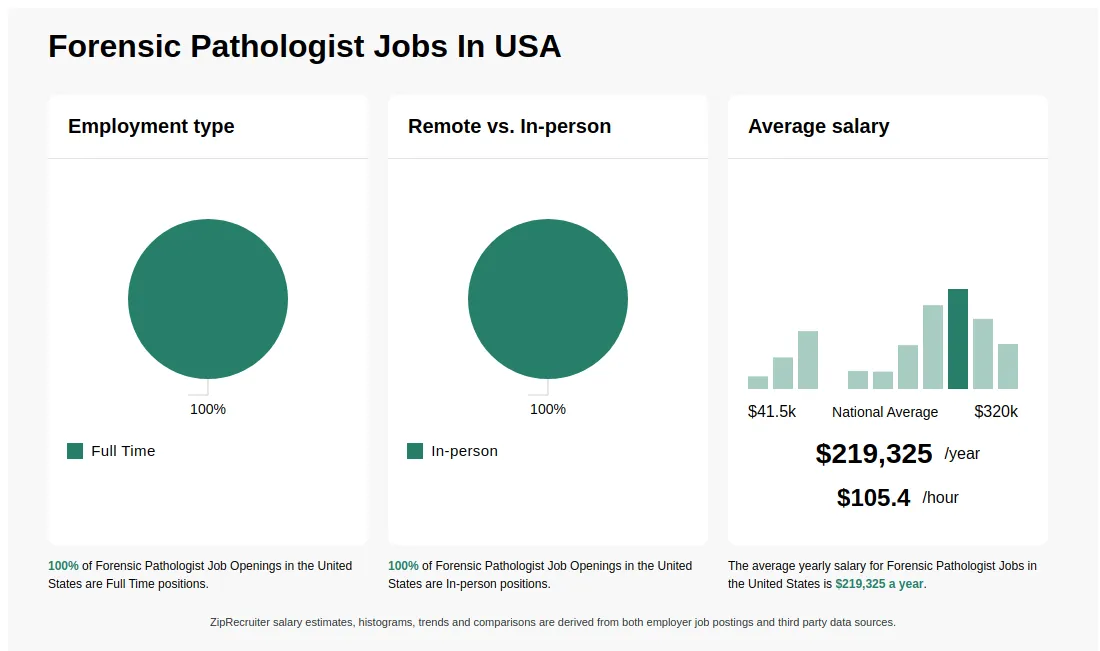
$41.5K
$219.3K
$320K
How much do forensic pathologist jobs pay per year?
As of Sep 14, 2026, the average yearly pay for forensic pathologist in the United States is $219,325.00, according to ZipRecruiter salary data. Most workers in this role earn between $183,000.00 and $274,000.00 per year, depending on experience, location, and employer.
What do forensic pathologists do?
Forensic pathologists are specially-trained physicians who work with law enforcement to determine the cause of a suspicious death in a case. They perform an autopsy to examine the body; they test blood and tissue samples, check for indications of injuries caused by firearms or other weapons, and seek other trace evidence that may provide information to the case. Before they make determinations on the cause of death, forensic pathologists also study the victim’s medical history and evaluate other evidence collected at the crime scene and witness statements. Once they compile and analyze the evidence, they prepare a report and may need to testify the reasons behind their findings in court.
What are the key skills and qualifications needed to thrive as a forensic pathologist?
To thrive as a Forensic Pathologist, you need a medical degree, board certification in pathology, and specialized training in forensic pathology. Familiarity with autopsy techniques, laboratory information systems, and evidence handling protocols is crucial. Strong analytical thinking, attention to detail, and clear written and verbal communication skills help in accurately determining causes of death and presenting findings. These competencies ensure reliable forensic investigations, support legal proceedings, and uphold public health and justice.
What are some of the unique challenges forensic pathologists face when working with law enforcement and legal teams?
Forensic pathologists often collaborate closely with law enforcement and legal professionals, which can present unique challenges such as communicating complex medical findings in a way that non-medical personnel can understand. They may be called upon to testify in court, requiring strong presentation skills and the ability to defend their conclusions under cross-examination. Balancing the need for scientific objectivity with the expectations and pressures from various stakeholders can also be demanding. Additionally, managing a high caseload while ensuring meticulous attention to detail is essential in this role.
What is the difference between Forensic Pathologist vs Medical Examiner?
| Aspect | Forensic Pathologist |
|---|
| Required Credentials | Medical degree, pathology residency, forensic pathology fellowship, medical license |
|---|---|
| Work Environment | Autopsy suites, laboratories, crime scenes |
| Employer & Industry | Law enforcement agencies, medical examiner offices, forensic labs |
| Common Search & Comparison | Often compared due to similar roles in death investigations |
While both forensic pathologists and medical examiners investigate unexplained deaths, forensic pathologists perform autopsies and analyze evidence in labs, whereas medical examiners are typically elected officials overseeing death investigations. The roles overlap in credentials and work environment, but their responsibilities differ slightly based on jurisdiction and specific duties.
Is forensic pathology a good career?
Forensic pathology is a specialized medical field involving the investigation of sudden or unexplained deaths through autopsies and evidence analysis. It requires medical training, certification, and strong attention to detail, with job stability and demand in criminal justice and public health sectors. The career can be rewarding for those interested in medicine, law enforcement, and scientific investigation.
Is it hard to get into forensic pathology?
Forensic pathology is a specialized medical field that requires completing medical school, a residency in pathology, and a fellowship in forensic pathology, making entry competitive. Candidates need strong academic records, relevant training, and certification from the American Board of Pathology, which can make the process challenging but achievable with dedication.
What jobs can you get as a forensic pathologist?
A forensic pathologist primarily works in medical examiner or coroner offices, performing autopsies to determine cause of death. They may also work in crime laboratories, hospitals, or research institutions, providing expert testimony in legal cases and collaborating with law enforcement. Certification by the American Board of Pathology is typically required for these roles.
More about Forensic Pathologist jobs
What cities are hiring for Forensic Pathologist jobs?
Cities with the most Forensic Pathologist job openings:
What are the most commonly searched types of Forensic Pathologist jobs?
The most popular types of Forensic Pathologist jobs are:
Who are the top companies hiring for Forensic Pathologist jobs?
The top employers for Forensic Pathologist jobs are:
What states have the most Forensic Pathologist jobs?
States with the most job openings for Forensic Pathologist jobs include:
What are popular job titles related to Forensic Pathologist jobs?
For Forensic Pathologist jobs, the most frequently searched job titles are:
Physician - Forensic Pathologist
Tampa, FL • On-site
22nd Health Care LLC
Other
Re-posted 19 days ago
Job description
Job Title: Physician - Forensic Pathologist
Location: Tampa, FL 33602
Duration: 3 Months to long term
Shift: Standard First Shift
Facility: Hillsborough County
Job Responsibilities:.
• Performs autopsies, including external and internal examination and fixed organ dissection. Interprets histological, toxicological, chemical, hematological, and micro-biologic laboratory results.
• Reviews medical records, law enforcement reports, and other reports as part of death investigation. Provides explanation of findings and opinions to families of deceased and other Client persons.
• Certifies indigent natural deaths, including external examinations, review requests for cremation and out of state body shipment.
• Provides opinions at departmental conferences or less formally, or other assistance to department members to resolve problems.
• Reviews case photographs, autopsy reports, and other file items prior to file sign-out.
• Provides testimony for depositions and at trial as an expert witness. Examines clothing, weapons, motor vehicles, and other items pertinent to death investigations.
• Investigates and interprets death scenes, including photographic documentation.
• Maintains eligibility for faculty appointment in the Department of Pathology and Cell Biology at the University of South Florida College of Medicine.
• Performs / assists in the scientific identification of unknown decedents via comparative dental / body x-ray imaging.
Requirements:
• MD (Doctor of Medicine) or DO (Doctor of Osteopathy)
• Completed ACGME-accredited training in Forensic Pathology
• Board Certified (or eligible) in Forensic Pathology
• Valid medical license (Florida OR able to obtain within 6 months)
• Strong experience in forensic/autopsy-based investigations
Location: Tampa, FL 33602
Duration: 3 Months to long term
Shift: Standard First Shift
Facility: Hillsborough County
Job Responsibilities:.
• Performs autopsies, including external and internal examination and fixed organ dissection. Interprets histological, toxicological, chemical, hematological, and micro-biologic laboratory results.
• Reviews medical records, law enforcement reports, and other reports as part of death investigation. Provides explanation of findings and opinions to families of deceased and other Client persons.
• Certifies indigent natural deaths, including external examinations, review requests for cremation and out of state body shipment.
• Provides opinions at departmental conferences or less formally, or other assistance to department members to resolve problems.
• Reviews case photographs, autopsy reports, and other file items prior to file sign-out.
• Provides testimony for depositions and at trial as an expert witness. Examines clothing, weapons, motor vehicles, and other items pertinent to death investigations.
• Investigates and interprets death scenes, including photographic documentation.
• Maintains eligibility for faculty appointment in the Department of Pathology and Cell Biology at the University of South Florida College of Medicine.
• Performs / assists in the scientific identification of unknown decedents via comparative dental / body x-ray imaging.
Requirements:
• MD (Doctor of Medicine) or DO (Doctor of Osteopathy)
• Completed ACGME-accredited training in Forensic Pathology
• Board Certified (or eligible) in Forensic Pathology
• Valid medical license (Florida OR able to obtain within 6 months)
• Strong experience in forensic/autopsy-based investigations