The CrimeScene Investigation, Forensic Biology, and Forensic Chemistry degree programs prepare students to apply a wide range of forensic techniques in all forensic settings. Students gain knowledge ...
The CrimeScene Investigation, Forensic Biology, and Forensic Chemistry degree programs prepare students to apply a wide range of forensic techniques in all forensic settings. Students gain knowledge ...

D. or equivalent) in Chemistry, Biology, Physics, Forensic Science, or a closely related STEM discipline. * At least 18 graduate semester hours in Forensic Science and/or Chemistry. * College-level ...
New
D. or equivalent) in Chemistry, Biology, Physics, Forensic Science, or a closely related STEM discipline. * At least 18 graduate semester hours in Forensic Science and/or Chemistry. * College-level ...
New

DPS - CLD - Biology/DNA Trainer - 6057
Garland, TX · On-site
$6.8K - $9.1K/mo
Performs highly advanced (seniorlevel) forensic science t work; involves DNA analyses to aid in investigations; specialized DNA analyses of biological materials; testifying in court; interpreting ...
DPS - CLD - Biology/DNA Trainer - 6057
Garland, TX · On-site
$6.8K - $9.1K/mo
Performs highly advanced (seniorlevel) forensic science t work; involves DNA analyses to aid in investigations; specialized DNA analyses of biological materials; testifying in court; interpreting ...
Qualifications Bachelor's degree from an accredited four-year college or university with a major in chemistry, biology, biochemistry, molecular biology, forensic sciences, natural sciences, or ...
Qualifications Bachelor's degree from an accredited four-year college or university with a major in chemistry, biology, biochemistry, molecular biology, forensic sciences, natural sciences, or ...
Forensic Science Examiner 3 (40 Hour)
Meriden, CT · On-site
$99K - $134K/yr
The Division is structured into three primary analytical sections: • Chemical Analysis Section - encompassing toxicology, controlled substances, and general chemistry • Forensic Biology/DNA ...
Forensic Science Examiner 3 (40 Hour)
Meriden, CT · On-site
$99K - $134K/yr
The Division is structured into three primary analytical sections: • Chemical Analysis Section - encompassing toxicology, controlled substances, and general chemistry • Forensic Biology/DNA ...

Required License/Registration/Certifications Texas Forensic Science Commission Forensic Biology Technician License Job Duties * Casework examination following all Quality Assurance Manual and ...
Required License/Registration/Certifications Texas Forensic Science Commission Forensic Biology Technician License Job Duties * Casework examination following all Quality Assurance Manual and ...
Required License/Registration/Certifications Texas Forensic Science Commission Forensic Biology Technician License Job Duties * Casework examination following all Quality Assurance Manual and ...
Required License/Registration/Certifications Texas Forensic Science Commission Forensic Biology Technician License Job Duties * Casework examination following all Quality Assurance Manual and ...

Associate Medical Examiner (Forensic Pathologist)
Decatur, GA · On-site
$260K - $280K/yr
This office is located within the GBI Coastal Regional Crime Laboratory, which include on-site Forensic Biology, Forensic Chemistry, Firearms Analysis, and Forensic Toxicology. The statewide GBI ...
Associate Medical Examiner (Forensic Pathologist)
Decatur, GA · On-site
$260K - $280K/yr
This office is located within the GBI Coastal Regional Crime Laboratory, which include on-site Forensic Biology, Forensic Chemistry, Firearms Analysis, and Forensic Toxicology. The statewide GBI ...
Required License/Registration/Certifications Texas Forensic Science Commission Forensic Biology Technician License Job Duties * Casework examination following all Quality Assurance Manual and ...
Required License/Registration/Certifications Texas Forensic Science Commission Forensic Biology Technician License Job Duties * Casework examination following all Quality Assurance Manual and ...

Biological and Forensic Sciences Posting Number: 0402388 SHRA/EHRA: Job Category: Temporary Hiring Range: Hourly/Varies Overall Position Competency: TMP Primary Purpose of the Organization: The ...
Biological and Forensic Sciences Posting Number: 0402388 SHRA/EHRA: Job Category: Temporary Hiring Range: Hourly/Varies Overall Position Competency: TMP Primary Purpose of the Organization: The ...
Associate Medical Examiner (Forensic Pathologist)
Decatur, GA · On-site
$260K - $280K/yr
This office is located within the GBI Coastal Regional Crime Laboratory, which include on-site Forensic Biology, Forensic Chemistry, Firearms Analysis, and Forensic Toxicology. The statewide GBI ...
Associate Medical Examiner (Forensic Pathologist)
Decatur, GA · On-site
$260K - $280K/yr
This office is located within the GBI Coastal Regional Crime Laboratory, which include on-site Forensic Biology, Forensic Chemistry, Firearms Analysis, and Forensic Toxicology. The statewide GBI ...
Required License/Registration/Certifications Texas Forensic Science Commission Forensic Biology Technician License Job Duties * Casework examination following all Quality Assurance Manual and ...
Quick apply
Required License/Registration/Certifications Texas Forensic Science Commission Forensic Biology Technician License Job Duties * Casework examination following all Quality Assurance Manual and ...
The CrimeScene Investigation, Forensic Biology, and Forensic Chemistry degree programs prepare students to apply a wide range of forensic techniques in all forensic settings. Students gain knowledge ...
The CrimeScene Investigation, Forensic Biology, and Forensic Chemistry degree programs prepare students to apply a wide range of forensic techniques in all forensic settings. Students gain knowledge ...
The School of Criminal Justice, Forensic Science and Security(CJFSS) is an interdisciplinary school that offers undergraduate degrees in CrimeScene Investigation, Forensic Biology, Forensic Chemistry ...
The School of Criminal Justice, Forensic Science and Security(CJFSS) is an interdisciplinary school that offers undergraduate degrees in CrimeScene Investigation, Forensic Biology, Forensic Chemistry ...

Analysts must have documentation of a bachelor's (or its equivalent) or an advanced degree in a biology-,chemistry-or forensic science- related area (also see experience requirements below)
Analysts must have documentation of a bachelor's (or its equivalent) or an advanced degree in a biology-,chemistry-or forensic science- related area (also see experience requirements below)

Adjunct Instructor - Natural Sciences (Biology, Forensic Biology, and Chemistry)
Hamburg, NY · On-site
$2.5K/wk
Description The Natural and Behavioral Sciences division is seeking qualified adjuncts to teach in-person Biology, Forensic Biology, and Chemistry lecture and lab courses, including the natural ...
Adjunct Instructor - Natural Sciences (Biology, Forensic Biology, and Chemistry)
Hamburg, NY · On-site
$2.5K/wk
Description The Natural and Behavioral Sciences division is seeking qualified adjuncts to teach in-person Biology, Forensic Biology, and Chemistry lecture and lab courses, including the natural ...
Analysts must have documentation of a bachelor's (or its equivalent) or an advanced degree in a biology-, chemistry- or forensic science- related area (also see experience requirements below)
Analysts must have documentation of a bachelor's (or its equivalent) or an advanced degree in a biology-, chemistry- or forensic science- related area (also see experience requirements below)

Forensic Technician IV
Austin, TX · On-site
Degrees must be in the biological or chemical sciences, or in forensic science with a biology focus. Essential Duties and Responsibilities: * Help train other staff members on serology methods ...
Forensic Technician IV
Austin, TX · On-site
Degrees must be in the biological or chemical sciences, or in forensic science with a biology focus. Essential Duties and Responsibilities: * Help train other staff members on serology methods ...
Forensic Technician IV
Austin, TX · On-site
$50K/yr
Degrees must be in the biological or chemical sciences, or in forensic science with a biology focus. Essential Duties and Responsibilities: * Help train other staff members on serology methods ...
Quick apply
Forensic Technician IV
Austin, TX · On-site
$50K/yr
Degrees must be in the biological or chemical sciences, or in forensic science with a biology focus. Essential Duties and Responsibilities: * Help train other staff members on serology methods ...
Analysts must have documentation of a bachelor's (or its equivalent) or an advanced degree in a biology-, chemistry- or forensic science- related area (also see experience requirements below)
Analysts must have documentation of a bachelor's (or its equivalent) or an advanced degree in a biology-, chemistry- or forensic science- related area (also see experience requirements below)
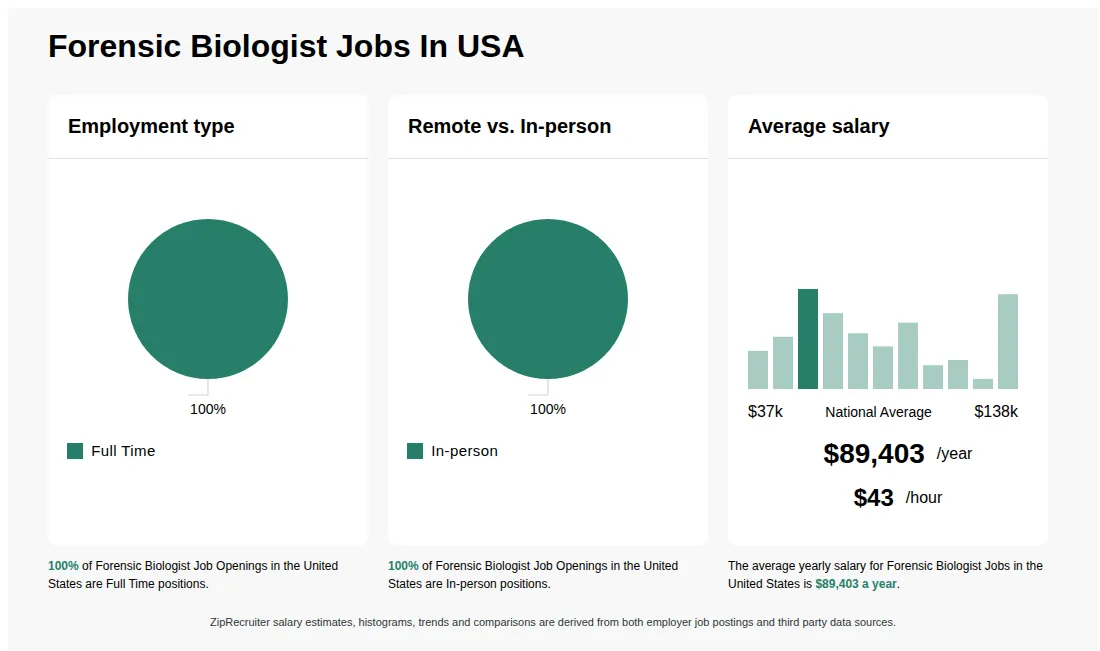
Forensic Biologist information
See salary details
$37K - $46.2K
6% of jobs
$46.2K - $55.4K
9% of jobs
$60.8K is the 25th percentile. Wages below this are outliers.
$55.4K - $64.5K
17% of jobs
$64.5K - $73.7K
13% of jobs
The median wage is $78.8K / yr.
$73.7K - $82.9K
10% of jobs
$82.9K - $92.1K
7% of jobs
$92.1K - $101.3K
12% of jobs
$104.7K is the 75th percentile. Wages above this are outliers.
$101.3K - $110.5K
4% of jobs
$110.5K - $119.6K
4% of jobs
$119.6K - $128.8K
1% of jobs
$128.8K - $138K
17% of jobs
$37K
$89.4K
$138K
How much do forensic biologist jobs pay per year?
As of Sep 15, 2026, the average yearly pay for forensic biologist in the United States is $89,403.00, according to ZipRecruiter salary data. Most workers in this role earn between $59,500.00 and $121,000.00 per year, depending on experience, location, and employer.
What is a forensic biologist?
Forensic biologists are scientists who apply biological principles and techniques to help solve crimes. They analyze biological evidence such as blood, hair, saliva, and other bodily fluids to identify victims or suspects and to reconstruct events related to criminal cases. Their work often involves DNA analysis, microscopic examination, and working closely with law enforcement agencies. Forensic biologists may also testify in court as expert witnesses and contribute to criminal investigations by providing scientific insights.
What are the key skills and qualifications needed to thrive as a forensic biologist, and why are they important?
To thrive as a Forensic Biologist, you need a strong background in biology, chemistry, and laboratory analysis, typically supported by a relevant bachelor's or advanced degree. Familiarity with DNA analysis techniques, laboratory information management systems (LIMS), and certifications such as those from the American Board of Criminalistics are commonly required. Attention to detail, critical thinking, and effective communication are essential soft skills for accurately analyzing evidence and presenting findings. These competencies ensure the integrity of forensic investigations and support the accurate delivery of evidence in legal contexts.
What are some common challenges faced by forensic biologists during evidence analysis?
Forensic biologists often encounter challenges such as working with degraded, limited, or contaminated biological samples, which can affect the accuracy of results. They must adhere to strict chain-of-custody protocols and maintain meticulous documentation to ensure evidence integrity. Additionally, balancing the need for thorough analysis with tight case deadlines and collaborating closely with law enforcement, attorneys, and other forensic specialists requires strong communication and organizational skills.
What is the difference between Forensic Biologist vs Forensic Scientist?
| Aspect | Forensic Biologist | Forensic Scientist |
|---|---|---|
| Credentials | Bachelor's or Master's in Biology, Microbiology, or related fields; certifications vary | Varies; often includes degrees in biology, chemistry, or forensic science; certifications may be required |
| Work Environment | Crime labs, crime scenes, research facilities | Crime labs, law enforcement agencies, research institutions |
| Industry Usage | Primarily in biological analysis, DNA testing, and specimen analysis | Broader scope including chemical analysis, ballistics, and toxicology |
While both roles work within forensic science, forensic biologists focus on biological evidence like DNA, whereas forensic scientists may handle a wider range of evidence types. The roles often overlap, but forensic biologists specialize in biological analysis and DNA testing within crime investigations.
Do forensic biologists make good money?
Forensic biologists typically earn a median annual salary ranging from $50,000 to $70,000, depending on experience, education, and location. Advanced certifications and working in government labs can lead to higher salaries, and the job often requires skills in DNA analysis and laboratory techniques.
Is a forensic biologist a good job?
A forensic biologist is a specialized scientist who analyzes biological evidence from crime scenes, often working in laboratories or crime labs. The role requires strong attention to detail, knowledge of biology and DNA analysis, and typically involves a stable work schedule. It can be a rewarding career for those interested in criminal justice and scientific investigation, with job growth expected to be steady in forensic science fields.
What qualifications do you need to be a forensic biologist?
To become a forensic biologist, a bachelor's degree in biology, forensic science, or a related field is typically required, with many positions preferring or requiring a master's degree. Relevant skills include laboratory techniques, DNA analysis, and familiarity with forensic tools; certifications such as the American Board of Criminalistics can enhance job prospects.
More about Forensic Biologist jobs
What cities are hiring for Forensic Biologist jobs?
Cities with the most Forensic Biologist job openings:
What are the most commonly searched types of Forensic Biologist jobs?
The most popular types of Forensic Biologist jobs are:
Who are the top companies hiring for Forensic Biologist jobs?
The top employers for Forensic Biologist jobs are:
What states have the most Forensic Biologist jobs?
States with the most job openings for Forensic Biologist jobs include:
What are popular job titles related to Forensic Biologist jobs?
For Forensic Biologist jobs, the most frequently searched job titles are:

Assistant Teaching Professor or Instructor of Forensic Science
Hattiesburg, MS • On-site
University of Southern Mississippi
• Colleges, Universities, and Professional Schools • 1 - 5K employees1,001 - 5,000 employees
Full-time
Re-posted 12 days ago
University Of Southern Mississippi rating

7.0
Based on 12 frontline employees who took The Breakroom Quiz
Job description
Special Instructions to Applicants
Applicants must complete an online application along with a letter of interest, statement of teaching philosophy and goals, current vita, and contact information for at least three professional references. To receive priority consideration, applications must be received by October 25, 2026. Official transcripts will be required prior to a campus interview.
Applicants must be currently authorized to work in the United States on a full-time basis without the need for visa sponsorship. The University will not sponsor applicants for work visas (e.g., H-1B).
Direct inquiries to:
Dr. Xuyang He,
Search Committee Chair
School of Criminal Justice, Forensic Science and Security
118 College Drive # 5127
Hattiesburg, MS. 39406
Xuyang.He@usm.edu
Job Summary
The School of Criminal Justice, Forensic Science and Security (CJFSS) is an interdisciplinary school with more than 500 students pursuing undergraduate degrees in Crime Scene Investigation, Forensic Biology, Forensic Chemistry, and Criminal Justice. The school offers undergraduate minors in Forensic Science, Criminal Justice, and Security Studies, as well as a fully online graduate program in Criminal Justice.
Housed in the newly renovated Paul H. "Bud" Holmes Criminal Justice Building, CJFSS features more than 30,000 square feet of state-of-the-art teaching and research laboratories, modern classrooms, fully functional mock courtroom.
The CrimeScene Investigation, Forensic Biology, and Forensic Chemistry degree programs prepare students to apply a wide range of forensic techniques in all forensic settings. Students gain knowledge and hands-on experience in drug identification, serology and DNA analysis, fingerprint analysis, crime scene documentation, firearms identification, arson and explosives investigation, forensic photography, courtroom testimony techniques footwear analysis and other specialized areas of forensic science.
Primary Duties and Responsibilities
- Teaching, advising, and mentoring students at the university level.
- Online and face-to-face course delivery and instruction.
- Preparing and submitting syllabi, grades, and other required course documentation in a timely manner.
- Engaging in scholarly and service activities commensurate with school, college, and university expectations.
- Attending school, college, and university meetings and recruitment events.
- Organizing and managing laboratory activities.
- Performs other duties as assigned.
What University Of Southern Mississippi employees say
Pay
Benefits
Hours and flexibility
Workplace
Get the full story on Breakroom

About University of Southern MIssissippi
Sourced by ZipRecruiter
Industry
Colleges, universities, and professional schools
Company size
1,001 - 5,000 Employees
Headquarters location
Hattiesburg, MS, US
Year founded
1910