D. in forensic science, biology, chemistry or closely related field, with practical experience in forensic science is preferred. Those possessing a master's degree in forensic science, biology ...
D. in forensic science, biology, chemistry or closely related field, with practical experience in forensic science is preferred. Those possessing a master's degree in forensic science, biology ...

Basic understanding of molecular biology, genetics, genomics, and forensic DNA principles. * Familiarity with standard laboratory practices and scientific instrumentation. * Experience with or ...
Basic understanding of molecular biology, genetics, genomics, and forensic DNA principles. * Familiarity with standard laboratory practices and scientific instrumentation. * Experience with or ...

Analysts must have documentation of a bachelor's (or its equivalent) or an advanced degree in a biology-, chemistry- or forensic science- related area (also see experience requirements below)
Analysts must have documentation of a bachelor's (or its equivalent) or an advanced degree in a biology-, chemistry- or forensic science- related area (also see experience requirements below)
D. in forensic science, biology, chemistry or closely related field, with practical experience in forensic science is preferred. Those possessing a master's degree in forensic science, biology ...
D. in forensic science, biology, chemistry or closely related field, with practical experience in forensic science is preferred. Those possessing a master's degree in forensic science, biology ...
Forensic Technician IV
Austin, TX · On-site
$50K/yr
Degrees must be in the biological or chemical sciences, or in forensic science with a biology focus. Essential Duties and Responsibilities: * Help train other staff members on serology methods ...
Forensic Technician IV
Austin, TX · On-site
$50K/yr
Degrees must be in the biological or chemical sciences, or in forensic science with a biology focus. Essential Duties and Responsibilities: * Help train other staff members on serology methods ...
Forensic Scientist- DNA Analyst
Charlottesville, VA · On-site
$55K/yr
Basic understanding of molecular biology, genetics, genomics, and forensic DNA principles. * Familiarity with standard laboratory practices and scientific instrumentation. * Experience with or ...
Quick apply
Forensic Scientist- DNA Analyst
Charlottesville, VA · On-site
$55K/yr
Basic understanding of molecular biology, genetics, genomics, and forensic DNA principles. * Familiarity with standard laboratory practices and scientific instrumentation. * Experience with or ...

Associate Forensic Scientist (LHC)
Phoenix, AZ · On-site
$56K/yr
The Associate Forensic Scientist receives extensive training in relevant forensic science areas in ... Biology * Chemistry * Physical Science with a minimum of 30 semester hours (45 qtr hours) in ...
Associate Forensic Scientist (LHC)
Phoenix, AZ · On-site
$56K/yr
The Associate Forensic Scientist receives extensive training in relevant forensic science areas in ... Biology * Chemistry * Physical Science with a minimum of 30 semester hours (45 qtr hours) in ...
Forensic Scientist- DNA Analyst
Charlottesville, VA · On-site
$55K/yr
Basic understanding of molecular biology, genetics, genomics, and forensic DNA principles. * Familiarity with standard laboratory practices and scientific instrumentation. * Experience with or ...
Forensic Scientist- DNA Analyst
Charlottesville, VA · On-site
$55K/yr
Basic understanding of molecular biology, genetics, genomics, and forensic DNA principles. * Familiarity with standard laboratory practices and scientific instrumentation. * Experience with or ...
Forensic Toxicologist
Horsham, PA · On-site
Design, validate, and apply analytical methods for biological specimen testing, including detection ... Who You Are You are a Forensic Toxicologist with moderate experience, a strong foundation in ...
Forensic Toxicologist
Horsham, PA · On-site
Design, validate, and apply analytical methods for biological specimen testing, including detection ... Who You Are You are a Forensic Toxicologist with moderate experience, a strong foundation in ...
Bachelor's degree from an accredited four-year college or university with a major in chemistry, biology, biochemistry, molecular biology, forensic sciences, natural sciences, or related field.
Bachelor's degree from an accredited four-year college or university with a major in chemistry, biology, biochemistry, molecular biology, forensic sciences, natural sciences, or related field.

Forensic Biology with laboratory * Chemical Forensics with laboratory * Fingerprints with laboratory Adjunct taught classes are in person and during the business day or in the evening. A minimum of a ...
Forensic Biology with laboratory * Chemical Forensics with laboratory * Fingerprints with laboratory Adjunct taught classes are in person and during the business day or in the evening. A minimum of a ...

Senior Forensic DNA Analyst, Lead
Omaha, NE · On-site
$73K - $110K/yr
At least one graduate level course registering 3 or more credit hours (Molecular Biology, Genetics or Biochemistry) * Course work or training in forensics analysis, statistics and/or population ...
Senior Forensic DNA Analyst, Lead
Omaha, NE · On-site
$73K - $110K/yr
At least one graduate level course registering 3 or more credit hours (Molecular Biology, Genetics or Biochemistry) * Course work or training in forensics analysis, statistics and/or population ...
The Division is structured into three primary analytical sections:\r\n\r\n Chemical Analysis Section - encompassing toxicology, controlled substances, and general chemistry\r\n Forensic Biology/DNA ...
The Division is structured into three primary analytical sections:\r\n\r\n Chemical Analysis Section - encompassing toxicology, controlled substances, and general chemistry\r\n Forensic Biology/DNA ...
At least one graduate level course registering 3 or more credit hours (Molecular Biology, Genetics or Biochemistry) * Course work or training in forensics analysis, statistics and/or population ...
At least one graduate level course registering 3 or more credit hours (Molecular Biology, Genetics or Biochemistry) * Course work or training in forensics analysis, statistics and/or population ...
In this position, you'll perform complex toxicological testing on biological specimens to identify ... SUPERVISION EXERCISED Collaborates with forensic pathologists, autopsy attendants, and clerical ...
In this position, you'll perform complex toxicological testing on biological specimens to identify ... SUPERVISION EXERCISED Collaborates with forensic pathologists, autopsy attendants, and clerical ...
Interprets histological, toxicological, chemical, hematological, and micro-biologic laboratory ... forensic/autopsy-based investigations
Interprets histological, toxicological, chemical, hematological, and micro-biologic laboratory ... forensic/autopsy-based investigations
Senior Forensic DNA Analyst, Lead
Omaha, NE · On-site
$73K - $110K/yr
At least one graduate level course registering 3 or more credit hours (Molecular Biology, Genetics or Biochemistry) * Course work or training in forensics analysis, statistics and/or population ...
Senior Forensic DNA Analyst, Lead
Omaha, NE · On-site
$73K - $110K/yr
At least one graduate level course registering 3 or more credit hours (Molecular Biology, Genetics or Biochemistry) * Course work or training in forensics analysis, statistics and/or population ...
Senior Forensic DNA Analyst, Lead
Omaha, NE · On-site +1
$73K - $110K/yr
At least one graduate level course registering 3 or more credit hours (Molecular Biology, Genetics or Biochemistry) * Course work or training in forensics analysis, statistics and/or population ...
Senior Forensic DNA Analyst, Lead
Omaha, NE · On-site +1
$73K - $110K/yr
At least one graduate level course registering 3 or more credit hours (Molecular Biology, Genetics or Biochemistry) * Course work or training in forensics analysis, statistics and/or population ...
What You'll Do Perform high-complexity analytical testing on biological specimens to identify ... SUPERVISION EXERCISED Collaborates with forensic pathologists, autopsy attendants, and clerical ...
What You'll Do Perform high-complexity analytical testing on biological specimens to identify ... SUPERVISION EXERCISED Collaborates with forensic pathologists, autopsy attendants, and clerical ...
At least one graduate level course registering 3 or more credit hours (Molecular Biology, Genetics or Biochemistry) * Course work or training in forensics analysis, statistics and/or population ...
At least one graduate level course registering 3 or more credit hours (Molecular Biology, Genetics or Biochemistry) * Course work or training in forensics analysis, statistics and/or population ...
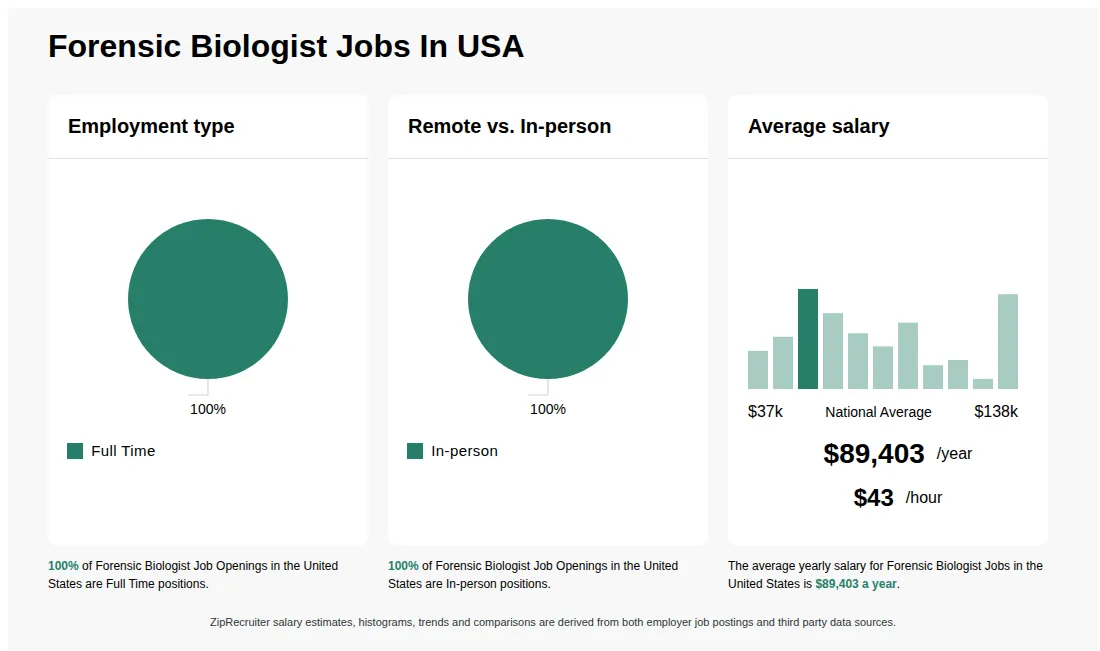
Forensic Biologist information
See salary details
$37K - $46.2K
6% of jobs
$46.2K - $55.4K
9% of jobs
$60.8K is the 25th percentile. Wages below this are outliers.
$55.4K - $64.5K
17% of jobs
$64.5K - $73.7K
13% of jobs
The median wage is $78.8K / yr.
$73.7K - $82.9K
10% of jobs
$82.9K - $92.1K
7% of jobs
$92.1K - $101.3K
12% of jobs
$104.7K is the 75th percentile. Wages above this are outliers.
$101.3K - $110.5K
4% of jobs
$110.5K - $119.6K
4% of jobs
$119.6K - $128.8K
1% of jobs
$128.8K - $138K
17% of jobs
$37K
$89.4K
$138K
How much do forensic biologist jobs pay per year?
As of Sep 15, 2026, the average yearly pay for forensic biologist in the United States is $89,403.00, according to ZipRecruiter salary data. Most workers in this role earn between $59,500.00 and $121,000.00 per year, depending on experience, location, and employer.
What is a forensic biologist?
Forensic biologists are scientists who apply biological principles and techniques to help solve crimes. They analyze biological evidence such as blood, hair, saliva, and other bodily fluids to identify victims or suspects and to reconstruct events related to criminal cases. Their work often involves DNA analysis, microscopic examination, and working closely with law enforcement agencies. Forensic biologists may also testify in court as expert witnesses and contribute to criminal investigations by providing scientific insights.
What are the key skills and qualifications needed to thrive as a forensic biologist, and why are they important?
To thrive as a Forensic Biologist, you need a strong background in biology, chemistry, and laboratory analysis, typically supported by a relevant bachelor's or advanced degree. Familiarity with DNA analysis techniques, laboratory information management systems (LIMS), and certifications such as those from the American Board of Criminalistics are commonly required. Attention to detail, critical thinking, and effective communication are essential soft skills for accurately analyzing evidence and presenting findings. These competencies ensure the integrity of forensic investigations and support the accurate delivery of evidence in legal contexts.
What are some common challenges faced by forensic biologists during evidence analysis?
Forensic biologists often encounter challenges such as working with degraded, limited, or contaminated biological samples, which can affect the accuracy of results. They must adhere to strict chain-of-custody protocols and maintain meticulous documentation to ensure evidence integrity. Additionally, balancing the need for thorough analysis with tight case deadlines and collaborating closely with law enforcement, attorneys, and other forensic specialists requires strong communication and organizational skills.
What is the difference between Forensic Biologist vs Forensic Scientist?
| Aspect | Forensic Biologist | Forensic Scientist |
|---|---|---|
| Credentials | Bachelor's or Master's in Biology, Microbiology, or related fields; certifications vary | Varies; often includes degrees in biology, chemistry, or forensic science; certifications may be required |
| Work Environment | Crime labs, crime scenes, research facilities | Crime labs, law enforcement agencies, research institutions |
| Industry Usage | Primarily in biological analysis, DNA testing, and specimen analysis | Broader scope including chemical analysis, ballistics, and toxicology |
While both roles work within forensic science, forensic biologists focus on biological evidence like DNA, whereas forensic scientists may handle a wider range of evidence types. The roles often overlap, but forensic biologists specialize in biological analysis and DNA testing within crime investigations.
Do forensic biologists make good money?
Forensic biologists typically earn a median annual salary ranging from $50,000 to $70,000, depending on experience, education, and location. Advanced certifications and working in government labs can lead to higher salaries, and the job often requires skills in DNA analysis and laboratory techniques.
Is a forensic biologist a good job?
A forensic biologist is a specialized scientist who analyzes biological evidence from crime scenes, often working in laboratories or crime labs. The role requires strong attention to detail, knowledge of biology and DNA analysis, and typically involves a stable work schedule. It can be a rewarding career for those interested in criminal justice and scientific investigation, with job growth expected to be steady in forensic science fields.
What qualifications do you need to be a forensic biologist?
To become a forensic biologist, a bachelor's degree in biology, forensic science, or a related field is typically required, with many positions preferring or requiring a master's degree. Relevant skills include laboratory techniques, DNA analysis, and familiarity with forensic tools; certifications such as the American Board of Criminalistics can enhance job prospects.
More about Forensic Biologist jobs
What cities are hiring for Forensic Biologist jobs?
Cities with the most Forensic Biologist job openings:
What are the most commonly searched types of Forensic Biologist jobs?
The most popular types of Forensic Biologist jobs are:
Who are the top companies hiring for Forensic Biologist jobs?
The top employers for Forensic Biologist jobs are:
What states have the most Forensic Biologist jobs?
States with the most job openings for Forensic Biologist jobs include:
What are popular job titles related to Forensic Biologist jobs?
For Forensic Biologist jobs, the most frequently searched job titles are:

Assistant Professor of Forensic Science
Campus, IL • On-site
University of Findlay
• Colleges, Universities, and Professional Schools • 501 - 1,000 employees501 - 1,000 employees
Full-time
Re-posted 23 days ago
University Of Findlay rating

7.4
Based on 6 frontline employees who took The Breakroom Quiz
Job description
If you are a current University employee, please use the internal career site to apply for this position.Job Description
The University of Findlay is seeking applicants for a full-time, tenure-track appointment for the position of Assistant Professor of Forensic Science. A Ph.D. in forensic science, biology, chemistry or closely related field, with practical experience in forensic science is preferred. Those possessing a master's degree in forensic science, biology, chemistry or closely related field with substantive practical tested professional experience in forensic science will be considered. ABD's will also be considered for this position. Preference will be given to individuals with practical experience in forensic science and familiarity with FEPAC guidelines.
Teaching responsibilities include Introductory Forensic Science, Forensic Biology/Chemistry, Crime Scene Investigation, Forensic Evidence and other introductory and advanced courses in area of expertise. Additional responsibilities will include, but are not limited to: engaging in student recruitment and retention activities; completing and/or assisting the department chair in gathering assessment data and in the writing and completion of program, university, and external assessment reports; maintaining program curriculum and standards in compliance with FEPAC guidelines; completing required tasks and responsibilities toward achieving and maintaining forensic science program accreditation; maintaining inventory of needed forensic science supplies and ordering new supplies as necessary; and completing other administrative duties as directed by university administration, deans, program chair, and or external bodies.
Applicants are expected to possess a strong commitment to excellence in teaching undergraduate forensic science courses. The selected candidate will also be expected to develop and maintain an independent and active research program; advise undergraduate students; advise, mentor, and supervise undergraduate student researchers; and provide service to the profession, university, program, and community.
The University of Findlay is a comprehensive master's institution and the largest private university in northwest Ohio with more than 3,600 students enrolled in diverse academic programs.Teaching excellence is the top priority of the University faculty. The City of Findlay, population 42,000, is recognized as one of the best micropolitan communities in Ohio, with a strong business base and school system and a friendly atmosphere.The University of Findlay's distinctive and renowned programs include animal science, equestrian studies, pre-veterinary medicine, nuclear medicine technology, occupational therapy, physical therapy, pharmacy, and physician assistant, as well as environmental, safety and occupational health management.For more information about the University of Findlay, visit https://www.findlay.edu/about-uf/.
Review of applications will begin immediately and continue until the position is filled.For optimal consideration of your applicant file, faculty applications must include a cover letter; current resume or curriculum vitae; a statement of teaching philosophy; and the contact information for three professional references with your application.The UF Employment Application may be found on the website at: https://findlay.wd5.myworkdayjobs.com/en-US/careers.
The University of Findlay is an equal opportunity employer and educator committed to building a diverse and inclusive academic community.It is the university's policy to prohibit discrimination and provide equal opportunity to all employees and applicants for employment, without regard to their race, sex, color, religion, ancestry, national origin, age, disability, veteran status, military or sexual orientation.
For optimal consideration of your applicant file, faculty applications must include a cover letter; current Resume or Curriculum Vitae; a statement of teaching philosophy; and the contact information for three professional references with your application. Staff applications must include a current Resume or Curriculum Vitae and cover letter with your application.
The University of Findlay is an Affirmative Action/Equal Opportunity Educator and Employer. It is the university's policy to prohibit discrimination and provide equal opportunity to all employees and applicants for employment, without regard to their race, sex (including gender identity/expression), color, religion, ancestry, national origin, age, disability, veteran status, military or sexual orientation.
What University Of Findlay employees say
Pay
Benefits
Hours and flexibility
Workplace
Get the full story on Breakroom

About University of Findlay
Sourced by ZipRecruiter
Industry
Colleges, universities, and professional schools
Company size
501 - 1,000 Employees
Headquarters location
Findlay, OH, US
Year founded
1882