1

Forensic Biologist Jobs (NOW HIRING)

next page

Showing results 1-20

Forensic Biologist information

See salary details

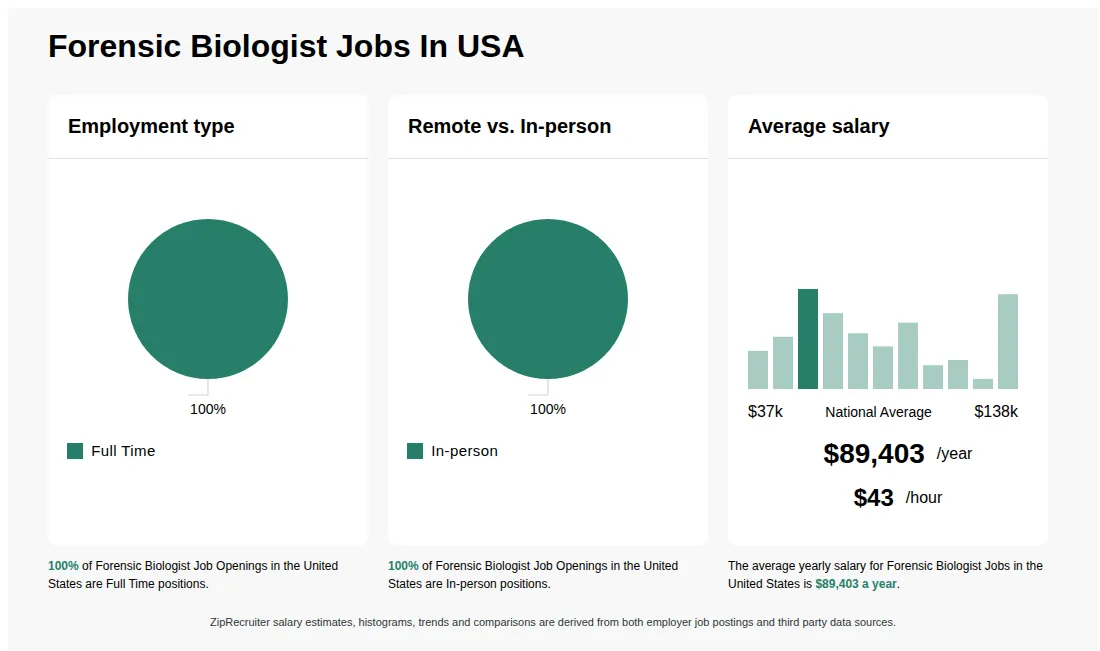
$37K

$89.4K

$138K

How much do forensic biologist jobs pay per year?

As of Jun 15, 2026, the average yearly pay for forensic biologist in the United States is $89,403.00, according to ZipRecruiter salary data. Most workers in this role earn between $59,500.00 and $121,000.00 per year, depending on experience, location, and employer.

What are the key skills and qualifications needed to thrive as a Forensic Biologist, and why are they important?

To thrive as a Forensic Biologist, you need a strong background in biology, chemistry, and laboratory analysis, typically supported by a relevant bachelor's or advanced degree. Familiarity with DNA analysis techniques, laboratory information management systems (LIMS), and certifications such as those from the American Board of Criminalistics are commonly required. Attention to detail, critical thinking, and effective communication are essential soft skills for accurately analyzing evidence and presenting findings. These competencies ensure the integrity of forensic investigations and support the accurate delivery of evidence in legal contexts.

Is a forensic scientist a 9-5 job?

Forensic biologists often work standard daytime hours, but their schedules can vary depending on case deadlines, lab needs, or crime scene investigations, which may require evening or weekend work. Flexibility and readiness to respond to emergencies are common in this field, especially for those involved in crime scene analysis or court appearances.

What is the difference between Forensic Biologist vs Forensic Scientist?

AspectForensic BiologistForensic Scientist
CredentialsBachelor's or Master's in Biology, Microbiology, or related fields; certifications varyVaries; often includes degrees in biology, chemistry, or forensic science; certifications may be required
Work EnvironmentCrime labs, crime scenes, research facilitiesCrime labs, law enforcement agencies, research institutions
Industry UsagePrimarily in biological analysis, DNA testing, and specimen analysisBroader scope including chemical analysis, ballistics, and toxicology

While both roles work within forensic science, forensic biologists focus on biological evidence like DNA, whereas forensic scientists may handle a wider range of evidence types. The roles often overlap, but forensic biologists specialize in biological analysis and DNA testing within crime investigations.

What jobs can you get with forensic biology?

Forensic biologists can work in crime laboratories, law enforcement agencies, or forensic consulting firms, analyzing biological evidence such as blood, hair, and DNA samples. They often perform DNA testing, evidence collection, and report writing, requiring skills in laboratory techniques and knowledge of forensic science protocols.

What do forensic biologist do?

A forensic biologist analyzes biological evidence from crime scenes, such as blood, hair, and DNA samples, to help identify suspects or victims. They use laboratory techniques like DNA profiling and often work closely with law enforcement agencies in a controlled environment. Certification and knowledge of laboratory safety are important in this field.

What are some common challenges faced by forensic biologists during evidence analysis?

Forensic biologists often encounter challenges such as working with degraded, limited, or contaminated biological samples, which can affect the accuracy of results. They must adhere to strict chain-of-custody protocols and maintain meticulous documentation to ensure evidence integrity. Additionally, balancing the need for thorough analysis with tight case deadlines and collaborating closely with law enforcement, attorneys, and other forensic specialists requires strong communication and organizational skills.

Can I be a CSI without being a cop?

A forensic biologist is typically not a police officer and does not need to be a sworn law enforcement officer to work in crime scene investigation. They often work in laboratories analyzing biological evidence and may collaborate with law enforcement agencies, but being a CSI usually requires specialized training in forensic science rather than police academy certification.

What are forensic biologists?

Forensic biologists are scientists who apply biological principles and techniques to help solve crimes. They analyze biological evidence such as blood, hair, saliva, and other bodily fluids to identify victims or suspects and to reconstruct events related to criminal cases. Their work often involves DNA analysis, microscopic examination, and working closely with law enforcement agencies. Forensic biologists may also testify in court as expert witnesses and contribute to criminal investigations by providing scientific insights.
More about Forensic Biologist jobs
What cities are hiring for Forensic Biologist jobs? Cities with the most Forensic Biologist job openings:
What are the most commonly searched types of Forensic Biologist jobs? The most popular types of Forensic Biologist jobs are:
What states have the most Forensic Biologist jobs? States with the most job openings for Forensic Biologist jobs include:
Infographic showing various Forensic Biologist job openings in the United States as of June 2026, with employment types broken down into 1% Locum Tenens, 39% Full Time, 6% Part Time, 1% Temporary, and 53% Contract. Highlights an 86% Physical, 3% Hybrid, and 11% Remote job distribution, with an average salary of $89,403 per year, or $43 per hour.
0000004280.FORENSIC BIOLOGIST I.CRIME LAB

0000004280.FORENSIC BIOLOGIST I.CRIME LAB

Dallas County

Dallas, TX • On-site

Full-time

Posted 11 days ago


Dallas County (Texas) rating

7.9

Company rating: 7.9 out of 10

Based on 35 frontline employees who took The Breakroom Quiz

300th of 649 rated public administrative organizations


Job description

Performs independent forensic testing of biological samples for the purpose of body fluid identification within the Forensic Biology Unit of the Criminal Investigation Laboratory.Education, Experience and Training:
Education and experience equivalent to a Bachelor's degree in Biology, Genetics, Chemistry, Forensic Sciences, or in a job related field of study with subjects providing a basic understanding of forensic biological analysis. Preference will be given to those with coursework in genetics, molecular biology, biochemistry, population genetics and/or statistics.
Special Requirements/Knowledge, Skills & Abilities:
Knowledge of the principles of animal and/or human genetics and the common techniques of DNA analysis as they relate to forensic DNA analysis and evidence handling procedures

Ability to operate and maintain laboratory equipment. Working knowledge of personal computers and standard applications. Ability to communicate in a concise and effective manner, work cooperatively with effective time management skills, and perform assigned tasks with minimal supervision.

Must pass pre-employment background check. Must have a valid Texas Driver License and good driving record. Will be required to provide a copy of 10-year driving history.

Must maintain a good driving record and remain in compliance with Article II. Subdivision II of Chapter 90 of the Dallas County Code.
Physical/Environmental Requirements:
Work is performed in a laboratory environment with potential exposure to biological and chemical hazard.

Must possess manual dexterity and visual acuity sufficient to accurately execute standard protocols. Moderate lifting up to 25 lbs., unassisted. 1

Performs independent case analysis, evidence collection, and evidence processing using standard protocols. Works closely with unit supervisor and other laboratory staff in the processing and analysis of evidentiary materials from investigations of assaults, homicides, and other crimes. Participates in the proper storage and tracking of evidence.


2. Reviews and interprets results of analytical procedures and prepares official reports of analysis results and offers expert opinion of test results. Consults with and advises police investigators and lawyers regarding analysis.


3. Provides expert witness court testimony regarding testing methods, testing results, validity of testing procedures, and the evidentiary value of the results in criminal and civil proceedings.
4.

Performs general laboratory duties; e.g., ordering supplies, preparing solutions, answering phones, and preparation of evidence collection materials.
5. Participates in the development, validation, and implementation of new analytical techniques and methods and makes recommendations to the unit supervisor regarding improvements in procedures


6. Performs quality control procedures and maintains accurate records related to quality control management. Assists with training analytical staff.


7. Performs other duties as assigned.
.


What Dallas County (Texas) employees say

Pay

Benefits

Hours and flexibility

Workplace

Get the full story on Breakroom