Financial Quantitative Analyst Location of Employment : 9200 Watson Rd., Ste. 200, St. Louis, MO 63126 Position Duties Summary : * Develop, implement, and maintain financial models to support budgets ...
Financial Quantitative Analyst Location of Employment : 9200 Watson Rd., Ste. 200, St. Louis, MO 63126 Position Duties Summary : * Develop, implement, and maintain financial models to support budgets ...
Financial Quantitative Analyst Location of Employment : 9200 Watson Rd., Ste. 200, St. Louis, MO 63126 Position Duties Summary : * Develop, implement, and maintain financial models to support budgets ...
Financial Quantitative Analyst Location of Employment : 9200 Watson Rd., Ste. 200, St. Louis, MO 63126 Position Duties Summary : * Develop, implement, and maintain financial models to support budgets ...

Senior Financial Quantitative Analyst
Sandy, UT · On-site
$81K - $101K/yr
Job Summary The Senior Financial Quantitative Analyst leads the development of advanced quantitative models that support strategic decision-making across our banking operations. This role will be ...
Senior Financial Quantitative Analyst
Sandy, UT · On-site
$81K - $101K/yr
Job Summary The Senior Financial Quantitative Analyst leads the development of advanced quantitative models that support strategic decision-making across our banking operations. This role will be ...
Senior Financial Quantitative Analyst
$81K - $101K/yr
Job Summary The Senior Financial Quantitative Analyst leads the development of advanced quantitative models that support strategic decision-making across our banking operations. This role will be ...
Senior Financial Quantitative Analyst
$81K - $101K/yr
Job Summary The Senior Financial Quantitative Analyst leads the development of advanced quantitative models that support strategic decision-making across our banking operations. This role will be ...

Quantitative Analyst
Northbrook, IL · On-site
Quantitative Analyst, Northbrook, IL - The Quantitative Analyst will assist in the research, design ... economic and financial data. - Design, conduct, and administer studies of long-range trends ...
Quantitative Analyst
Northbrook, IL · On-site
Quantitative Analyst, Northbrook, IL - The Quantitative Analyst will assist in the research, design ... economic and financial data. - Design, conduct, and administer studies of long-range trends ...

Quantitative Analyst
San Juan, PR · On-site
$80 - $120/hr
Candidates will have experience in quantitative analysis, knowledge of financial crime compliance, and statistical modeling. The Quantitative Analyst will support the monitoring of models used to ...
Quantitative Analyst
San Juan, PR · On-site
$80 - $120/hr
Candidates will have experience in quantitative analysis, knowledge of financial crime compliance, and statistical modeling. The Quantitative Analyst will support the monitoring of models used to ...

Quantitative Analyst
Washington, DC · On-site
We are seeking a highly skilled Quantitative Analyst and Tester to join the Financial and IT Modeling & Analytics team. This role will support capital markets trading and market risk management by ...
Quick apply
Quantitative Analyst
Washington, DC · On-site
We are seeking a highly skilled Quantitative Analyst and Tester to join the Financial and IT Modeling & Analytics team. This role will support capital markets trading and market risk management by ...

Data Science, Mathematics, Quantitative Analysis, Machine Learning, Business Analytics, Financial Engineering) * Entrepreneurial mindset with a strong sense of ownership - sets goals, drives outcomes ...
Data Science, Mathematics, Quantitative Analysis, Machine Learning, Business Analytics, Financial Engineering) * Entrepreneurial mindset with a strong sense of ownership - sets goals, drives outcomes ...
Quantitative Analyst
Jersey City, NJ · On-site
$75 - $85/hr
... Economics, Quantitative Finance, Computer Science, or a related discipline. 2) 5+ years of ... analytics, or human‐centric risk modeling.
Quick apply
Quantitative Analyst
Jersey City, NJ · On-site
$75 - $85/hr
... Economics, Quantitative Finance, Computer Science, or a related discipline. 2) 5+ years of ... analytics, or human‐centric risk modeling.
Quantitative Analyst
Omaha, NE · On-site
Data Science, Mathematics, Quantitative Analysis, Machine Learning, Business Analytics, Financial Engineering) * Entrepreneurial mindset with a strong sense of ownership - sets goals, drives outcomes ...
Quantitative Analyst
Omaha, NE · On-site
Data Science, Mathematics, Quantitative Analysis, Machine Learning, Business Analytics, Financial Engineering) * Entrepreneurial mindset with a strong sense of ownership - sets goals, drives outcomes ...
Quantitative Analyst
Omaha, NE · On-site
$85 - $125/hr
Data Science, Mathematics, Quantitative Analysis, Machine Learning, Business Analytics, Financial Engineering) * Entrepreneurial mindset with a strong sense of ownership - sets goals, drives outcomes ...
Quantitative Analyst
Omaha, NE · On-site
$85 - $125/hr
Data Science, Mathematics, Quantitative Analysis, Machine Learning, Business Analytics, Financial Engineering) * Entrepreneurial mindset with a strong sense of ownership - sets goals, drives outcomes ...
Quantitative Analyst
Omaha, NE · On-site
$95 - $140/hr
Data Science, Mathematics, Quantitative Analysis, Machine Learning, Business Analytics, Financial Engineering) * Entrepreneurial mindset with a strong sense of ownership - sets goals, drives outcomes ...
Quantitative Analyst
Omaha, NE · On-site
$95 - $140/hr
Data Science, Mathematics, Quantitative Analysis, Machine Learning, Business Analytics, Financial Engineering) * Entrepreneurial mindset with a strong sense of ownership - sets goals, drives outcomes ...

Quantitative Analyst
New York, NY · On-site
$90K - $127K/yr
Together we fight for everyone's opportunity for a better financial future. We will do this ... Quantitative Analyst for the Multi-Asset Strategies and Solutions Group (MASS). The group manages ...
Quantitative Analyst
New York, NY · On-site
$90K - $127K/yr
Together we fight for everyone's opportunity for a better financial future. We will do this ... Quantitative Analyst for the Multi-Asset Strategies and Solutions Group (MASS). The group manages ...
Quantitative Analyst
Manhattan, NY · On-site
$150 - $250/hr
You'll combine statistical analysis with financial theory to identify alpha-generating opportunities. What You'll Do * Research and develop quantitative trading strategies * Analyze market data to ...
Quantitative Analyst
Manhattan, NY · On-site
$150 - $250/hr
You'll combine statistical analysis with financial theory to identify alpha-generating opportunities. What You'll Do * Research and develop quantitative trading strategies * Analyze market data to ...
Quantitative Analyst
$135K - $150K/yr
The Quantitative Analyst will work together with the analytics team, data team, and business ... Bachelor's in Mathematics, Computer Science, Finance, Economics, or similar field with a strong ...
Quantitative Analyst
$135K - $150K/yr
The Quantitative Analyst will work together with the analytics team, data team, and business ... Bachelor's in Mathematics, Computer Science, Finance, Economics, or similar field with a strong ...

Quantitative Analyst
Boston, MA · On-site
$100K - $200K/yr
The Team SAI's quantitative research analysts work either directly on an asset class or product ... Graduate degree in a related field (Finance, Engineering, Mathematics, Operations Research ...
Quantitative Analyst
Boston, MA · On-site
$100K - $200K/yr
The Team SAI's quantitative research analysts work either directly on an asset class or product ... Graduate degree in a related field (Finance, Engineering, Mathematics, Operations Research ...
Quantitative Analyst
$100K - $200K/yr
The Team SAI's quantitative research analysts work either directly on an asset class or product ... Graduate degree in a related field (Finance, Engineering, Mathematics, Operations Research ...
Quantitative Analyst
$100K - $200K/yr
The Team SAI's quantitative research analysts work either directly on an asset class or product ... Graduate degree in a related field (Finance, Engineering, Mathematics, Operations Research ...
Quantitative Analyst I
Denver, CO · On-site
$64K - $91K/yr
Bachelor's or Master's degree in Mathematics, Statistics, Computer Science, Finance, Economics, or a related quantitative field. * Outstanding mathematical, statistical and analytical skills.
Quantitative Analyst I
Denver, CO · On-site
$64K - $91K/yr
Bachelor's or Master's degree in Mathematics, Statistics, Computer Science, Finance, Economics, or a related quantitative field. * Outstanding mathematical, statistical and analytical skills.
Quantitative Analyst I
Denver, CO · On-site
Bachelor's or Master's degree in Mathematics, Statistics, Computer Science, Finance, Economics, or a related quantitative field. * Outstanding mathematical, statistical and analytical skills.
Quantitative Analyst I
Denver, CO · On-site
Bachelor's or Master's degree in Mathematics, Statistics, Computer Science, Finance, Economics, or a related quantitative field. * Outstanding mathematical, statistical and analytical skills.

Quantitative Analyst
Jersey City, NJ · On-site
QUANTITATIVE ANALYST OTHER ACCEPTABLE TITLES: APPLICATION DEVELOPER SCHEDULE: HYBRID - 3 DAYS ... PLEASE SHARE CANDIDATES WHO HAVE PRIOR EXPERIENCE WORKING IN THE FINANCIAL SERVICES INDUSTRY
Quick apply
Quantitative Analyst
Jersey City, NJ · On-site
QUANTITATIVE ANALYST OTHER ACCEPTABLE TITLES: APPLICATION DEVELOPER SCHEDULE: HYBRID - 3 DAYS ... PLEASE SHARE CANDIDATES WHO HAVE PRIOR EXPERIENCE WORKING IN THE FINANCIAL SERVICES INDUSTRY
Financial Quantitative Analyst information
See salary details
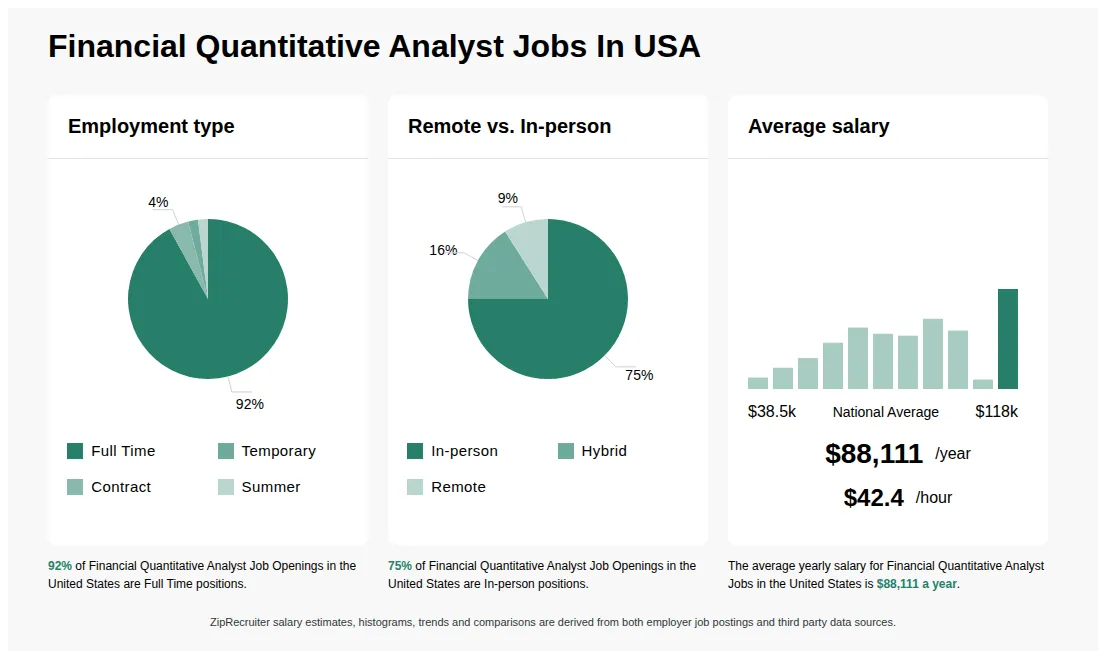
$38.5K - $45.7K
2% of jobs
$45.7K - $53K
4% of jobs
$53K - $60.2K
5% of jobs
$60.2K - $67.4K
9% of jobs
$70.4K is the 25th percentile. Wages below this are outliers.
$67.4K - $74.6K
12% of jobs
$74.6K - $81.9K
11% of jobs
The median wage is $86.9K / yr.
$81.9K - $89.1K
11% of jobs
$89.1K - $96.3K
14% of jobs
$101.2K is the 75th percentile. Wages above this are outliers.
$96.3K - $103.5K
12% of jobs
$103.5K - $110.8K
1% of jobs
$110.8K - $118K
20% of jobs
$38.5K
$88.1K
$118K
How much do financial quantitative analyst jobs pay per year?
As of Sep 5, 2026, the average yearly pay for financial quantitative analyst in the United States is $88,111.00, according to ZipRecruiter salary data. Most workers in this role earn between $70,000.00 and $110,500.00 per year, depending on experience, location, and employer.
What is a financial quantitative analyst?
Financial Quantitative Analysts, often known as 'quants,' are professionals who use mathematical models, statistical techniques, and computer algorithms to analyze financial markets and securities. They develop strategies for trading, risk management, and investment by interpreting complex financial data. Quants often work for banks, hedge funds, asset management firms, or financial technology companies. Their expertise helps organizations make data-driven decisions to maximize returns and minimize risks.
What are the key skills and qualifications needed to thrive as a financial quantitative analyst?
To thrive as a Financial Quantitative Analyst, you need strong quantitative analysis skills, advanced knowledge of mathematics, statistics, and finance, typically supported by a degree in a quantitative field such as mathematics, finance, or engineering. Proficiency with programming languages like Python, R, or MATLAB, as well as experience with financial modeling tools and data analysis systems, is essential. Analytical thinking, attention to detail, and effective communication are crucial soft skills for interpreting data and conveying complex findings. These skills enable analysts to develop accurate financial models, assess risk, and support strategic decision-making in fast-paced financial environments.
How do financial quantitative analysts typically collaborate with other departments within a financial institution?
Financial Quantitative Analysts often work closely with teams such as risk management, trading, portfolio management, and IT. They provide quantitative models and analytical tools that help inform trading strategies, risk assessments, and investment decisions. Collaboration may involve communicating complex statistical findings in accessible terms, working on cross-functional projects, and ensuring that models meet the practical needs of end-users. Strong teamwork and communication skills are essential, as analysts must regularly translate technical insights into actionable recommendations for colleagues with varying levels of technical expertise.
What is the difference between Financial Quantitative Analyst vs Financial Data Analyst?
| Aspect | Financial Quantitative Analyst | Financial Data Analyst |
|---|---|---|
| Required Credentials | Degree in Finance, Mathematics, or Statistics; often certifications like CFA or CQF | Degree in Finance, Economics, or Data Science; certifications less common |
| Work Environment | Quantitative research teams, hedge funds, investment banks | Banking, asset management, financial services firms |
| Job Focus | Developing complex models to predict market behavior and manage risk | Analyzing financial data to generate reports and support decision-making |
The main difference between a Financial Quantitative Analyst and a Financial Data Analyst lies in their focus and complexity of work. Quantitative Analysts develop advanced models for trading and risk management, requiring strong mathematical skills. Data Analysts focus on interpreting financial data to inform business decisions, often using standard analytical tools. Both roles are vital in finance but serve different functions within organizations.
More about Financial Quantitative Analyst jobs
What cities are hiring for Financial Quantitative Analyst jobs?
Cities with the most Financial Quantitative Analyst job openings:
What states have the most Financial Quantitative Analyst jobs?
States with the most job openings for Financial Quantitative Analyst jobs include:
What job categories do people searching Financial Quantitative Analyst jobs look for?
The top searched job categories for Financial Quantitative Analyst jobs are:
- Biotech Finance Analyst
- Siemens Financial Analyst
- Senior Financial Analyst Amazon
- Financial Analyst Financial Planning And Analysis
- Flexible Agriculture Financial Analyst
- Functional Financial Analyst
- Junior Financial Operations Analyst
- Financial Analyst Government Contractor
- Financial Hiring
- Salaried Infolease

Full-time
This job post has expired 1 day ago. Applications are no longer accepted.
Job description
Overview
Employer: Roeslein & Associates, Inc.
Position Title: Financial Quantitative Analyst
Location of Employment: 9200 Watson Rd., Ste. 200, St. Louis, MO 63126
Position Duties Summary:
- Develop, implement, and maintain financial models to support budgets, cost control initiatives, and production planning.
- Analyze trends in resource allocation, direct labor efficiency, and overhead management to guide operational and strategic decisions.
- Assess project profitability, capital expenditures and new project opportunities using NPV, IRR, and scenario analysis tailored to production investment cycles.
- Apply statistical methods (e.g., regression analysis, Monte Carlo simulations, and time series forecasting) to predict production models and resource needs.
- Utilize ERP systems (such as SAP, Oracle, or Infor) to monitor revenues and costs per projects, purchase orders, and operational KPIs, integrating real-time financial data into
- performance dashboards.
- Update financial forecasts and cost schedules in response to changes in production capacity, and resource availability.
- Generate reports and deliver presentations to operations, and finance teams detailing plant profitability, cost trends, and resource utilization.
- Perform variance analyses comparing actual vs. forecasted production costs, identifying root causes of inefficiencies and recommending corrective actions.
Position Requirements:
- Must have at least a master's degree in business administration, finance, economics, statistics, mathematics, or a related field (foreign equivalents accepted).
- Must have at least three (3) years of performing financial analysis in a production, manufacturing, or supply chain setting with experience including:
- Developing and maintaining financial reports and budgets to support operational and management decision-making.
- Conducting cost analysis related to labor, materials, and overhead in a manufacturing setting.
- Using enterprise resource planning (ERP) systems (such as SAP, Oracle, or Infor) to extract and analyze financial and operational data.
- Using database management and programming software (such as Python, SQL, C#, Java, .NET, VBA) for developing and implementing mathematical models.
- Preparing variance analyses by comparing budgeted vs. actual costs and identifying key drivers.
- Supporting forecasting activities by analyzing historical trends in production and spending.
- Assisting in inventory valuation and cost accounting activities, including tracking inventory levels, purchase costs, and production output.
- Communicating financial insights and performance trends to cross-functional teams, including operations and supply chain personnel, in a clear and actionable format.
To Apply, Contact: Please send a copy of your cv/resume to: Roeslein & Associates, Inc. Attn: Bethanie Becker at: (i) bbecker@ROESLEIN.com or (ii) 9200 Watson Rd., Ste. 200, St. Louis, MO 63126.
Employment Type: FULL_TIME
About Roeslein & Associates
Sourced by ZipRecruiter
Industry
Industrial machinery manufacturing
Company size
501 - 1,000 Employees
Headquarters location
Saint Louis, MO, US
Year founded
1990