1

Film Sound Jobs (NOW HIRING)

Adjunct, Film

UT · On-site

Familiarity with industry-standard editing and sound software. Film Studies Courses Taught: * FLM 1023 Introduction to Film * FLM 1070 Film & Culture Essential Duties & Responsibilities: * Teach ...

This along with our state-of-the-art film / sound studio in South San Francisco are strong tools for closing business. This job is 90% outgoing and 10% incoming and telecommuting is encouraged. Most ...

This along with our state-of-the-art film / sound studio in South San Francisco are strong tools for closing business. This job is 90% outgoing and 10% incoming and telecommuting is encouraged. Most ...

Application Instructions The Sound Concentration in the BFA and MS in Film and Television provides ... a thorough study of film production and post-production sound. While sound is a focus, students ...

Distant Moon Film Editor | Leesburg, VA Distant Moon is an award-winning production company seeking ... Handle basic temp sound design, music editing, and supporting audio work during editorial process

Filmmaking Mentor

Calistoga, CA · On-site

$31.80/hr

... sound, producing) * Working knowledge of video editing sufficient to edit short-form content * Bachelor's degree in Film or a closely related field * Comfort working in a K-12 public school ...

... sound, producing) * Working knowledge of video editing sufficient to edit short-form content * Bachelor's degree in Film or a closely related field * Comfort working in a K-12 public school ...

next page

Showing results 1-20

Film Sound information

See salary details

$6

$26

$57

How much do film sound jobs pay per hour?

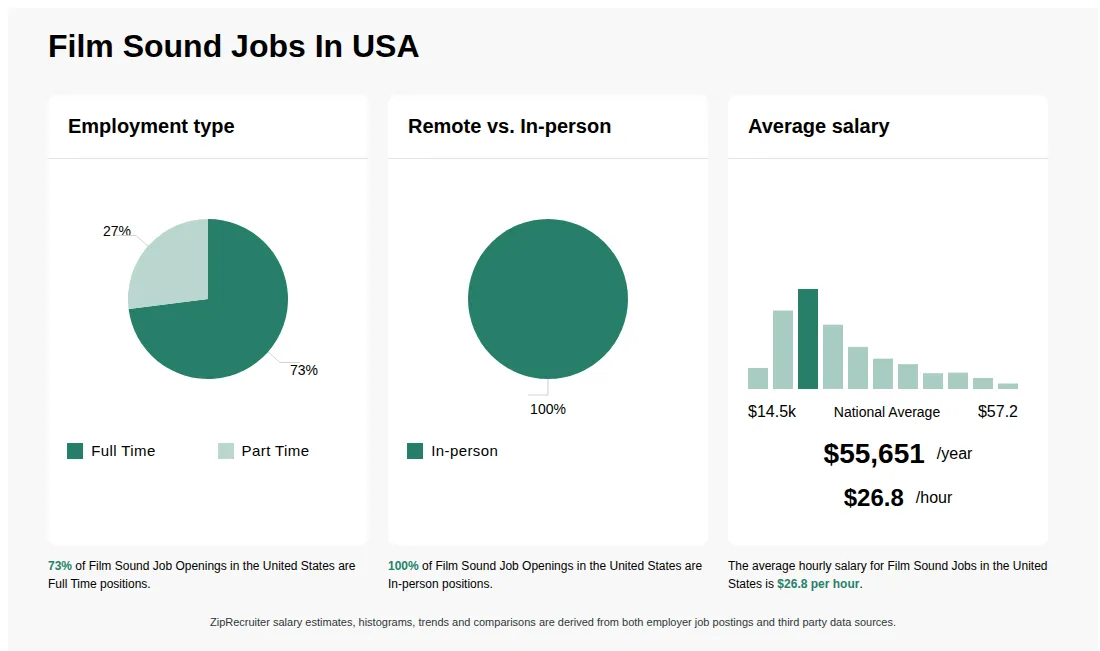
As of Jun 17, 2026, the average hourly pay for film sound in the United States is $26.76, according to ZipRecruiter salary data. Most workers in this role earn between $16.11 and $31.97 per hour, depending on experience, location, and employer.

What are the careers in audio in film?

Careers in audio in film include roles such as sound designer, sound editor, re-recording mixer, boom operator, and production sound mixer. These professionals work with audio recording, editing, and mixing using tools like Pro Tools and often require knowledge of acoustics and sound equipment. They contribute to creating the film's overall soundscape and may work on set or in post-production environments.

How much do film sound designers make?

Film sound designers typically earn between $40,000 and $100,000 annually, depending on experience, project scope, and industry location. Entry-level designers may start lower, while experienced professionals working on major productions can earn higher salaries and additional project-based income.

What are the typical challenges faced by professionals working in Film Sound on set and in post-production?

Professionals in Film Sound often face challenges such as capturing clean audio in noisy or unpredictable environments, syncing sound seamlessly with visuals, and adapting quickly to last-minute script or scene changes. On set, managing environmental factors, handling multiple microphones, and ensuring clear dialogue recording are daily tasks, while in post-production, balancing sound effects, dialogue, and music requires a sharp ear and meticulous attention. Collaboration with directors, editors, and other crew members is crucial to address creative feedback and technical requirements. These challenges make the role dynamic and rewarding for those who enjoy problem-solving and teamwork.


What are the key skills and qualifications needed to thrive in the Film Sound position, and why are they important?

To thrive in Film Sound, a strong background in audio recording, editing, and mixing techniques—often supported by a degree in audio engineering or related field—is essential. Expertise with digital audio workstations (such as Pro Tools), microphones, boom operation, and industry-standard post-production software is typically required, and professional certifications can be advantageous. Attention to detail, creativity, effective communication, and the ability to collaborate with directors and other film crew members set candidates apart. These skills ensure high-quality sound production that enhances storytelling and integrates seamlessly with other elements of a film.

What is the job where you make sounds for film?

A film sound professional, often called a sound designer or sound editor, is responsible for creating, recording, and editing sound effects, dialogue, and ambient noise to enhance the film's audio experience. They use tools like digital audio workstations and may work closely with directors and composers throughout production and post-production.

What is a Film Sound job?

A Film Sound job involves recording, editing, and mixing audio to enhance the overall experience of a movie. Professionals in this field work on dialogue, sound effects, and music to create an immersive soundscape. Key roles include production sound mixers, Foley artists, and sound designers. Their work ensures clear dialogue, realistic ambient sounds, and impactful audio effects that support the film’s story and emotions.

What is a movie sound job called?

A movie sound job is typically called a sound designer or sound editor. These professionals are responsible for creating, recording, and mixing the audio elements of a film, often using tools like Pro Tools and working closely with directors and other post-production staff.
More about Film Sound jobs
What cities are hiring for Film Sound jobs? Cities with the most Film Sound job openings:
What are the most commonly searched types of Film Sound jobs? The most popular types of Film Sound jobs are:
What states have the most Film Sound jobs? States with the most job openings for Film Sound jobs include:
Infographic showing various Film Sound job openings in the United States as of June 2026, with employment types broken down into 17% As Needed, 49% Full Time, 17% Part Time, and 17% Temporary. Highlights an 92% Physical, 1% Hybrid, and 7% Remote job distribution, with an average salary of $55,651 per year, or $26.8 per hour.
Adjunct, Film

Full-time

Retirement

Posted 22 days ago


Salt Lake Community College rating

7.3

Company rating: 7.3 out of 10

Based on 19 frontline employees who took The Breakroom Quiz

309th of 537 rated colleges and universities


Job description

Salary: $1,056.00 Hourly
Location : Various SLCC locations, UT
Job Type: Adjunct Contract
Job Number: 202500234
Division: Academic Affairs
Department: Communication&Performing Arts
Opening Date: 07/30/2025
Closing Date: 7/31/2026 11:59 PM Mountain
FLSA: Exempt
Applicants must be authorized to work in the United States.
All employees are expected to maintain a permanent residence within the State of Utah as a condition of employment. New employees must provide a valid Utah residential address within 30 days of their start date.
Job Summary
This Adjunct Faculty position in the Film Department includes two distinct instructional areas: Film Production and Film Studies. Applicants may be considered for one or both areas based on their qualifications.
Under the general supervision of the Associate Dean, the Adjunct Faculty member will work collaboratively with full-time faculty to support a range of program and course-related responsibilities. These include in-person and/or online instruction, curriculum development, content delivery, and student assessment. The primary teaching responsibilities will involve lower-division courses in introductory film studies and/or film production, depending on the candidate's expertise.
This is a pooled position. The department reviews applications as positions become available.
This position is paid at $1,056 per instructional unit.
Please attach resume or curriculum vitae, copy of transcripts, or other documents for consideration.
1) In accordance with SLCC policy, adjunct positions are offered on a semester-by-semester basis with no guarantee of continued employment.
2) Official transcripts are required for those who are offered employment within in 30 days of hire.
Essential Duties & Responsibilities & Knowledge Skills & Abilities
Film Production
Courses Taught:
  • FLM 1045 Beginning Film Production
  • FLM 1055 Intermediate Film Production
Essential Duties & Responsibilities:
  • Teach in-person courses in beginning and intermediate film production.
  • Instruct students in the use of Blackmagic and Sony cameras, lighting techniques, and grip equipment.
  • Teach post-production using Adobe Premiere Pro and Adobe Audition.
  • Provide timely and constructive feedback on student projects.
  • Maintain accurate attendance and grade records.
  • Foster a safe, respectful, and collaborative classroom environment.
  • Respond to student inquiries within 1-2 days.
  • Participate in department meetings and trainings as needed.
Knowledge, Skills & Abilities:
  • Proficiency in digital filmmaking from pre-production through post.
  • Strong working knowledge of professional camera systems, lighting setups, and audio recording.
  • Ability to teach technical and creative aspects of production in an engaging and accessible way.
  • Familiarity with industry-standard editing and sound software.

Film Studies
Courses Taught:
  • FLM 1023 Introduction to Film
  • FLM 1070 Film & Culture
Essential Duties & Responsibilities:
  • Teach courses in film appreciation, history, and culture in both online and in-person formats.
  • In FLM 1023 Introduction to Film, the instructor will teach foundational concepts in film theory, analysis, history, and criticism. Candidates should have a strong academic background in film studies, along with experience or college coursework in film production, and a working knowledge of screenwriting, cinematography, sound, and editing.
  • In FLM 1070 Film & Culture, explore American cultures through their representations in contemporary cinema, applying critical/theoretical approaches including race, ethnicity, gender identity, sexual identity, class, geography, ability/disability, and generational issues.
  • Lead discussions and lectures on cinematic form, narrative, and cultural context.
  • Evaluate student writing and analytical assignments.
  • Provide timely and constructive feedback.
  • Maintain accurate attendance and grade records.
  • Respond to student inquiries within 1-2 days.
  • Participate in department meetings and trainings as needed.
Knowledge, Skills & Abilities:
  • Graduate-level knowledge of film history, theory, and criticism.
  • Ability to lead engaging discussions and foster critical thinking.
  • Strong writing and analytical skills.
  • Familiarity with diverse cinematic traditions and global cinema.
  • Ability to communicate effectively with a broad range of diverse people, culture, ethnic background, and abilities, to maintain good working relationships across the College
  • Ability to work with all groups in a diverse academic, socioeconomic, cultural and ethnic background of community college students, faculty and staff, including those with disabilities

All Faculty will maintain an on-site campus presence to encourage in-person relationships and create engaging, meaningful, and impactful learning experiences unless approved for on-line only courses.
You are employed as an Adjunct Faculty member/ Instructor on a contract-to-contractbasis, with no future expectation or obligation for employment. Your employment may be terminated At Will at any time.
You are required to maintain professional boundaries with all SLCC students.
Minimum qualifications
Film Production:
  • Bachelor's degree in Film Production, Film, or a closely related filed.
  • Demonstrated experience in commercial or narrative film production.
Film Studies:
  • Master's degree in Film Studies, Film, or a closely related field.

Preferred Qualifications
Film Production:
  • Master's degree in Film Production or a related field.
  • One year of college-level teaching experience.
  • Experience with student-centered instruction and inclusive teaching practices.
Film Studies:
  • One year of college-level teaching experience.
  • Experience in film criticism, scholarship, or cultural analysis.
  • Professional experience in film production is a plus.

SLCC Information
Salt Lake Community College is Utah's largest open-access college in the state. We proudly educate 45,000+ students pursuing degrees in 100+ programs across 8 areas of study, and Utah's fastest growing industries and four-year baccalaureate programs consistently welcome SLCC graduates. Every SLCC employee has a hand in transforming students' lives to strengthen its surrounding communities. SLCC employees work at 8 locations across the valley and capital city of Salt Lake with easy access to the beautiful Wasatch Mountains, world-class outdoor recreation, sporting events, museums, history, and arts and entertainment.
Salt Lake Community College seeks and values contributions from each community member and welcomes new perspectives. A respectful work environment is its top priority; academic excellence and lasting transformation occurs when we can collaborate freely. As an emerging Hispanic Serving Institution, SLCC leads the state with the highest enrollment of students from the Latinx/a/o community. SLCC is committed to serving students and being a model for inclusive and transformative education.
Salt Lake Community College (SLCC) is fully committed to policies of equal employment and nondiscrimination. The College does not discriminate on the basis of race, color, national origin, age, sex, sexual orientation, gender identity, genetic information, disability, religion, protected veteran status, expression of political or personal beliefs outside of the workplace, or any other status protected under applicable federal, state, or local law.
SLCC is a participating employer with Utah Retirement Systems ("URS"). In addition to URS, SLCC offers several other retirement account options.
This position is subject to a successful completion of a criminal background check.
  • More information about Salt Lake Community College benefits:

  • Find our Total Compensation Estimator here:

01
Do you have at least a Bachelor's degree in Film Production, Film, or a closely related field?
  • Yes
  • No

02
Do you have at least a Master's degree in Film Studies, Film, or a closely related field?
  • Yes
  • No

03
Do you have demonstrable experience in commercial or narrative film production?
  • Yes
  • No

Required Question

What Salt Lake Community College employees say

Pay

Hours and flexibility

Workplace

Get the full story on Breakroom