Certified Ethical Hacker or Offensive Security Certified Professional and; * Documented experience in at least one of the following: * Penetration Testing (PENTEST) (government or contractor) * Red ...
Certified Ethical Hacker or Offensive Security Certified Professional and; * Documented experience in at least one of the following: * Penetration Testing (PENTEST) (government or contractor) * Red ...
Certified Ethical Hacker or Offensive Security Certified Professional and; * Documented experience in at least one of the following: * Penetration Testing (PENTEST) (government or contractor) * Red ...
Quick apply
Certified Ethical Hacker or Offensive Security Certified Professional and; * Documented experience in at least one of the following: * Penetration Testing (PENTEST) (government or contractor) * Red ...

Information Security Analyst
Boise, ID · On-site
$75 - $100/hr
Often called ethical hackers or pentesters, they use advanced tools and strategies to test networks ... government. Commonly Used Stages or Job Duties Performed by Information Security Analysts
Information Security Analyst
Boise, ID · On-site
$75 - $100/hr
Often called ethical hackers or pentesters, they use advanced tools and strategies to test networks ... government. Commonly Used Stages or Job Duties Performed by Information Security Analysts

Red Team Penetration Tester
Virginia Beach, VA · On-site +1
Government and DoD systems. You will work collaboratively with Blue Team and Cybersecurity ... Exploit Writing, and Ethical Hacking (GXPN Certification) * SEC642 - Advanced Web App Penetration ...
Red Team Penetration Tester
Virginia Beach, VA · On-site +1
Government and DoD systems. You will work collaboratively with Blue Team and Cybersecurity ... Exploit Writing, and Ethical Hacking (GXPN Certification) * SEC642 - Advanced Web App Penetration ...
Red Team Penetration Tester
King George, VA · On-site +1
Government and DoD systems. You will work collaboratively with Blue Team and Cybersecurity ... Exploit Writing, and Ethical Hacking (GXPN Certification) * SEC642 - Advanced Web App Penetration ...
Red Team Penetration Tester
King George, VA · On-site +1
Government and DoD systems. You will work collaboratively with Blue Team and Cybersecurity ... Exploit Writing, and Ethical Hacking (GXPN Certification) * SEC642 - Advanced Web App Penetration ...
Red Team Penetration Tester
Zacata, VA · On-site
Government and DoD systems. You will work collaboratively with Blue Team and Cybersecurity ... Exploit Writing, and Ethical Hacking (GXPN Certification) * SEC642 - Advanced Web App Penetration ...
Red Team Penetration Tester
Zacata, VA · On-site
Government and DoD systems. You will work collaboratively with Blue Team and Cybersecurity ... Exploit Writing, and Ethical Hacking (GXPN Certification) * SEC642 - Advanced Web App Penetration ...
Government and DoD systems. You will work collaboratively with Blue Team and Cybersecurity ... Exploit Writing, and Ethical Hacking (GXPN Certification) * SEC642 - Advanced Web App Penetration ...
Government and DoD systems. You will work collaboratively with Blue Team and Cybersecurity ... Exploit Writing, and Ethical Hacking (GXPN Certification) * SEC642 - Advanced Web App Penetration ...
Government and DoD systems. You will work collaboratively with Blue Team and Cybersecurity ... Exploit Writing, and Ethical Hacking (GXPN Certification) * SEC642 - Advanced Web App Penetration ...
Government and DoD systems. You will work collaboratively with Blue Team and Cybersecurity ... Exploit Writing, and Ethical Hacking (GXPN Certification) * SEC642 - Advanced Web App Penetration ...
Government and DoD systems. You will work collaboratively with Blue Team and Cybersecurity ... Exploit Writing, and Ethical Hacking (GXPN Certification) * SEC642 - Advanced Web App Penetration ...
Government and DoD systems. You will work collaboratively with Blue Team and Cybersecurity ... Exploit Writing, and Ethical Hacking (GXPN Certification) * SEC642 - Advanced Web App Penetration ...
Government and DoD systems. You will work collaboratively with Blue Team and Cybersecurity ... Exploit Writing, and Ethical Hacking (GXPN Certification) * SEC642 - Advanced Web App Penetration ...
Government and DoD systems. You will work collaboratively with Blue Team and Cybersecurity ... Exploit Writing, and Ethical Hacking (GXPN Certification) * SEC642 - Advanced Web App Penetration ...
Government and DoD systems. You will work collaboratively with Blue Team and Cybersecurity ... Exploit Writing, and Ethical Hacking (GXPN Certification) * SEC642 - Advanced Web App Penetration ...
Government and DoD systems. You will work collaboratively with Blue Team and Cybersecurity ... Exploit Writing, and Ethical Hacking (GXPN Certification) * SEC642 - Advanced Web App Penetration ...
Government and DoD systems. You will work collaboratively with Blue Team and Cybersecurity ... Exploit Writing, and Ethical Hacking (GXPN Certification) * SEC642 - Advanced Web App Penetration ...
Government and DoD systems. You will work collaboratively with Blue Team and Cybersecurity ... Exploit Writing, and Ethical Hacking (GXPN Certification) * SEC642 - Advanced Web App Penetration ...
Red Team Penetration Tester
Zacata, VA · On-site
Government and DoD systems. You will work collaboratively with Blue Team and Cybersecurity ... Exploit Writing, and Ethical Hacking (GXPN Certification) * SEC642 - Advanced Web App Penetration ...
Red Team Penetration Tester
Zacata, VA · On-site
Government and DoD systems. You will work collaboratively with Blue Team and Cybersecurity ... Exploit Writing, and Ethical Hacking (GXPN Certification) * SEC642 - Advanced Web App Penetration ...
Red Team Penetration Tester
Woodford, VA · On-site
Government and DoD systems. You will work collaboratively with Blue Team and Cybersecurity ... Exploit Writing, and Ethical Hacking (GXPN Certification) * SEC642 - Advanced Web App Penetration ...
Red Team Penetration Tester
Woodford, VA · On-site
Government and DoD systems. You will work collaboratively with Blue Team and Cybersecurity ... Exploit Writing, and Ethical Hacking (GXPN Certification) * SEC642 - Advanced Web App Penetration ...
Government and DoD systems. You will work collaboratively with Blue Team and Cybersecurity ... Exploit Writing, and Ethical Hacking (GXPN Certification) * SEC642 - Advanced Web App Penetration ...
Government and DoD systems. You will work collaboratively with Blue Team and Cybersecurity ... Exploit Writing, and Ethical Hacking (GXPN Certification) * SEC642 - Advanced Web App Penetration ...
Government and DoD systems. You will work collaboratively with Blue Team and Cybersecurity ... Exploit Writing, and Ethical Hacking (GXPN Certification) * SEC642 - Advanced Web App Penetration ...
Government and DoD systems. You will work collaboratively with Blue Team and Cybersecurity ... Exploit Writing, and Ethical Hacking (GXPN Certification) * SEC642 - Advanced Web App Penetration ...
Red Team Penetration Tester
Issue, MD · On-site
Government and DoD systems. You will work collaboratively with Blue Team and Cybersecurity ... Exploit Writing, and Ethical Hacking (GXPN Certification) * SEC642 - Advanced Web App Penetration ...
Red Team Penetration Tester
Issue, MD · On-site
Government and DoD systems. You will work collaboratively with Blue Team and Cybersecurity ... Exploit Writing, and Ethical Hacking (GXPN Certification) * SEC642 - Advanced Web App Penetration ...
Government and DoD systems. You will work collaboratively with Blue Team and Cybersecurity ... Exploit Writing, and Ethical Hacking (GXPN Certification) * SEC642 - Advanced Web App Penetration ...
Government and DoD systems. You will work collaboratively with Blue Team and Cybersecurity ... Exploit Writing, and Ethical Hacking (GXPN Certification) * SEC642 - Advanced Web App Penetration ...
Government and DoD systems. You will work collaboratively with Blue Team and Cybersecurity ... Exploit Writing, and Ethical Hacking (GXPN Certification) * SEC642 - Advanced Web App Penetration ...
Government and DoD systems. You will work collaboratively with Blue Team and Cybersecurity ... Exploit Writing, and Ethical Hacking (GXPN Certification) * SEC642 - Advanced Web App Penetration ...
Government and DoD systems. You will work collaboratively with Blue Team and Cybersecurity ... Exploit Writing, and Ethical Hacking (GXPN Certification) * SEC642 - Advanced Web App Penetration ...
Government and DoD systems. You will work collaboratively with Blue Team and Cybersecurity ... Exploit Writing, and Ethical Hacking (GXPN Certification) * SEC642 - Advanced Web App Penetration ...
Ethical Hacking Government information
See salary details
$24.5K - $36.5K
6% of jobs
$36.5K - $48.5K
8% of jobs
$48.5K - $60.5K
9% of jobs
$67.3K is the 25th percentile. Wages below this are outliers.
$60.5K - $72.5K
4% of jobs
$72.5K - $84.5K
3% of jobs
$84.5K - $96.5K
5% of jobs
$96.5K - $108.5K
13% of jobs
The median wage is $109.8K / yr.
$108.5K - $120.5K
15% of jobs
$128.6K is the 75th percentile. Wages above this are outliers.
$120.5K - $132.5K
17% of jobs
$132.5K - $144.5K
15% of jobs
$144.5K - $156.5K
4% of jobs
$24.5K
$101.9K
$156.5K
How much do ethical hacking government jobs pay per year?
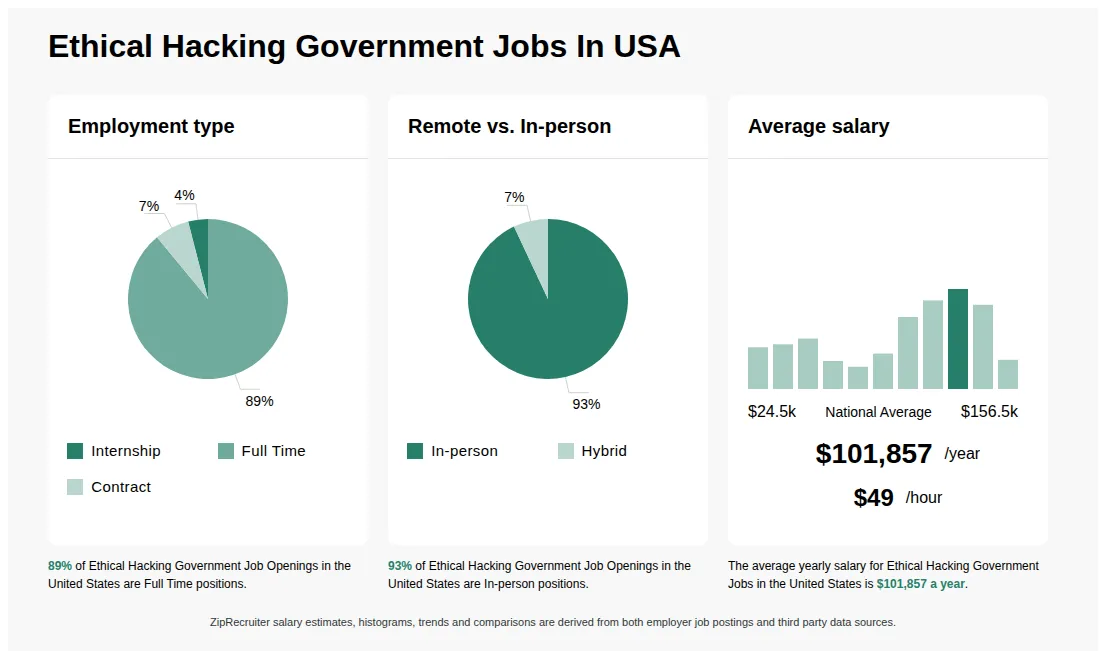
As of Sep 5, 2026, the average yearly pay for ethical hacking government in the United States is $101,857.00, according to ZipRecruiter salary data. Most workers in this role earn between $66,000.00 and $130,500.00 per year, depending on experience, location, and employer.
What is an ethical hacking government?
An Ethical Hacking Government job involves assessing and securing government systems, networks, and data by identifying vulnerabilities before malicious hackers can exploit them. Ethical hackers, also known as penetration testers or security analysts, use authorized hacking techniques to test cybersecurity defenses. These professionals work for government agencies to protect sensitive information, maintain national security, and ensure compliance with cybersecurity regulations. They may also assist in cybercrime investigations and develop strategies to strengthen digital infrastructure.
What does an ethical hacking government professional do?
As an Ethical Hacking Government professional, your daily responsibilities often include conducting penetration tests, analyzing system vulnerabilities, preparing security assessment reports, and collaborating with IT and security teams to address identified risks. You may also review new technologies or software for potential weaknesses and help develop strategies to secure government networks. Frequent communication with stakeholders and educational sessions for staff on cybersecurity best practices are also common. The work environment is typically fast-paced and highly collaborative, with a strong focus on maintaining confidentiality and adhering to strict government protocols.
What skills and qualifications are needed for an ethical hacking government position?
To thrive as an Ethical Hacking Government professional, you need expertise in network security, vulnerability assessment, penetration testing, and an in-depth understanding of government regulations, typically supported by a degree in computer science or related fields. Proficiency with tools like Metasploit, Nmap, Burp Suite, Wireshark, and certifications such as CEH, OSCP, or CISSP are highly valued. Strong analytical thinking, discretion, effective communication, and teamwork skills help you collaborate securely within government teams and present findings clearly. These skills ensure you can identify and mitigate security threats while adhering to strict compliance requirements vital to protecting sensitive government data and infrastructure.
Do ethical hackers work for the government?
Ethical hackers, including those working in government roles, are employed by government agencies to identify and fix security vulnerabilities in their systems. They often hold certifications like CEH or OSCP and may work in environments requiring strict confidentiality and adherence to security protocols.
What is the salary of government ethical hackers?
Government ethical hackers typically earn between $60,000 and $120,000 annually, depending on experience, location, and level of security clearance. Senior professionals with specialized skills and certifications can earn higher salaries, often exceeding $130,000. Salaries may also include benefits such as health insurance and retirement plans.
More about Ethical Hacking Government jobs
What cities are hiring for Ethical Hacking Government jobs?
Cities with the most Ethical Hacking Government job openings:
What states have the most Ethical Hacking Government jobs?
States with the most job openings for Ethical Hacking Government jobs include:
What job categories do people searching Ethical Hacking Government jobs look for?
The top searched job categories for Ethical Hacking Government jobs are:

Security Software Engineer - Red Team Penetra with Security Clearance
Arlington, VA • On-site
Other
Medical, Dental, Vision, Retirement
Re-posted 14 hours ago
Job description
This position requires U.S. citizenship and an active U.S. DoD clearance . Candidates who are not U.S. citizens are not eligible for this role. Imagine One Technology & Management, Ltd. is seeking one (1) Security Software Engineer. This position is contingent upon award of the associated work and will be performed in Dahlgren, Virginia. The Security Software Engineer will be expected to: * Debug and reverse engineer software. * Analyze Windows Events and Linux syslog's, boot logs and dmesg logs. * Program and debug Web 2.0, Java, Perl, Ada, C++, Tool Command Language (tcl/tk) scripts and graphical user interfaces (GUis) using Microsoft Visual tel and Rational ClearCase for software configuration management. * Recommend software modifications to systems to mitigate known vulnerabilities. * Operate and administrate computer systems running HP-UX, UNIX, Solaris, Linux and Microsoft Windows. * Identify security flaws in compiled and human readable source code. * Understand code utilizing real-time VxWorks and Lynx OS operating systems, Common Object Resource Broker Architecture (CORBA), firewalls and networking protocols. * Understand how to implement NSA approved encryption technologies and devices. * Apply DISA Security Technical Implementation Guides (STIGs).
* Apply virtual hosting and server technology in system architectures. * Understand and apply the concept of deceptive technology such as honey pots in system architectures. * Participate in Code Reviews. Perform Static Source Code Analysis. Author recommendations for improving software and code design. * Contribute to a System Security Administrator and Operators Manual (SSAOM). Desired Experience: * Five (5) years of experience in software engineering applied to program development; modeling and simulation applied to DoD or Information Technology systems.
* Five (5) Years experience in: * Linux - firm grasp/demonstrated knowledge
* Associated Training: COMPTIA Linux+ or FedVTE Linux+ * Five (5) Years experience in: * Windows - foundational knowledge with good understanding of enterprise networks
* Associated Training: Microsoft course (MCSA; Various) * Strong working knowledge of common Penetration Testing (PENTEST) tools: * Kali, Metasploit, NMAP, Cobalt Strike * Associated Training: Certified Ethical Hacker or Offensive Security Certified Professional and;
* Documented experience in at least one of the following: * Penetration Testing (PENTEST) (government or contractor)
* Red Team Operations (government or contractor)
* Tool/Software Development (exploits/malware, C2, reverse engineering, bug bounties)
* Python, C, C Sharp, C++, Go, Perl, Powershell
* Web Dev/Web App Dev/Web Penetration testing * PHP, ASP, SQL db's, Java, HTML, No SQL [VW1] Educational Requirements: * Minimum certification as IAT Level II per DoD 8570.01, or successor.
* Minimum certification as penetration tester and possess one of the following certificates: * Offensive Security Certs: Offensive Security Certified Professional (OSCP), Offensive Security Certified Expert (OSCE), Offensive Security Exploitation Expert (OSEE), Offensive Security Wireless Professional (OSWP)
* SANS Certs: SEC560 - Network Penetration testing and Ethical Hacking (GPEN Certification), SEC542 - Web App Penetration Testing and Ethical Hacking (GWAPT Certification), SEC660 - Advance Penetration Testing. Exploit Writing, and Ethical Hacking (GXPN Certification), SEC642 - Advanced Web App Penetration Testing and Ethical Hacking, SEC564 - Red Team Operations and Threat Emulation
* OSD Sponsored Cyber Operation Academy Course (COAC) graduates. * Bachelor's degree desired Security Requirements: * Active DoD Top Secret clearance required Imagine One Technology & Management, Ltd., offers a full package of benefits and competitive salary, excellent group medical, vision, and dental programs. 401K savings plan; $4K annual tuition reimbursement ($5K if pursuing master's degree); employee training, development, and education programs; profit sharing; advancement opportunities; and much more! ISO 9001:2015, ISO 20000-1:2018, ISO 27001:2013 CMMI Development and Services - Maturity Level 3 An Employee-Owned Business EEO/Veterans/Disabled
* Apply virtual hosting and server technology in system architectures. * Understand and apply the concept of deceptive technology such as honey pots in system architectures. * Participate in Code Reviews. Perform Static Source Code Analysis. Author recommendations for improving software and code design. * Contribute to a System Security Administrator and Operators Manual (SSAOM). Desired Experience: * Five (5) years of experience in software engineering applied to program development; modeling and simulation applied to DoD or Information Technology systems.
* Five (5) Years experience in: * Linux - firm grasp/demonstrated knowledge
* Associated Training: COMPTIA Linux+ or FedVTE Linux+ * Five (5) Years experience in: * Windows - foundational knowledge with good understanding of enterprise networks
* Associated Training: Microsoft course (MCSA; Various) * Strong working knowledge of common Penetration Testing (PENTEST) tools: * Kali, Metasploit, NMAP, Cobalt Strike * Associated Training: Certified Ethical Hacker or Offensive Security Certified Professional and;
* Documented experience in at least one of the following: * Penetration Testing (PENTEST) (government or contractor)
* Red Team Operations (government or contractor)
* Tool/Software Development (exploits/malware, C2, reverse engineering, bug bounties)
* Python, C, C Sharp, C++, Go, Perl, Powershell
* Web Dev/Web App Dev/Web Penetration testing * PHP, ASP, SQL db's, Java, HTML, No SQL [VW1] Educational Requirements: * Minimum certification as IAT Level II per DoD 8570.01, or successor.
* Minimum certification as penetration tester and possess one of the following certificates: * Offensive Security Certs: Offensive Security Certified Professional (OSCP), Offensive Security Certified Expert (OSCE), Offensive Security Exploitation Expert (OSEE), Offensive Security Wireless Professional (OSWP)
* SANS Certs: SEC560 - Network Penetration testing and Ethical Hacking (GPEN Certification), SEC542 - Web App Penetration Testing and Ethical Hacking (GWAPT Certification), SEC660 - Advance Penetration Testing. Exploit Writing, and Ethical Hacking (GXPN Certification), SEC642 - Advanced Web App Penetration Testing and Ethical Hacking, SEC564 - Red Team Operations and Threat Emulation
* OSD Sponsored Cyber Operation Academy Course (COAC) graduates. * Bachelor's degree desired Security Requirements: * Active DoD Top Secret clearance required Imagine One Technology & Management, Ltd., offers a full package of benefits and competitive salary, excellent group medical, vision, and dental programs. 401K savings plan; $4K annual tuition reimbursement ($5K if pursuing master's degree); employee training, development, and education programs; profit sharing; advancement opportunities; and much more! ISO 9001:2015, ISO 20000-1:2018, ISO 27001:2013 CMMI Development and Services - Maturity Level 3 An Employee-Owned Business EEO/Veterans/Disabled

About Imagine One Technology & Management
Sourced by ZipRecruiter
Company size
201 - 500 Employees
Headquarters location
Lexington Park, MD, US
Year founded
1998