1

Epic Application Coordinator Jobs (NOW HIRING)

Epic Application Coordinator Location: San Jose, CA - Hybrid (2 days on site) Contract Duration: 10 months initially Background: Our client requires Epic Application Coordinator resources for the ...

next page

Showing results 1-20

Epic Application Coordinator information

See salary details

$72K

$132.9K

$248K

How much do epic application coordinator jobs pay per year?

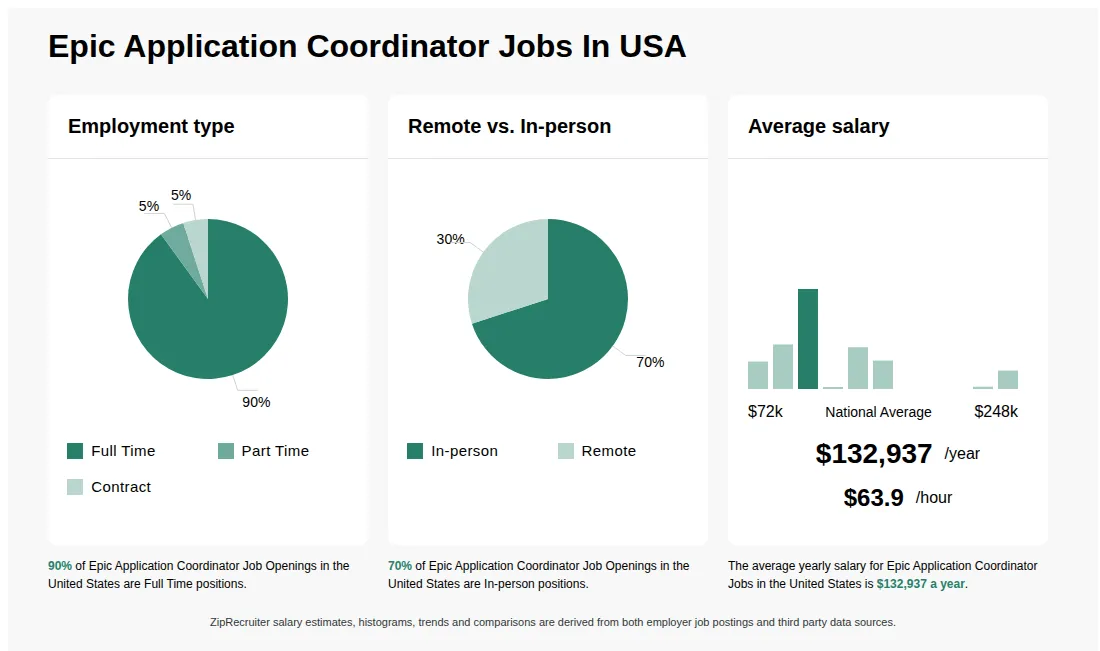
As of Jul 6, 2026, the average yearly pay for epic application coordinator in the United States is $132,937.00, according to ZipRecruiter salary data. Most workers in this role earn between $103,500.00 and $150,000.00 per year, depending on experience, location, and employer.

What is the difference between Epic Application Coordinator vs Epic Analyst?

AspectEpic Application CoordinatorEpic Analyst
CredentialsEpic certifications, healthcare IT experienceEpic certifications, healthcare IT experience
Work EnvironmentHospitals, clinics, healthcare organizationsHospitals, clinics, healthcare organizations
Employer & IndustryHealthcare providers using Epic systemsHealthcare providers using Epic systems
Primary FocusImplementing, configuring, and supporting Epic applicationsAnalyzing, optimizing, and troubleshooting Epic systems

The Epic Application Coordinator and Epic Analyst roles both require Epic certifications and healthcare IT experience, often working within similar healthcare environments. The Coordinator primarily focuses on implementing and supporting Epic applications, while the Analyst concentrates on analyzing and optimizing Epic system performance. Both roles are essential in healthcare IT teams using Epic systems, but their core responsibilities differ slightly.

What is an Epic Application Coordinator?

An Epic Application Coordinator is a specialized healthcare IT professional responsible for implementing, configuring, and maintaining Epic electronic health record (EHR) systems within a healthcare organization. They serve as a bridge between clinical staff and IT, ensuring the Epic system supports clinical workflows and complies with healthcare regulations. Their duties often include project management, system customization, user training, troubleshooting, and ongoing optimization of the Epic system. Epic Application Coordinators play a crucial role in ensuring smooth EHR operations and improving patient care through technology.

What are some common challenges faced by Epic Application Coordinators during system upgrades?

Epic Application Coordinators often encounter challenges during system upgrades, such as ensuring seamless communication between clinical staff, IT teams, and vendors. Coordinators must meticulously manage timelines, test new features, and address integration issues to prevent disruptions to patient care. Proactive planning, detailed documentation, and collaboration with end users are crucial for a successful upgrade and smooth transition.

What are the key skills and qualifications needed to thrive as an Epic Application Coordinator, and why are they important?

To thrive as an Epic Application Coordinator, you need expertise in healthcare workflows, strong analytical skills, and typically a bachelor’s degree in a related field, along with Epic certification. Familiarity with Epic modules, electronic health records (EHR) systems, and project management tools is essential. Excellent communication, problem-solving, and teamwork skills are crucial for collaborating with clinical staff and IT professionals. These competencies are vital for ensuring effective implementation, optimization, and support of Epic systems within healthcare organizations.

What Does an Epic Application Coordinator Do?

The Epic application is a suite of software solutions designed for healthcare professionals. As an Epic application coordinator, your duties and responsibilities differ depending on the type of software solutions you are working on and the department in which you work. Typically, you work with clinical and medical staff to design and build software, such as a new training module, patient record configuration, or communication system between departments, or for end users or patients to more readily access information about their care.

What cities are hiring for Epic Application Coordinator jobs? Cities with the most Epic Application Coordinator job openings:
Who are the top companies hiring for Epic Application Coordinator jobs? The top employers for Epic Application Coordinator jobs are:
What states have the most Epic Application Coordinator jobs? States with the most job openings for Epic Application Coordinator jobs include:
Infographic showing various Epic Application Coordinator job openings in the United States as of June 2026, with employment types broken down into 75% Full Time, 19% Part Time, and 6% Contract. Highlights an 96% Physical, 1% Hybrid, and 3% Remote job distribution, with an average salary of $132,937 per year, or $63.9 per hour.
Epic Application Coordinator

Epic Application Coordinator

TriOptus LLC

San Jose, CA • On-site

Full-time

Medical

Posted 3 days ago


Job description

Position Title: Epic Application Coordinator
Location: San Jose, CA - Hybrid (2 days on site)
Contract Duration: 10 months initially
Background:
Our client requires Epic Application Coordinator resources for the stabilization and support of the newly implemented Epic platform.
Tapestry Platform Implementation: Client has implemented a new Epic Tapestry platform to consolidate the management of key business functions. This application portfolio includes membership and enrollment functions, utilization management / treatment authorizations referrals, case management, population health, and claims / capitation processing and payment operations.
Key Responsibilities: Resources will provide direct Epic application support and Epic software development lifecycle
for the design, development, monitoring, testing, updating, integration, and maintenance of system stabilization. Resources will analyze user, system, and application needs and will evaluate approaches to determine the best solution to meet business needs via performance of the defined itemization of responsibilities above and below.
Typical Tasks:
  • Analyzing of workflows, data collection engines, and reporting details.
  • Recommending process improvements and enhancements for better operational performance and implementing those recommendations within the Epic system.
  • Serving as a liaison between end users' workflow needs and Epic assigned implementation staff.
  • Maintaining regular communication with Epic representatives, including participating in weekly project team meetings.
  • Working with Epic representatives, your organization's business community, and end users to ensure the system meets the organization's business needs regarding the project deliverables and timelines.
  • Ensuring interoperability between Epic applications and other supporting applications.

Required Skills & Abilities:
  • Experience: A minimum of 1 year of application support/build/configuration and/or related business/operational analyst experience in a health plan or health care setting.

Desirable Qualifications:
  • Experience or knowledge in the following areas is desired.
  • Experience in business analysis and project management.
  • Knowledge of healthcare and health insurance regulatory standards.
  • Epic implementation experience specifically at a health plan.
  • Understanding relationships of providers and their processes in the healthcare continuum (primary care, specialists, lab ordering, surgery).
  • Familiarity with case management workflows and wellness programs. Familiarity with or background in quality reporting initiatives such as PQRS, ACOs/MSSP, and MU.
  • Familiarity with health plan concepts and workflows.
  • Understanding of operations within the AP Claims department, including claim intake, review, and payment.
  • Familiarity with integration points with other areas of business, such as eligibility, authorizations, and internal claims.
  • Familiarity with the benefit structures of plans.
  • Familiarity with the use of care plans to coordinate care for members/patients.
  • Familiarity with managed care contracting.
  • Understanding of treatment authorization polices/processes that affect approvals or denials and the concepts of treatment referrals and the processes followed.