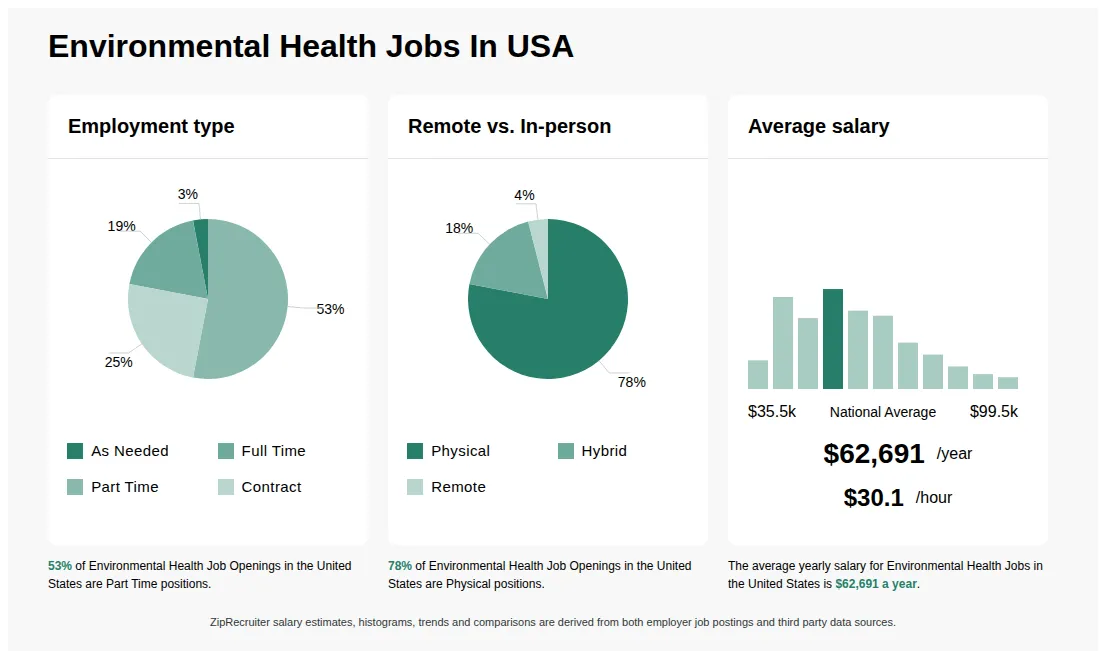
Salary: $55,613.00 - $63,517.00 Annually
Location : Towson, MD
Job Type: MERIT
Job Number: 04.311 06-26
Department: HHS/COMMUNICABLE DISEASE AND ENVIRONMENTAL HEALTH
Opening Date: 06/09/2026
Closing Date: Continuous
Pay Schedule I, Grade 28, Regular Schedule: 35 hours per week.
Several Merit vacancies exist in the Bureau of Animal Services, Communicable Disease, and Environmental Health Services, Department of Health and Human Services.
A list of eligible applicants will be established based on the examination as outlined below.
Current and future vacancies occurring within this class may be filled from the list of eligible applicants.
All interested candidates must apply at this time.
List all
promotions and changes in job duties due to
reclassification as separate work experience on your application. Applicants must include the dates of the promotions and reclassifications.
NOTE: Failure to complete all fields of the "Work Experience" section of the application will result in your application not being considered. A resume will not be considered in determining your qualifications for a position. Applicants selected for an interview may provide a resume at that time.
You
must attach your transcript(s)/degree(s) and professional license(s)/certification(s) to your application. Unofficial copies are acceptable.
Failure to submit proof of professional Licenses, Certifications and Educationwill result in your application not being considered. Proof of licenses, certifications, and/or education
must be submitted with each application.
Examples of Duties
Job Purpose
Under close supervision, performs professional environmental and public health sanitation work and ensures compliance with Federal, State, and local laws and regulations.
Essential Job Duties
- Inspects restaurants, retail grocery stores, taverns, bakeries, and other retail food service facilities.
- Investigates community hygiene violations.
- Inspects all facilities such as nurseries, kindergartens, hospitals, health care and convalescent homes.
- Collects samples from food service facilities, public bathing beaches, public swimming pools, estuaries, rivers, streams and groundwater to ensure protection of public health and compliance with Federal, State, and local environmental regulations.
- Conducts sanitary surveys of transient noncommunity water systems.
Examples of Other Duties
- Performs inspections of facilities and writes detailed reports in accordance with federal, state, and local laws and regulations.
- Investigates and prepares reports on complaints involving environmental health issues.
- Operates sampling and/or monitoring devices.
- Performs other related duties as required.
NOTE: The duties and responsibilities listed above are for the purpose of determining a common set of minimum qualifications for all positions in this class. They may not include all of the essential job functions of each position in the class. Each position may not be required to perform all of the essential job functions listed.
Qualifications
Graduation from an accredited college or university with a bachelor's degree in one of the physical, environmental health or biological sciences, engineering, or agriculture.
Plus
Current registration as a Licensed Environmental Health Specialist (LEHS) in the State of Maryland or possession a Certificate of Eligibility for registration.
Knowledge, Skills, and Abilities (Entry Level)
- Knowledge of the physical, biological, and environmental health sciences.
- Knowledge of epidemiology.
- Basic knowledge of natural resources and environmental protection principles.
- Basic knowledge of inspection procedures.
- Basic computer and software skills.
- Ability to enforce codes and regulations.
- Ability to conduct field investigations.
- Ability to operate sampling and/or monitoring equipment.
- Ability to resolve problems.
- Ability to deal tactfully with the public.
- Ability to communicate effectively both orally and in writing.
Knowledge, Skills, and Abilities (Full Performance)
- Basic knowledge of Federal, State and local environmental laws and regulations.
- Basic knowledge of the principles and objectives of environmental health and sanitation programs.
- Knowledge of sampling techniques.
- Skill in operating sampling and/or monitoring equipment.
- Skill in conducting field investigations and inspections.
- Ability to promote community understanding and support for environmental health programs.
Licenses and Certificates
Possession of a valid license to legally operate any class of vehicle or equipment necessary to perform the duties of the position is required at the time of appointment.
Current registration as a Professional Environmental Health Specialist in the State of Maryland or possession of a Certificate of Eligibility for such registration is required at the time of application.
Proof of Licenses, Certifications and Education
Applicants are required to submit proof of licenses, certifications and education beyond high school to meet the required and preferred qualifications of the position. Diplomas or transcripts must show the applicant's major field of study. Copies and unofficial transcripts are acceptable. Proof of licenses, certifications, and/or education must be submitted with each application.
Proof of Degree Equivalency
Applicants who have obtained a degree from outside the United States of America are required to submit degree equivalence documentation from World Education Services, Inc. ()
Mail or deliver documents to:
ATTN: Environmental Health Specialist I
Office of Human Resources
Baltimore County Government
308 Allegheny Ave.
Towson, MD 21204
You
must attach your transcript(s)/degree(s) and professional license(s)/certification(s) to your application. Unofficial copies are acceptable.
EXAMINATION PROCEDURE
Applicants will be qualified based on an evaluation of their training and experience, as stated on their application, which includes answers to the supplemental questions. Applicants must state the dates and duties of past and present experience clearly and completely for evaluation purposes.
Conditions of Employment
Employees must maintain required licenses and certifications throughout the course of employment.
Physical and Environmental Conditions
The work of these positions requires some physical activity such as walking, bending, stooping and carrying of moderately heavy objects. Field investigations may involve exposure to inclement weather.
Medical Examination and Employment Background InvestigationApplicants selected for employment with Baltimore County must successfully complete a physical examination, drug screening and employment investigation, including, but not limited to criminal background, education certification and fingerprinting checks.
Employment Benefits for Full-Time, Merit or Classified Employees
Baltimore County General Government offers the following benefits to full-time,merit or classified employees. Some benefits vary for sworn employees of the Police and Fire Departments. New employees are eligible for benefits upon hire, unless noted otherwise.
Equal Opportunity Employer
Baltimore County is an equal opportunity employer and encourages minority, female and disabled applicants.
Smoke free workplace
All Baltimore County offices are smoke free.
Drug free workplace
Baltimore County provides a drug free workplace. Prospective employees are required to submit to urinalysis drug testing as part of the pre-employment physical examination.
Salary
Annual Salary review - Step increases may be granted on anniversary date based on satisfactory job performance
General Increases - Cost of living increases and adjustments may be granted as legislated.
Longevity Increases - In accordance with the specific pay schedule, a full-time merit or classified employee may receive a longevity increase, equivalent to one step, upon completion of a certain number of years of classified service with the County.
Employee Assistance Program
Our Employee Assistance Program provides confidential and professional assessment and referral assistance for employees and eligible dependents in the household who are experiencing personal problems that may be affecting work performance, job satisfaction, or overall quality of life.
Health Insurance
Health Insurance benefits elected become effective the first day of the month following the date of hire if the employee has completed online enrollment prior to that date. New employees must enroll within thirty (30) calendar days of hire. Plans offered include:
Medical, Prescription, Dental and Vision insurance.
Flexible Spending Accounts
Opportunity to set aside pre-tax dollars, through payroll deduction, for eligible unreimbursed medical care expenses and/or dependent care costs.
Life Insurance
Employees may elect basic term life insurance for themselves equal to one time the employee's annual salary, rounded to the next higher $1,000. Employees contribute a portion of the premium through monthly payroll deductions. The County also offers an Additional/Employee paid Life Insurance plan with coverage up to $100,000.
Retirement
Employees are required to participate in the Baltimore County Employees' Retirement System (ERS), with very limited exceptions.
Paid Leave
Paid benefits listed below vary depending upon the Classification.
Sick Leave
Vacation Leave
Personal Leave
Holidays
Bereavement Leave
Jury Leave
Military Leave
Baltimore County Employees Federal Credit Union
Membership in Baltimore County Employees Federal Credit Union offers a full range of savings programs, loans, checking, direct deposit, payroll deduction, savings bonds, and other financial services.
Direct Deposit
Payroll through direct deposit to the financial institution selected by employee is required.
Educational Assistance
70 to 80 percent tuition reimbursement following successful completion of pre-approved courses related to position. Amount of reimbursement and fiscal year dollar limitations vary with bargaining group.
Deferred Compensation
Nationwide Retirement Solutions offers a 457 retirement plan allowing for payroll contributions of tax deferred dollars to investment options of your choice.
Disclaimer
This is only a summary of benefits and policies in Baltimore County. Any benefit or policy may be changed at any time at the discretion of the administration. This summary does not constitute an express or implied contract, nor does it constitute a guarantee that your employment relationship will continue for any specified period of time or end only under certain conditions.
01
The purpose of the supplemental questions listed below is to further evaluate your experience and education to determine your eligibility for this job classification. Answer each question accurately and thoroughly. To be considered for this position, the experience you indicate in your responses to the supplemental questions must also be described, in detail, on the
Work History section of this application. Questions with text answers require you to include the name of the employer/organization and dates of the specific experience.
- I have read and acknowledge the above instructions.
02
Failure to complete all fields of the "Work Experience" section of the application will result in your application not being considered.
A resume will not be considered in determining your qualifications for this position. Applicants selected for an interview may provide a resume at that time.
- I have read and acknowledge the above statement.
03
Which of the following best describes your combination of education and experience?
- Master's degree in one of the physical, environmental health, or biological sciences, engineering or agriculture; plus registration as a Professional Environmental Health Specialist in the State of Maryland.
- Bachelor's degree in one of the physical, environmental health, or biological sciences, engineering or agriculture; plus registration as a Professional Environmental Health Specialist in the State of Maryland.
- I do not meet the minimum qualifications for this position.
04
Do you have current registration as a Professional Environmental Health Specialist in the State of Maryland?
05
Do you have a Certificate of Eligibility for registration as an Environmental Health Specialist in the State of Maryland?
THIS REGISTRATION IS REQUIRED AT THE TIME OF APPLICATION.
06
I have attached proof of my Certificate of Eligibility for registration as an Environmental Health Specialist in the State of Maryland.
- I have read and agree to the above instructions.
07
Select your level of experience with Microsoft Office.
- Five (5) or more years of experience with Microsoft Office.
- At least three (3) years of experience but less than five (5) years of experience.
- At least one (