You will act as an entry-level professional with theoretical knowledge of RF or EO/IR signal processing to support development, execution, and completion of difficult and potentially complex program ...
You will act as an entry-level professional with theoretical knowledge of RF or EO/IR signal processing to support development, execution, and completion of difficult and potentially complex program ...
You will act as an entry-level professional with theoretical knowledge of RF or EO/IR signal processing to support development, execution, and completion of difficult and potentially complex program ...
You will act as an entry-level professional with theoretical knowledge of RF or EO/IR signal processing to support development, execution, and completion of difficult and potentially complex program ...
You will act as an entry-level professional with theoretical knowledge of RF or EO/IR signal processing to support development, execution, and completion of difficult and potentially complex program ...
You will act as an entry-level professional with theoretical knowledge of RF or EO/IR signal processing to support development, execution, and completion of difficult and potentially complex program ...
You will act as an entry-level professional with theoretical knowledge of RF or EO/IR signal processing to support development, execution, and completion of difficult and potentially complex program ...
You will act as an entry-level professional with theoretical knowledge of RF or EO/IR signal processing to support development, execution, and completion of difficult and potentially complex program ...
You will act as an entry-level professional with theoretical knowledge of RF or EO/IR signal processing to support development, execution, and completion of difficult and potentially complex program ...
You will act as an entry-level professional with theoretical knowledge of RF or EO/IR signal processing to support development, execution, and completion of difficult and potentially complex program ...
You will act as an entry-level professional with theoretical knowledge of RF or EO/IR signal processing to support development, execution, and completion of difficult and potentially complex program ...
You will act as an entry-level professional with theoretical knowledge of RF or EO/IR signal processing to support development, execution, and completion of difficult and potentially complex program ...
You will act as an entry-level professional with theoretical knowledge of RF or EO/IR signal processing to support development, execution, and completion of difficult and potentially complex program ...
You will act as an entry-level professional with theoretical knowledge of RF or EO/IR signal processing to support development, execution, and completion of difficult and potentially complex program ...
You will act as an entry-level professional with theoretical knowledge of RF or EO/IR signal processing to support development, execution, and completion of difficult and potentially complex program ...
You will act as an entry-level professional with theoretical knowledge of RF or EO/IR signal processing to support development, execution, and completion of difficult and potentially complex program ...
You will act as an entry-level professional with theoretical knowledge of RF or EO/IR signal processing to support development, execution, and completion of difficult and potentially complex program ...
You will act as an entry-level professional with theoretical knowledge of RF or EO/IR signal processing to support development, execution, and completion of difficult and potentially complex program ...
You will act as an entry-level professional with theoretical knowledge of RF or EO/IR signal processing to support development, execution, and completion of difficult and potentially complex program ...
You will act as an entry-level professional with theoretical knowledge of RF or EO/IR signal processing to support development, execution, and completion of difficult and potentially complex program ...
You will act as an entry-level professional with theoretical knowledge of RF or EO/IR signal processing to support development, execution, and completion of difficult and potentially complex program ...
You will act as an entry-level professional with theoretical knowledge of RF or EO/IR signal processing to support development, execution, and completion of difficult and potentially complex program ...
You will act as an entry-level professional with theoretical knowledge of RF or EO/IR signal processing to support development, execution, and completion of difficult and potentially complex program ...
You will act as an entry-level professional with theoretical knowledge of RF or EO/IR signal processing to support development, execution, and completion of difficult and potentially complex program ...
You will act as an entry-level professional with theoretical knowledge of RF or EO/IR signal processing to support development, execution, and completion of difficult and potentially complex program ...
You will act as an entry-level professional with theoretical knowledge of RF or EO/IR signal processing to support development, execution, and completion of difficult and potentially complex program ...
You will act as an entry-level professional with theoretical knowledge of RF or EO/IR signal processing to support development, execution, and completion of difficult and potentially complex program ...
You will act as an entry-level professional with theoretical knowledge of RF or EO/IR signal processing to support development, execution, and completion of difficult and potentially complex program ...
You will act as an entry-level professional with theoretical knowledge of RF or EO/IR signal processing to support development, execution, and completion of difficult and potentially complex program ...
You will act as an entry-level professional with theoretical knowledge of RF or EO/IR signal processing to support development, execution, and completion of difficult and potentially complex program ...
You will act as an entry-level professional with theoretical knowledge of RF or EO/IR signal processing to support development, execution, and completion of difficult and potentially complex program ...
You will act as an entry-level professional with theoretical knowledge of RF or EO/IR signal processing to support development, execution, and completion of difficult and potentially complex program ...

Signal Integrity Engineer (Entry level)
Lisle, IL · On-site
$85K - $100K/yr
Your Job Molex is seeking an enthusiastic and motivated Entry level Signal Integrity Engineer to ... Basic programming or scripting skills for automating analysis processes This position does not ...
Signal Integrity Engineer (Entry level)
Lisle, IL · On-site
$85K - $100K/yr
Your Job Molex is seeking an enthusiastic and motivated Entry level Signal Integrity Engineer to ... Basic programming or scripting skills for automating analysis processes This position does not ...

Entry-Level Satellite Systems Engineer: RF, Digital Optical
El Segundo, CA · On-site
$79.05 - $106.95/hr
The Boeing Company is seeking an Entry-level System Engineer to join the Space and Launch ... optical communication systems, verifying signal processing architectures, and supporting ...
Entry-Level Satellite Systems Engineer: RF, Digital Optical
El Segundo, CA · On-site
$79.05 - $106.95/hr
The Boeing Company is seeking an Entry-level System Engineer to join the Space and Launch ... optical communication systems, verifying signal processing architectures, and supporting ...

Algorithm development includes- detection processes, waveform selection, signal processing, clutter and EA mitigation, adaptive beamforming, target identification, etc. RF hardware includes ...
Algorithm development includes- detection processes, waveform selection, signal processing, clutter and EA mitigation, adaptive beamforming, target identification, etc. RF hardware includes ...
Algorithm development includes- detection processes, waveform selection, signal processing, clutter and EA mitigation, adaptive beamforming, target identification, etc. RF hardware includes ...
Algorithm development includes- detection processes, waveform selection, signal processing, clutter and EA mitigation, adaptive beamforming, target identification, etc. RF hardware includes ...
Entry Level Signal Processing information
See salary details
$15.14 - $18.53
12% of jobs
$18.53 - $21.92
7% of jobs
$22.70 is the 25th percentile. Wages below this are outliers.
$21.92 - $25.31
26% of jobs
$25.31 - $28.69
0% of jobs
$28.69 - $32.08
0% of jobs
$32.08 - $35.47
1% of jobs
The median wage is $37.84 / hr.
$35.47 - $38.85
5% of jobs
$38.85 - $42.24
9% of jobs
$42.24 - $45.63
13% of jobs
$45.96 is the 75th percentile. Wages above this are outliers.
$45.63 - $49.02
14% of jobs
$49.02 - $52.40
13% of jobs
$15
$35
$52
How much do entry level signal processing jobs pay per hour?
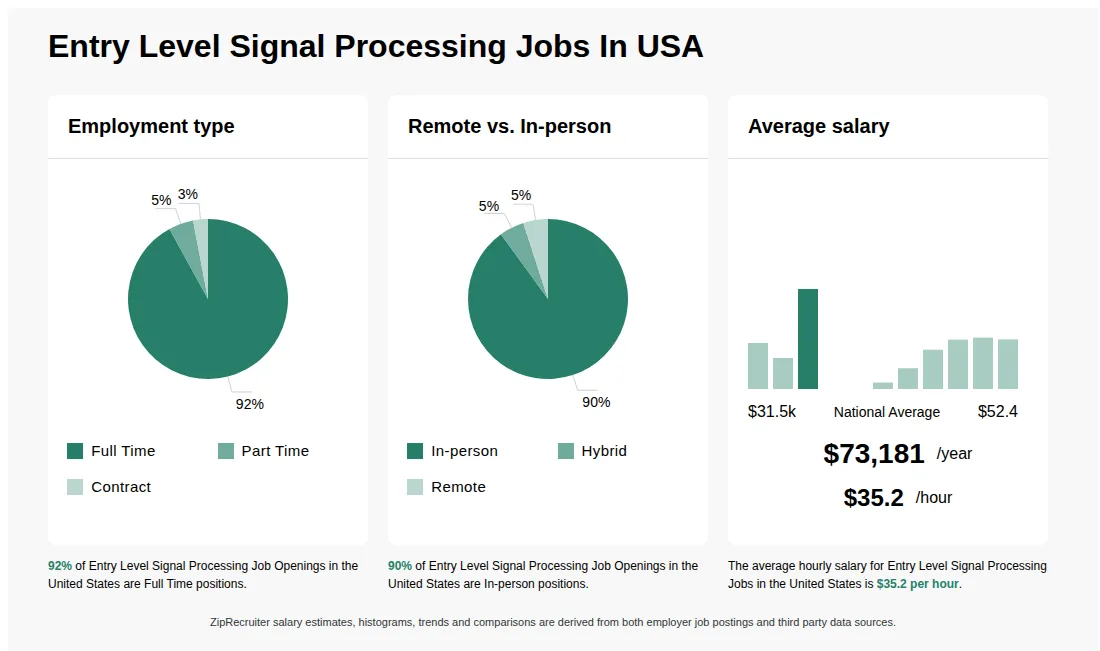
As of Sep 6, 2026, the average hourly pay for entry level signal processing in the United States is $35.18, according to ZipRecruiter salary data. Most workers in this role earn between $24.28 and $46.63 per hour, depending on experience, location, and employer.
What is an entry level signal processing job?
Entry level signal processing jobs are positions designed for individuals who are new to the field of signal processing, typically recent graduates or those with limited professional experience. These roles often involve analyzing, modifying, and interpreting signals such as audio, video, or sensor data using mathematical and computational techniques. Responsibilities may include supporting senior engineers with data analysis, algorithm development, and testing, as well as learning to use specialized software and hardware tools. Entry level positions are a great way to gain hands-on experience in industries like telecommunications, audio engineering, healthcare, and defense, while building a foundation for career growth.
What are the key skills and qualifications needed to thrive as an entry level signal processing engineer?
To succeed as an Entry Level Signal Processing Engineer, you need a solid understanding of digital signal processing concepts, mathematics, and programming, typically supported by a degree in electrical engineering, computer engineering, or a related field. Familiarity with MATLAB, Python, and signal processing libraries, as well as knowledge of simulation tools and possibly DSP hardware, is commonly required. Strong analytical thinking, attention to detail, and effective communication skills help you solve complex problems and collaborate with multidisciplinary teams. These abilities are crucial for accurately designing, analyzing, and implementing signal processing solutions that meet technical and project requirements.
What types of projects and tasks can I expect to work on as an entry level signal processing engineer?
As an entry-level signal processing engineer, you'll typically assist in developing and testing algorithms for processing signals such as audio, images, or sensor data. Your daily tasks may include analyzing raw data, writing and debugging code (often in MATLAB or Python), and supporting senior engineers with documentation and simulations. You'll likely work as part of a collaborative team, interfacing with hardware, software, and systems engineers to integrate your work into larger products or solutions. These experiences provide a strong foundation for advancing into more specialized or senior roles over time.
What is the difference between Entry Level Signal Processing vs Entry Level Communications Engineer?
| Aspect | Entry Level Signal Processing | Entry Level Communications Engineer |
|---|---|---|
| Required Credentials | Bachelor's in Electrical Engineering, Computer Science, or related field; basic knowledge of DSP and MATLAB | Bachelor's in Electrical Engineering, Telecommunications, or related; understanding of networking and RF principles |
| Work Environment | Research labs, R&D departments, technology companies | Telecom companies, network providers, infrastructure firms |
| Industry Usage | Designing and analyzing signal algorithms, filtering, and data processing | Developing communication systems, network setup, and signal transmission |
Entry Level Signal Processing focuses on analyzing and designing algorithms for signals, often in research or development settings. Entry Level Communications Engineer involves implementing and maintaining communication systems and networks. While both roles require a foundation in electrical engineering and similar credentials, their daily tasks and industry applications differ, with signal processing emphasizing data analysis and communications engineering focusing on system deployment.
How to become an Entry Level Signal Processing engineer?
To become an entry-level signal processing engineer, candidates typically need a bachelor's degree in electrical engineering, computer engineering, or a related field. Developing skills in digital signal processing, programming languages like MATLAB or Python, and understanding of communication systems are essential; internships or project experience can also improve job prospects.
Is signal processing in demand?
Signal processing is in high demand across industries such as telecommunications, aerospace, and healthcare, as it is essential for analyzing and interpreting data from sensors, audio, and images. Entry-level signal processing roles often require knowledge of tools like MATLAB or Python and understanding of digital signal processing concepts, making skills in this area valuable for job seekers.
What careers use entry level signal processing?
Entry level signal processing skills are used in careers such as telecommunications engineer, audio engineer, radar and sonar technician, and data analyst. These roles often require knowledge of digital signal processing, programming languages like MATLAB or Python, and understanding of systems and hardware. They are common in industries like aerospace, defense, consumer electronics, and healthcare technology.
More about Entry Level Signal Processing jobs
What cities are hiring for Entry Level Signal Processing jobs?
Cities with the most Entry Level Signal Processing job openings:
What are the most commonly searched types of Signal Processing jobs?
The most popular types of Signal Processing jobs are:
What states have the most Entry Level Signal Processing jobs?
States with the most job openings for Entry Level Signal Processing jobs include:
What job categories do people searching Entry Level Signal Processing jobs look for?
The top searched job categories for Entry Level Signal Processing jobs are:

Full-time
Medical, Dental, Vision, Life, Retirement, PTO
Re-posted 13 days ago
RTX rating

8.2
Based on 86 frontline employees who took The Breakroom Quiz
38th of 72 rated aerospace companies
Job description
Date Posted:
2026-07-09Country:
United States of AmericaLocation:
US-AZ-TUCSON-849 ~ 1151 E Hermans Rd ~ BLDG 849 (External Site)Position Role Type:
OnsiteU.S. Citizen, U.S. Person, or Immigration Status Requirements:
Active and transferable U.S. government issued security clearance is required prior to start date. U.S. citizenship is required, as only U.S. citizens are eligible for a security clearanceSecurity Clearance Type:
DoD Clearance: SecretSecurity Clearance Status:
Ability to obtain INTERIM U.S. government issued security clearance is required prior to start dateAt Raytheon, the foundation of everything we do is rooted in our values and a higher calling – to help our nation and allies defend freedoms and deter aggression. We bring the strength of more than 100 years of experience and renowned engineering expertise to meet the needs of today’s mission and stay ahead of tomorrow’s threat. Our team solves tough, meaningful problems that create a safer, more secure world.
The Systems Engineering and Test Center (SE&TC) organization is currently hiring a Signal Processing Systems Engineer II to join our Tucson, AZ location. SE&TC is an exciting and challenging environment where you will have the opportunity to design, develop, and test to shape innovative solutions for our customers.
Join our organization and collaborate in the design, development, prototyping, integration, testing, and performance assessment of radar frequency (RF) or ElectroOptical/Infrared (EO/IR) algorithms and models. Used across our products and new business initiatives, signal processing algorithms extract and exploit signals to be used for calibration and de-noising of raw sensor data; detecting, acquiring, tracking, and classifying objects of interest; and sensor fusion.
This role is 100% on-site at our Tucson, AZ campus.
What You Will Do:
In this Systems Engineer II role, you will support the following types of activities:
- You will act as an entry-level professional with theoretical knowledge of RF or EO/IR signal processing to support development, execution, and completion of difficult and potentially complex program objectives.
- Troubleshoot and Analyze: Participate in engineering lab environments to test, verify, and validate RF or EO/IR models and signal processing algorithm performance in accordance with requirements.
- Drive Performance: Collaborate across functions to drive performance improvements and resolve system issues.
- Integrate Systems: Integrate algorithms into tactical system hardware and software, evaluating their functionality and impact.
- Decision analysis & Resolution: Conduct trade studies and present results to stakeholders.
- Document and Communicate: Develop integration documentation, execute plans, analyze data, verify requirements and effectively communicate results to leadership and stakeholders.
- Collaborate Across Disciplines: Work within a multi-disciplinary team to achieve seamless integration and system functionality through all development phases from program start-up to live-fire testing.
- Perform Data Analysis: Use and modify simulations for the design, development, prototyping, integration, testing, and performance assessment of RF or EO/IR algorithms and models.
- Present Findings: Present technical findings and solutions to leadership and customers.
Qualifications You Must Have:
- Master’s degree in Science, Technology, Engineering, or Mathematics (STEM)
- This position requires 12 months or less of professional experience (excluding internships)
- Experience developing scripts and functions with MATLAB or Python for evaluation of data sets.
- Experience with the C or C++ programming languages.
- Ability to obtain an Interim Secret U.S. government issued Security Clearance is required prior to start date with the ability to obtain special program access after start. U.S. citizenship is required, as only U.S. citizens are eligible for a security clearance.
Qualifications We Prefer
- Have completed or currently be taking at least two courses in Signal Processing / Image Processing (e.g., Signals & Systems, Digital Signal Processing, Signal Analysis, Radar Signal Processing, Radar and Communication Systems, Radar Systems Analysis & Design, Adaptive Array Processing, Digital Image Processing, or equivalent).
- Minimum 3.00 cumulative GPA.
- Professional internships, capstone/senior project, or academic research that provides experience applying signal processing techniques to RF or EO/IR data and models.
- Experience with version control tools such as Azure DevOps and Git.
- Experience with performance analysis and presenting analytical and technical material.
- Experience working in an engineering lab, test facility, or in the field, supporting integration and/or verification.
- Experience with generating technical documentation, such as trade studies, test plans, procedures, or technical reports.
- Experience with evaluating systems using simulated environments.
- Effective communication and organization skills.
What We Offer:
- Our values drive our actions, behaviors, and performance with a vision for a safer, more connected world. At RTX we value: Trust, Respect, Accountability, Collaboration, and Innovation.
- Relocation eligible
Learn More & Apply Now!
Please consider the following role type definition as you apply for this role.
Employees who are working in Onsite roles will work primarily onsite. This includes all production and maintenance employees, as they are essential to the development of our products.
Please upload a copy of your most recent transcripts with your resume when applying to this requisition. Include your cumulative GPA and projected graduation date on your resume.
This position requires the ability to obtain a security clearance. DCSA Consolidated Adjudication Services (DCSA CAS), an agency of the Department of Defense, handles and adjudicates the security clearance process. More information about Security Clearances can be found on the US Department of State government website here: https://www.state.gov/m/ds/clearances/c10978.htm
As part of our commitment to maintaining a secure hiring process, candidates may be asked to attend select steps of the interview process in-person at one of our office locations, regardless of whether the role is designated as on-site, hybrid or remote.
The salary range for this role is 68,900 USD - 131,100 USD. The salary range provided is a good faith estimate representative of all experience levels. RTX considers several factors when extending an offer, including but not limited to, the role, function and associated responsibilities, a candidate’s work experience, location, education/training, and key skills. Hired applicants may be eligible for benefits, including but not limited to, medical, dental, vision, life insurance, short-term disability, long-term disability, 401(k) match, flexible spending accounts, flexible work schedules, employee assistance program, Employee Scholar Program, parental leave, paid time off, and holidays. Specific benefits are dependent upon the specific business unit as well as whether or not the position is covered by a collective-bargaining agreement. Hired applicants may be eligible for annual short-term and/or long-term incentive compensation programs depending on the level of the position and whether or not it is covered by a collective-bargaining agreement. Payments under these annual programs are not guaranteed and are dependent upon a variety of factors including, but not limited to, individual performance, business unit performance, and/or the company’s performance. This role is a U.S.-based role. If the successful candidate resides in a U.S. territory, the appropriate pay structure and benefits will apply. RTX anticipates the application window closing approximately 40 days from the date the notice was posted. However, factors such as candidate flow and business necessity may require RTX to shorten or extend the application window.RTX is an Equal Opportunity Employer. All qualified applicants will receive consideration for employment without regard to race, color, religion, sex, sexual orientation, gender identity, national origin, age, disability or veteran status, or any other applicable state or federal protected class. RTX provides affirmative action in employment for qualified Individuals with a Disability and Protected Veterans in compliance with Section 503 of the Rehabilitation Act and the Vietnam Era Veterans’ Readjustment Assistance Act.
Privacy Policy and Terms:
Click on this link to read the Policy and Terms

About RTX
Sourced by ZipRecruiter
Industry
Guided missile and space vehicle manufacturing, it services, aerospace product and parts manufacturing and engineering professional services
Company size
10,000+ Employees
Headquarters location
Waltham, MA, US