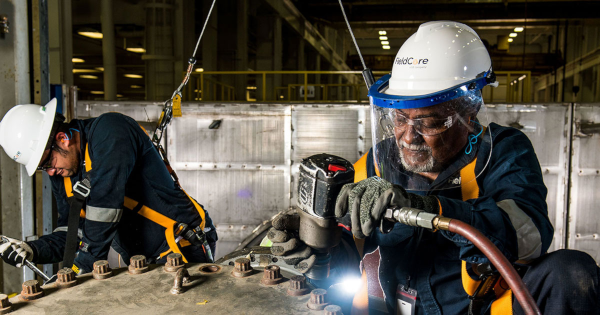
CenTrio is seeking a qualified Instrumentation & Controls Technician to join our team in Syracuse, NY!
Location- Syracuse, NY
Full-Time Permanent
Onsite
Job Summary
Under the direction of the Electrical and Controls Manager, this position will be responsible for installing, calibrating, repairing, and maintaining Customer steam and chilled water metering stations as well as instrumentation and control systems in the boiler houses and chilled water plant. Diagnose and troubleshoot issues with measuring, recording and control devices in a timely manner. Coordinate and communicate with plant operators and customers when servicing or calibrating metering and control equipment. Must also be able to program, troubleshoot, and maintain loop controllers, PLCs, and other types of logic controllers.
The successful candidate will be a self-starter that enjoys working in a fast-paced environment, strong commitment to deadlines and team, is process oriented with a high sense of ownership in their work, possesses a high degree of intellectual curiosity, and has a superior controls and instrumentation foundation.
Core Responsibilities
- Install, calibrate, troubleshoot, and program field control devices including control valves, pneumatic damper drives, motor control circuits, VFDs, PLCs, and process control systems
- Develop calibration procedures and perform calibrations of process measurement and control system nodes.
- Maintain and expand new control loops including associated panels.
- Commission and integrate new systems within the facility.
- Work with a preventive maintenance program.
- Support and maintain established system standards and documentation for process control loops and analytical equipment.
- Maintain calibration records and documentation
- Read complex schematics, wiring diagrams and shop drawings for the purpose of installation, troubleshooting, and repairing of major systems and minor subsystems and components
- Utilizes a wide range of test equipment, including recorders, computers, PC based software analyzer programs, oscilloscopes, data analyzers, analog and digital multi-meters, and other test equipment, while performing tests to identify problems and to maintain and calibrate equipment to performance standards
- Connects, disconnects, and tags out equipment and circuits for test or repair and safety of personnel and equipment
- Performs soldering on electronic components.
- Maintains shop and storage areas in a neat and orderly fashion.
- Maintains the safe and efficient use of materials, tools, test equipment and personal safety and all others working in the vicinity.
- Cleans work area after work is complete.
- Complies with plant policy and procedures, particularly those involving personnel and equipment safety.
- Maintains and repairs network communications systems (i.e., fiber networks, Ethernet networks and network peripherals)
- Maintains and repairs complete process systems and repair/replace subcomponents as required.
- Maintains telephone and/or radio contact with operation and management personnel
- Maintains regular and punctual attendance
- Other duties as assigned
Working Style to Be Successful in This Role:
- Effectively communicate and work collaboratively at all levels of the organization in diverse work group settings and in concert with external resources.
- Effectively use a variety of media (i.e., MS office suite, etc.) to convey technical data, concepts and ideas.
Technical Skills & Requirements:
- Strong knowledge of PLC/HMI/SCADA/DCS hardware and software.
- Strong knowledge of various instrumentation, including flow, temperature, pressure, and valves.
- Must have experience with development and integration of various communication protocols such as CIP, Modbus RTU and Modbus TCP/IP.
- Be able to read and understand P&ID and PFD diagrams.
- Must be proficient in the use of Microsoft Office Suite including Word, Excel, and Outlook.
- Will work closely with the operations and maintenance lead personnel along with the Plant management.
- Highly analytical with great attention to detail.
- Demonstrated strong communication skills.
- Exemplifies the right motivation by aspiring to achieve collective goals.
- Collaborative and interpersonal skills.
- A process-focused individual with a passion to drive and deliver effective change.
- Self-motivated and proactive, with respect to both managing workload and professional development.
- Ability to work in a dynamic, complex, fast-paced environment, to adapt quickly and to manage changing priorities.
Professional Experience & Knowledge:
- Associates Degree or vocational/ technical trade school in an electrical or electronic discipline or equivalent experience
- 1-3 years of previous work experience in a manufacturing or industrial process plant environment is strongly preferred
Physical Requirements:
- Frequent movement throughout plant areas (including mechanical rooms and platforms)
- Must be proficient with all types of hand tools and power tools both electric and pneumatic.
- Must be able to work with all types of PPE including (but not limited to); dust mask, half-face respirator, all manner of hand protection, eye protection and hearing protection.
- Must be able to perform the following work in a safe manner; overhead, climb ladders, squat, bend, lift 100 lbs, perform in a confined space, dusty and noisy environment, work outdoors, plenum spaces, hot and cold environments.
- Must be willing to work holidays, weekends and over-time.
- Must be willing to work during all types of weather events including hurricanes and storms.
Who is CenTrio?
CenTrio is a fully integrated, innovative and sustainable energy services provider to a wide range of industries such as higher education & healthcare campuses, cities, and communities. It serves more with utility infrastructures serving more than 170+ million square feet of space and operations in 10 cities across the United States and growing. In each community, the company operates highly efficient and innovative utility infrastructures that produce and distribute electricity, steam, hot water and/or chilled water to customer buildings and campuses. Customers connected to these systems enjoy multiple benefits including reduced operating costs, lower emissions and unmatched reliability.
CenTrio is a wholly owned subsidiary of a global Infrastructure Investment Consortium with unmatched financial wherewithal and manages a portfolio of long-life, high quality infrastructure assets with high barriers to entry that generate stable and growing cash flows.
Why Join CenTrio?
CenTrio offers a dynamic and friendly work environment, dedicated to nurturing a top-notch team culture! Additionally, CenTrio offers an array of fabulous benefits and perks.
- Medical Benefits first day of hire
- Medical, dental, vision, Life & AD&D benefits
- Option of supplemental Life & AD&D benefits
- Company paid High Deductible Healthcare Benefit Plan
- 401k plan with % match
- Training Opportunities and career progression
- Competitive salaries that reflect the value of skills and experience
- Dynamic and friendly work environment in a rapidly expanding industry with a national presence
- Remote, Hybrid, and In Office schedules available dependent on job responsibilities
- 24-hour Employee Assistance Program/Hotline
- Corporate discounts (Travel, Entertainment, Home, Auto, Apparel, Health and Wellbeing, and other various retail options)