2

Entry Level Healthcare Data Analyst Jobs in California

The Healthcare Data Analyst is responsible for analyzing healthcare data to support clinical, operational, and financial decision-making within Medicare Advantage programs. This role focuses on key ...

Healthcare Data Analyst

Orange, CA · On-site

$85K - $115K/yr

The Healthcare Data Analyst is responsible for analyzing healthcare data to support clinical, operational, and financial decision-making within Medicare Advantage programs. This role focuses on key ...

Be Seen First

Marketing, Business Administration, or Healthcare. Required Experience: 2 Years - Professional work experience which includes data analysis Required Skills: * Able to manage and engage functional ...

New

Analyze complex healthcare datasets from multiple clinical sources. * Identify trends, patterns, and correlations in clinical and operational data. * Develop statistical models to support healthcare ...

next page

Showing results 1-20

Entry Level Healthcare Data Analyst information

See California salary details

$13

$32

$60

How much do entry level healthcare data analyst jobs pay per hour?

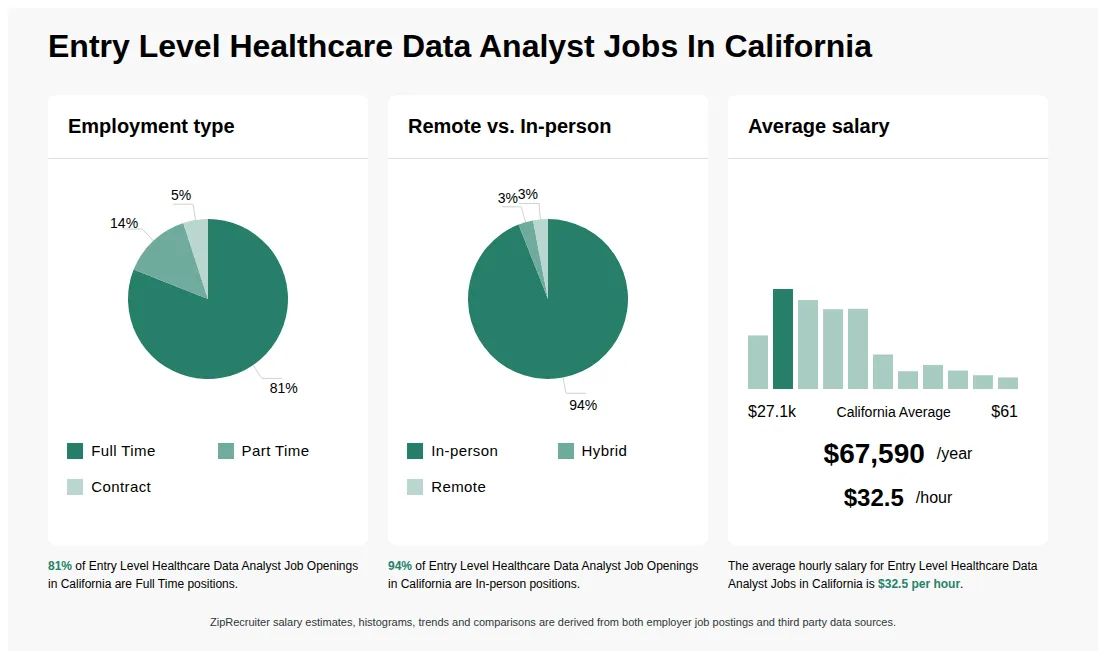
As of Aug 22, 2026, the average hourly pay for entry level healthcare data analyst in California is $32.50, according to ZipRecruiter salary data. Most workers in this role earn between $20.87 and $36.30 per hour, depending on experience, location, and employer.

What does an entry level healthcare data analyst do?

An Entry Level Healthcare Data Analyst is responsible for collecting, processing, and analyzing healthcare data to help organizations make informed decisions. They work with large datasets related to patient care, billing, and hospital operations, using statistical tools and software to identify trends and generate reports. Their work supports improvements in patient outcomes, operational efficiency, and regulatory compliance. Entry-level analysts typically collaborate with more experienced data professionals and healthcare staff to ensure data integrity and accuracy.

What are the key skills and qualifications needed to thrive as an entry level healthcare data analyst?

To thrive as an Entry Level Healthcare Data Analyst, you need a solid grounding in statistics, data analysis, and healthcare concepts, usually backed by a bachelor’s degree in health informatics, statistics, or a related field. Familiarity with data visualization tools (like Tableau or Power BI), SQL, and electronic health record (EHR) systems is typically required. Strong attention to detail, analytical thinking, and effective communication skills help you interpret data and present findings clearly to non-technical stakeholders. These abilities are crucial for transforming complex healthcare data into actionable insights that drive better patient outcomes and organizational efficiency.

What are some common challenges faced by entry level healthcare data analysts, and how can they be addressed?

Entry level healthcare data analysts often face challenges such as navigating complex healthcare data systems, ensuring data accuracy, and understanding industry-specific regulations like HIPAA. To overcome these obstacles, new analysts should focus on developing strong technical skills in data management tools, actively seek mentorship from experienced colleagues, and stay updated on healthcare compliance standards. Regular collaboration with clinical and IT teams also helps bridge knowledge gaps and fosters a more comprehensive understanding of how data impacts patient care and operational decisions.

What is the difference between Entry Level Healthcare Data Analyst vs Healthcare Data Coordinator?

AspectEntry Level Healthcare Data AnalystHealthcare Data Coordinator
Required CredentialsBachelor's in health informatics, data science, or related field; basic knowledge of healthcare data systemsBachelor's in health information management or related field; familiarity with healthcare data management
Work EnvironmentHealthcare facilities, clinics, or health IT companies; focus on data analysis and reportingHospitals or clinics; managing data entry, organization, and compliance
Employer & Industry UsageUsed across healthcare providers, insurance companies, and health IT firmsPrimarily in hospitals and healthcare organizations for data management

While both roles involve working with healthcare data, the Entry Level Healthcare Data Analyst focuses on analyzing and interpreting data to support decision-making, whereas the Healthcare Data Coordinator handles data entry, organization, and ensuring data accuracy. The analyst role typically requires more analytical skills, while the coordinator role emphasizes data management and compliance.


Can I become an entry level healthcare data analyst with no experience?

Entry level healthcare data analysts typically need some familiarity with data analysis tools like Excel, SQL, or statistical software, but many employers accept candidates with relevant coursework or certifications rather than extensive experience. Developing skills through online courses, internships, or certifications can help you qualify for entry-level positions even without prior work experience.

Can you be an entry level healthcare data analyst in healthcare?

Yes, entry-level healthcare data analysts can work in healthcare settings, often requiring basic knowledge of data analysis tools like Excel or SQL, and understanding of healthcare data and terminology. Many positions are open to candidates with relevant internships, certifications, or degrees in health informatics, data science, or related fields. Strong analytical skills and attention to detail are essential for entry-level roles in this field.

How to become an entry level healthcare data analyst with no experience?

To become an entry-level healthcare data analyst with no experience, focus on gaining foundational skills in data analysis, such as proficiency in Excel, SQL, and data visualization tools like Tableau or Power BI. Pursuing relevant certifications, such as the Certified Health Data Analyst (CHDA), and completing online courses or internships can also improve your qualifications and understanding of healthcare data environments.

What are the most commonly searched types of Healthcare Data Analyst jobs in California?

The most popular types of Healthcare Data Analyst jobs in California are:

What are popular job titles related to Entry Level Healthcare Data Analyst jobs in California?

For Entry Level Healthcare Data Analyst jobs in California, the most frequently searched job titles are:

What job categories do people searching Entry Level Healthcare Data Analyst jobs in California look for?

The top searched job categories for Entry Level Healthcare Data Analyst jobs in California are:

What cities in California are hiring for Entry Level Healthcare Data Analyst jobs?

Cities in California with the most Entry Level Healthcare Data Analyst job openings:

Infographic showing various Entry Level Healthcare Data Analyst job openings in California as of August 2026, with employment types broken down into 64% Full Time, 23% Part Time, and 13% Contract. Highlights an 90% In-person, and 10% Remote job distribution, with an average salary of $67,590 per year, or $32.5 per hour.

$85K - $115K/yr

Full-time

Re-posted 4 days ago


Job description

Description

About Us:

Astiva Health, Inc., located in Orange, CA is a premier healthcare provider specializing in Medicare and HMO services. With a focus on delivering comprehensive care tailored to the needs of our diverse community, we prioritize accessibility, affordability, and quality in all aspects of our services. Join us in our mission to transform healthcare delivery and make a meaningful difference in the lives of our members.


SUMMARY:

The Healthcare Data Analyst is responsible for analyzing healthcare data to support clinical, operational, and financial decision-making within Medicare Advantage programs. This role focuses on key areas including risk adjustment, quality measures (HEDIS and Star Ratings), pharmacy adherence, and claims analysis. 

The analyst collaborates with clinical, quality, pharmacy, and provider teams to identify trends, monitor program performance, and support CMS regulatory reporting. The role also includes developing automated data workflows and reporting solutions that deliver timely, actionable insights across the organization.


ESSENTIAL DUTIES AND RESPONSIBILITIES include the following:


Data Analysis & Reporting

  • Analyze medical and pharmacy claims, membership, supplement, lab, risk adjustment, and encounter data to support Medicare Advantage quality, risk, and operational programs.
  • Develop and maintain dashboards and reports for HEDIS, Star Ratings, medication adherence, RAF/HCC performance, and EDPS encounter data.
  • Identify trends, care gaps, and performance opportunities to support quality improvement, pharmacy initiatives, and risk adjustment efforts.
  • Provide analytics and reporting to MSOs/IPAs and internal teams, including quality, pharmacy, and risk adjustment.
  • Support regulatory and CMS-related analyses, including encounter data monitoring, claims acceptance, and HCC performance.
  • Deliver consolidated reporting and insights to leadership for strategic decision-making.
  • Examine payments, cost of care, and utilization data to produce metrics for bid submission and JOMs or to address concerns from business partners.
  • Support ad hoc reporting needs across the organization.

Data Quality & Validation

  • Validate and reconcile claims, pharmacy, provider, membership, supplement, and lab data to ensure accuracy and completeness.
  • Investigate and resolve data discrepancies, anomalies, and reporting issues across Medicare Advantage data sources.

Technical & Database Work

  • Write and optimize SQL queries and stored procedures for data extraction, transformation, and analysis.
  • Develop automated ETL workflows and data pipelines to support ongoing reporting needs.
  • Work with large datasets in SQL Server and healthcare analytics platforms.
  • Build dashboards and data visualizations using Power BI or SSRS.
  • Utilize tools such as SQL Server, SSIS, Power BI, SSRS, Python, and Excel.

Collaboration

  • Partner with clinical, pharmacy, quality, enrollment, credentialing, and finance teams to interpret results and support program initiatives.
  • Assist with regulatory and compliance-related reporting requirements.
  • Present findings and insights to both technical and non-technical stakeholders

Requirements

Required Qualifications

  • Bachelor's degree in Data Analytics, Health Informatics, Statistics, Computer Science, or related field.
  • 2-5+ years of healthcare data analytics experience.
  • Knowledge of Medicare Advantage programs, HEDIS, and/or CMS Star Ratings.
  • Advanced SQL skills for querying and analyzing large datasets.
  • Experience with BI tools such as Power BI, SSRS, or similar tools.
  • Strong analytical, problem-solving, and communication skills.

Preferred Qualifications

  • Experience working in Medicare Advantage organizations, MSOs, or managed care settings.
  • Knowledge of HCC risk adjustment, RAF methodologies, capitation payment model, DOFR, claim processing, bid design, and CMS regulatory requirements.
  • Experience analyzing pharmacy adherence metrics (e.g., PDC).
  • Familiarity with EDPS encounter data, claims submissions, and acceptance processes.
  • Experience with ETL tools (e.g., SSIS) or programming languages such as Python or .NET.