1

Emergency Disaster Preparedness Jobs (NOW HIRING)

Security Officer I

Mobile, AL · On-site

$13.75 - $16.25/hr

Emergency/Disaster Preparedness plans. * Demonstrate a willingness to participate in additional training as required. * Proficiency in basic computer skills is a plus. * Conforms to all uniform and ...

Showing results 41-60

Emergency Disaster Preparedness information

See salary details

$65K

$99.9K

$155K

How much do emergency disaster preparedness jobs pay per year?

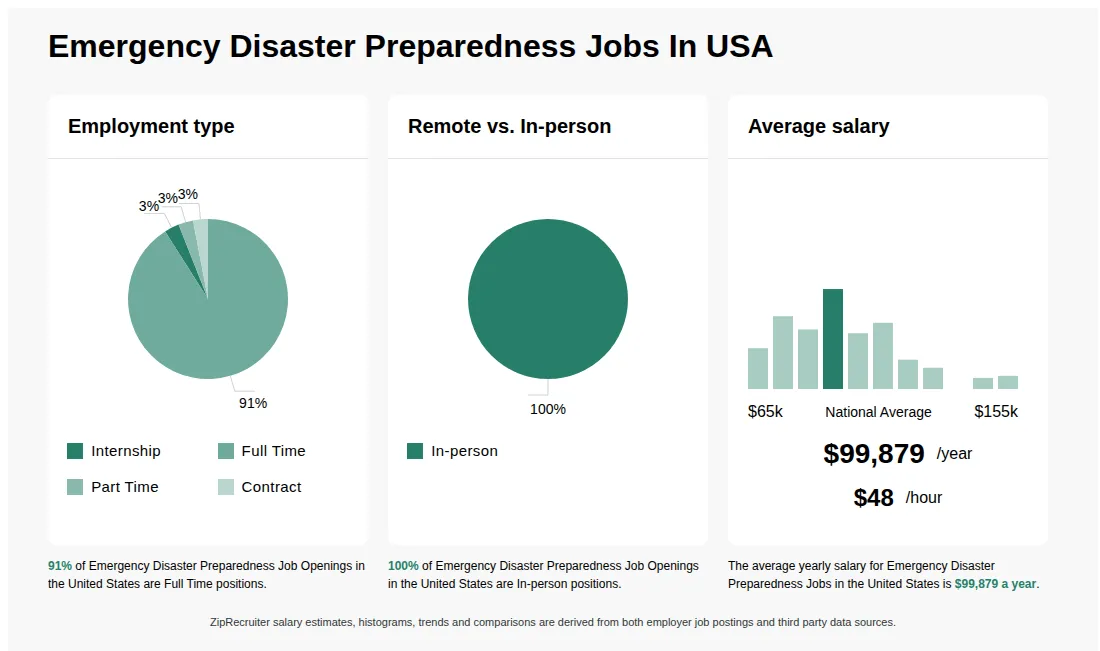
As of Sep 5, 2026, the average yearly pay for emergency disaster preparedness in the United States is $99,879.00, according to ZipRecruiter salary data. Most workers in this role earn between $82,500.00 and $107,500.00 per year, depending on experience, location, and employer.

What is emergency disaster preparedness?

Emergency disaster preparedness refers to the planning, organization, and implementation of measures designed to prepare for, respond to, and recover from emergencies and disasters. This includes creating emergency plans, conducting training and drills, stockpiling necessary supplies, and establishing communication protocols. The goal is to minimize the impact of disasters on people, property, and communities by ensuring a coordinated and effective response. Preparedness efforts are carried out by individuals, organizations, and government agencies at all levels.

What are the key skills and qualifications needed to thrive as an emergency disaster preparedness specialist?

To thrive as an Emergency Disaster Preparedness Specialist, you need expertise in risk assessment, emergency planning, and crisis management, often backed by a degree in emergency management or a related field. Familiarity with incident command systems (ICS), emergency notification platforms, and certifications such as Certified Emergency Manager (CEM) are typically required. Strong communication, critical thinking, and leadership skills help coordinate effective responses and foster collaboration among agencies. These competencies ensure rapid, organized, and effective action during disasters, minimizing harm and promoting community resilience.

What are some common challenges faced by professionals in emergency disaster preparedness, and how are they typically addressed?

Professionals in Emergency Disaster Preparedness often encounter challenges such as rapidly changing situations, coordinating with multiple agencies, and ensuring clear communication during crises. To address these, teams conduct regular training exercises, develop detailed contingency plans, and maintain strong relationships with local authorities and community organizations. Flexibility and adaptability are crucial, as is staying updated on best practices and emerging threats to effectively respond to a wide range of incidents.

What is the difference between Emergency Disaster Preparedness vs Emergency Response Coordinator?

AspectEmergency Disaster PreparednessEmergency Response Coordinator
CertificationsCPR, First Aid, Emergency Management certificationsCPR, First Aid, Emergency Management certifications
Work EnvironmentPlanning, training, drills, policy developmentOn-site response, incident management, coordination during emergencies
Employer & IndustryGovernment agencies, NGOs, corporationsGovernment agencies, emergency services, large organizations

Emergency Disaster Preparedness focuses on planning, training, and developing protocols to prevent or mitigate disasters. In contrast, Emergency Response Coordinators actively manage and respond to emergencies as they occur. Both roles require similar certifications and often work within the same organizations, but their core responsibilities differ in proactive versus reactive functions.

More about Emergency Disaster Preparedness jobs

What cities are hiring for Emergency Disaster Preparedness jobs?

Cities with the most Emergency Disaster Preparedness job openings:

What states have the most Emergency Disaster Preparedness jobs?

States with the most job openings for Emergency Disaster Preparedness jobs include:

Infographic showing various Emergency Disaster Preparedness job openings in the United States as of August 2026, with employment types broken down into 2% As Needed, 75% Full Time, 19% Part Time, and 4% Contract. Highlights an 98% Physical, and 2% Remote job distribution, with an average salary of $99,879 per year, or $48 per hour.

Disaster Medicine Fellow

Johns Hopkins University

Baltimore, MD • On-site

$48K - $66K/yr

Full-time

Medical, Life, Retirement

Re-posted 8 days ago


Johns Hopkins University rating

8.0

Company rating: 8.0 out of 10

Based on 71 frontline employees who took The Breakroom Quiz

190th of 630 rated colleges and universities


Job description

Description
The Disaster Medicine Fellowship at Johns Hopkins is a 2-year program designed for recent emergency medicine residency graduates. Fellows will gain expertise in disaster preparedness, management, and response at local, state, and federal levels, integrating public health knowledge and field experience.
For more details, visit Johns Hopkins Disaster Fellowship
https://www.hopkinsmedicine.org/emergency-medicine/fellowship-programs/disaster
Qualifications
Responsibilities:
- Complete an MPH with a focus on disaster/humanitarian issues.
- Engage in disaster-related field work.
- Participate in teaching and academic activities.
- Conduct research in disaster science.
- Work 800 clinical hours annually as emergency medicine faculty.
Requirements:
- Board certification or eligibility in Emergency Medicine.
- Ability to apply for a Maryland medical license.
- Ability to pursue an MPH degree.
Equal Employment Opportunity Statement
Salary Range
The referenced salary range represents the minimum and maximum salaries for this position and is based on Johns Hopkins University's good faith belief at the time of posting. Not all candidates will be eligible for the upper end of the salary range. The actual compensation offered to the selected candidate may vary and will ultimately depend on multiple factors, which may include the successful candidate's geographic location, skills, work experience, internal equity, market conditions, education/training and other factors, as reasonably determined by the University.
Total Rewards
Johns Hopkins offers a total rewards package that supports our employees' health, life, career and retirement. More information can be found here: https://hr.jhu.edu/benefits-worklife/.
Equal Opportunity Employer
The Johns Hopkins University is committed to equal opportunity for its faculty, staff, and students. To that end, the university does not discriminate on the basis of sex, gender, marital status, pregnancy, race, color, ethnicity, national origin, age, disability, religion, sexual orientation, gender identity or expression, veteran status or other legally protected characteristics. The University is committed to providing qualified individuals access to all academic and employment programs, benefits and activities on the basis of demonstrated ability, performance and merit without regard to personal factors or demographic characteristics that are irrelevant to the program involved.
Pre-Employment Information
If you are interested in applying for employment with Johns Hopkins University and require special assistance or accommodation during any part of the pre-employment process, please contact the HR Business Services Office at jhurecruitment@jhu.edu. For TTY users, call via Maryland Relay or dial 711. For more information about workplace accommodations at Johns Hopkins University for disabilities, medical conditions (including medical conditions related to pregnancy or childbirth), accessibility, or religious reasons, please visit accessibility.jhu.edu.
Background Checks
After receiving a conditional offer, the successful candidate(s) for this position will be subject to a pre-employment background check including education verification. When deciding whether a candidate's conviction history is job-disqualifying, the University considers the nature and gravity of the offense, the time that has passed since the conviction, and the nature of the job being sought.
EEO is the Law
https://www.eeoc.gov/employees-job-applicants
Vaccine Requirements
Johns Hopkins University strongly encourages, but no longer requires, at least one dose of the COVID-19 vaccine. This change does not apply to the School of Medicine (SOM). SOM hires must be fully vaccinated with an FDA COVID-19 vaccination and provide proof of vaccination status. We still require all faculty, staff, and students to receive the seasonal flu vaccine.
Exceptions to the seasonal flu vaccine or COVID-19 vaccine (for SOM) requirement(s) may be provided to individuals with sincerely held religious beliefs or medical conditions that preclude them from receiving the vaccine. Requests for an exception must be submitted to the JHU vaccination registry. For additional information, applicants for SOM positions should visit https://www.hopkinsmedicine.org/coronavirus/covid-19-vaccine/ and all other JHU applicants should visit https://covidinfo.jhu.edu/health-safety/covid-vaccination-information/.
The following additional vaccine requirements may apply, depending upon your campus. Please contact the hiring department for more information.
The pre-employment physical for positions in clinical areas, laboratories, working with research subjects, or involving community contact requires documentation of immune status against Rubella (German measles), Rubeola (Measles), Mumps, Varicella (chickenpox), Hepatitis B and documentation of having received the Tdap (Tetanus, diphtheria, pertussis) vaccination. This may include documentation of having two (2) MMR vaccines; two (2) Varicella vaccines; or antibody status to these diseases from laboratory testing. Blood tests for immunities to these diseases are ordinarily included in the pre-employment physical exam except for those candidates who provide results of blood tests or immunization documentation from their own health care providers. Any vaccinations required for these diseases will be given at no cost in our Occupational Health office.

What Johns Hopkins University employees say

Pay

Benefits

Hours and flexibility

Workplace

Get the full story on Breakroom


Johns Hopkins University logo

About Johns Hopkins University

Sourced by ZipRecruiter

Gilman believed that teaching and research go hand in hand—that success in one depends on success in the other—and that a modern university must do both well. He also believed that sharing our knowledge and discoveries would help make the world a better place. In 145 years, we haven’t strayed from that vision. This is still a destination for excellent, ambitious scholars and a world leader in teaching and research. Distinguished professors mentor students in the arts and music, humanities, social and natural sciences, engineering, international studies, education, business, and the health professions. Those same faculty members, along with their colleagues at the university’s Applied Physics Laboratory, have made us the nation’s leader in federal research and development funding every year since 1979. That’s a fitting distinction for America’s first research university, a place that has revolutionized higher education in the U.S. and continues to bring knowledge and discoveries to the world.

Industry

Colleges, universities, and professional schools

Company size

10,000+ Employees

Headquarters location

Baltimore, MD, US

Year founded

1876