1

Emergency Disaster Preparedness Jobs (NOW HIRING)

... Disaster recovery and experience working with FEMA. - Representation in Emergency Operations ... preparedness personnel. - Familiarity with emergency management software and GIS mapping tools ...

next page

Showing results 1-20

Emergency Disaster Preparedness information

See salary details

$65K

$99.9K

$155K

How much do emergency disaster preparedness jobs pay per year?

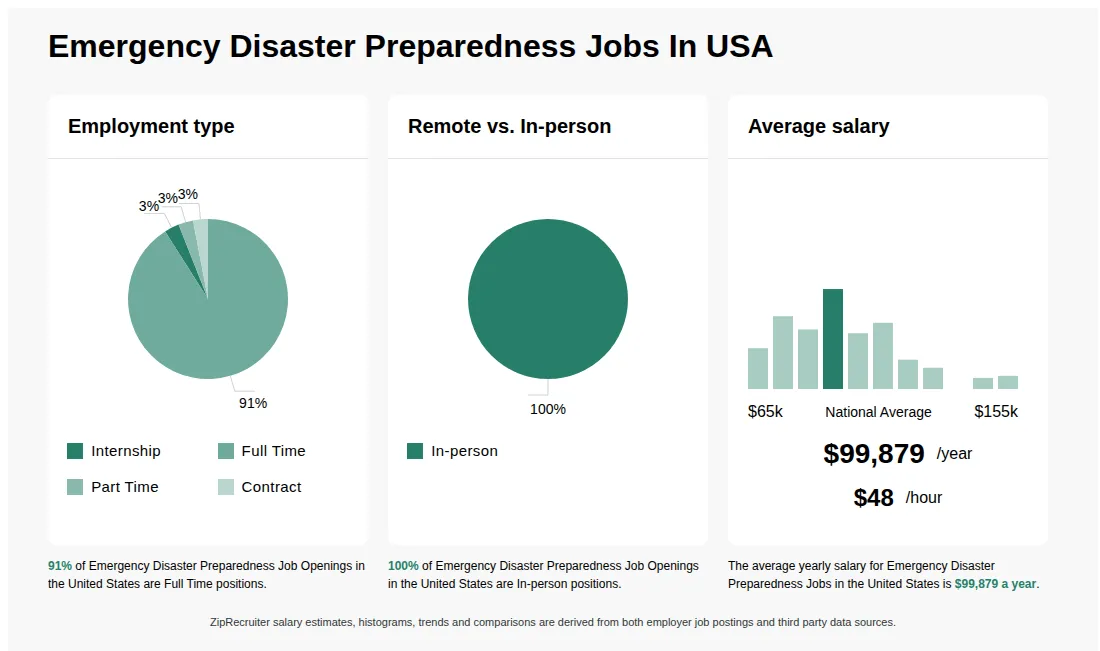
As of Jul 24, 2026, the average yearly pay for emergency disaster preparedness in the United States is $99,879.00, according to ZipRecruiter salary data. Most workers in this role earn between $82,500.00 and $107,500.00 per year, depending on experience, location, and employer.

What are the key skills and qualifications needed to thrive as an Emergency Disaster Preparedness Specialist, and why are they important?

To thrive as an Emergency Disaster Preparedness Specialist, you need expertise in risk assessment, emergency planning, and crisis management, often backed by a degree in emergency management or a related field. Familiarity with incident command systems (ICS), emergency notification platforms, and certifications such as Certified Emergency Manager (CEM) are typically required. Strong communication, critical thinking, and leadership skills help coordinate effective responses and foster collaboration among agencies. These competencies ensure rapid, organized, and effective action during disasters, minimizing harm and promoting community resilience.

What are some common challenges faced by professionals in Emergency Disaster Preparedness, and how are they typically addressed?

Professionals in Emergency Disaster Preparedness often encounter challenges such as rapidly changing situations, coordinating with multiple agencies, and ensuring clear communication during crises. To address these, teams conduct regular training exercises, develop detailed contingency plans, and maintain strong relationships with local authorities and community organizations. Flexibility and adaptability are crucial, as is staying updated on best practices and emerging threats to effectively respond to a wide range of incidents.

What is emergency disaster preparedness?

Emergency disaster preparedness refers to the planning, organization, and implementation of measures designed to prepare for, respond to, and recover from emergencies and disasters. This includes creating emergency plans, conducting training and drills, stockpiling necessary supplies, and establishing communication protocols. The goal is to minimize the impact of disasters on people, property, and communities by ensuring a coordinated and effective response. Preparedness efforts are carried out by individuals, organizations, and government agencies at all levels.

What is the difference between Emergency Disaster Preparedness vs Emergency Response Coordinator?

AspectEmergency Disaster PreparednessEmergency Response Coordinator
CertificationsCPR, First Aid, Emergency Management certificationsCPR, First Aid, Emergency Management certifications
Work EnvironmentPlanning, training, drills, policy developmentOn-site response, incident management, coordination during emergencies
Employer & IndustryGovernment agencies, NGOs, corporationsGovernment agencies, emergency services, large organizations

Emergency Disaster Preparedness focuses on planning, training, and developing protocols to prevent or mitigate disasters. In contrast, Emergency Response Coordinators actively manage and respond to emergencies as they occur. Both roles require similar certifications and often work within the same organizations, but their core responsibilities differ in proactive versus reactive functions.

More about Emergency Disaster Preparedness jobs
What cities are hiring for Emergency Disaster Preparedness jobs? Cities with the most Emergency Disaster Preparedness job openings:
What states have the most Emergency Disaster Preparedness jobs? States with the most job openings for Emergency Disaster Preparedness jobs include:
Infographic showing various Emergency Disaster Preparedness job openings in the United States as of July 2026, with employment types broken down into 1% As Needed, 80% Full Time, 17% Part Time, and 2% Contract. Highlights an 93% Physical, 2% Hybrid, and 5% Remote job distribution, with an average salary of $99,879 per year, or $48 per hour.

Disaster Preparedness Coordinator

Southeastern Vermont Community Action Inc

Westminster, VT • On-site

$28 - $30/hr

Part-time

Posted 10 days ago


Job description

Description:

SEVCA’s mission is to empower and partner with individuals and communities to alleviate the hardships of poverty, provide opportunities to thrive, and eliminate root causes of poverty in southeastern Vermont. Our core values serve as the foundation for how we work with our communities and each other:

  • Respect & Kindness: We treat everyone with dignity and compassion
  • Accountability: We do what we say we will do
  • Equity & Justice: We strive for fairness and celebrate diversity
  • Learning & Growth: We embrace change and invest in growth
  • Collaboration: We work together – across SEVCA and with our community
  • Service Excellence: We put people and community first


Position Summary

The Disaster Preparedness Coordinator is a part-time position that addresses a critical gap in the region's disaster management infrastructure through the regional Community Organizations Active in Disaster (COAD) framework. While Windham County has a strong acute emergency response capacity, limited resources currently exist for community preparedness before disasters and sustained, equitable recovery afterward. Working at half-time capacity, the Disaster Preparedness Coordinator focuses on building the foundational relationships, communication structures, and coordination frameworks needed to connect state, regional, and local partners to lay the groundwork for a more resilient and coordinated Windham County based regional response over time.


Primary Responsibilities

  • Bridge Partners: Develop and maintain working relationships with a defined network of regional stakeholders, including regional planning commissions, emergency management agencies, economic development organizations, and human service providers. Serve as a consistent point of contact that keeps core partners informed and connected before, during, and after disaster events, prioritizing depth of relationship over breadth of reach.
  • Organize Community Capacity: Identify and map existing community networks, relationships, and assets that can be mobilized for disaster response and recovery. Prioritize building trust with key connectors and organizations rather than attempting to engage all community sectors simultaneously.
  • Define Roles: Work with partner organizations to clarify responsibilities and establish basic coordination structures before a disaster occurs. Focus initial efforts on documenting a shared framework of partner roles and activation protocols that can be built up over time.
  • Strengthen Communication: Establish and maintain reliable communication channels that link state-level emergency management with regional partners and municipalities. Ensure that critical information reaches the right people at the right time, and that local needs and gaps are surfaced and communicated upward to state-level partners.
  • Focus on Equity: Ensure that the perspectives of people most in need during disasters (including low-income households, elderly residents, and people with disabilities) are actively incorporated in planning and coordination efforts through direct engagement with individuals. Work to include organizations that serve these communities are active partners in preparedness and recovery work.

Job Standards/Accountability

The Disaster Preparedness Coordinator will be evaluated on outcomes that reflect steady, realistic progress in building the regional coordination network over time. Given the part-time nature of this role, success is measured by the quality and consistency of foundational work rather than the breadth of the network at any given moment. Key indicators include:

  1. a defined and documented core partner network with evidence of active engagement across sectors; a basic regional coordination framework, including partner roles and activation protocols, that is in place and understood by key partners;
  2. communication channels between state, regional, and local levels that are established and functional;
  3. and a working map of existing community networks, volunteer groups and assets that can be drawn upon for response and recovery.

Equity is a consistent measure across all areas, with particular attention to whether vulnerable populations are represented in planning and whether connections to organizations serving those communities are maintained.


Progress will be assessed through partner feedback, documentation of planning products, and structured reflection following any disaster activation.


Working Conditions

This is a hybrid position that may spend a fair amount of time traveling within Windham County and beyond. It is not fully remote. The expectation is that some work will be performed at one of SEVCA’s locations, as well as in the community, and some may be performed remotely. This position relies heavily on the use of a computer and phone as well as other typical office equipment. Environmental factors will vary from those usually found in an office to a range of conditions that cannot be predicted in the community. The ability to physically navigate these various environments is required. Reasonable accommodations may be made to enable individuals with disabilities to perform the essential functions.

Requirements:

Required Knowledge, Skills, and Abilities

  • Experience working collaboratively with others across organizational or sector boundaries, in any professional, volunteer, or community context
  • Ability to build and sustain working relationships with a variety of people and organizations
  • Strong written and verbal communication skills
  • Skill in facilitating or participating in meetings and group planning processes
  • Ability to work independently, manage priorities, and follow through with limited supervision
  • Basic familiarity with nonprofit, government, or community-based organizations in Vermont or a similar rural setting
  • Proficiency with Microsoft Office applications and comfort with virtual meeting platforms
  • Valid driver's license and reliable personal transportation

Preferred

  • Experience with or knowledge of emergency management, disaster preparedness, or disaster recovery
  • Familiarity with Windham and Windsor Counties and their organizational landscape
  • Community organizing, outreach, or human services experience, particularly with low-income or vulnerable populations
  • Experience with COAD, VOAD, or similar coordination networks

SEVCA is an equal opportunity employer. We strive to recruit a broad pool of candidates for open positions, and to hire and promote qualified individuals whose personal experiences, characteristics, and talents reasonably reflect the diversity of the communities we serve. Our equal employment opportunities apply to all terms and conditions of employment, including recruiting, hiring, placement, promotion, termination, layoff, recall, transfer, leaves of absence, compensation, and training. We encourage applications from women, minority groups, veterans, and people with disabilities. Qualifications for positions are determined by the duties and responsibilities of the position itself.


Applications accepted through July 31, 2026