1

Data Annotator Jobs (NOW HIRING)

We are seeking a highly motivated Senior Data Scientist to lead analysis into annotation project trends to uncover patterns in annotator performance, task complexity, and data characteristics to help ...

Design, build, and maintain dbt models and data marts that serve the Quality organization's enterprise reporting needs - covering throughput, accuracy, defect rates, CAPA effectiveness, annotator ...

Monitoring & Data Quality: Develop and implement monitoring frameworks to track evaluation progress, annotator performance, inter-rater agreement, and data quality in real time. Flag anomalies and ...

... rate, inter-annotator agreement, and pairwise preference scoring) Client Partnership ... Champion continuous improvement across data quality, tools, and delivery processes Required ...

Human Data Operations Manager

San Francisco, CA ยท On-site

$160K - $190K/yr

Define and track inter-rater reliability, error rates by category, and annotator-level performance ... Experience in AI/ML data operations or evaluation pipelines * Background in audio, speech, or ...

... annotator analytics. One of your first projects will be designing and scaling an AI interviewer ... Contribute to core infrastructure powering data for leading AI labs * Write clean, maintainable ...

next page

Showing results 1-20

People also search for

Data Annotator information

See salary details

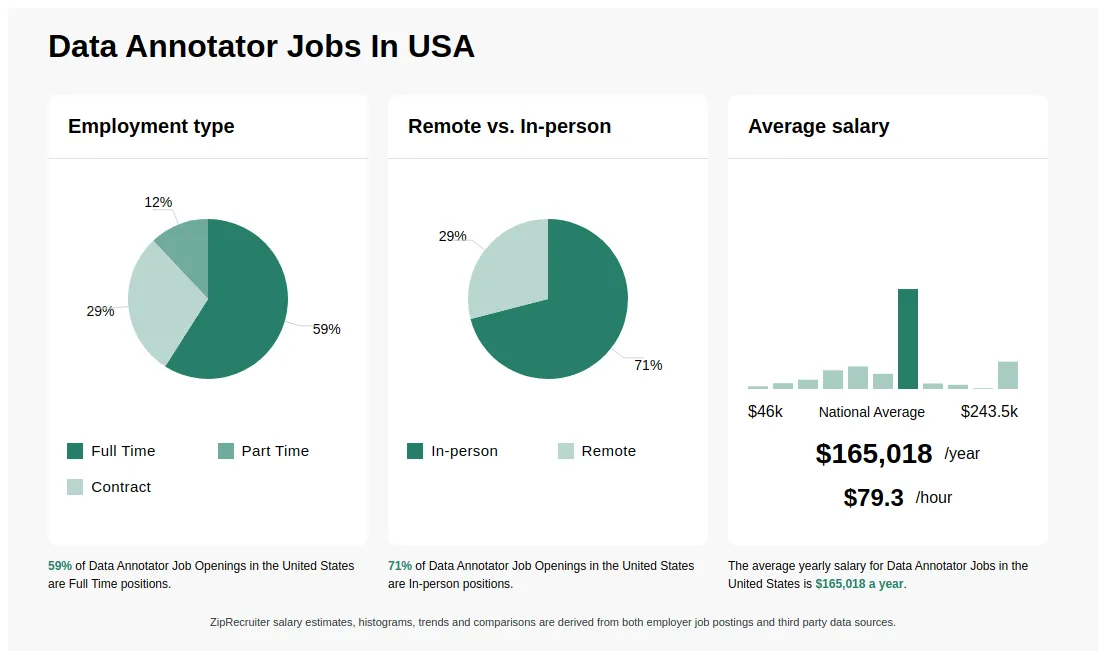
$46K

$165K

$243.5K

How much do data annotator jobs pay per year?

As of Jun 7, 2026, the average yearly pay for data annotator in the United States is $165,018.00, according to ZipRecruiter salary data. Most workers in this role earn between $133,500.00 and $170,000.00 per year, depending on experience, location, and employer.

What are Data Annotators?

Data Annotators are professionals who label or tag data such as images, text, audio, or video to prepare it for use in machine learning and artificial intelligence (AI) models. Their work is crucial because accurately labeled data helps algorithms learn to recognize patterns and make decisions. Data annotators may use specialized software tools to highlight objects, transcribe speech, or classify documents according to specific guidelines. The quality and accuracy of their annotations directly affect the performance of AI systems.

What is the difference between Data Annotator vs Data Labeler?

AspectData AnnotatorData Labeler
Required CredentialsHigh school diploma or equivalent; some roles may prefer basic technical skillsSimilar; often requires only basic education and attention to detail
Work EnvironmentRemote or office-based; working with datasets and annotation toolsPrimarily remote; focused on labeling data for machine learning
Industry UsageUsed across AI, machine learning, and data science industriesCommonly used in AI and machine learning sectors for training data
Search & Comparison IntentOften compared due to similar tasks and roles in data preparation

Both Data Annotators and Data Labelers perform data preparation tasks for AI models, often with overlapping skills and work environments. The main difference lies in terminology used by employers or platforms, but their roles are largely similar, focusing on labeling data to improve machine learning algorithms.

What are the typical challenges Data Annotators face when working with large datasets, and how can they overcome them?

Data Annotators often encounter challenges such as repetitive tasks, maintaining high accuracy, and dealing with ambiguous data points when working with large datasets. To overcome these, it's important to follow clear annotation guidelines, regularly communicate with team leads or project managers about uncertainties, and leverage quality control tools provided by the organization. Collaborating with peers and participating in review sessions can also help ensure consistency and improve the overall quality of the annotations.

What are the key skills and qualifications needed to thrive as a Data Annotator, and why are they important?

To thrive as a Data Annotator, you need attention to detail, accuracy, and a basic understanding of data structures, often supported by a high school diploma or equivalent. Familiarity with data labeling platforms, annotation tools like Labelbox or Supervisely, and sometimes basic coding skills are typically required. Strong organizational skills, patience, and the ability to follow precise guidelines make someone stand out in this position. These skills and qualities are crucial for producing high-quality datasets that drive effective machine learning and AI model development.
More about Data Annotator jobs
What cities are hiring for Data Annotator jobs? Cities with the most Data Annotator job openings:
What are the most commonly searched types of Data Annotator jobs? The most popular types of Data Annotator jobs are:
Who are the top companies hiring for Data Annotator jobs? The top employers for Data Annotator jobs are:
What states have the most Data Annotator jobs? States with the most job openings for Data Annotator jobs include:
Infographic showing various Data Annotator job openings in the United States as of May 2026, with employment types broken down into 18% Internship, 64% As Needed, and 18% Nights. Highlights an 56% Physical, 1% Hybrid, and 43% Remote job distribution, with an average salary of $165,018 per year, or $79.3 per hour.

Research Scientist - Frontier Data

AfterQuery

San Francisco, CA โ€ข On-site

$150K - $250K/yr

Full-time

Posted 23 days ago


Job description

About AfterQuery
AfterQuery builds the training data and evaluation infrastructure that frontier AI labs use to make their models better. We work with the world's leading labs to design high signal datasets and run rigorous evaluations that go beyond static benchmarks. We are a small, early team (post Series A) where individual contributors have a direct impact on how the next generation of models learn and improve.
The Role
You'll design the datasets and evaluation frameworks that shape how frontier models are trained and measured. Working directly with research teams at top AI labs, you'll experiment with data collection strategies, diagnose model failure modes, and develop the metrics that determine whether a model is actually getting better. This is hands-on, high leverage work: you'll go from hypothesis to live experiment quickly, and your output will directly influence model training runs at scale.
What You'll Do
  • Design data slides and explore data shapes that expose meaningful model failure modes across domains like finance, code, and enterprise workflows
  • Build and refine evaluation rubrics and reward signals for RLHF and RLVR training pipelines
  • Model annotator behavior and run experiments to improve different model capabilities
  • Develop quantitative frameworks for measuring dataset quality, diversity, and downstream impact on model alignment and capability
  • Partner with lab research teams to translate their training objectives into concrete data and evaluation specifications

What We're Looking For
  • Great candidates are undergrad research or master's research (but haven't done a phd)
  • Major plus if they've worked for/interned for any RL environment companies in the past or any AI safety or benchmarking orgs like METR, Artificial Analysis, etc..
  • Genuine obsession with how data structure, selection, and quality drive model behavior
  • Ability to design lightweight experiments, move fast, and extract actionable insights from messy results
  • Comfort working across domains (you'll touch finance, software engineering, policy, and more)
  • Strong quantitative instincts and familiarity with LLM training pipelines, RLHF/RLVR, or evaluation methodology
  • A bias toward building over theorizing

Compensation Structure:
$250k-450k total compensation + equity