1

Data Annotator Jobs (NOW HIRING)

We are looking for Language Data Annotators to support the improvement of AI-generated content in English . Job Type: Freelance Location: Texas, work from home Work Schedule: Part-time - 10+ hours ...

We are looking for Language Data Annotators to support the improvement of AI-generated content in English . Job Type: Freelance Location: Texas, work from home Work Schedule: Part-time - 10+ hours ...

Image Annotator

Fort Worth, TX · Remote

$22.90/hr

The Image Annotator (also known as a Defect Annotator) is responsible for reviewing and analyzing ... Team members use data-driven processes to locate and review images containing defects of interest ...

RWS Group is seeking USA-based Dutch Data Annotators to annotate, evaluate, and curate text, video, and geographic data for AI models. The role involves collaboration with project managers and ...

next page

Showing results 1-20

Data Annotator information

See salary details

$46K

$165K

$243.5K

How much do data annotator jobs pay per year?

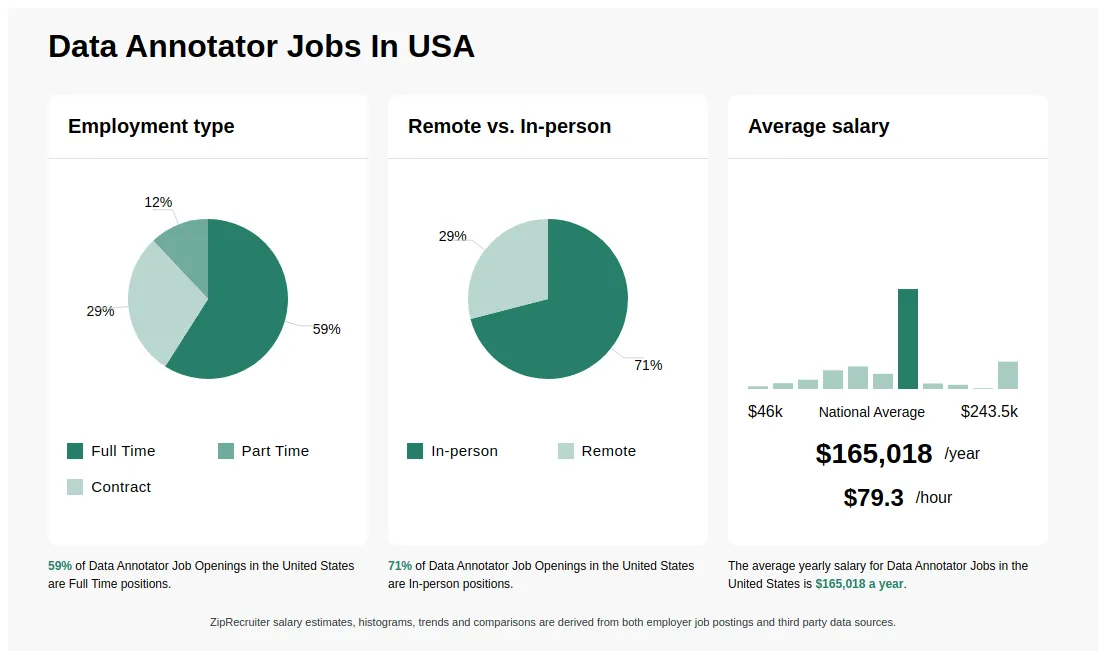
As of Jul 1, 2026, the average yearly pay for data annotator in the United States is $165,018.00, according to ZipRecruiter salary data. Most workers in this role earn between $133,500.00 and $170,000.00 per year, depending on experience, location, and employer.

What are Data Annotators?

Data Annotators are professionals who label or tag data such as images, text, audio, or video to prepare it for use in machine learning and artificial intelligence (AI) models. Their work is crucial because accurately labeled data helps algorithms learn to recognize patterns and make decisions. Data annotators may use specialized software tools to highlight objects, transcribe speech, or classify documents according to specific guidelines. The quality and accuracy of their annotations directly affect the performance of AI systems.

What is the difference between Data Annotator vs Data Labeler?

AspectData AnnotatorData Labeler
Required CredentialsHigh school diploma or equivalent; some roles may prefer basic technical skillsSimilar; often requires only basic education and attention to detail
Work EnvironmentRemote or office-based; working with datasets and annotation toolsPrimarily remote; focused on labeling data for machine learning
Industry UsageUsed across AI, machine learning, and data science industriesCommonly used in AI and machine learning sectors for training data
Search & Comparison IntentOften compared due to similar tasks and roles in data preparation

Both Data Annotators and Data Labelers perform data preparation tasks for AI models, often with overlapping skills and work environments. The main difference lies in terminology used by employers or platforms, but their roles are largely similar, focusing on labeling data to improve machine learning algorithms.

What is the role of a data annotator?

A data annotator is responsible for labeling and categorizing data such as images, text, or videos to help machine learning models understand and process information. This role often involves using annotation tools and requires attention to detail to ensure data accuracy, which is essential for training effective AI systems.

How much do data annotators get paid?

Data annotators typically earn between $10 and $20 per hour, depending on experience, location, and the complexity of the annotation tasks. Some positions may offer project-based pay or part-time schedules, and familiarity with annotation tools can improve earning potential.

What are the typical challenges Data Annotators face when working with large datasets, and how can they overcome them?

Data Annotators often encounter challenges such as repetitive tasks, maintaining high accuracy, and dealing with ambiguous data points when working with large datasets. To overcome these, it's important to follow clear annotation guidelines, regularly communicate with team leads or project managers about uncertainties, and leverage quality control tools provided by the organization. Collaborating with peers and participating in review sessions can also help ensure consistency and improve the overall quality of the annotations.

What is a data annotation job?

A data annotation job involves labeling or tagging data such as images, text, or videos to help machine learning models understand and process information. Annotators typically use specialized tools and need attention to detail to ensure data accuracy, which is essential for training AI systems effectively.

What does a data annotator do?

A data annotator labels and tags data such as images, text, or audio to help machine learning models understand and learn from the data. They often use specialized tools and need attention to detail to ensure accuracy, supporting AI development and data quality. The role typically requires good organizational skills and may involve working with large datasets on flexible schedules.

What are the key skills and qualifications needed to thrive as a Data Annotator, and why are they important?

To thrive as a Data Annotator, you need attention to detail, accuracy, and a basic understanding of data structures, often supported by a high school diploma or equivalent. Familiarity with data labeling platforms, annotation tools like Labelbox or Supervisely, and sometimes basic coding skills are typically required. Strong organizational skills, patience, and the ability to follow precise guidelines make someone stand out in this position. These skills and qualities are crucial for producing high-quality datasets that drive effective machine learning and AI model development.
More about Data Annotator jobs
What cities are hiring for Data Annotator jobs? Cities with the most Data Annotator job openings:
What are the most commonly searched types of Data Annotator jobs? The most popular types of Data Annotator jobs are:
Who are the top companies hiring for Data Annotator jobs? The top employers for Data Annotator jobs are:
What states have the most Data Annotator jobs? States with the most job openings for Data Annotator jobs include:
Infographic showing various Data Annotator job openings in the United States as of June 2026, with employment types broken down into 1% As Needed, 88% Full Time, and 11% Part Time. Highlights an 87% Physical, 3% Hybrid, and 10% Remote job distribution, with an average salary of $165,018 per year, or $79.3 per hour.

AI Trainer - Freelance Data Annotator

Toloka Annotators

Remote

$23/hr

Part-time

Posted 21 days ago


Job description

Please submit your resume in English and indicate your level of English.
At Toloka, we connect smart, curious people from around the world with freelance online tasks that train and improve artificial intelligence.
What we do
The Toloka Annotators connects individuals with Generative AI projects from leading tech innovators. Our mission is to unlock the full potential of AI by involving real people from around the world in the development process.
About the Role
Annotation is what helps AI make sense of the world. As an annotator, you may be invited to take part in online projects such as rating AI-generated content, evaluating factual accuracy, or comparing responses - when projects are available.
Responsibilities:
  • Carefully review provided data (text, images, or videos)
  • Label or classify content based on project guidelines
  • Identify and flag factually incorrect, sensitive, inappropriate, or unclear material

Important note: This is project-based work. Tasks are available only when projects are active. You may be invited to one or more projects depending on your profile and current opportunities.
Each project has its own compensation level based on scope and expertise required. On this project, AI trainers earn up to $23 per hour equivalent.
Requirements
  • Bachelor's degree in any discipline
  • Minimum 1 year of experience in any professional role
  • Advanced level of English (C1 or higher), both written and spoken
  • Logical thinking, fact-checking and reasoning abilities
  • Strong attention to detail and ability to understand and follow complex instructions
  • Strong communication skills, including the ability to ask clarifying questions when needed
  • Genuine interest in technology and artificial intelligence

Benefits
Why this freelance opportunity might be a great fit for you?
  • Take part in a part-time, remote, freelance project that fits around your primary professional or academic commitments.
  • Work on advanced AI projects and gain valuable experience that enhances your portfolio.
  • Influence how future AI models understand and communicate in your field of expertise.