The National Cyber-Forensics & Training Alliance (NCFTA) is a Pittsburgh based globally focused non-profit corporation committed to identifying, mitigating and neutralizing cyber crime threats. The ...
The National Cyber-Forensics & Training Alliance (NCFTA) is a Pittsburgh based globally focused non-profit corporation committed to identifying, mitigating and neutralizing cyber crime threats. The ...
The National Cyber-Forensics & Training Alliance (NCFTA) is a Pittsburgh based globally focused non-profit corporation committed to identifying, mitigating and neutralizing cyber crime threats. The ...
The National Cyber-Forensics & Training Alliance (NCFTA) is a Pittsburgh based globally focused non-profit corporation committed to identifying, mitigating and neutralizing cyber crime threats. The ...
Our capabilities include cyber space operations, cyber defense and resiliency, vulnerability ... Nightwing is seeking a Network Forensics Analyst to support this critical customer mission.
Our capabilities include cyber space operations, cyber defense and resiliency, vulnerability ... Nightwing is seeking a Network Forensics Analyst to support this critical customer mission.
Our capabilities include cyber space operations, cyber defense and resiliency, vulnerability ... Nightwing is seeking a Network Forensics Analyst to support this critical customer mission.
Our capabilities include cyber space operations, cyber defense and resiliency, vulnerability ... Nightwing is seeking a Network Forensics Analyst to support this critical customer mission.
Our capabilities include cyber space operations, cyber defense and resiliency, vulnerability ... Nightwing is seeking a Network Forensics Analyst to support this critical customer mission.
Our capabilities include cyber space operations, cyber defense and resiliency, vulnerability ... Nightwing is seeking a Network Forensics Analyst to support this critical customer mission.

Cyber Defense Response Analyst II
$93K - $156K/yr
The Cyber Defense Response Analyst II is a mid-level technical role focused on responding to and ... Digital Forensics and Incident Response: Drive the full incident response lifecycle from initial ...
Cyber Defense Response Analyst II
$93K - $156K/yr
The Cyber Defense Response Analyst II is a mid-level technical role focused on responding to and ... Digital Forensics and Incident Response: Drive the full incident response lifecycle from initial ...
Cyber Defense Response Analyst II
Chicago, IL · On-site
$93K - $156K/yr
The Cyber Defense Response Analyst II is a mid-level technical role focused on responding to and ... Digital Forensics and Incident Response: Drive the full incident response lifecycle from initial ...
Cyber Defense Response Analyst II
Chicago, IL · On-site
$93K - $156K/yr
The Cyber Defense Response Analyst II is a mid-level technical role focused on responding to and ... Digital Forensics and Incident Response: Drive the full incident response lifecycle from initial ...
Cyber Defense Response Analyst II
Chicago, IL · On-site
$93K - $156K/yr
The Cyber Defense Response Analyst II is a mid-level technical role focused on responding to and ... Digital Forensics and Incident Response: Drive the full incident response lifecycle from initial ...
Cyber Defense Response Analyst II
Chicago, IL · On-site
$93K - $156K/yr
The Cyber Defense Response Analyst II is a mid-level technical role focused on responding to and ... Digital Forensics and Incident Response: Drive the full incident response lifecycle from initial ...

Network Forensics Cybersecurity Analyst * Arlington, VA * Information Technology Our Partner ... experience cyber-attacks. They provide advanced technical assistance, proactive hunting, rapid ...
Network Forensics Cybersecurity Analyst * Arlington, VA * Information Technology Our Partner ... experience cyber-attacks. They provide advanced technical assistance, proactive hunting, rapid ...
Work is seeking a skilled Digital Forensics Specialist to conduct forensic investigations and ... cyber attacks. • Reconstruct attack timelines and determine root causes of security incidents ...
Work is seeking a skilled Digital Forensics Specialist to conduct forensic investigations and ... cyber attacks. • Reconstruct attack timelines and determine root causes of security incidents ...
Contract personnel provide front line response for digital forensics/incident response (DFIR) and proactively hunt for malicious cyber activity. They are seeking Host Forensics Analysts to support ...
Contract personnel provide front line response for digital forensics/incident response (DFIR) and proactively hunt for malicious cyber activity. They are seeking Host Forensics Analysts to support ...

Cyber Forensic Specialist
Arlington, VA · On-site
... Digital Forensics and Incident Response (DFIR) team. This role is critical in supporting the organization's Cyber Incident Response Team (CIRT) by providing expert-level digital forensic and ...
Cyber Forensic Specialist
Arlington, VA · On-site
... Digital Forensics and Incident Response (DFIR) team. This role is critical in supporting the organization's Cyber Incident Response Team (CIRT) by providing expert-level digital forensic and ...

Cyber Network Defense Analyst (CNDA) - Cloud Forensics
Arlington, VA · On-site
$130K - $160K/yr
Our teams provide rapid incident response, digital forensics, proactive hunt operations, and continuous cyber defense across host-based, network-based, and cloud-based systems. We combine mission ...
Quick apply
Cyber Network Defense Analyst (CNDA) - Cloud Forensics
Arlington, VA · On-site
$130K - $160K/yr
Our teams provide rapid incident response, digital forensics, proactive hunt operations, and continuous cyber defense across host-based, network-based, and cloud-based systems. We combine mission ...
Cyber Forensic Specialist
Arlington, VA · On-site
... Digital Forensics and Incident Response (DFIR) team. This role is critical in supporting the organization's Cyber Incident Response Team (CIRT) by providing expert-level digital forensic and ...
Cyber Forensic Specialist
Arlington, VA · On-site
... Digital Forensics and Incident Response (DFIR) team. This role is critical in supporting the organization's Cyber Incident Response Team (CIRT) by providing expert-level digital forensic and ...
Cyber Forensic Specialist
Arlington, VA · On-site
... Digital Forensics and Incident Response (DFIR) team. This role is critical in supporting the organization's Cyber Incident Response Team (CIRT) by providing expert-level digital forensic and ...
Cyber Forensic Specialist
Arlington, VA · On-site
... Digital Forensics and Incident Response (DFIR) team. This role is critical in supporting the organization's Cyber Incident Response Team (CIRT) by providing expert-level digital forensic and ...
Team personnel provide front line response for digital forensics/incident response (DFIR) and proactively hunting for malicious cyber activity. They are seeking Cyber Network Defense Analysts (CNDA ...
Quick apply
Team personnel provide front line response for digital forensics/incident response (DFIR) and proactively hunting for malicious cyber activity. They are seeking Cyber Network Defense Analysts (CNDA ...

Cyber Network Defense Analyst Location: Arlington, VA Clearance: Active TS/SCI Required Company ... Key Responsibilities • Conduct forensic investigations across Microsoft 365, Azure/Entra ID, AWS ...
Cyber Network Defense Analyst Location: Arlington, VA Clearance: Active TS/SCI Required Company ... Key Responsibilities • Conduct forensic investigations across Microsoft 365, Azure/Entra ID, AWS ...
They are seeking a Cyber Host Forensic Analyst III to support U.S. Government customers with onsite ... forensics liaison to stakeholders and explaining investigation details to include forensic ...
They are seeking a Cyber Host Forensic Analyst III to support U.S. Government customers with onsite ... forensics liaison to stakeholders and explaining investigation details to include forensic ...
... forensics, information assurance, systems engineering, and/or network and systems administration. * Experience applying cyber operational knowledge to adversary networks, network defenses, and ...
... forensics, information assurance, systems engineering, and/or network and systems administration. * Experience applying cyber operational knowledge to adversary networks, network defenses, and ...
Cyber Threat Hunter
Sterling, VA · On-site
$130K - $140K/yr
Cyber Threat Hunter - SME Location: Sterling, VA and Beltsville, MD Terms: Full-time Requirements ... Conducts forensic, malicious code, and packet-level analyses to develop comprehensive technical ...
Quick apply
Cyber Threat Hunter
Sterling, VA · On-site
$130K - $140K/yr
Cyber Threat Hunter - SME Location: Sterling, VA and Beltsville, MD Terms: Full-time Requirements ... Conducts forensic, malicious code, and packet-level analyses to develop comprehensive technical ...
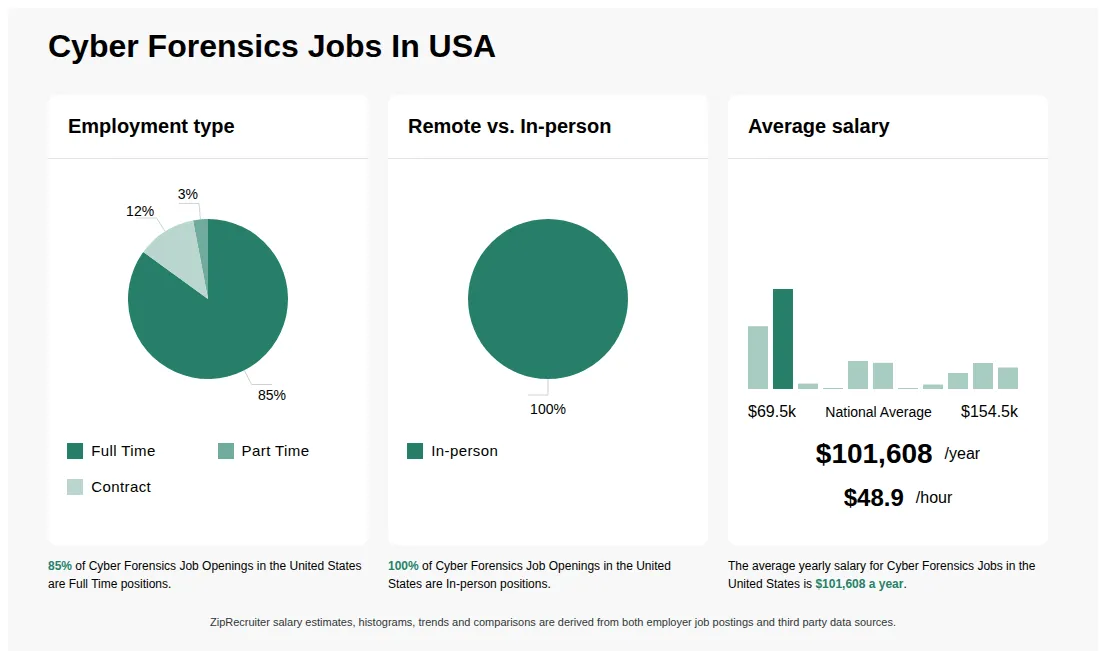
Cyber Forensics information
See salary details
$69.5K - $77.2K
22% of jobs
$77.8K is the 25th percentile. Wages below this are outliers.
$77.2K - $85K
36% of jobs
$85K - $92.7K
1% of jobs
$92.7K - $100.4K
0% of jobs
$100.4K - $108.1K
10% of jobs
$113.4K is the 75th percentile. Wages above this are outliers.
$108.1K - $115.9K
9% of jobs
$115.9K - $123.6K
0% of jobs
$123.6K - $131.3K
1% of jobs
$131.3K - $139K
5% of jobs
$139K - $146.8K
9% of jobs
$146.8K - $154.5K
7% of jobs
$69.5K
$101.6K
$154.5K
How much do cyber forensics jobs pay per year?
As of Sep 4, 2026, the average yearly pay for cyber forensics in the United States is $101,608.00, according to ZipRecruiter salary data. Most workers in this role earn between $78,500.00 and $132,000.00 per year, depending on experience, location, and employer.
What is a cyber forensics?
A Cyber Forensics job involves investigating digital crimes by analyzing electronic devices, networks, and data to uncover evidence of cybercrimes such as hacking, fraud, and data breaches. Cyber forensic professionals use specialized tools and techniques to recover deleted files, trace cybercriminal activities, and ensure the integrity of digital evidence for legal proceedings. They often work with law enforcement, government agencies, or private companies to prevent and mitigate cyber threats. Additionally, they may provide expert testimony in court and help strengthen an organization’s cybersecurity measures.
What are the typical daily responsibilities of a cyber forensics professional?
A Cyber Forensics professional usually spends their day collecting, preserving, and analyzing digital evidence from computers, networks, and mobile devices. They may be tasked with investigating security breaches, recovering deleted or encrypted data, preparing detailed forensic reports, and supporting legal proceedings with credible findings. Collaboration with IT security teams, law enforcement, or legal counsel is common, requiring clear documentation and communication. These responsibilities help organizations or law enforcement agencies understand the nature of security incidents and take appropriate actions.
What are the key skills and qualifications needed to thrive in cyber forensics?
To thrive in Cyber Forensics, you need expertise in computer science, digital evidence handling, and incident response, typically supported by a degree in a related field and industry-recognized certifications like EnCE or GCFA. Familiarity with tools such as EnCase, FTK, X-Ways, Cellebrite, and knowledge of operating systems and forensic imaging software is essential. Strong analytical thinking, attention to detail, clear communication, and the ability to work under pressure are crucial soft skills. These skills ensure the accurate extraction, analysis, and reporting of digital evidence in criminal investigations and corporate security incidents.
How much do cybersecurity forensics make?
Cyber forensics specialists typically earn between $60,000 and $120,000 annually, depending on experience, certifications, and location. Entry-level roles may start lower, while experienced professionals with certifications like GCFA or CISSP can command higher salaries, especially in larger organizations or high-demand areas.
Is cyber forensics a good career?
Cyber forensics is a growing field that involves investigating cybercrimes and analyzing digital evidence using specialized tools and techniques. It offers opportunities in law enforcement, private security, and consulting, often requiring certifications like GCFA or EnCE. The profession typically demands strong technical skills, attention to detail, and the ability to work under pressure.
What are the jobs in cyber forensics?
Jobs in cyber forensics include roles such as digital forensic analyst, cyber security investigator, incident responder, and forensic examiner. These professionals analyze digital evidence, use specialized tools like EnCase or FTK, and often require certifications such as GCFA or EnCE to investigate cybercrimes and security breaches.
What can you do with a cyber forensics degree?
A cyber forensics degree prepares individuals for roles in digital investigation, data recovery, and cybersecurity analysis. Graduates can work as digital forensic analysts, incident responders, or cybersecurity specialists, often using tools like EnCase or FTK and obtaining certifications such as GCFA or CISSP to enhance career prospects.
More about Cyber Forensics jobs
What cities are hiring for Cyber Forensics jobs?
Cities with the most Cyber Forensics job openings:
What are the most commonly searched types of Cyber Forensics jobs?
The most popular types of Cyber Forensics jobs are:
What states have the most Cyber Forensics jobs?
States with the most job openings for Cyber Forensics jobs include:
What job categories do people searching Cyber Forensics jobs look for?
The top searched job categories for Cyber Forensics jobs are:

Cyber Intelligence Analyst Internships Fall 2026
Pittsburgh, PA
Part-time
Re-posted 10 days ago
Job description
Who we are: The National Cyber-Forensics & Training Alliance (NCFTA) is a Pittsburgh based globally focused non-profit corporation committed to identifying, mitigating and neutralizing cyber crime threats. The NCFTA operates by conducting real time information sharing by analysis and subject matter experts in the public, private and academic sectors. Through these partnerships, the NCFTA proactively identifies cyber threats in order to help its partners take preventive measures to mitigate and neutralize those threats. For more information see www.ncfta.net.
About the Program: The NCFTA offers talented students an innovative work experience in a growing sector that will help them enhance their professional development and academic goals. Our program offers paid internships for undergraduate and graduate degree students. It is an intensive 12-week program that gives rising college seniors or graduate level students the opportunity to work in areas such as intellectual property fraud, financial fraud, and malware and cyber threats in order to build knowledge and skills in the intelligence analysis field. The student will receive training and be part of the team from day one. They will be assigned to a manager and mentor to enable them to quickly learn and acclimate. During their first few weeks on the team, they will participate in the internship orientation to become familiar with the NCFTA's various resources, policies and procedures.
Role of the Intern: Selected candidates will work on various organizational program initiatives. Duties will focus on conducting research and data collection using various tools and applications as well as proactive research in open sources to produce a finished product for dissemination. The intern will engage in collaboration with NCFTA partners and peers and be expected to participate in program meetings.
Internships with our Malware & Cyber Threats Program are more technical in nature and, as such, applicants with a technical interest and background are desired. These duties may include writing scripts to automate processes (e.g. Python scripts), reviewing and analyzing malicious code (e.g. C, C++, VB.NET, Assembly, Java), and creating databases (MySQL, MS SQL Server, Postgres). Also, technical threat actor hunting and identity attribution to cybercriminals on the dark web and clear net sites. Students with working knowledge of Mac OS may have an opportunity to work on special projects.
Required Qualifications
Must be legally authorized to work in the United States and be eligible for a U.S. Government security clearance
Major studies in areas of consideration: International Affairs/Politics/Relations; Intelligence/Security Studies; Computer Science; Information Security; Business Intelligence or related fields. Other majors are considered on a case-by-case basis.
Minimum GPA of 3.0
Excellent writing skills and strong analytical thinking
Proficiency in Microsoft Office required
Arabic, Turkish, Russian, Chinese and Eastern European language skills desirable but not required
Extensive experience with computers and networking highly preferred but not required
Candidate Skills: While applicants come from a range of academic backgrounds, the most competitive applicants also should possess the following:
Flexibility and adaptability
Take initiative and be self-motivated
Work well with others and have strong interpersonal abilities
Good judgment and decision-making skills
Locations: Internships are available in Pittsburgh, PA

About NATIONAL CYBER-FORENSICS & TRAINING ALLIANCE
Sourced by ZipRecruiter