Crime Scene Supervisor Summary : Under close supervision, performs a wide variety of tasks ... Assists with documenting crime scenes by taking photos and video as directed by OPD Officers and ...
Crime Scene Supervisor Summary : Under close supervision, performs a wide variety of tasks ... Assists with documenting crime scenes by taking photos and video as directed by OPD Officers and ...

Police Crime Scene Unit Technician
Odessa, TX · On-site
$21.75 - $30.96/hr
Crime Scene Supervisor Summary : Under close supervision, performs a wide variety of tasks ... Assists with documenting crime scenes by taking photos and video as directed by OPD Officers and ...
Police Crime Scene Unit Technician
Odessa, TX · On-site
$21.75 - $30.96/hr
Crime Scene Supervisor Summary : Under close supervision, performs a wide variety of tasks ... Assists with documenting crime scenes by taking photos and video as directed by OPD Officers and ...
Crime Scene Investigator (Police Department)
San Angelo, TX · On-site
$47K/yr
Identifies, collects and preserves crime scene and accident scene evidence to aid in the ... crime scenes; photographs persons, crime scenes and other areas related to investigations.
Crime Scene Investigator (Police Department)
San Angelo, TX · On-site
$47K/yr
Identifies, collects and preserves crime scene and accident scene evidence to aid in the ... crime scenes; photographs persons, crime scenes and other areas related to investigations.

Crime Scene Analyst
Sarasota, FL · On-site
$68K - $91K/yr
Attend autopsies to photograph, collect, document, and package all evidence obtained from decedents ... crime scene; generate rough draft sketch of crime scene; document and photograph blood splatter ...
Crime Scene Analyst
Sarasota, FL · On-site
$68K - $91K/yr
Attend autopsies to photograph, collect, document, and package all evidence obtained from decedents ... crime scene; generate rough draft sketch of crime scene; document and photograph blood splatter ...

Crime Scene Analyst
Denton, TX · On-site
$27.01 - $35.12/hr
... photographic techniques using alternate light sources. * Conduct analytical examinations on ... Must obtain a valid Certified Crime Scene Investigator (CCSI), Certified Crime Scene Analyst (CCSA ...
Crime Scene Analyst
Denton, TX · On-site
$27.01 - $35.12/hr
... photographic techniques using alternate light sources. * Conduct analytical examinations on ... Must obtain a valid Certified Crime Scene Investigator (CCSI), Certified Crime Scene Analyst (CCSA ...
Crime Scene Analyst
Denton, TX · On-site
$27.01 - $35.12/hr
... photographic techniques using alternate light sources. Conduct analytical examinations on collected ... Crime Scene Analyst (CSCSA) certification within two (2) years of employment; OR One (1) year ...
Crime Scene Analyst
Denton, TX · On-site
$27.01 - $35.12/hr
... photographic techniques using alternate light sources. Conduct analytical examinations on collected ... Crime Scene Analyst (CSCSA) certification within two (2) years of employment; OR One (1) year ...
Crime Scene Analyst
Sarasota, FL · On-site
$68K - $91K/yr
INV-Crime Scene Unit Opening Date: 08/24/2026 Closing Date: 9/6/2026 11:59 PM Eastern All ... Attend autopsies to photograph, collect, document, and package all evidence obtained from decedents.
Crime Scene Analyst
Sarasota, FL · On-site
$68K - $91K/yr
INV-Crime Scene Unit Opening Date: 08/24/2026 Closing Date: 9/6/2026 11:59 PM Eastern All ... Attend autopsies to photograph, collect, document, and package all evidence obtained from decedents.

Crime Scene Cleanup Technician
Newark, NJ · On-site
$20 - $28/hr
We are actively hiring a Crime Scene Cleanup Technician to help clean and remediate environments ... Document and photograph work before and after remediation. * Maintain equipment and supplies in ...
Crime Scene Cleanup Technician
Newark, NJ · On-site
$20 - $28/hr
We are actively hiring a Crime Scene Cleanup Technician to help clean and remediate environments ... Document and photograph work before and after remediation. * Maintain equipment and supplies in ...
Crime Scene Cleanup Technician
Oklahoma City, OK · On-site
$20 - $28/hr
We are actively hiring a Crime Scene Cleanup Technician to help clean and remediate environments ... Document and photograph work before and after remediation. * Maintain equipment and supplies in ...
Quick apply
Crime Scene Cleanup Technician
Oklahoma City, OK · On-site
$20 - $28/hr
We are actively hiring a Crime Scene Cleanup Technician to help clean and remediate environments ... Document and photograph work before and after remediation. * Maintain equipment and supplies in ...
Crime Scene Cleanup Technician
Oklahoma City, OK · On-site
$20 - $28/hr
We are actively hiring a Crime Scene Cleanup Technician to help clean and remediate environments ... Document and photograph work before and after remediation. * Maintain equipment and supplies in ...
Crime Scene Cleanup Technician
Oklahoma City, OK · On-site
$20 - $28/hr
We are actively hiring a Crime Scene Cleanup Technician to help clean and remediate environments ... Document and photograph work before and after remediation. * Maintain equipment and supplies in ...
Crime Scene Cleanup Technician
Orlando, FL · On-site
$30/hr
We are actively hiring a Crime Scene Cleanup Technician to help clean and remediate environments ... Document and photograph work before and after remediation. * Maintain equipment and supplies in ...
Quick apply
Crime Scene Cleanup Technician
Orlando, FL · On-site
$30/hr
We are actively hiring a Crime Scene Cleanup Technician to help clean and remediate environments ... Document and photograph work before and after remediation. * Maintain equipment and supplies in ...

Takes crime scene photos. Reviews security / surveillance footage. * Conducts surveillance, investigations and internal investigations * Prepares investigative and activity reports, maintains records ...
Takes crime scene photos. Reviews security / surveillance footage. * Conducts surveillance, investigations and internal investigations * Prepares investigative and activity reports, maintains records ...
Crime Scene Cleanup Technician
Newark, NJ · On-site
$20 - $28/hr
We are actively hiring a Crime Scene Cleanup Technician to help clean and remediate environments ... Document and photograph work before and after remediation. * Maintain equipment and supplies in ...
Quick apply
Crime Scene Cleanup Technician
Newark, NJ · On-site
$20 - $28/hr
We are actively hiring a Crime Scene Cleanup Technician to help clean and remediate environments ... Document and photograph work before and after remediation. * Maintain equipment and supplies in ...
Crime Scene Cleanup Technician
Orlando, FL · On-site
$30/hr
We are actively hiring a Crime Scene Cleanup Technician to help clean and remediate environments ... Document and photograph work before and after remediation. * Maintain equipment and supplies in ...
Quick apply
Crime Scene Cleanup Technician
Orlando, FL · On-site
$30/hr
We are actively hiring a Crime Scene Cleanup Technician to help clean and remediate environments ... Document and photograph work before and after remediation. * Maintain equipment and supplies in ...
Takes crime scene photos. Reviews security / surveillance footage. * Conducts surveillance, investigations and internal investigations * Prepares investigative and activity reports, maintains records ...
Takes crime scene photos. Reviews security / surveillance footage. * Conducts surveillance, investigations and internal investigations * Prepares investigative and activity reports, maintains records ...
Crime Scene Unit Team Leader
Grand Rapids, MI · On-site
$49.66/hr
... the Crime Scene Unit (CSU) Specialists. The primary responsibilities of this position include ... Proficiency in Excel, databases, graphics, CAD, digital photography software, and flowcharting.
Crime Scene Unit Team Leader
Grand Rapids, MI · On-site
$49.66/hr
... the Crime Scene Unit (CSU) Specialists. The primary responsibilities of this position include ... Proficiency in Excel, databases, graphics, CAD, digital photography software, and flowcharting.
Takes crime scene photos. Reviews security / surveillance footage. * Conducts surveillance, investigations and internal investigations * Prepares investigative and activity reports, maintains records ...
Quick apply
Takes crime scene photos. Reviews security / surveillance footage. * Conducts surveillance, investigations and internal investigations * Prepares investigative and activity reports, maintains records ...

... the Crime Scene Unit (CSU) Specialists. The primary responsibilities of this position include ... Proficiency in Excel, databases, graphics, CAD, digital photography software, and flowcharting.
... the Crime Scene Unit (CSU) Specialists. The primary responsibilities of this position include ... Proficiency in Excel, databases, graphics, CAD, digital photography software, and flowcharting.
Forensic Specialist at Crime Scene Resources, Inc Culver City, CA
Culver City, CA · On-site
$60 - $80/hr
Forensic Specialist job at Crime Scene Resources, Inc. Culver City, CA. Duties * This non-sworn ... This includes taking photographs, processing and lifting latent prints, and other processing ...
Forensic Specialist at Crime Scene Resources, Inc Culver City, CA
Culver City, CA · On-site
$60 - $80/hr
Forensic Specialist job at Crime Scene Resources, Inc. Culver City, CA. Duties * This non-sworn ... This includes taking photographs, processing and lifting latent prints, and other processing ...
Position Summary The Crime Scene / Clean up Technician is responsible for performing specialty ... Document work performed, take before-and-after photos when required, and complete service reports.
Quick apply
Position Summary The Crime Scene / Clean up Technician is responsible for performing specialty ... Document work performed, take before-and-after photos when required, and complete service reports.
Crime Scene Photographer information
See salary details
$9.62 - $12.11
3% of jobs
$12.11 - $14.60
14% of jobs
$15.36 is the 25th percentile. Wages below this are outliers.
$14.60 - $17.09
27% of jobs
The median wage is $17.69 / hr.
$17.09 - $19.58
26% of jobs
$20.71 is the 75th percentile. Wages above this are outliers.
$19.58 - $22.07
11% of jobs
$22.07 - $24.56
9% of jobs
$24.56 - $27.05
4% of jobs
$27.05 - $29.55
4% of jobs
$29.55 - $32.04
1% of jobs
$32.04 - $34.53
0% of jobs
$34.53 - $37.02
0% of jobs
$9
$20
$37
How much do crime scene photographer jobs pay per hour?
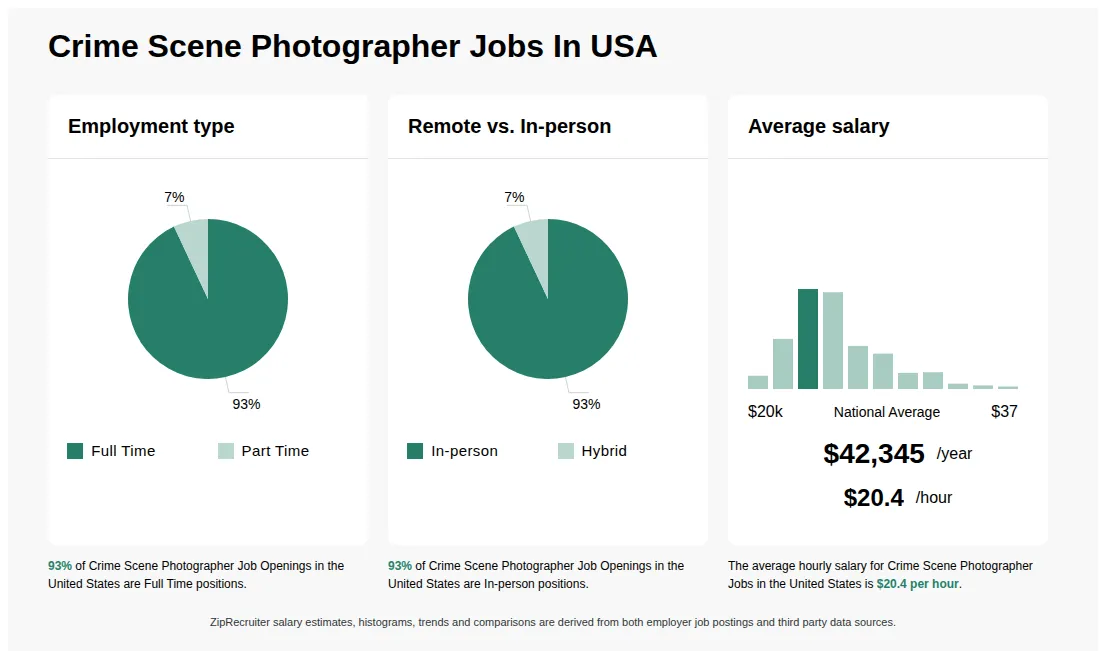
As of Sep 5, 2026, the average hourly pay for crime scene photographer in the United States is $20.36, according to ZipRecruiter salary data. Most workers in this role earn between $15.38 and $21.63 per hour, depending on experience, location, and employer.
What does a crime scene photographer do?
As a crime scene photographer, you apply forensic science principles to an investigation and collect images that may be useful to said investigation. You document and record physical evidence, ensure each photo has an item to provide scale, and coordinate with analysis labs to answer any questions. Crime scene photographers may be asked to document a site at any time of day or night and are often exposed to gruesome and tragic sites, so mental fortitude is essential to success in this field. Some crime scene photographers focus exclusively on this role while others serve in another position—often a law enforcement role—and switch to forensic photography as needed.
What does a crime scene photographer do?
A crime scene photographer is responsible for capturing detailed and accurate images of crime scenes, evidence, and sometimes victims, to support criminal investigations. Their photographs help law enforcement and legal professionals document and analyze crime scenes, preserve evidence, and present findings in court. Crime scene photographers must follow strict protocols to maintain the integrity of their images and often work closely with forensic teams to ensure all relevant details are documented.
What are some common challenges faced by crime scene photographers on the job?
Crime scene photographers often work in high-pressure environments where attention to detail is critical. Challenges can include working long or irregular hours, responding to crime scenes at short notice, and documenting scenes in difficult weather or lighting conditions. Additionally, maintaining objectivity and emotional resilience is important, as scenes may be distressing. Collaboration with law enforcement officers and forensic teams is frequent, requiring strong communication skills to ensure all necessary evidence is captured accurately.
What are the key skills and qualifications needed to thrive as a crime scene photographer, and why are they important?
To thrive as a Crime Scene Photographer, you need a solid understanding of forensic photography principles, attention to detail, and knowledge of law enforcement procedures, often supported by formal training or certification in forensic photography. Familiarity with digital cameras, photo editing software, and evidence management systems is crucial. Strong observational skills, discretion, and the ability to remain calm under pressure set top professionals apart in this field. These competencies ensure that photographic evidence is accurately captured, preserved, and admissible in court, supporting successful investigations and legal proceedings.
What is the difference between Crime Scene Photographer vs Forensic Photographer?
| Aspect | Crime Scene Photographer | Forensic Photographer |
|---|---|---|
| Credentials | Photography skills, law enforcement training | Photography skills, forensic science knowledge |
| Work Environment | Crime scenes, law enforcement agencies | Crime labs, law enforcement agencies |
| Industry Usage | Law enforcement, criminal investigations | Legal cases, forensic analysis |
Crime Scene Photographers focus on capturing images at crime scenes for investigative purposes, often working directly with law enforcement. Forensic Photographers have similar skills but may also have additional forensic science training, working in labs or detailed forensic documentation. Both roles are essential in criminal investigations, but their work environments and specific focus areas differ slightly.
How much money do crime scene photographers make?
Crime scene photographers typically earn between $30,000 and $70,000 annually, depending on experience, location, and employer. Entry-level positions may start lower, while experienced professionals with specialized skills or certifications can earn higher salaries.
More about Crime Scene Photographer jobs
What cities are hiring for Crime Scene Photographer jobs?
Cities with the most Crime Scene Photographer job openings:
What are the most commonly searched types of Crime Scene Photographer jobs?
The most popular types of Crime Scene Photographer jobs are:
Who are the top companies hiring for Crime Scene Photographer jobs?
The top employers for Crime Scene Photographer jobs are:
What states have the most Crime Scene Photographer jobs?
States with the most job openings for Crime Scene Photographer jobs include:
What job categories do people searching Crime Scene Photographer jobs look for?
The top searched job categories for Crime Scene Photographer jobs are:
What are popular job titles related to Crime Scene Photographer jobs?
For Crime Scene Photographer jobs, the most frequently searched job titles are:
Full-time
Posted 28 days ago
Job description
Department: Police Reports to: Crime Scene Supervisor
Summary: Under close supervision, performs a wide variety of tasks associated with the collection, processing, tracking, handling, and safekeeping of crime scene evidence for the Odessa Police Department (OPD); performs duties in compliance with state laws and OPD policies.
Essential Functions: Essential duties and responsibilities may include, but are not limited to, the following:
- Responds to crime scenes as directed, and assists OPD officers with investigations by processing the crime scene for evidence; collects and preserves crime scene and accident scene evidence to aid in the prosecution of criminals and crimes; performs work in compliance with state laws, City policies, and OPD quality standards; duties may vary according to job assignment and training.
- Collects, preserves, logs, and secures evidence as directed by officers and investigators; documents all handling of evidence and property; maintains activity logs and generates reports as needed.
- Assists with the identification of evidence at crime scenes, and mapping of the crime scene.
- Assists with documenting crime scenes by taking photos and video as directed by OPD Officers and other law enforcement agencies; responds to requests for photographs and videos.
- Receives property and evidence from law enforcement officers; documents receipt of items; maintains the chain of custody from intake to disposition.
- Collects fingerprint evidence and enters information into Automated Fingerprint Identification System (AFIS).
- Creates case notes and narrative summaries; maintains logs of services, cases, and information requests; requests additional information from OPD sources in order to supplement case notes.
- Assists and coordinates with other emergency services personnel, outside organizations and businesses, and Federal, state and local law enforcement organizations.
- Maintains the absolute confidentiality of all records and information.
- Supports the departmental operations with regular and timely attendance.
- Supports the relationship between the City of Odessa and the general public by demonstrating courteous and cooperative behavior when interacting with visitors and City staff; maintains confidentiality of work-related issues and City information; performs other duties as required or assigned.
Essential functions, as defined under the Americans with Disabilities Act, may include any of the representative duties, knowledge, and skills. This is not a comprehensive listing of all functions and duties performed by incumbents of this class; employees may be assigned duties which are not listed; reasonable accommodations will be made as required. The job description does not constitute an employment agreement and is subject to change at any time by the employer.
Minimum Qualifications:
Education, Training and Experience Guidelines: High School Diploma or GED required; one year of computer experience desired. Successful completion of a background investigation and polygraph is required.
Knowledge of:
- Rules for collecting, preserving, processing, and securing physical evidence.
- Federal and state laws governing the entry, storage, and transfer of evidence and property.
- State and Federal laws, regulations, and statutes governing management of property and evidence.
- Principles and practices of photographing and documenting crime scenes.
- Police radio, dispatch, and communication protocols and procedures.
- Principles of record keeping and confidential records management.
- Geography, roads, and landmarks of City and surrounding areas.
Skill in:
- Packaging and organizing numerous items of evidence in an orderly fashion for storage and retrieval.
- Carefully collecting, processing, and preserving crime scene evidence.
- Closely following verbal and written instructions.
- Operating a personal computer utilizing standard and specialized software.
- Communicating effectively verbally and in writing.
License and certification requirements: A valid Texas State Driver's License is required. Certification for access to Automated Fingerprint Identification System (AFIS) from Texas Department of Public Safety may be required; additional technical training and certifications may also be required for some incumbents.
Physical demands and working environments: The physical and work environment demands described here are representative of those that must be met by an employee to successfully perform the essential functions of this job. Reasonable accommodations may be made to enable individuals with disabilities to perform the essential functions. While performing the duties of this job, the employee is regularly required to sit; use hands to operate equipment, handle or feel; reach with hands and arms and talk or hear. The employee is frequently required to stand, walk, and sit. The employee is occasionally required to stoop, kneel, crouch, or crawl. The employee must occasionally lift and/or move up to 50 pounds. Employee work on slippery and uneven surfaces and are exposed to loud noise, odors, and dirt. This job requires exposure to indoor, outdoor weather conditions and exposed to any hazardous chemicals or communicable diseases while attending to crime scenes. Specific vision abilities required by this job include close vision, color vision, peripheral vision, depth perception and ability to adjust focus. Must be on-call 24 hours, seven days a week including holidays.
Work is performed in a standard office environment and at City facilities; requires moderate physical efforts, may be exposed to safety hazards and dangerous tools and equipment; safety precautions must be followed, including use of safety equipment.