Overview A Crime Scene Investigator (CSI) is responsible for the documentation, collection, preservation, analysis, and processing of evidence that is identified and recovered at crime scenes. Duties ...
Overview A Crime Scene Investigator (CSI) is responsible for the documentation, collection, preservation, analysis, and processing of evidence that is identified and recovered at crime scenes. Duties ...
JOB SUMMARY The Crime Scene Investigator is responsible for the professional collection, preservation, and analysis of physical evidence, including the documentation of crime scenes through ...
JOB SUMMARY The Crime Scene Investigator is responsible for the professional collection, preservation, and analysis of physical evidence, including the documentation of crime scenes through ...
JOB SUMMARY The Crime Scene Investigator is responsible for the professional collection, preservation, and analysis of physical evidence, including the documentation of crime scenes through ...
JOB SUMMARY The Crime Scene Investigator is responsible for the professional collection, preservation, and analysis of physical evidence, including the documentation of crime scenes through ...

Crime Scene Investigator - Police
Mount Pleasant, SC · On-site
$30.54 - $38.17/hr
JOB SUMMARY The Crime Scene Investigator is responsible for the professional collection, preservation, and analysis of physical evidence, including the documentation of crime scenes through ...
Crime Scene Investigator - Police
Mount Pleasant, SC · On-site
$30.54 - $38.17/hr
JOB SUMMARY The Crime Scene Investigator is responsible for the professional collection, preservation, and analysis of physical evidence, including the documentation of crime scenes through ...
CA · On-site
$81K - $101K/yr
Under direction, Crime Scene Investigator I learns to identify, collect, and preserve crime scene evidence, analyze evidence, prepare reports, testify in legal proceedings and perform other ...
CA · On-site
$81K - $101K/yr
Under direction, Crime Scene Investigator I learns to identify, collect, and preserve crime scene evidence, analyze evidence, prepare reports, testify in legal proceedings and perform other ...
$87K - $108K/yr
This announcement is for Crime Scene Investigator II. Crime Scene Investigator II's identify, collect, and preserve crime scene evidence, analyze evidence, prepare reports, testify in legal ...
$87K - $108K/yr
This announcement is for Crime Scene Investigator II. Crime Scene Investigator II's identify, collect, and preserve crime scene evidence, analyze evidence, prepare reports, testify in legal ...
Crime Scene Investigator
$79K - $107K/yr
... Crime Scene Investigation Supervisor in the processing of evidence and photography. Transport physical evidence, drugs, and biological evidence back and forth to the Orange County Crime Lab. Perform ...
Crime Scene Investigator
$79K - $107K/yr
... Crime Scene Investigation Supervisor in the processing of evidence and photography. Transport physical evidence, drugs, and biological evidence back and forth to the Orange County Crime Lab. Perform ...
Crime Scene Investigator
Costa Mesa, CA · On-site
$79K - $107K/yr
... Crime Scene Investigation Supervisor in the processing of evidence and photography. Transport physical evidence, drugs, and biological evidence back and forth to the Orange County Crime Lab. Perform ...
Crime Scene Investigator
Costa Mesa, CA · On-site
$79K - $107K/yr
... Crime Scene Investigation Supervisor in the processing of evidence and photography. Transport physical evidence, drugs, and biological evidence back and forth to the Orange County Crime Lab. Perform ...

Crime Scene Investigator (Sheriff's Office)
Centennial, CO · On-site
$33.35 - $50/hr
While the full salary range for the Crime Scene Investigator position is $33.35 - $50.00 hourly / $69,368.00 - $104,000.00 annually, the anticipated hiring range is $33.35 - $41.65 hourly / $69,368 ...
Crime Scene Investigator (Sheriff's Office)
Centennial, CO · On-site
$33.35 - $50/hr
While the full salary range for the Crime Scene Investigator position is $33.35 - $50.00 hourly / $69,368.00 - $104,000.00 annually, the anticipated hiring range is $33.35 - $41.65 hourly / $69,368 ...
Crime Scene Investigator (Police Department)
San Angelo, TX · On-site
$47K/yr
Identifies, collects and preserves crime scene and accident scene evidence to aid in the ... related to investigations. * Receives property and evidence from law enforcement officers ...
Crime Scene Investigator (Police Department)
San Angelo, TX · On-site
$47K/yr
Identifies, collects and preserves crime scene and accident scene evidence to aid in the ... related to investigations. * Receives property and evidence from law enforcement officers ...

Crime Scene Investigation Bureau Manager
Fresno, CA · On-site
$109K - $133K/yr
The Crime Scene Investigation Bureau Manager is a non-sworn, management position in the Police Department. The incumbent plans, schedules, and supervises the activities of personnel involved in the ...
Crime Scene Investigation Bureau Manager
Fresno, CA · On-site
$109K - $133K/yr
The Crime Scene Investigation Bureau Manager is a non-sworn, management position in the Police Department. The incumbent plans, schedules, and supervises the activities of personnel involved in the ...

Crime Scene Technician
Spartanburg, SC · On-site
$42K/yr
Examples of Duties Conducts comprehensive crime scene investigations, ensuring the accurate identification, collection, analysis, and preservation of physical and biological evidence. Conducts ...
Crime Scene Technician
Spartanburg, SC · On-site
$42K/yr
Examples of Duties Conducts comprehensive crime scene investigations, ensuring the accurate identification, collection, analysis, and preservation of physical and biological evidence. Conducts ...
Crime Scene Technician
GA · On-site
$45K/yr
Continuous Summary The Crime Scene Technician position is under general supervision of the ... Conducts investigations on crimes including residential, commercial and bank robberies, thefts ...
Crime Scene Technician
GA · On-site
$45K/yr
Continuous Summary The Crime Scene Technician position is under general supervision of the ... Conducts investigations on crimes including residential, commercial and bank robberies, thefts ...

Crime Scene Technician
Macon, GA · On-site
$45K/yr
Summary The Crime Scene Technician position is under general supervision of the Forensics Division ... Essential Duties and Responsibilities Conducts investigations on crimes including residential ...
Crime Scene Technician
Macon, GA · On-site
$45K/yr
Summary The Crime Scene Technician position is under general supervision of the Forensics Division ... Essential Duties and Responsibilities Conducts investigations on crimes including residential ...
Crime Scene Technician
Spartanburg, SC · On-site
$42K/yr
Conducts comprehensive crime scene investigations, ensuring the accurate identification, collection, analysis, and preservation of physical and biological evidence. * Conducts advanced forensic ...
Crime Scene Technician
Spartanburg, SC · On-site
$42K/yr
Conducts comprehensive crime scene investigations, ensuring the accurate identification, collection, analysis, and preservation of physical and biological evidence. * Conducts advanced forensic ...
The Crime Scene Investigation Bureau Manager is a non-sworn, management position in the Police Department. The incumbent plans, schedules, and supervises the activities of personnel involved in the ...
The Crime Scene Investigation Bureau Manager is a non-sworn, management position in the Police Department. The incumbent plans, schedules, and supervises the activities of personnel involved in the ...
Crime Scene Investigation Bureau Manager
Fresno, CA · On-site
$109K - $133K/yr
The Crime Scene Investigation Bureau Manager is a non-sworn, management position in the Police Department. The incumbent plans, schedules, and supervises the activities of personnel involved in the ...
Crime Scene Investigation Bureau Manager
Fresno, CA · On-site
$109K - $133K/yr
The Crime Scene Investigation Bureau Manager is a non-sworn, management position in the Police Department. The incumbent plans, schedules, and supervises the activities of personnel involved in the ...

CRIME SCENE TECHNICIAN
Killeen, TX · On-site
$22.60/hr
Description Job Posting Closes: 09/16/2026 CITY OF KILLEEN POSITION DESCRIPTION Crime Scene Technician Provide support to criminal investigations by performing routine and complex crime scene ...
CRIME SCENE TECHNICIAN
Killeen, TX · On-site
$22.60/hr
Description Job Posting Closes: 09/16/2026 CITY OF KILLEEN POSITION DESCRIPTION Crime Scene Technician Provide support to criminal investigations by performing routine and complex crime scene ...

Crime Scene Technician
Santa Fe, NM · On-site
$61K - $73K/yr
... criminal investigations and in accordance with modern investigative principles. Essential Job ... Trains patrol officers and instructs the public at community events regarding crime scene protocols.
Crime Scene Technician
Santa Fe, NM · On-site
$61K - $73K/yr
... criminal investigations and in accordance with modern investigative principles. Essential Job ... Trains patrol officers and instructs the public at community events regarding crime scene protocols.

Crime Scene Analyst
Denton, TX · On-site
$27.01 - $35.12/hr
OR One (1) year experience in collection or testing of forensic evidence, or related field; and, Must have a valid Certified Crime Scene Investigator (CCSI), Certified Crime Scene Analyst (CCSA), or ...
Crime Scene Analyst
Denton, TX · On-site
$27.01 - $35.12/hr
OR One (1) year experience in collection or testing of forensic evidence, or related field; and, Must have a valid Certified Crime Scene Investigator (CCSI), Certified Crime Scene Analyst (CCSA), or ...
Crime Scene Investigator information
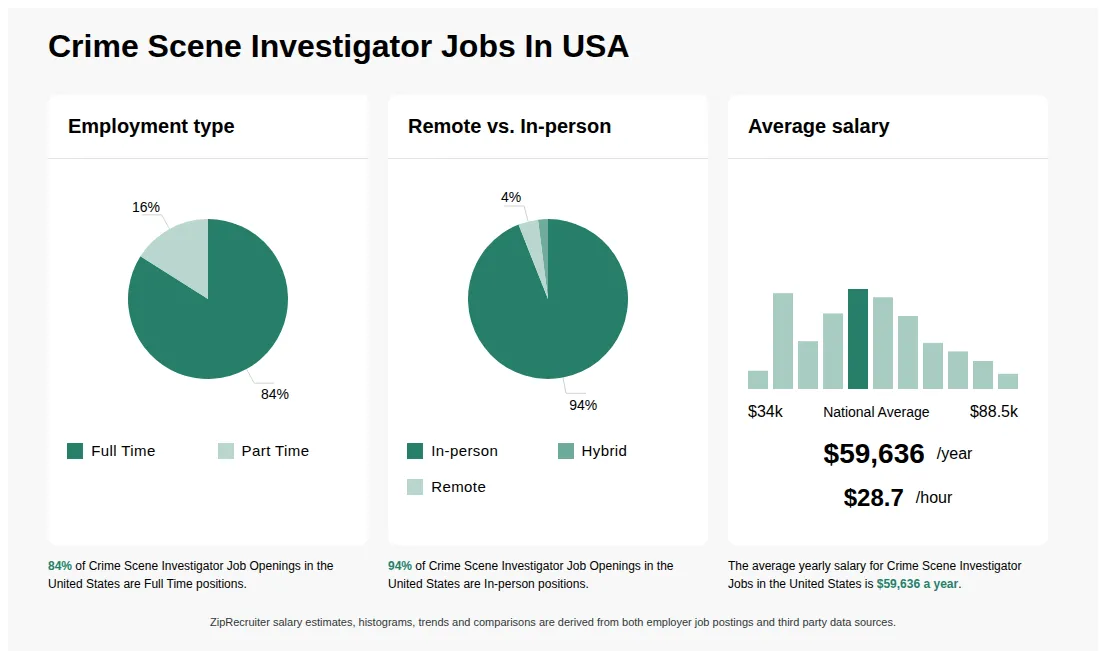
See salary details
$34K - $39K
2% of jobs
$39K - $43.9K
16% of jobs
$48.5K is the 25th percentile. Wages below this are outliers.
$43.9K - $48.9K
7% of jobs
$48.9K - $53.8K
13% of jobs
The median wage is $57.5K / yr.
$53.8K - $58.8K
16% of jobs
$58.8K - $63.7K
15% of jobs
$66.2K is the 75th percentile. Wages above this are outliers.
$63.7K - $68.7K
12% of jobs
$68.7K - $73.6K
7% of jobs
$73.6K - $78.6K
5% of jobs
$78.6K - $83.5K
4% of jobs
$83.5K - $88.5K
2% of jobs
$34K
$59.6K
$88.5K
How much do crime scene investigator jobs pay per year?
As of Sep 8, 2026, the average yearly pay for crime scene investigator in the United States is $59,636.00, according to ZipRecruiter salary data. Most workers in this role earn between $48,500.00 and $67,500.00 per year, depending on experience, location, and employer.
What is a crime scene investigator?
Crime scene investigators (CSIs) are professionals who collect, preserve, and analyze physical evidence from crime scenes. They document the scene through photographs, sketches, and detailed notes, and gather evidence such as fingerprints, biological samples, and trace materials. CSIs work closely with law enforcement and forensic laboratories to help solve crimes by reconstructing events and identifying suspects. Their findings often play a crucial role in criminal investigations and court cases.
What are the key skills and qualifications needed to thrive as a crime scene investigator, and why are they important?
To thrive as a Crime Scene Investigator, you need a background in forensic science or criminal justice, attention to detail, and strong analytical skills, often supported by a relevant degree and specialized training. Familiarity with evidence collection tools, photography equipment, and crime lab software is typically required, along with certifications such as the International Association for Identification (IAI) certification. Strong observational skills, critical thinking, and clear communication are essential for accurately documenting crime scenes and collaborating with law enforcement. These qualifications ensure precise evidence handling, reliable analysis, and the integrity of investigations crucial for successful case outcomes.
What are some common challenges faced by crime scene investigators during evidence collection?
Crime Scene Investigators (CSIs) often encounter challenges such as maintaining the integrity of evidence in uncontrolled environments and working under time pressure to document and collect items before they are compromised. They must carefully avoid contamination and ensure every piece of evidence is properly labeled, photographed, and preserved. Additionally, CSIs frequently collaborate with law enforcement officers, forensic laboratories, and legal teams, requiring strong communication and attention to detail to ensure a thorough and legally defensible investigation.
More about Crime Scene Investigator jobs
- How to become a crime scene investigator?
- Do crime scene investigators travel?
- Where do crime scene investigators work?
- What do crime scene investigators wear?
- The 10 Top Types Of Crime Scene Investigator Jobs
- The 9 Best Types of Crime Scene Investigator in 2026
- What Is a Crime Scene Investigator and How to Become One
- Crime Scene Investigator Job Description Sample Template
What cities are hiring for Crime Scene Investigator jobs?
Cities with the most Crime Scene Investigator job openings:
What are the most commonly searched types of Crime Scene Investigator jobs?
The most popular types of Crime Scene Investigator jobs are:
Who are the top companies hiring for Crime Scene Investigator jobs?
The top employers for Crime Scene Investigator jobs are:
What states have the most Crime Scene Investigator jobs?
States with the most job openings for Crime Scene Investigator jobs include:
What job categories do people searching Crime Scene Investigator jobs look for?
The top searched job categories for Crime Scene Investigator jobs are:
- Teen Crime Scene Investigator
- International Crime Scene Investigator
- Entry Level International Crime Scene Investigator
- Civilian Crime Scene Investigator
- On Call Crime Scene Surveyor
- Fbi Crime Scene Investigator
- Entry Level Civilian Crime Scene Investigator
- Homicide Investigator
- Crime Scene Investigation Certificate
- Permanent Civilian Crime Scene Investigator
What are popular job titles related to Crime Scene Investigator jobs?
For Crime Scene Investigator jobs, the most frequently searched job titles are:

Full-time
Posted 7 days ago
Key responsibilities
Document crime scenes and evidence using photography, video, and sketches to create a permanent record.
Process and collect evidence at crime scenes, including latent prints, trace evidence, and physical items, and submit them for laboratory analysis.
Operate specialized equipment such as laser scanning systems, GNSS instruments, and UAVs to assist in scene reconstruction, measurement, and documentation.
City Of Corpus Christi rating

7.7
Based on 31 frontline employees who took The Breakroom Quiz
488th of 856 rated public administrative organizations
Job description
Overview
A Crime Scene Investigator (CSI) is responsible for the documentation, collection, preservation, analysis, and processing of evidence that is identified and recovered at crime scenes. Duties include scene photography, tire/shoe impression photography and casting, scene search, identification and collection of physical and biological evidence, latent fingerprint processing, follow-up investigation at hospitals, attending autopsies, obtaining postmortem fingerprints and palm prints of deceased individuals, scene sketches and report writing. Laboratory duties include chemical and powder processing of evidence for latent fingerprint development, latent fingerprint photography, trace evidence collection, evidence preservation, utilizing alternate light sources, packaging and submission to the police property room or Texas DPS Crime Laboratory for DNA analysis and CODIS entry while maintaining chain of custody. Additional duties include state and federal courtroom testimony, presentation of recovered evidence, verification of arrested individuals for background investigation purposes. Occasionally assist other law enforcement agencies with crime scene processing. All work must conform to established quality control measures and ISO accreditation requirements.
Responsibilities
• Document crime scenes using digital cameras, video recorders, and related equipment to create a permanent record of the crime scene and evidence observed/collected
• Document injuries or other evidence on body of victims, suspects, and other subjects
• Operate unmanned aerial vehicles (UAVs, aka drones) to capture aerial photos or video footage of crime scenes, or act as visual observer for drone pilot as needed
• Photograph evidence taken to laboratory for additional processing
• Process evidence at scenes for latent prints using powders, chemicals, and alternate light sources; submit to Latent Print Unit for examination/identification
• Detect and collect trace evidence such as blood stains, body fluids, hairs, fibers, paint, glass, and tool/tire marks using visual or chemical means (e.g., alternate light sources/lasers, luminol or BlueStar, electrostatic dust lifters, protein stains, etc.)
• Collect items of evidence for processing at lab or for investigative purposes (clothing, bedding, footwear/tire track impressions, etc.)
• Properly package, secure, and store items of evidence
• Utilize proper techniques and the correct sequence for multiple processing types
• Morgue detail: photograph body, view autopsy, obtain postmortem finger/palm prints, collect trace evidence (nail clipping/scrapings, hair, tissue, blood) and physical evidence collection (clothing, footwear, bullets, ligatures, etc.)
• Verify identity through prints of subjects with multiple arrest records
• Identify deceased subjects by collecting morgue prints and comparing them to arrest records
• Operate 30 laser scanning system to capture data for extremely detailed and precise scene reconstruction of major crime scenes such as homicides and officer-involved shootings
• Use GNSS (Global Navigation Satellite System) instrumentation as needed to obtain precise measurements for crime scene dimensions, location of evidence within crime scene, etc
• Render data through specialized CAD software application (Trimble Reveal) to create three-dimensional "digital twin" of crime scene for investigative and courtroom purposes
• Take manual measurements and create hand-drawn sketches where necessary
• Prepare thorough technical reports detailing activities at crime scenes and continued work in the laboratory using the laboratory information management system (LIMS); conduct administrative and technical reviews Upload digital evidence into digital image management system (DIMS)
• Transfer 30 scan data to computer for software rendering
• Submit evidence to Firearms or Latent Print Unit for proper analysis. Submit other items (DNA, trace evidence, etc.) to Texas DPS Lab
• Coordinate transfer of evidence to and from Property Room, ensuring chain of custody is maintained
• Meet with attorneys in pre-trial discussions to prepare for testimony
• Prepare exhibits or visual aids (charts, photographs, PowerPoint slides, etc.) as needed Present findings and observations in courts of law
• Participate in relevant training courses (virtual/web-based or on-site)
• Stay abreast of advancements in technology, technique, and other topics relevant to job duties Assist Corpus Christi Police Academy with instruction of cadets in crime scene investigations
• Assist with training and observation of crime scene investigator trainees and interns
• Participate in various community outreach activities (CCPD Citizens Academy, school functions, etc.)
• Clean and restock crime scene vehicles with supplies, tools, and packaging materials; monitor vehicle condition and report maintenance issues
• Ensure batteries for all electronic equipment (3D scanners, cameras/flashes, scene lights, tablets, etc.) are fully charged and devices are ready for use
• Conduct basic maintenance/cleaning of crime scene equipment; inform management when repair is needed Other duties as assigned
• May be asked to perform other duties as assigned
Position Type and Typical Hours of Work
• Exempt - Full-Time
40-hour work week with rotating shifts. Selected candidate will be required to work weekends and holidays, as this is a 24/7 position. Call outs when necessary.
• In the event of an emergency, employees are required to work to provide for the safety and well-being of the public, including the delivery and restoration of vital services.
The above statements are intended to describe the general nature and level of work being performed by individuals assigned to this job. They are not intended to be an exhaustive list of all responsibilities, duties, and skills required of personnel so classified in this position. This job description is subject to change as the needs and requirements of the job change.
Minimum Qualifications
• Bachelor's Degree (BA/ BS)
• Six (6) months to one (1) year of experience
Licenses and Certifications
Required
• A valid driver's license is required; successful out-of-state candidates must be able to obtain a valid Texas driver's license within 90 days of hire
Required within six (6) months of hire
• TCIC/ NCIC certification
• First aid/ CPR certification
Employment Testing
Employment is contingent on passing any post-offer pre-employment screening as listed below:
• Police Criminal Background Check: Yes
• Motor Vehicle Record Check: Yes
• Drug Screening: Yes
• Physical Exam: Yes
Basis of Rating
A recruitment consultant will evaluate all applications against the posted qualifications. The city may also conduct additional skill assessment tests, in addition to the panel interview.
Supplemental Information
• Any position that lists a minimum qualification for education level and/or license/certification will require the applicant to provide proof of documentation if selected for hire into the position with the City of Corpus Christi.
The City of Corpus is an Equal Opportunity Employer and complies with the Americans with Disabilities Act and Uniformed Services Employment and Reemployment Rights Act (USERRA). If you require an accommodation in order to apply for a position, please request assistance from the Human Resources Department.
A Crime Scene Investigator (CSI) is responsible for the documentation, collection, preservation, analysis, and processing of evidence that is identified and recovered at crime scenes. Duties include scene photography, tire/shoe impression photography and casting, scene search, identification and collection of physical and biological evidence, latent fingerprint processing, follow-up investigation at hospitals, attending autopsies, obtaining postmortem fingerprints and palm prints of deceased individuals, scene sketches and report writing. Laboratory duties include chemical and powder processing of evidence for latent fingerprint development, latent fingerprint photography, trace evidence collection, evidence preservation, utilizing alternate light sources, packaging and submission to the police property room or Texas DPS Crime Laboratory for DNA analysis and CODIS entry while maintaining chain of custody. Additional duties include state and federal courtroom testimony, presentation of recovered evidence, verification of arrested individuals for background investigation purposes. Occasionally assist other law enforcement agencies with crime scene processing. All work must conform to established quality control measures and ISO accreditation requirements.
Responsibilities
• Document crime scenes using digital cameras, video recorders, and related equipment to create a permanent record of the crime scene and evidence observed/collected
• Document injuries or other evidence on body of victims, suspects, and other subjects
• Operate unmanned aerial vehicles (UAVs, aka drones) to capture aerial photos or video footage of crime scenes, or act as visual observer for drone pilot as needed
• Photograph evidence taken to laboratory for additional processing
• Process evidence at scenes for latent prints using powders, chemicals, and alternate light sources; submit to Latent Print Unit for examination/identification
• Detect and collect trace evidence such as blood stains, body fluids, hairs, fibers, paint, glass, and tool/tire marks using visual or chemical means (e.g., alternate light sources/lasers, luminol or BlueStar, electrostatic dust lifters, protein stains, etc.)
• Collect items of evidence for processing at lab or for investigative purposes (clothing, bedding, footwear/tire track impressions, etc.)
• Properly package, secure, and store items of evidence
• Utilize proper techniques and the correct sequence for multiple processing types
• Morgue detail: photograph body, view autopsy, obtain postmortem finger/palm prints, collect trace evidence (nail clipping/scrapings, hair, tissue, blood) and physical evidence collection (clothing, footwear, bullets, ligatures, etc.)
• Verify identity through prints of subjects with multiple arrest records
• Identify deceased subjects by collecting morgue prints and comparing them to arrest records
• Operate 30 laser scanning system to capture data for extremely detailed and precise scene reconstruction of major crime scenes such as homicides and officer-involved shootings
• Use GNSS (Global Navigation Satellite System) instrumentation as needed to obtain precise measurements for crime scene dimensions, location of evidence within crime scene, etc
• Render data through specialized CAD software application (Trimble Reveal) to create three-dimensional "digital twin" of crime scene for investigative and courtroom purposes
• Take manual measurements and create hand-drawn sketches where necessary
• Prepare thorough technical reports detailing activities at crime scenes and continued work in the laboratory using the laboratory information management system (LIMS); conduct administrative and technical reviews Upload digital evidence into digital image management system (DIMS)
• Transfer 30 scan data to computer for software rendering
• Submit evidence to Firearms or Latent Print Unit for proper analysis. Submit other items (DNA, trace evidence, etc.) to Texas DPS Lab
• Coordinate transfer of evidence to and from Property Room, ensuring chain of custody is maintained
• Meet with attorneys in pre-trial discussions to prepare for testimony
• Prepare exhibits or visual aids (charts, photographs, PowerPoint slides, etc.) as needed Present findings and observations in courts of law
• Participate in relevant training courses (virtual/web-based or on-site)
• Stay abreast of advancements in technology, technique, and other topics relevant to job duties Assist Corpus Christi Police Academy with instruction of cadets in crime scene investigations
• Assist with training and observation of crime scene investigator trainees and interns
• Participate in various community outreach activities (CCPD Citizens Academy, school functions, etc.)
• Clean and restock crime scene vehicles with supplies, tools, and packaging materials; monitor vehicle condition and report maintenance issues
• Ensure batteries for all electronic equipment (3D scanners, cameras/flashes, scene lights, tablets, etc.) are fully charged and devices are ready for use
• Conduct basic maintenance/cleaning of crime scene equipment; inform management when repair is needed Other duties as assigned
• May be asked to perform other duties as assigned
Position Type and Typical Hours of Work
• Exempt - Full-Time
40-hour work week with rotating shifts. Selected candidate will be required to work weekends and holidays, as this is a 24/7 position. Call outs when necessary.
• In the event of an emergency, employees are required to work to provide for the safety and well-being of the public, including the delivery and restoration of vital services.
The above statements are intended to describe the general nature and level of work being performed by individuals assigned to this job. They are not intended to be an exhaustive list of all responsibilities, duties, and skills required of personnel so classified in this position. This job description is subject to change as the needs and requirements of the job change.
Minimum Qualifications
• Bachelor's Degree (BA/ BS)
• Six (6) months to one (1) year of experience
Licenses and Certifications
Required
• A valid driver's license is required; successful out-of-state candidates must be able to obtain a valid Texas driver's license within 90 days of hire
Required within six (6) months of hire
• TCIC/ NCIC certification
• First aid/ CPR certification
Employment Testing
Employment is contingent on passing any post-offer pre-employment screening as listed below:
• Police Criminal Background Check: Yes
• Motor Vehicle Record Check: Yes
• Drug Screening: Yes
• Physical Exam: Yes
Basis of Rating
A recruitment consultant will evaluate all applications against the posted qualifications. The city may also conduct additional skill assessment tests, in addition to the panel interview.
Supplemental Information
• Any position that lists a minimum qualification for education level and/or license/certification will require the applicant to provide proof of documentation if selected for hire into the position with the City of Corpus Christi.
The City of Corpus is an Equal Opportunity Employer and complies with the Americans with Disabilities Act and Uniformed Services Employment and Reemployment Rights Act (USERRA). If you require an accommodation in order to apply for a position, please request assistance from the Human Resources Department.
What City Of Corpus Christi employees say
Pay
Benefits
Hours and flexibility
Workplace
Get the full story on Breakroom

About City of Corpus Christi
Sourced by ZipRecruiter
Industry
Public administration
Company size
1,001 - 5,000 Employees
Headquarters location
Corpus Christi, TX, US
Year founded
1852