Court Interpreter - Spanish
$45.34 - $48.10/hr
Hourly Rate/Full Time $45.34-$48.10 Full-time court interpreters receive full benefits (medical, dental, vision and retirement same as other regular court employees). Part-time and/or Pro Tempore ...
$45.34 - $48.10/hr
Hourly Rate/Full Time $45.34-$48.10 Full-time court interpreters receive full benefits (medical, dental, vision and retirement same as other regular court employees). Part-time and/or Pro Tempore ...
$45.34 - $48.10/hr
Hourly Rate/Full Time $45.34-$48.10 Full-time court interpreters receive full benefits (medical, dental, vision and retirement same as other regular court employees). Part-time and/or Pro Tempore ...
Eureka, CA · On-site
$38.58 - $46.89/hr
Certified Court Interpreter (Spanish) FLSA Status: Non-Exempt Reports to: Assistant Operations Manager POSITION SUMMARY Under general direction, Court Interpreters perform literal and general ...
Eureka, CA · On-site
$38.58 - $46.89/hr
Certified Court Interpreter (Spanish) FLSA Status: Non-Exempt Reports to: Assistant Operations Manager POSITION SUMMARY Under general direction, Court Interpreters perform literal and general ...
Santa Barbara, CA · On-site
$42.49 - $52.06/hr
Court interpreters must accurately interpret for individuals with a high level of education and an extensive vocabulary, as well as for persons with very limited language skills without changing the ...
Santa Barbara, CA · On-site
$42.49 - $52.06/hr
Court interpreters must accurately interpret for individuals with a high level of education and an extensive vocabulary, as well as for persons with very limited language skills without changing the ...
$80K - $97K/yr
Court Interpreter (Spanish) $83,449.60 - $101,441.60 annually Final Filing - Until Filled The Superior Court of Contra Costa County is conducting an open recruitment to fill full-time permanent ...
$80K - $97K/yr
Court Interpreter (Spanish) $83,449.60 - $101,441.60 annually Final Filing - Until Filled The Superior Court of Contra Costa County is conducting an open recruitment to fill full-time permanent ...
$85K - $104K/yr
Under general supervision, performs simultaneous or consecutive oral language interpretation between English and another language in court proceedings, court-ordered programs for which an interpreter ...
$85K - $104K/yr
Under general supervision, performs simultaneous or consecutive oral language interpretation between English and another language in court proceedings, court-ordered programs for which an interpreter ...
Oakland, CA · On-site
$41.32 - $50.23/hr
The Court is seeking to hire Court Interpreters (Spanish) . This position may be assigned to work in any court location, including Alameda, Berkeley, Fremont, Hayward, Oakland, Dublin and San Leandro.
Oakland, CA · On-site
$41.32 - $50.23/hr
The Court is seeking to hire Court Interpreters (Spanish) . This position may be assigned to work in any court location, including Alameda, Berkeley, Fremont, Hayward, Oakland, Dublin and San Leandro.
Santa Rosa, CA · On-site
$95K - $115K/yr
Position Summary Under general supervision, Court Interpreters provide an essential public service, giving assistance to LEP (limited English Proficiency) parties. They perform a wide variety of ...
Santa Rosa, CA · On-site
$95K - $115K/yr
Position Summary Under general supervision, Court Interpreters provide an essential public service, giving assistance to LEP (limited English Proficiency) parties. They perform a wide variety of ...
San Luis Obispo, CA · On-site
$42.49 - $48.66/hr
Minimum Qualifications Possess and maintain a valid Certificate as a "Certified Court Interpreter" issued by the Judicial Council of California on behalf of the State of California, or registered as ...
San Luis Obispo, CA · On-site
$42.49 - $48.66/hr
Minimum Qualifications Possess and maintain a valid Certificate as a "Certified Court Interpreter" issued by the Judicial Council of California on behalf of the State of California, or registered as ...
Santa Barbara, CA · On-site
$45.89 - $52.55/hr
Possession of a valid Certificate as a "Certified Court Interpreter" issued by the Judicial Council of California on behalf of the State of California in the language of Spanish, AND * A valid ...
Santa Barbara, CA · On-site
$45.89 - $52.55/hr
Possession of a valid Certificate as a "Certified Court Interpreter" issued by the Judicial Council of California on behalf of the State of California in the language of Spanish, AND * A valid ...
The Union Vicinage is seeking a Court Interpreter, who is highly motivated, organized, and detail oriented. Under the general direction of the Interpreting Supervisor, the selected candidate must be ...
The Union Vicinage is seeking a Court Interpreter, who is highly motivated, organized, and detail oriented. Under the general direction of the Interpreting Supervisor, the selected candidate must be ...
Santa Cruz, CA · On-site
$85K - $104K/yr
Brings to the court's attention any items that may impede the interpreters' performance; * Researches and understands legal terminology used in court and functions of the court; * Receives daily ...
Santa Cruz, CA · On-site
$85K - $104K/yr
Brings to the court's attention any items that may impede the interpreters' performance; * Researches and understands legal terminology used in court and functions of the court; * Receives daily ...
Madera, CA · On-site
Experienced Spanish Court Interpreters with years of services are encouraged to apply. * The Madera County Superior Court offers membership into CalPERS and for Classic Members a 2.7% at 55 ...
Quick apply
Madera, CA · On-site
Experienced Spanish Court Interpreters with years of services are encouraged to apply. * The Madera County Superior Court offers membership into CalPERS and for Classic Members a 2.7% at 55 ...
$42.49 - $48.66/hr
Definition/Distinguishing Characteristics DEFINITION Under general direction performs a wide variety of language interpretation activities on an assigned and as needed basis for the Superior Courts ...
$42.49 - $48.66/hr
Definition/Distinguishing Characteristics DEFINITION Under general direction performs a wide variety of language interpretation activities on an assigned and as needed basis for the Superior Courts ...
Bakersfield, CA · On-site
$46.68 - $48.10/hr
Court Interpreters Opening Date: 07/15/2015 Closing Date: Continuous Description CERTIFIED SPANISH COURT INTERPRETER, INTERMITTENT Bakersfield - 032 This recruitment is open continuous and may close ...
Bakersfield, CA · On-site
$46.68 - $48.10/hr
Court Interpreters Opening Date: 07/15/2015 Closing Date: Continuous Description CERTIFIED SPANISH COURT INTERPRETER, INTERMITTENT Bakersfield - 032 This recruitment is open continuous and may close ...
Court Interpreter 1- Journey (English/Spanish): The salary range for this position is $74,454.81 to $105,725.80. for Schedule A, and $74,454.81 to $100,439.52 for Schedule B Employees at this level ...
Court Interpreter 1- Journey (English/Spanish): The salary range for this position is $74,454.81 to $105,725.80. for Schedule A, and $74,454.81 to $100,439.52 for Schedule B Employees at this level ...
COURT INTERPRETER - 22012226 Pay Plan: State Courts System Position Number: 22012226 Salary: $73,070.04 annually ($65,763.12 if not certified) Posting Closing Date: 07/24/2026 Total Compensation ...
COURT INTERPRETER - 22012226 Pay Plan: State Courts System Position Number: 22012226 Salary: $73,070.04 annually ($65,763.12 if not certified) Posting Closing Date: 07/24/2026 Total Compensation ...
Stuart, FL · On-site
$73K/yr
COURT INTERPRETER - 22012226 Pay Plan: State Courts System Position Number: 22012226 Salary: $73,070.04 annually ($65,763.12 if not certified) Posting Closing Date: 07/24/2026 Total Compensation ...
Stuart, FL · On-site
$73K/yr
COURT INTERPRETER - 22012226 Pay Plan: State Courts System Position Number: 22012226 Salary: $73,070.04 annually ($65,763.12 if not certified) Posting Closing Date: 07/24/2026 Total Compensation ...
Port Saint Lucie, FL · On-site
$73K/yr
COURT INTERPRETER - 22012226 Pay Plan: State Courts System Position Number: 22012226 Salary: $73,070.04 annually ($65,763.12 if not certified) Posting Closing Date: 07/24/2026 Total Compensation ...
Port Saint Lucie, FL · On-site
$73K/yr
COURT INTERPRETER - 22012226 Pay Plan: State Courts System Position Number: 22012226 Salary: $73,070.04 annually ($65,763.12 if not certified) Posting Closing Date: 07/24/2026 Total Compensation ...
COURT INTERPRETER - 22012226 Pay Plan: State Courts System Position Number: 22012226 Salary: $73,070.04 annually ($65,763.12 if not certified) Posting Closing Date: 07/24/2026 Total Compensation ...
COURT INTERPRETER - 22012226 Pay Plan: State Courts System Position Number: 22012226 Salary: $73,070.04 annually ($65,763.12 if not certified) Posting Closing Date: 07/24/2026 Total Compensation ...
West Palm Beach, FL · On-site
$76K/yr
Court Interpreter Office Opening Date: 04/17/2023 SUMMARY NEW SALARY: $76,725 (annual salary of $73,070.04 plus competitive area differential pay of $3,654.96). Perform skilled professional duties as ...
West Palm Beach, FL · On-site
$76K/yr
Court Interpreter Office Opening Date: 04/17/2023 SUMMARY NEW SALARY: $76,725 (annual salary of $73,070.04 plus competitive area differential pay of $3,654.96). Perform skilled professional duties as ...
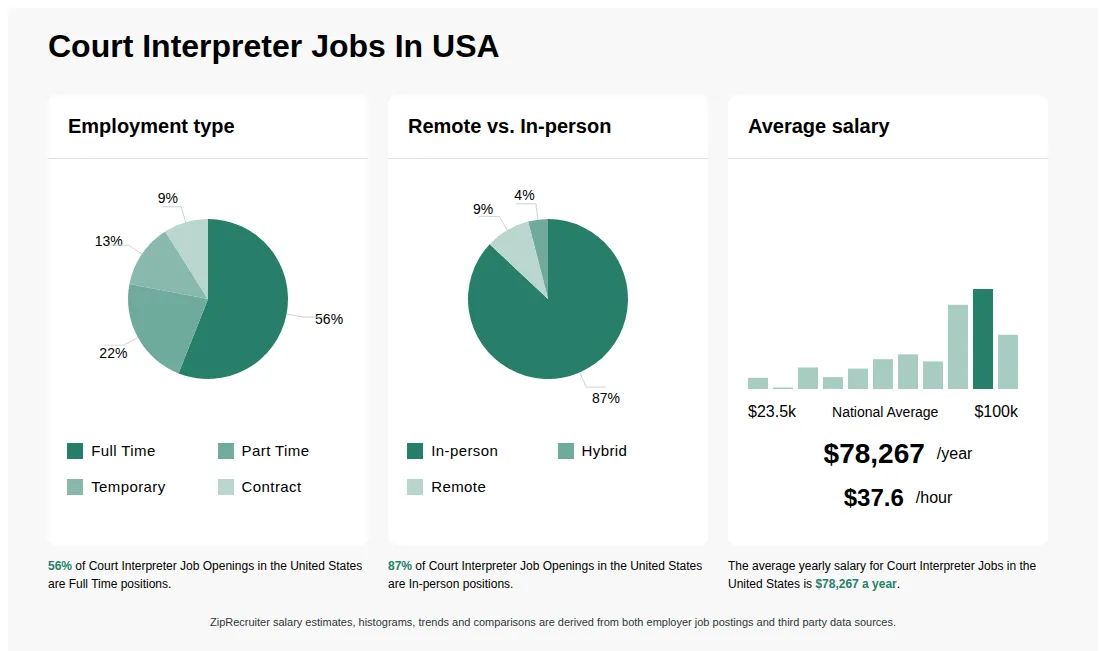
$23.5K - $30.5K
2% of jobs
$30.5K - $37.4K
0% of jobs
$37.4K - $44.4K
5% of jobs
$44.4K - $51.3K
2% of jobs
$51.3K - $58.3K
5% of jobs
$58.3K - $65.2K
7% of jobs
$67.4K is the 25th percentile. Wages below this are outliers.
$65.2K - $72.2K
9% of jobs
$72.2K - $79.1K
6% of jobs
The median wage is $83.1K / yr.
$79.1K - $86.1K
22% of jobs
$90.1K is the 75th percentile. Wages above this are outliers.
$86.1K - $93K
27% of jobs
$93K - $100K
14% of jobs
$23.5K
$78.3K
$100K
| Aspect | Court Interpreter | Legal Translator |
|---|---|---|
| Credentials | Certification in court interpreting, language proficiency tests | Translation certifications, legal translation credentials |
| Work Environment | Courts, legal proceedings, live interpretation | Legal documents, contracts, written translation |
| Employer & Industry | Courts, government agencies, legal institutions | Law firms, legal departments, translation agencies |
| Search & Comparison Intent | Understanding roles in legal settings, certification requirements | Legal document translation, accuracy in legal language |
While both Court Interpreters and Legal Translators work within the legal industry, Court Interpreters provide real-time oral translation during legal proceedings, requiring live interpretation skills and certifications. Legal Translators focus on translating legal documents and texts, emphasizing written accuracy and legal terminology expertise. Both roles are essential in legal settings but serve different functions based on the mode of communication and certification requirements.
A court interpreter assists people who do not speak fluent English in a court of law. A person who is unsure of their ability or unable to communicate in English is appointed a court interpreter to translate on their behalf. A court interpreter is fluent in English and another or several other languages. In this job, you must be familiar with the legal system, legal terminology in both languages, and the courtroom setting. Duties include translations of legal documents and helping to translate written statements made by witnesses, defendants, or plaintiffs. In addition to interpreting in the courtroom proceedings, you join lawyers at pretrial hearings, meetings, and depositions to provide translation services for witnesses or clients. Court interpreters can be employed by the court or by private firms, especially immigration law firms or other firms that handle many cases with non-English fluent clients.
$45.34 - $48.10/hr
Other
Medical, Dental, Vision, Retirement, PTO
Re-posted 12 days ago
Description SPANISH LANGUAGE (Full-Time, Part-Time and PRO Tempore) CONTINUOUS FILING UNTIL FILLED CURRENT SALARY: Hourly Rate/Full Time $45.34-$48.10 Full-time court interpreters receive full benefits (medical, dental, vision and retirement same as other regular court employees). Part-time and/or Pro Tempore positions do not include benefits but may accrue an annual leave balance or holiday time on a pro-rated basis. This is a single level classification
Employees in this classification perform consecutive and simultaneous interpretation of courtroom proceedings and other related interpreting services as needed. Employees in this classification also perform sight translation (reading written texts and giving an oral translation of text) as needed. Typical Duties Interprets from and into English and the applicable non-English language using simultaneous and consecutive modes at court proceedings and for other court-related departments at the direction of the court.
Makes sight translations of documents for the benefit of the court including, but not limited to, court petitions, reports, waivers, felony disposition statement forms, and other documents. Interprets for judges, attorneys, court staff, and other court-related departments at the direction of the court. Notifies the court of any issues or situations that may impede the interpreters' performance.
Researches and understands terminology used in court and functions of the court which may include but not be limited to legal, technological, scientific, and/or medical terminology. Reviews the daily docket and receives daily calendar assignments from the Trial Court Interpreter Coordinator (or other) and accurately completes daily activity logs, or other documentation as required. Performs other language interpretation duties as assigned, such as providing general court information at an information counter to the non-English speaking public and processes documents related to interpretation.
Minimum Qualifications Licenses and Certificates A valid Class "C" driver's license, or the equivalent, or the ability to utilize an alternative method of transportation when needed to carry out job-related essential functions. Required / Minimum Qualifications Possession of a valid Certificate as a "Certified Court Interpreter" issued by the Judicial Council of California on behalf of the State of California, or registered as a Court Interpreter by the Judicial Council of California on behalf of the State of California. For information on certification, please visit the Court Interpreter's website at http://www.courts.ca.gov/programs-interpreters.htm Supplemental Information Working Conditions Work is performed in the courtroom and related court facilities and includes but is not limited to contact with judges, staff, attorneys, and the public
The position requires the ability to concentrate and deliver interpreting services in a busy and fast-paced environment. Courtroom interpreting requires the ability to adjust to speakers with differing voices and accents at varying rates of speed. Interpreters come into contact with a wide variety of people from differing educational and economic backgrounds.
Travel within the county is required. If cross assignments are accepted, travel between counties may be required. Physical Requirements Stamina to sit and/or stand and concentrate for extended periods; corrected hearing and vision to normal range.
Required Skills and Knowledge Orally convey the meaning from and into English and the applicable non-English language by interpreting in the simultaneous, consecutive, and sight translation modes; the meaning must be conveyed accurately, not editing, summarizing, adding meaning, or omitting. Correct usage of grammar and vocabulary of English and non-English language specified, provided the source language speaker is using correct grammar and vocabulary. The ability to interpret accurately and remain impartial including in adversarial and emotionally charged situations.
Knowledge and understanding of legal concepts and forensic terminology in both English and non-English language(s). Familiarity with the general range of regional and cultural variations in the specified language. Ability to conduct ongoing research into variations in terminology and usage of the specified language.
Ability to use office equipment, including computer, telephone, and copiers, as required by the assignment. Use of transmitter and receiver equipment provided by the court for simultaneous interpretation. Ability to understand and adhere to California statutes, Rules of Court, and applicable personnel rules concerning court interpretation.
Knowledge of and adherence to interpreter ethics and standards, as stipulated in California Rules of Court Rule 984.4, Professional Conduct for Interpreters. Ability to interact professionally and cooperatively with those contacted in the course of work.