Director, Credit Risk
San Francisco, CA · On-site
This is a team for analytical, commercially minded risk leaders who are energized by building ... Counterparty risk management: Set and oversee counterparty risk standards for banking partners ...
San Francisco, CA · On-site
This is a team for analytical, commercially minded risk leaders who are energized by building ... Counterparty risk management: Set and oversee counterparty risk standards for banking partners ...
San Francisco, CA · On-site
This is a team for analytical, commercially minded risk leaders who are energized by building ... Counterparty risk management: Set and oversee counterparty risk standards for banking partners ...
Manhattan, NY · On-site
$185K - $200K/yr
We are seeking a highly skilled quantitative professional to join the Risk Analytics group to develop and manage analytics for counterparty credit risk models focused on fixed income products ...
Manhattan, NY · On-site
$185K - $200K/yr
We are seeking a highly skilled quantitative professional to join the Risk Analytics group to develop and manage analytics for counterparty credit risk models focused on fixed income products ...
This is a junior analyst role working in partnership with experienced SMEs to build knowledge of ... Evaluate, monitor, and report on counterparty credit exposures and trends. * Partner with ...
This is a junior analyst role working in partnership with experienced SMEs to build knowledge of ... Evaluate, monitor, and report on counterparty credit exposures and trends. * Partner with ...
Manhattan, NY · Hybrid
$110K - $140K/yr
Treasury Risk Analyst Primarily responsible for monitoring liquidity risks in Americas Division to ... Ensure proper credit line and counterparty risk management. * May liaise with Head Office.
Quick apply
Manhattan, NY · Hybrid
$110K - $140K/yr
Treasury Risk Analyst Primarily responsible for monitoring liquidity risks in Americas Division to ... Ensure proper credit line and counterparty risk management. * May liaise with Head Office.
Manhattan, NY · On-site
$110K - $140K/yr
Treasury Risk Analyst Primarily responsible for monitoring liquidity risks in Americas Division to ... Ensure proper credit line and counterparty risk management. * May liaise with Head Office.
Quick apply
Manhattan, NY · On-site
$110K - $140K/yr
Treasury Risk Analyst Primarily responsible for monitoring liquidity risks in Americas Division to ... Ensure proper credit line and counterparty risk management. * May liaise with Head Office.
Monitor and analyze counterparty exposures across various activities such as Prime Brokerage ... Partner with Credit Risk, Market Risk, and other teams to ensure robust risk controls and ...
Monitor and analyze counterparty exposures across various activities such as Prime Brokerage ... Partner with Credit Risk, Market Risk, and other teams to ensure robust risk controls and ...
Irving, TX · On-site
$114K - $172K/yr
The Counterparty Credit Risk (CCR) project execution team within Enterprise Data is responsible for building tools to: Provide in-depth quantitative or qualitative analysis to solve business problems ...
Irving, TX · On-site
$114K - $172K/yr
The Counterparty Credit Risk (CCR) project execution team within Enterprise Data is responsible for building tools to: Provide in-depth quantitative or qualitative analysis to solve business problems ...
$114K - $172K/yr
The Counterparty Credit Risk (CCR) project execution team within Enterprise Data is responsible for building tools to: Provide in-depth quantitative or qualitative analysis to solve business problems ...
$114K - $172K/yr
The Counterparty Credit Risk (CCR) project execution team within Enterprise Data is responsible for building tools to: Provide in-depth quantitative or qualitative analysis to solve business problems ...
Irving, TX · On-site
$114K - $172K/yr
The Counterparty Credit Risk (CCR) project execution team within Enterprise Data is responsible for building tools to: * Provide in-depth quantitative or qualitative analysis to solve business ...
Irving, TX · On-site
$114K - $172K/yr
The Counterparty Credit Risk (CCR) project execution team within Enterprise Data is responsible for building tools to: * Provide in-depth quantitative or qualitative analysis to solve business ...
Manhattan, NY · Hybrid
$110K - $140K/yr
Treasury Risk Analyst Primarily responsible for monitoring liquidity risks in Americas Division to ... Ensure proper credit line and counterparty risk management. * May liaise with Head Office.
Quick apply
Manhattan, NY · Hybrid
$110K - $140K/yr
Treasury Risk Analyst Primarily responsible for monitoring liquidity risks in Americas Division to ... Ensure proper credit line and counterparty risk management. * May liaise with Head Office.
New York, NY · On-site
$160K - $220K/yr
Looking for a Mid-Level to Senior Counterparty Credit Risk Analyst for the Financial Institutions Group in NY with a specialization in Insurance Companies, and can also include Non-Bank Financial ...
New York, NY · On-site
$160K - $220K/yr
Looking for a Mid-Level to Senior Counterparty Credit Risk Analyst for the Financial Institutions Group in NY with a specialization in Insurance Companies, and can also include Non-Bank Financial ...
Your expertise will be crucial in challenging risk assumptions, monitoring exposures, and ... Experience analyzing counterparty exposure, collateral management, margin frameworks, and ...
Your expertise will be crucial in challenging risk assumptions, monitoring exposures, and ... Experience analyzing counterparty exposure, collateral management, margin frameworks, and ...
Perform counterparty reviews, recommend internal ratings, and set counterparty risk limits Basic ... Strong analytical, communication, and organizational skills. Attention to detail * Values ...
Perform counterparty reviews, recommend internal ratings, and set counterparty risk limits Basic ... Strong analytical, communication, and organizational skills. Attention to detail * Values ...
... trading activities, or offering analytical and regulatory compliance oversight, our work ... Portfolio monitoring of active positions, surveilling industry and counterparty specific risks ...
... trading activities, or offering analytical and regulatory compliance oversight, our work ... Portfolio monitoring of active positions, surveilling industry and counterparty specific risks ...
... AVP, Counterparty Credit Risk Management. \n \n The position is responsible for exposure and portfolio management of the derivatives and traded products portfolio, which includes analysis of ...
... AVP, Counterparty Credit Risk Management. \n \n The position is responsible for exposure and portfolio management of the derivatives and traded products portfolio, which includes analysis of ...
Manhattan, NY · On-site
$135K - $185K/yr
Role Description The Vice President, Portfolio Analysis - Stress Testing & CCAR, will serve as a key contributor within the Counterparty Credit Risk (CCR) Portfolio Analysis team. The VP will drive ...
Manhattan, NY · On-site
$135K - $185K/yr
Role Description The Vice President, Portfolio Analysis - Stress Testing & CCAR, will serve as a key contributor within the Counterparty Credit Risk (CCR) Portfolio Analysis team. The VP will drive ...
San Francisco, CA · On-site
This is a team for analytical, commercially minded risk leaders who are energized by building ... Counterparty risk management: Set and oversee counterparty risk standards for banking partners ...
San Francisco, CA · On-site
This is a team for analytical, commercially minded risk leaders who are energized by building ... Counterparty risk management: Set and oversee counterparty risk standards for banking partners ...
... trading activities, or offering analytical and regulatory compliance oversight, our work ... Portfolio monitoring of active positions, surveilling industry and counterparty specific risks ...
... trading activities, or offering analytical and regulatory compliance oversight, our work ... Portfolio monitoring of active positions, surveilling industry and counterparty specific risks ...
Manhattan, NY · On-site
You identify, analyze, and elevate exposures, validate risk reporting, and act as a subject matter ... Act as Counterparty Credit Risk coverage lead supporting Prime Brokerage * Identify, analyze ...
Manhattan, NY · On-site
You identify, analyze, and elevate exposures, validate risk reporting, and act as a subject matter ... Act as Counterparty Credit Risk coverage lead supporting Prime Brokerage * Identify, analyze ...
New York, NY · On-site
$48/hr
... Counterparty risk management capabilities across covered sectors #CareerBuilder #Monster #Dice #Indeed #LinkedIn
Quick apply
New York, NY · On-site
$48/hr
... Counterparty risk management capabilities across covered sectors #CareerBuilder #Monster #Dice #Indeed #LinkedIn
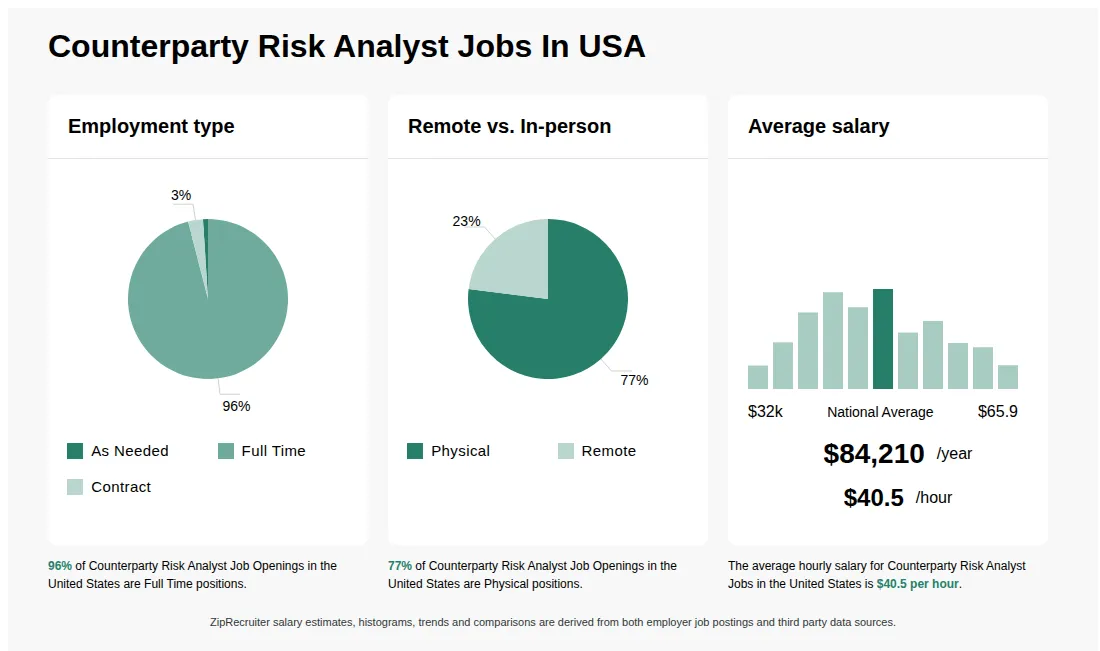
$15.38 - $19.97
3% of jobs
$19.97 - $24.56
7% of jobs
$24.56 - $29.15
12% of jobs
$30.05 is the 25th percentile. Wages below this are outliers.
$29.15 - $33.74
15% of jobs
$33.74 - $38.33
13% of jobs
The median wage is $38.48 / hr.
$38.33 - $42.92
16% of jobs
$42.92 - $47.51
8% of jobs
$48.08 is the 75th percentile. Wages above this are outliers.
$47.51 - $52.10
11% of jobs
$52.10 - $56.69
6% of jobs
$56.69 - $61.28
6% of jobs
$61.28 - $65.87
3% of jobs
$15
$40
$65
| Aspect | Counterparty Risk Analyst | Credit Risk Analyst |
|---|---|---|
| Required Credentials | Bachelor's degree in finance, economics, or related field; certifications like CFA are common | Bachelor's degree in finance, economics, or related; CFA often preferred |
| Work Environment | Financial institutions, investment banks, trading firms | Banks, credit agencies, financial services companies |
| Employer & Industry Usage | Focuses on assessing risks of specific counterparties in trading and lending | Evaluates creditworthiness of borrowers and clients |
While both roles involve assessing financial risks, a Counterparty Risk Analyst primarily evaluates the risk of specific trading or lending counterparties, whereas a Credit Risk Analyst focuses on the creditworthiness of borrowers. Both roles require similar credentials and are common in financial institutions, but their focus areas differ within risk management.
Cities with the most Counterparty Risk Analyst job openings:
The most popular types of Counterparty Risk Analyst jobs are:
For Counterparty Risk Analyst jobs, the most frequently searched job titles are:

San Francisco, CA • On-site
Other
Posted 16 days ago
Airwallex is the only unified payments and financial platform for global businesses. Powered by our unique combination of proprietary infrastructure and software, we empower over 250,000 businesses worldwide – including Brex, Navan, Qantas, SHEIN and many more – with fully integrated solutions to manage everything from business accounts, payments, spend management and treasury, to embedded finance at a global scale.
Proudly founded in Melbourne, we have a team of over 2,300 of the brightest and most innovative people in tech across 27 offices around the globe. Valued at US$11 billion and backed by world-leading investors including T. Rowe Price, Visa, Mastercard, Robinhood Ventures, Sequoia, Salesforce Ventures, DST Global, and Lone Pine Capital, Airwallex is leading the charge in building the global payments and financial platform of the future. If you're ready to do the most ambitious work of your career, join us.
Attributes We ValueWe hire successful builders with founder-like energy who want real impact, accelerated learning, and true ownership. You bring strong role-related expertise and sharp thinking, and you're motivated by our mission and operating principles. You move fast with good judgment, dig deep with curiosity, and make decisions from first principles, balancing speed and rigor.
You're humble and collaborative; turn zero-to-one ideas into real products, and you "get stuff done" end-to-end. You use AI to work smarter and solve problems faster. Here, you'll tackle complex, high-visibility problems with exceptional teammates and grow your career as we build the future of global banking. If that sounds like you, let's build what's next.
About the TeamThe Credit Risk team is part of Airwallex's Second Line of Defence and helps the company grow responsibly as a global financial platform. We work at the intersection of credit, FX, and counterparty risk, partnering closely with Product, Sales, Operations, Treasury, Finance, Engineering, Compliance, and Legal to enable commercial growth while protecting Airwallex from financial loss and excessive risk exposure. This is a team for analytical, commercially minded risk leaders who are energized by building scalable frameworks and practical controls across a fast-moving, multi-currency global network.
What You'll DoAs Director, Credit Risk, you will lead Airwallex's global second-line oversight of credit, FX, and counterparty risk. You will set the risk guardrails that allow the business to grow safely across merchant acquiring, charge cards, FX, treasury, settlement, and banking-partner activities. Reporting to the Senior Director, Financial Risk, you will own the global framework, risk appetite, limits, governance, and portfolio oversight for these risk areas. You will provide independent challenge to first-line decisions and act as a trusted advisor to senior leaders across the business. This role is based in New York or San Francisco.
ResponsibilitiesWe're looking for people who meet the minimum requirements for this role. The preferred qualifications are great to have, but are not mandatory.
Minimum QualificationsTo protect you from recruitment scams, please be aware that Airwallex will not ask for bank details, sensitive ID numbers (i.e. passport), or any form of payment during the application or interview process. All official communication will come from an @ airwallex.com email address. Please apply only through careers.airwallex.com or our official LinkedIn page.
Airwallex does not accept unsolicited resumes from search firms/recruiters. Airwallex will not pay any fees to search firms/recruiters if a candidate is submitted by a search firm/recruiter unless an agreement has been entered into with respect to specific open position(s). Search firms/recruiters submitting resumes to Airwallex on an unsolicited basis shall be deemed to accept this condition, regardless of any other provision to the contrary.
Equal OpportunityAirwallex is proud to be an equal opportunity employer. We value diversity and anyone seeking employment at Airwallex is considered based on merit, qualifications, competence and talent. We don't regard color, religion, race, national origin, sexual orientation, ancestry, citizenship, sex, marital or family status, disability, gender

Sourced by ZipRecruiter