Corporate Safety Director
Melbourne, FL · On-site
The Corporate Safety Director will develop a comprehensive safety management framework that applies across BRPH Companies, Inc. and its subsidiaries, including Architecture & Engineering (AE) and ...
Melbourne, FL · On-site
The Corporate Safety Director will develop a comprehensive safety management framework that applies across BRPH Companies, Inc. and its subsidiaries, including Architecture & Engineering (AE) and ...
Melbourne, FL · On-site
The Corporate Safety Director will develop a comprehensive safety management framework that applies across BRPH Companies, Inc. and its subsidiaries, including Architecture & Engineering (AE) and ...
Melbourne, FL · On-site
The Corporate Safety Director will develop a comprehensive safety management framework that applies across BRPH Companies, Inc. and its subsidiaries, including Architecture & Engineering (AE) and ...
Melbourne, FL · On-site
The Corporate Safety Director will develop a comprehensive safety management framework that applies across BRPH Companies, Inc. and its subsidiaries, including Architecture & Engineering (AE) and ...
Kingsport, TN · On-site
$150 - $200/hr
The Corporate Safety Director will influence how safety is planned, communicated, measured, and implemented across the organization. The right candidate will bring credibility, field presence, strong ...
Kingsport, TN · On-site
$150 - $200/hr
The Corporate Safety Director will influence how safety is planned, communicated, measured, and implemented across the organization. The right candidate will bring credibility, field presence, strong ...
Louisville, KY · On-site
$100 - $125/hr
Corporate Safety Director Build a Culture of Safety. Drive Compliance. Lead Continuous Improvement. We are seeking an experienced and motivated Corporate Safety Director to lead, implement, and ...
New
Louisville, KY · On-site
$100 - $125/hr
Corporate Safety Director Build a Culture of Safety. Drive Compliance. Lead Continuous Improvement. We are seeking an experienced and motivated Corporate Safety Director to lead, implement, and ...
New
Nashville, TN · On-site
Position Summary Flow Service Partners is seeking an experienced Corporate Safety Director to become the architect of our safety culture. This role will lead the development and execution of our ...
Nashville, TN · On-site
Position Summary Flow Service Partners is seeking an experienced Corporate Safety Director to become the architect of our safety culture. This role will lead the development and execution of our ...
Nashville, TN · On-site
Position Summary Flow Service Partners is seeking an experienced Corporate Safety Director to become the architect of our safety culture. This role will lead the development and execution of our ...
Nashville, TN · On-site
Position Summary Flow Service Partners is seeking an experienced Corporate Safety Director to become the architect of our safety culture. This role will lead the development and execution of our ...
Saint Paul, MN · On-site
The Contingent Plan is actively recruiting a corporate EHS director for its client headquartered in ... The person selected for this role will have a direct impact on the safety programs of the ...
Saint Paul, MN · On-site
The Contingent Plan is actively recruiting a corporate EHS director for its client headquartered in ... The person selected for this role will have a direct impact on the safety programs of the ...
The Corporate Safety Director Assistant supports and helps lead all safety, environmental, health, and DOT compliance programs for three affiliated companies, including one asphalt paving operation ...
Quick apply
The Corporate Safety Director Assistant supports and helps lead all safety, environmental, health, and DOT compliance programs for three affiliated companies, including one asphalt paving operation ...
Manhattan, NY · On-site
$170K/yr
We are currently seeking a "Corporate Safety Director". The ideal candidate leads company-wide safety programs across all projects and worksites, ensuring compliance with regulations and client ...
Quick apply
Manhattan, NY · On-site
$170K/yr
We are currently seeking a "Corporate Safety Director". The ideal candidate leads company-wide safety programs across all projects and worksites, ensuring compliance with regulations and client ...
The Corporate Safety Director Assistant supports and helps lead all safety, environmental, health, and DOT compliance programs for three affiliated companies, including one asphalt paving operation ...
Quick apply
The Corporate Safety Director Assistant supports and helps lead all safety, environmental, health, and DOT compliance programs for three affiliated companies, including one asphalt paving operation ...
Pontiac, MI · On-site
$60 - $80/hr
The Corporate Safety Director Assistant supports and helps lead all safety, environmental, health, and DOT compliance programs for three affiliated companies, including one asphalt paving operation ...
Pontiac, MI · On-site
$60 - $80/hr
The Corporate Safety Director Assistant supports and helps lead all safety, environmental, health, and DOT compliance programs for three affiliated companies, including one asphalt paving operation ...
The Corporate Safety Director Assistant supports and helps lead all safety, environmental, health, and DOT compliance programs for three affiliated companies, including one asphalt paving operation ...
The Corporate Safety Director Assistant supports and helps lead all safety, environmental, health, and DOT compliance programs for three affiliated companies, including one asphalt paving operation ...
Franklin, TN · On-site
Corporate Safety Director Category: Safety • Location: Franklin, TN Titan International (TWI) is currently recruiting for a Corporate Director of Safety to be ideally located at the Franklin, TN ...
Franklin, TN · On-site
Corporate Safety Director Category: Safety • Location: Franklin, TN Titan International (TWI) is currently recruiting for a Corporate Director of Safety to be ideally located at the Franklin, TN ...
Invite a friend Back to job search The Corporate Safety Director Assistant supports and helps lead all safety, environmental, health, and DOT compliance programs for three affiliated companies ...
Invite a friend Back to job search The Corporate Safety Director Assistant supports and helps lead all safety, environmental, health, and DOT compliance programs for three affiliated companies ...
Manhattan, NY · On-site
$170K/yr
We are currently seeking a "Corporate Safety Director". The ideal candidate leads company-wide safety programs across all projects and worksites, ensuring compliance with regulations and client ...
Manhattan, NY · On-site
$170K/yr
We are currently seeking a "Corporate Safety Director". The ideal candidate leads company-wide safety programs across all projects and worksites, ensuring compliance with regulations and client ...
Manhattan, NY · On-site
$150 - $200/hr
We are currently seeking a "Corporate Safety Director". The ideal candidate leads company-wide safety programs across all projects and worksites, ensuring compliance with regulations and client ...
Manhattan, NY · On-site
$150 - $200/hr
We are currently seeking a "Corporate Safety Director". The ideal candidate leads company-wide safety programs across all projects and worksites, ensuring compliance with regulations and client ...
Manhattan, NY · On-site
$150 - $200/hr
We are currently seeking a "Corporate Safety Director". The ideal candidate leads company-wide safety programs across all projects and worksites, ensuring compliance with regulations and client ...
Manhattan, NY · On-site
$150 - $200/hr
We are currently seeking a "Corporate Safety Director". The ideal candidate leads company-wide safety programs across all projects and worksites, ensuring compliance with regulations and client ...
Aventura, FL · On-site
Reporting to senior leadership, the Corporate Safety Director will design, implement, and continuously improve a comprehensive occupational health and safety program that ensures full regulatory ...
Aventura, FL · On-site
Reporting to senior leadership, the Corporate Safety Director will design, implement, and continuously improve a comprehensive occupational health and safety program that ensures full regulatory ...
Aventura, FL · On-site
Reporting to senior leadership, the Corporate Safety Director will design, implement, and continuously improve a comprehensive occupational health and safety program that ensures full regulatory ...
Aventura, FL · On-site
Reporting to senior leadership, the Corporate Safety Director will design, implement, and continuously improve a comprehensive occupational health and safety program that ensures full regulatory ...
NY · On-site
$150 - $200/hr
Conduct and oversee systematic safety audits, inspections, and risk assessments across all ... a direct, measurable impact on the well‑being of our employees and guests. We provide a ...
NY · On-site
$150 - $200/hr
Conduct and oversee systematic safety audits, inspections, and risk assessments across all ... a direct, measurable impact on the well‑being of our employees and guests. We provide a ...
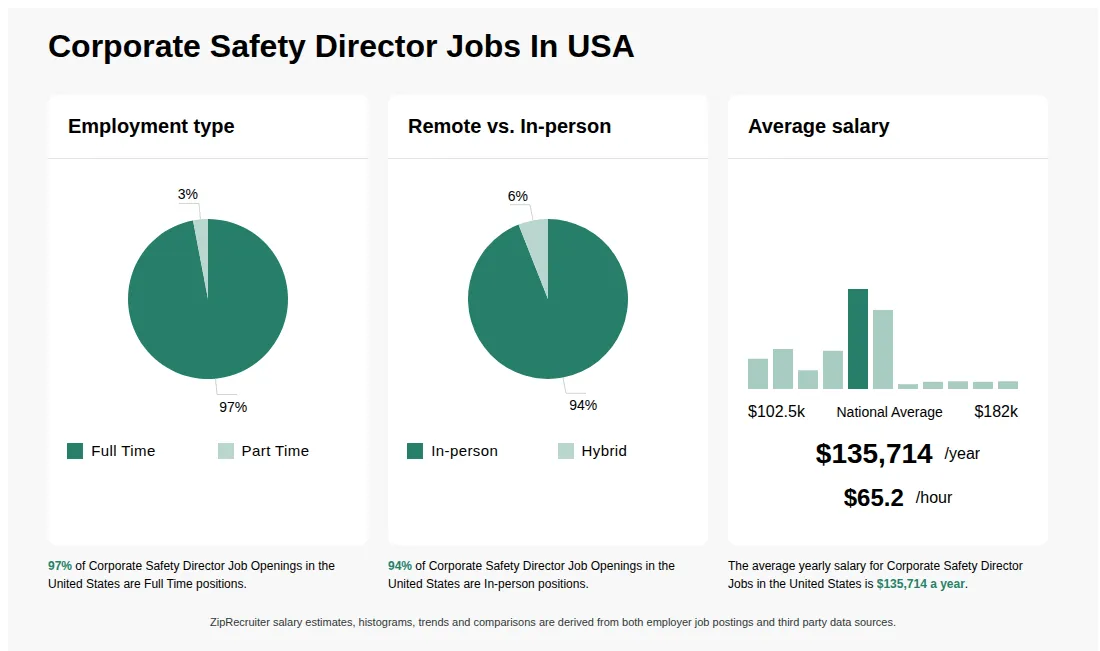
$102.5K - $109.7K
8% of jobs
$109.7K - $117K
11% of jobs
$124.2K is the 25th percentile. Wages below this are outliers.
$117K - $124.2K
5% of jobs
$124.2K - $131.4K
11% of jobs
The median wage is $134.6K / yr.
$131.4K - $138.6K
30% of jobs
$141.2K is the 75th percentile. Wages above this are outliers.
$138.6K - $145.9K
24% of jobs
$145.9K - $153.1K
1% of jobs
$153.1K - $160.3K
2% of jobs
$160.3K - $167.5K
2% of jobs
$167.5K - $174.8K
2% of jobs
$174.8K - $182K
2% of jobs
$102.5K
$135.7K
$182K
| Aspect | Corporate Safety Director | Safety Manager |
|---|---|---|
| Certifications | OSHA, CSP, ASP | OSHA, CSP, ASP |
| Work Environment | Corporate offices, multiple sites | Specific site or department |
| Responsibilities | Developing safety policies, overseeing multiple locations | Implementing safety procedures at a single site |
| Industry Usage | Large corporations, multi-site companies | Medium to large organizations, specific departments |
The main difference between a Corporate Safety Director and a Safety Manager lies in scope and responsibilities. The Corporate Safety Director oversees safety policies across multiple locations and sets strategic safety goals, while the Safety Manager focuses on implementing safety procedures within a specific site or department. Both roles require similar certifications and work in related environments, but the Corporate Safety Director has a broader, more strategic focus.
Cities with the most Corporate Safety Director job openings:
The most popular types of Corporate Safety jobs are:
The top employers for Corporate Safety Director jobs are:
States with the most job openings for Corporate Safety Director jobs include:
The top searched job categories for Corporate Safety Director jobs are:
Develop and lead a comprehensive enterprise safety strategy and governance framework.
Implement, maintain, and evaluate an enterprise-wide Safety Management System and related programs.
Serve as the executive champion for building a safety-focused organizational culture and promote safety leadership across the company.
About Melbourne:
Our headquarters is located in Melbourne, Florida, a vibrant city on the Space Coast where high-tech innovation meets coastal living. Here, you'll work on dynamic, impactful projects while enjoying front-row views of rocket launches from our rooftop and quick access to some of Florida's most beautiful beaches. Just an hour from world-class attractions like Disney World and Universal Studios, Melbourne offers the perfect balance of career growth, family life, and fun, all in a warm subtropical climate with a relaxed, suburban feel.
Overview
The Corporate Safety Director is the senior enterprise leader responsible for establishing, implementing, and continuously improving BRPH's company-wide safety strategy, programs, standards, and culture. The Corporate Safety Director will develop a comprehensive safety management framework that applies across BRPH Companies, Inc. and its subsidiaries, including Architecture & Engineering (AE) and Construction Services (CS), while recognizing the different risk profiles and operating environments of each business.
Reporting to the Chief Executive Officer, the Corporate Safety Director provides strategic leadership, governance, and oversight of safety throughout the organization. This position establishes corporate expectations, policies, accountability structures, performance measures, training requirements, and reporting processes and works through executive leadership, operational leaders, project leadership, and designated safety personnel to ensure consistent implementation. The role leads and governs the safety function at the enterprise level rather than serving as the day-to-day safety manager for individual projects or business units.
The Corporate Safety Director serves as the company's principal advisor regarding occupational health and safety, regulatory compliance, risk reduction, and safety culture. The position has authority to elevate significant safety concerns to executive leadership and recommend corrective actions when conditions, behaviors, or practices create unacceptable risk.
Job Responsibilities
Corporate Safety Strategy and Governance
Develop and lead a comprehensive enterprise safety strategy for BRPH Companies, Inc., AE, and CS that supports the company's business objectives and operating environments.
Establish the corporate safety vision, philosophy, expectations, policies, standards, and governance structure.
Develop a multi-year roadmap for building and sustaining a strong, proactive safety culture across the organization.
Establish clear safety roles, responsibilities, accountability, and decision-making authority throughout corporate operations, business units, and project teams.
Advise the CEO and executive leadership regarding significant safety risks, trends, regulatory developments, incidents, and organizational performance.
Establish minimum corporate safety requirements while allowing business-unit-specific procedures when appropriate for differing operational risks.
Ensure safety considerations are incorporated into strategic planning, operational decisions, project planning, and organizational risk management.
Maintain independence and authority to escalate significant safety matters to the CEO and executive leadership.
Safety Management System and Programs
Develop, implement, and maintain an enterprise-wide Safety Management System and supporting policies, procedures, standards, and programs.
Establish corporate safety requirements applicable to office operations, architecture and engineering activities, field observations, construction operations, and other company activities.
Direct the development of business-unit and project-level safety programs consistent with corporate standards.
Establish processes for hazard identification, risk assessment, prevention, corrective action, and continuous improvement.
Develop standards for contractor and subcontractor safety expectations and oversight, particularly within Construction Services.
Establish appropriate programs for emergency preparedness, occupational health, ergonomics, environmental health and safety considerations, and other workplace risks.
Periodically evaluate company safety policies and programs to ensure they remain effective and appropriate for changing operations and regulatory requirements.
Safety Culture and Leadership
Serve as the executive champion for building a culture in which safety is a core organizational value and an integral part of business and project decision-making.
Partner with executive and business-unit leadership to establish visible leadership expectations and accountability for safety performance.
Develop initiatives that encourage employee participation, hazard reporting, stop-work responsibility, proactive intervention, and continuous improvement.
Establish expectations for leadership safety engagement, including executive and management participation in safety discussions, observations, and reviews.
Promote consistent communication regarding safety expectations, lessons learned, emerging risks, and successful practices.
Develop methods to evaluate employee perceptions of safety culture and identify opportunities for organizational improvement.
Regulatory Compliance and Risk Management
Establish systems designed to maintain compliance with applicable federal, state, and local occupational health and safety requirements.
Maintain current knowledge of OSHA requirements and other safety regulations and standards applicable to company operations.
Evaluate emerging regulatory requirements and recommend appropriate changes to company policies and practices.
Coordinate with Legal, Human Resources, Risk Management, Operations, and executive leadership regarding significant safety and occupational risk matters.
Establish processes for identifying and addressing systemic safety risks across the enterprise.
Provide executive-level guidance related to safety considerations associated with new operations, markets, projects, acquisitions, or other business initiatives.
Construction and Field Safety Oversight
Establish corporate minimum safety standards for construction operations and active project sites.
Provide governance and oversight of Construction Services safety programs without assuming the routine responsibilities of project-level safety personnel.
Establish requirements for project-specific safety planning, subcontractor safety performance, inspections, audits, corrective actions, and documentation.
Work with Construction Services leadership to establish consistent expectations for project executives, project managers, superintendents, project engineers, safety professionals, and subcontractors.
Review significant or recurring construction safety concerns and direct development of systemic corrective actions when appropriate.
Establish processes for evaluating construction safety performance during preconstruction, project execution, and project closeout.
Architecture & Engineering Safety
Develop safety standards appropriate to AE employees performing site visits, field investigations, assessments, inspections, commissioning activities, and other work outside traditional office environments.
Establish protocols addressing employee interaction with active construction sites, industrial facilities, equipment, environmental hazards, and client-controlled workplaces.
Coordinate with AE leadership to integrate safety considerations into project planning and field activities.
Establish appropriate training and PPE requirements for employees entering construction, industrial, or other potentially hazardous environments.
Incident Management and Corrective Action
Establish enterprise requirements for reporting, investigating, documenting, and communicating workplace incidents, injuries, near misses, and significant safety observations.
Provide executive oversight for investigations involving serious incidents or significant organizational risk.
Establish root-cause analysis and corrective-action methodologies to identify both immediate and systemic causes.
Ensure significant findings and lessons learned are communicated appropriately throughout the organization.
Monitor completion and effectiveness of corrective actions resulting from incidents, audits, inspections, and risk assessments.
Identify recurring trends and recommend organizational or operational changes necessary to reduce future risk.
Auditing, Metrics, and Performance Management
Establish a corporate safety audit and assessment program covering offices, project sites, business units, and applicable company activities.
Develop leading and lagging safety performance indicators that provide meaningful information regarding organizational risk and program effectiveness.
Establish dashboards and reporting systems that provide executive leadership with clear visibility into company-wide safety performance.
Analyze incident trends, observations, audit findings, training completion, corrective actions, and other safety data to identify systemic risks.
Establish annual safety objectives and performance measures and monitor organizational progress.
Present periodic safety performance reports, significant findings, and recommendations to the CEO and executive leadership.
Benchmark company performance and practices against appropriate industry standards and leading practices.
Training and Employee Development
Establish a corporate safety training framework based on employee roles, responsibilities, and exposure to workplace hazards.
Define mandatory safety training requirements for executives, managers, supervisors, field personnel, and other employees.
Develop leadership training that reinforces management responsibility and accountability for safety.
Ensure processes are established to document and monitor required training.
Develop and mentor safety professionals and other employees assigned responsibility for implementing safety programs throughout the organization.
Organizational Leadership
Establish the appropriate organizational structure, resources, and capabilities necessary to support the company's enterprise safety program.
Provide functional leadership and direction to safety professionals and employees with assigned safety responsibilities throughout BRPH and its subsidiaries.
Define expectations and competency requirements for safety-related positions.
Participate in the selection, development, and evaluation of safety professionals as appropriate.
Build effective working relationships with executive leadership, business-unit leaders, Human Resources, Legal, Risk Management, Quality, project leadership, employees, clients, subcontractors, and other stakeholders.
Perform other duties as assigned based on business needs.
SUPERVISORY RESPONSIBILITIES:
The Corporate Safety Director provides enterprise functional leadership for the safety function and may directly supervise corporate or business-unit safety professionals as the organization develops. The position establishes standards, expectations, and accountability for safety personnel and operational leaders throughout BRPH, AE, and CS while maintaining appropriate separation between corporate safety governance and the day-to-day management of individual projects and operations.
Qualifications
Bachelor's degree in occupational safety, safety management, engineering, construction management, industrial hygiene, environmental health and safety, or a related discipline preferred. An equivalent combination of education and significant relevant professional experience may be considered.
Minimum of 20 years of progressively responsible safety, occupational health, construction, engineering, industrial, or related risk-management experience.
Extensive experience developing, implementing, and leading organizational safety programs across multiple locations, operating groups, or business units.
Demonstrated experience establishing or significantly transforming an enterprise safety program and organizational safety culture.
Significant leadership experience in environments involving construction, engineering, architecture, industrial operations, or related professional services.
Demonstrated experience advising executive leadership regarding significant safety risks, regulatory matters, incidents, and organizational performance.
Experience leading organizational change and influencing leaders and employees who do not report directly to the safety function.
Experience developing policies, management systems, audit programs, performance metrics, training programs, and corrective-action processes.
Strong working knowledge of OSHA requirements and recognized occupational safety and health practices.
Experience with construction safety programs and subcontractor safety management strongly preferred.
LICENSES and CERTIFICATIONS:
Certified Safety Professional (CSP), Certified Industrial Hygienist (CIH), Construction Health and Safety Technician (CHST), or comparable professional safety credential preferred.
Relevant OSHA training and professional safety education preferred.
Additional industry-specific safety certifications are desirable where applicable to company operations.
OTHER SKILLS and ABILITIES:
Executive-level leadership, judgment, and communication skills.
Ability to establish a new corporate function, create organizational structure, and translate safety strategy into sustainable business practices.
Ability to influence executives, managers, project leaders, technical professionals, field personnel, and subcontractors across organizational boundaries.
Strong knowledge of safety management systems, regulatory compliance, incident investigation, risk assessment, auditing, and corrective-action methodologies.
Ability to distinguish between enterprise governance responsibilities and operational safety responsibilities and establish appropriate accountability at each level.
Strong analytical skills with the ability to interpret safety performance data, identify trends, and translate findings into actionable recommendations.
Demonstrated ability to lead organizational and cultural change.
Excellent written and verbal communicati...

Sourced by ZipRecruiter
Professional, scientific, and technical services
201 - 500 Employees
Melbourne, FL, US
1964