1

Confocal Microscopy Jobs (NOW HIRING)

Research Assistant (Biology)

Amherst, MA ยท On-site

$20.87 - $22/hr

Imaging of sea anemone embryos and cells using confocal microscopy * Quantification of images and RNA sequencing data using basic bioinformatic tools * Animal maintenance and husbandry. RA will ...

Specialized skills may be required, including but not limited to, aerobiology, clinical pathology, electron or confocal microscopy, histopathology, quality assurance, and good laboratory practice.

Postdoctoral Fellow/Trainee

Aurora, CO ยท On-site

$49K - $67K/yr

The lab employs a variety of techniques, including confocal microscopy, spatial transcriptomics and in vitro and in vivo models to study brain tumor cell-cell interactions and the organization of the ...

Field Service Engineer I

Charlotte, NC ยท On-site

$95K - $110K/yr

Hands-on experience with AFM, SEM, fluorescence, or confocal microscopy . * Strong workflow understanding of imaging software and calibration. * Clean, methodical work habits and a love for ...

Senior Research Associate

Pasadena, CA ยท On-site

$29.75 - $37.25/hr

Experience with confocal microscopy or confocal imaging analysis. * Demonstrated independent end-to-end ownership of a research project. Required Documents * Resume Hiring Range $29.75 - $37.25 Per ...

In this full-time Research Technician II position, you will become proficient in the latest molecular biology, genetic sequencing, and confocal microscopy techniques. Be Bold. Work Performed ...

Histology pipeline from tissue harvest to embedding, sectioning, staining, and confocal microscopy. Design and execute experiments to investigate molecular mechanisms underlying biological processes.

next page

Showing results 1-20

Confocal Microscopy information

Who makes the best confocal microscopes?

Confocal microscopy is produced by several leading manufacturers, including Leica Microsystems, Zeiss, Nikon, and Olympus. These companies are known for their high-quality, reliable systems used in research and clinical laboratories, often requiring specialized training to operate effectively.

How to get a job in microscopy?

To get a job in microscopy, candidates typically need a relevant degree such as a bachelor's or master's in biology, physics, or a related field, along with hands-on experience using confocal microscopes and imaging software. Developing skills in sample preparation, data analysis, and understanding optical systems can improve employability. Certifications or specialized training in microscopy techniques can also enhance job prospects.

What are some common challenges faced by professionals working in confocal microscopy?

One common challenge in confocal microscopy roles is optimizing imaging conditions for different sample types to achieve the highest resolution and data accuracy, which often requires troubleshooting both hardware and software components. Professionals may also encounter the need to balance multiple projects or adapt imaging protocols to unique research questions. Collaboration with researchers, technicians, and other specialists is typical, requiring effective communication and teamwork skills. Overcoming these challenges is rewarding, as it contributes directly to meaningful scientific discoveries and high-impact research outcomes.

What are the key skills and qualifications needed to thrive in the Confocal Microscopy position, and why are they important?

To succeed in Confocal Microscopy, a strong background in biological sciences or related fields, hands-on experience with advanced microscopy, and meticulous attention to detail are critical. Familiarity with confocal microscope systems (such as Leica, Zeiss, or Nikon), image analysis software (like ImageJ or Imaris), and any relevant laboratory certifications is often expected. Excellent problem-solving skills, patience, and the ability to communicate complex findings clearly are valuable soft skills in this role. These competencies are essential to ensure high-quality imaging, accurate data interpretation, and effective collaboration within research and clinical teams.

What can confocal microscopy be used for?

Confocal microscopy is used in research and clinical laboratories to obtain high-resolution, three-dimensional images of biological specimens. It is commonly employed in cell biology, neurobiology, and materials science to study cellular structures, protein localization, and tissue morphology with precise optical sectioning. Proficiency in microscopy techniques and image analysis software is essential for confocal microscopy roles.

What are some careers that use microscopes?

Confocal microscopy is used in careers such as biomedical research, materials science, and clinical diagnostics. Professionals in these fields often operate advanced microscopes, analyze microscopic data, and require specialized training in imaging techniques. These roles are common in laboratories, research institutions, and healthcare settings.

What does a Confocal Microscopy job involve?

A Confocal Microscopy job typically involves operating and maintaining confocal microscopes to capture high-resolution images of biological or material samples. Professionals in this role prepare specimens, adjust imaging parameters, and analyze data for research or diagnostic purposes. They often work in laboratories within academic institutions, healthcare facilities, or industrial settings, supporting scientific studies in areas such as cell biology, neuroscience, and materials science. Strong technical skills, attention to detail, and knowledge of imaging software are essential for success in this field.

More about Confocal Microscopy jobs
What cities are hiring for Confocal Microscopy jobs? Cities with the most Confocal Microscopy job openings:
What are the most commonly searched types of Confocal Microscopy jobs? The most popular types of Confocal Microscopy jobs are:
What states have the most Confocal Microscopy jobs? States with the most job openings for Confocal Microscopy jobs include:
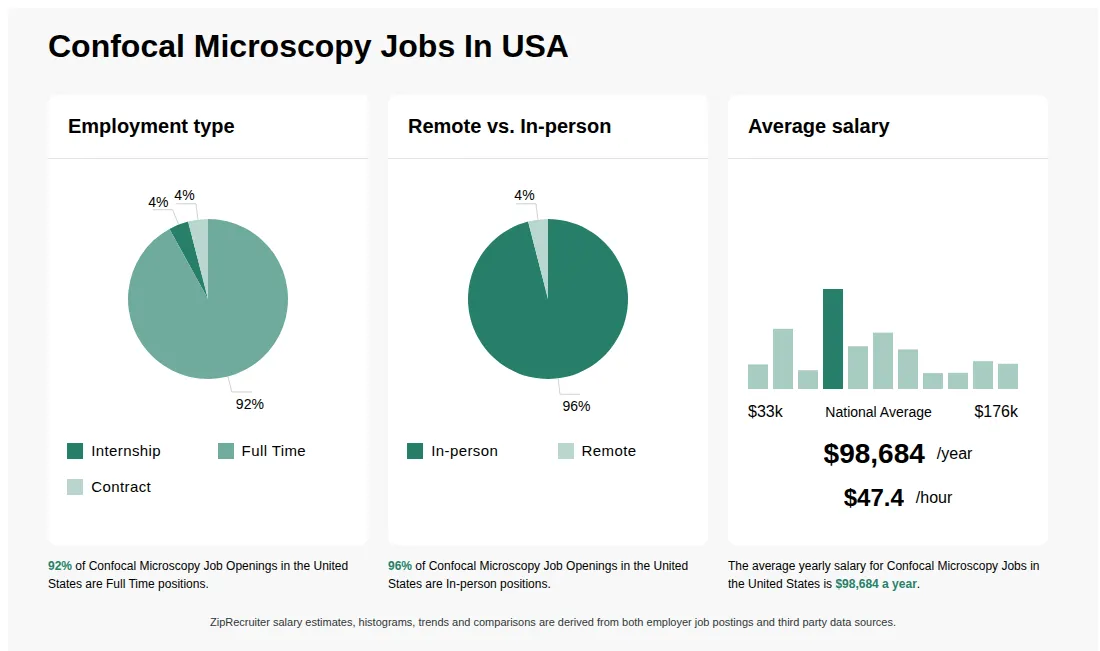
Infographic showing various Confocal Microscopy job openings in the United States as of June 2026, with employment types broken down into 37% Full Time, 57% Part Time, 3% Contract, and 3% Nights. Highlights an 94% Physical, 4% Hybrid, and 2% Remote job distribution.

Research Scientist, Cancer Biology, Levi Lab

4406

Dallas, TX โ€ข On-site

Other

Medical, Retirement, PTO

Posted yesterday


Job description

WHY UT SOUTHWESTERN?
With over 75 years of excellence in Dallas-Fort Worth, Texas, UT Southwestern is committed to excellence, innovation, teamwork, and compassion. As a world-renowned medical and research center, we strive to provide the best possible care, resources, and benefits for our valued employees. Ranked as the number 1 hospital in Dallas-Fort Worth according to U.S. News & World Report, we invest in you with opportunities for career growth and development to align with your future goals. Our highly competitive benefits package offers healthcare, PTO and paid holidays, on-site childcare, wage, merit increases and so much more. We invite you to be a part of the UT Southwestern team where you'll discover a culture of teamwork, professionalism, and a rewarding career!
JOB SUMMARY
Plans, coordinates, directs, and participates in work of smaller research project or major unit of large research project in field of specialization for which incumbent is particularly qualified in terms of extensive training and/or experience.

The Levi laboratory in the Division of Burn, Trauma, Acute and Critical Care Surgery in the Department of Surgery has an opening for a Research Scientist. The Levi lab's mission is to improve the lives of people living with skin and musculoskeletal injuries and diseases through rigorous science and compassion. Current projects in the Levi laboratory are related to the molecular biology behind tissue fibrosis and the repair and regeneration process in tendon, muscle, and bone. The laboratory integrates multiomics-based approaches with investigations of musculoskeletal development, homeostasis, repair, and regeneration. The laboratory uses transgenic animal models combined with bioinformatic approaches to understand the cell-cell interactions that occur within the stem cell niche under physiological conditions and strives to understand how these divergent signaling mechanisms may guide future therapeutic strategies to promote faithful repair of damaged tissue.

The Levi Lab is looking for a Research Scientist with an Osteosarcoma focus to join the team who is willing to commit to at least two years. The Research Scientist will support ongoing bench and animal work within the lab related to tendon injury/fibrosis, muscle injury/fibrosis or bone/tendon/muscle regeneration. Duties will include routine molecular bench work combined with the use of animal models (animal handling, injections, surgeries, sample collection) as well as downstream processing (histology, immunofluorescent stain and confocal imaging, flow cytometry, cell culture, single cell and bulk RNA sequencing) under supervision of the PI.

Laboratory Expectations

  • Routine molecular bench work combined with the use of animal models
  • Animal handling, injections, modified diet maintenance, surgeries, and sample collection
  • Downstream processing
  • Histology, immunofluorescent stain and confocal imaging, flow cytometry, and work with cell cultures and single-cell and bulk RNA sequencing

Preferred Experience

  • Able to utilize a variety of molecular biology techniques, including but not limited to PCR, qPCR, western blotting, RNA/DNA extraction, cloning, CRISPR/Cas9 gene editing, and next generation sequencing.
  • Experience with animal handling, animal breeding, genotyping, and animal surgery.
  • Experience with single-cell transcriptomic analyses.
  • Experience with histology pipeline from tissue harvest to embedding, sectioning, staining, and confocal microscopy.
  • Experience with flow cytometry and mass spectrometry.
  • Excellent written and oral communication and organizational skills.
  • Able to perform data analysis and interpretation using bioinformatics tools, statistical methods, and relevant software packages.

Laboratory Duties

  • Animal breeding, genotyping, handling, and surgery
  • Molecular biology techniques, including but not limited to PCR, qPCR, western blotting, RNA/DNA extraction, cloning, CRISPR/Cas9 gene editing, and next generation sequencing.
  • Flow cytometry and mass spectrometry.
  • Histology pipeline from tissue harvest to embedding, sectioning, staining, and confocal microscopy.
  • Design and execute experiments to investigate molecular mechanisms underlying biological processes.
  • Plan and develop standard operating protocols for experimental protocols.
  • Review and analyze resulting research data.
  • Revise techniques or approaches to work problems that are indicated as necessary by research data.
  • May confer with industrial, governmental, or other groups concerning progress or results of research project.
  • Maintain a respectful and inclusive laboratory environment.
  • Maintain a clean and functional workspace.
  • Analyze and interpret experimental data using relevant software and statistical methods.
  • Stay current with advances in molecular biology research and contribute to the development of new methodologies and techniques.
  • Prepare research findings for publication in scientific journals and present results at conferences and meetings, including weekly laboratory meetings and reading/writing clubs.
  • Contribute to grant writing and fundraising efforts to support research activities.
  • Collaborate with interdisciplinary teams to contribute molecular biology expertise to research projects and initiatives.
  • Assist in the training and supervision of junior laboratory personnel, including technicians, graduate students, and postdoctoral fellows.

BENEFITS
UT Southwestern is proud to offer a competitive and comprehensive benefits package to eligible employees. Our benefits are designed to support your overall wellbeing, and include:

  • PPO medical plan, available day one at no cost for full-time employee-only coverage
  • 100% coverage for preventive healthcare-no copay
  • Paid Time Off, available day one
  • Retirement Programs through the Teacher Retirement System of Texas (TRS)
  • Paid Parental Leave Benefit
  • Wellness programs
  • Tuition Reimbursement
  • Public Service Loan Forgiveness (PSLF) Qualified Employer
  • Learn more about these and other UTSW employee benefits!


EXPERIENCE AND EDUCATION
Required

  • Education
    PhD with major course work in the field of assignment or
    Master's Degree with major course work in the field of assignment or
    Bachelor's Degree with major course work in the field of assignment

  • Experience
    5 years of research experience in the field of assignment with PhD and 2 years at the level of Senior Research Associate or its equivalent or
    7 years of research experience in the field of assignment with Master's degree. and 3 years at the level of Senior Research Associate or its equivalent or
    9 years of research experience in the field of assignment with Bachelor's degree. and 4 years Level of Senior Research Associate or its equivalent.


JOB DUTIES

    • Plans, organizes coordinates, directs, and personally participates in assigned scientific or medical research project. Selects or assists in selection of key research personnel. Determines specific goals or objectives to be attained. Assigns and reviews work of subordinates. Plans experimental protocols.
    • Reviews and analyzes resulting research data. Revises techniques or approaches to work problems as indicated necessary by research data.
    • Compiles, writes, and submits research results to supervisor. Prepares or assists in preparation of research papers, reports, and abstracts for publication as one of co-authors.
    • Designs, develops, or adapts equipment used in experiments or research to obtain desired results.
    • Plans and supervises training of technicians and other laboratory personnel with respect to proper laboratory techniques, use of laboratory equipment, and safety procedures.
    • Supervises group of employees of lower grade engaged in performance of technical and professional work, which vary from routine to complex laboratory work tasks.
    • May confer with industrial, governmental, or other groups concerning progress or results of research project.
    • Performs other duties as assigned.


SECURITY AND EEO STATEMENT
Security
This position is security-sensitive and subject to Texas Education Code 51.215, which authorizes UT Southwestern to obtain criminal history record information.
EEO Statement
UT Southwestern Medical Center is committed to an educational and working environment that provides equal opportunity to all members of the University community. As an equal opportunity employer, UT Southwestern prohibits unlawful discrimination, including discrimination on the basis of race, color, religion, national origin, sex, sexual orientation, gender identity, gender expression, age, disability, genetic information, citizenship status, or veteran status.