1

Confocal Microscopy Jobs (NOW HIRING)

Confocal Sales Specialist

Boston, MA · On-site

$150K - $160K/yr

With a culture rooted in customer focus, innovation, and teamwork, we lead the market in microscopy ... The Confocal Sales Specialist is responsible for growth and expansion of direct sales and profit ...

Confocal Sales Specialist

Boston, MA · On-site +1

$150K - $160K/yr

With a culture rooted in customer focus, innovation, and teamwork, we lead the market in microscopy ... The Confocal Sales Specialist is responsible for growth and expansion of direct sales and profit ...

Experience in optical microscopy, confocal microscopy, slide scanner, multiphoton in vivo experiments, TIRF, spinning disk confocal, and atomic force microscopy. * Knowledge in designing imaging ...

next page

Showing results 1-20

Confocal Microscopy information

Who makes the best confocal microscopes?

Confocal microscopy is produced by several leading manufacturers, including Leica Microsystems, Zeiss, Nikon, and Olympus. These companies are known for their high-quality, reliable systems used in research and clinical laboratories, often requiring specialized training to operate effectively.

How to get a job in microscopy?

To get a job in microscopy, candidates typically need a relevant degree such as a bachelor's or master's in biology, physics, or a related field, along with hands-on experience using confocal microscopes and imaging software. Developing skills in sample preparation, data analysis, and understanding optical systems can improve employability. Certifications or specialized training in microscopy techniques can also enhance job prospects.

What are some common challenges faced by professionals working in confocal microscopy?

One common challenge in confocal microscopy roles is optimizing imaging conditions for different sample types to achieve the highest resolution and data accuracy, which often requires troubleshooting both hardware and software components. Professionals may also encounter the need to balance multiple projects or adapt imaging protocols to unique research questions. Collaboration with researchers, technicians, and other specialists is typical, requiring effective communication and teamwork skills. Overcoming these challenges is rewarding, as it contributes directly to meaningful scientific discoveries and high-impact research outcomes.

What are the key skills and qualifications needed to thrive in the Confocal Microscopy position, and why are they important?

To succeed in Confocal Microscopy, a strong background in biological sciences or related fields, hands-on experience with advanced microscopy, and meticulous attention to detail are critical. Familiarity with confocal microscope systems (such as Leica, Zeiss, or Nikon), image analysis software (like ImageJ or Imaris), and any relevant laboratory certifications is often expected. Excellent problem-solving skills, patience, and the ability to communicate complex findings clearly are valuable soft skills in this role. These competencies are essential to ensure high-quality imaging, accurate data interpretation, and effective collaboration within research and clinical teams.


What can confocal microscopy be used for?

Confocal microscopy is used in research and clinical laboratories to obtain high-resolution, three-dimensional images of biological specimens. It is commonly employed in cell biology, neurobiology, and materials science to study cellular structures, protein localization, and tissue morphology with precise optical sectioning. Proficiency in microscopy techniques and image analysis software is essential for confocal microscopy roles.

What are some careers that use microscopes?

Confocal microscopy is used in careers such as biomedical research, materials science, and clinical diagnostics. Professionals in these fields often operate advanced microscopes, analyze microscopic data, and require specialized training in imaging techniques. These roles are common in laboratories, research institutions, and healthcare settings.

What does a Confocal Microscopy job involve?

A Confocal Microscopy job typically involves operating and maintaining confocal microscopes to capture high-resolution images of biological or material samples. Professionals in this role prepare specimens, adjust imaging parameters, and analyze data for research or diagnostic purposes. They often work in laboratories within academic institutions, healthcare facilities, or industrial settings, supporting scientific studies in areas such as cell biology, neuroscience, and materials science. Strong technical skills, attention to detail, and knowledge of imaging software are essential for success in this field.

More about Confocal Microscopy jobs
What cities are hiring for Confocal Microscopy jobs? Cities with the most Confocal Microscopy job openings:
What are the most commonly searched types of Confocal Microscopy jobs? The most popular types of Confocal Microscopy jobs are:
What states have the most Confocal Microscopy jobs? States with the most job openings for Confocal Microscopy jobs include:
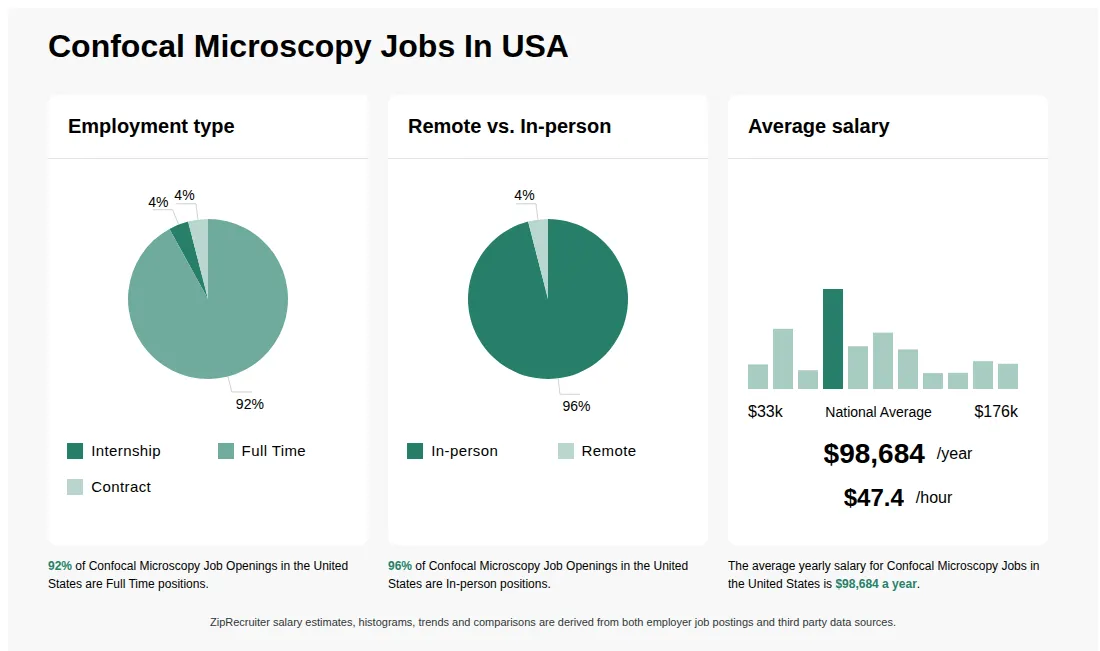
Infographic showing various Confocal Microscopy job openings in the United States as of June 2026, with employment types broken down into 37% Full Time, 57% Part Time, 3% Contract, and 3% Nights. Highlights an 94% Physical, 4% Hybrid, and 2% Remote job distribution.
Postdoctoral Associate

Full-time

Posted 23 hours ago


Stony Brook University rating

7.7

Company rating: 7.7 out of 10

Based on 21 frontline employees who took The Breakroom Quiz

222nd of 541 rated colleges and universities


Job description

Required Qualifications: (as evidenced by an attached resume)
PhD degree (or foreign equivalent) in Biomedical Sciences or a closely related field. Strong competence in Molecular Biology (PCR, cloning, and site-directed mutagenesis, RT-PCR), Immunoprecipitation and Western Blotting. Must be highly proficient in scientific writing.

Preferred Qualifications:
Experience with mammalian cell culture. Experience with expression (E. coli, yeast, and mammalian cells) and purification of proteins. Experience with Drosophila Genetics, Dissection, Immunostaining and Confocal Microscopy.

Brief Description of Duties:
The Misra laboratory at Stony Brook University is looking for a Postdoctoral Associate to join our starting group. Our NIH/funded research is centered on growth regulation by Hippo signaling during Drosophila development as well as cancer. We use Drosophila developmental genetics, cell biology and biochemistry to address these questions. Substantial training will be provided for techniques.

Under direct supervision of Dr. Jyoti Misra, the incumbent will perform the following duties:

      Maintain Drosophila stocks, setup genetic crosses, perform dissections, immunostaining and confocal microscopy

      Protein, RNA and DNA preparation, molecular cloning and purification of recombinant protein from e.coli, insect cells etc. and analyses; mammalian cell culture with sterile techniques.

      Perform biochemical analysis through kinase assay, Western Blotting etc.
Data analysis and participate in manuscript writing for publication; may assist in grant writing.

      Perform other duties as assigned such as training new personnel.

Special Notes:
The Research Foundation of SUNY is a private educational corporation. Employment is subject to the Research Foundation policies and procedures, sponsor guidelines and the availability of funding. FLSA Exempt position, not eligible for the overtime provisions of the FLSA. Minimum salary threshold must be met to maintain FLSA exemption.

Visit The Office of Postdoctoral Affairs to learn more about our postdoctoral community.

Resume/CV and cover letter should be included with the online application.

Stony Brook University is committed to excellence in diversity and the creation of an inclusive learning, and working environment. All qualified applicants will receive consideration for employment without regard to race, color, national origin, religion, sex, pregnancy, familial status, sexual orientation, gender identity or expression, age, disability, genetic information, veteran status and all other protected classes under federal or state laws.

If you need a disability-related accommodation, please call the university Office of Equity and Access (OEA) at (631) 632-6280 or visit OEA.

In accordance with the Title II Crime Awareness and Security Act a copy of our crime statistics can be viewed here.
Visit our WHY WORK HERE page to learn about the total rewards we offer.

SUNY Research Foundation: A Great Place to Work.

The starting salary range (or hiring range) to be offered for this position is noted below, it represents SBU's good faith and reasonable estimate of the range of possible compensation at the time of posting.


What Stony Brook University employees say

Pay

Hours and flexibility

Workplace

Get the full story on Breakroom