1

Computer Hacking Forensic Investigator Jobs (NOW HIRING)

next page

Showing results 1-20

Computer Hacking Forensic Investigator information

See salary details

$33K

$77.4K

$133K

How much do computer hacking forensic investigator jobs pay per year?

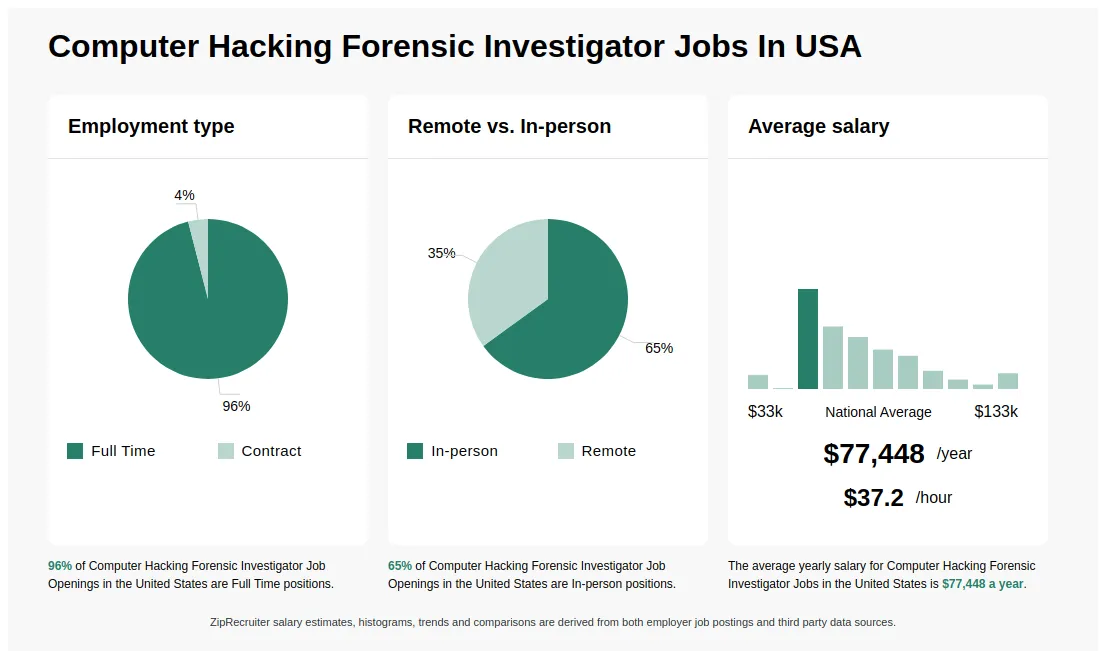
As of Jul 2, 2026, the average yearly pay for computer hacking forensic investigator in the United States is $77,448.00, according to ZipRecruiter salary data. Most workers in this role earn between $57,000.00 and $89,000.00 per year, depending on experience, location, and employer.

How much does a computer hacking forensic investigator make?

The average salary for a computer hacking forensic investigator ranges from $70,000 to $120,000 annually, depending on experience, certifications, and location. Professionals with specialized skills in digital forensics tools and certifications like GCFA or EnCE tend to earn higher salaries.

How do you become a computer forensics investigator?

To become a computer forensics investigator, individuals typically need a bachelor's degree in computer science, cybersecurity, or a related field, along with specialized training in digital forensics. Certifications such as Certified Computer Forensics Examiner (CCFE) or GIAC Certified Forensic Analyst (GCFA) can enhance job prospects, and experience with forensic tools like EnCase or FTK is valuable.

What does a cyber forensic investigator do?

A computer hacking forensic investigator analyzes digital evidence from computers, networks, and storage devices to identify, recover, and preserve data related to cybercrimes. They use specialized tools and techniques to investigate security breaches, fraud, or other illegal activities, often working closely with law enforcement and requiring certifications like CFCE or GCFA. Their work helps support legal proceedings and improve cybersecurity defenses.

What are the key skills and qualifications needed to thrive in the Computer Hacking Forensic Investigator position, and why are they important?

To thrive as a Computer Hacking Forensic Investigator, you need a solid understanding of computer science, digital forensics, cybersecurity practices, and legal protocols, often backed by a relevant degree and professional certifications like CHFI or GCFA. Familiarity with forensic software tools such as EnCase, FTK, and open-source utilities, as well as expertise with operating systems and network analysis, is essential. Attention to detail, critical thinking, and strong written and verbal communication are highly valued soft skills in this field. These skills and qualifications are crucial for accurately detecting, investigating, and documenting cyber incidents while adhering to legal standards.

What types of cases do Computer Hacking Forensic Investigators typically work on, and what might a normal workweek look like?

Computer Hacking Forensic Investigators often work on cases involving data breaches, cybercrimes, insider threats, intellectual property theft, and fraud investigations. A typical workweek may include analyzing compromised systems, collecting and preserving digital evidence, preparing technical reports for legal proceedings, and collaborating with law enforcement or corporate security teams. Investigators may juggle multiple active cases and occasionally respond to urgent incidents on short notice. The workload can vary between periods of detailed technical analysis in a lab environment and collaborative meetings to discuss findings or testify in court. This dynamic role requires adaptability and continuous learning to keep up with emerging cyber threats.

What is a Computer Hacking Forensic Investigator job?

A Computer Hacking Forensic Investigator (CHFI) is a cybersecurity professional who specializes in detecting, analyzing, and recovering forensic evidence from cybercrimes. They investigate hacking incidents, data breaches, and cyber fraud to identify perpetrators and prevent future attacks. CHFI professionals use advanced tools to analyze digital evidence, recover lost data, and support legal cases. They often work with law enforcement, government agencies, or private firms to ensure cybersecurity and compliance.

How much do computer forensics make?

Computer Hacking Forensic Investigators typically earn between $60,000 and $120,000 annually, depending on experience, certifications, and location. Entry-level roles may start lower, while experienced professionals with specialized skills and certifications can earn higher salaries in this field.
More about Computer Hacking Forensic Investigator jobs
What are the most commonly searched types of Computer Hacking Forensic Investigator jobs? The most popular types of Computer Hacking Forensic Investigator jobs are:
What states have the most Computer Hacking Forensic Investigator jobs? States with the most job openings for Computer Hacking Forensic Investigator jobs include:
Infographic showing various Computer Hacking Forensic Investigator job openings in the United States as of June 2026, with employment types broken down into 76% Full Time, and 24% Nights. Highlights an 94% Physical, 1% Hybrid, and 5% Remote job distribution, with an average salary of $77,448 per year, or $37.2 per hour.

Computer Investigative Forensic Specialist (CIFA)

Criminal Investigation & Law Enforcement | IRS Careers

Seattle, WA • On-site

$61K/yr

Other

Posted 14 days ago


Job description

WHAT IS CRIMINAL INVESTIGATION?
A description of the business units can be found at: https://www.jobs.irs.gov/about/who/business-divisions
  • Position(s) are to be filled in the following area(s):
    • CI- Digital Forensics
  • Consider each location carefully when applying. If you are selected for a location, that location will become your official post of duty.
REVIEW THE ADDITIONAL INFORMATION BELOW FOR FURTHER DETAILSQualifications:

Federal experience is not required. Experience may have been gained in the public sector, private sector or through Volunteer Service. One year of experience refers to full-time work; part-timework is considered on a prorated basis. To ensure full credit for your work experience, please indicate dates of employment by month/day/year, and indicate number of hours worked per week, on your resume.
You must meet the following requirements by the closing date of this announcement.
QUALIFICATION REQUIREMENTS: To qualify for this position, you must meet the qualification requirements outlined below:
SPECIALIZED EXPERIENCE FOR GS-09:
You must have 1 year of specialized experience at a level of difficulty and responsibility equivalent to the GS-07 grade level in the Federal service. Specialized experience for this position includes: Providing basic Digital Forensic support and the analysis of electronic evidence; conducting computer and mobile forensic examinations per established standards; testing forensic software; using analytical tools on digital media; preparing comprehensive final forensic reports; assisting in the assembling of PC workstations and configuring CPU environments; troubleshooting common software problems and/or referring to higher graded specialists for assistance; planning and carrying out assignments and revising methods and approaches; working with vendors to discuss upgrade and maintenance problems; assist in initial testing of systems and programs; testifying in Grand Juries, courts of law or administrative hearings.
OR
You may substitute education for specialized experience as follows: master's or equivalent graduate degree OR two (2) full years of progressively higher-level graduate education leading to a master's or equivalent graduate degree OR an LL.B. or J.D., if related.
OR
COMBINATION OF EXPERIENCE AND EDUCATION: At least 1 year of combined graduate education and experience as defined in paragraphs above.
SPECIALIZED EXPERIENCE FOR GS-11:
You must have 1 year of specialized experience at a level of difficulty and responsibility equivalent to the GS-09 grade level in the Federal service. Specialized experience for this position includes: Assisting with digital forensic support and analysis of electronic evidence and conducting computer and mobile forensic examinations to ensure compliance with internal policies and operating procedures as well as organizing and summarizing data to identify trends, patterns, and profiles. Utilizing forensic software using analytical tools to analyze digital media and prepare comprehensive final forensic reports. Configuring, maintaining and troubleshooting forensic hardware/software, used in support of digital forensic investigations. Communicating technical forensic information through written documentation and briefings to technical and non-technical audiences. Supporting investigative or legal proceedings by explaining forensic processes or findings and assisting with the preparation and evaluation of digital evidence for administrative, civil or criminal proceedings.
OR
You may substitute education for specialized experience as follows a Ph.D. or equivalent doctoral degree OR Three (3) full years of progressively higher-level graduate education leading to a doctoral degree OR LL.M., if related.
OR
COMBINATION OF EXPERIENCE AND EDUCATION: At least 1 year of combined graduate education and experience as defined in paragraphs above.
SPECIALIZED EXPERIENCE FOR GS-12:
You must have 1 year of specialized experience at a level of difficulty and responsibility equivalent to the GS-11 grade level in the Federal service. Specialized experience for this position includes: providing advanced digital forensic support and analysis of electronic evidence; conducting advanced computer and mobile forensic examinations per established standards; testing forensic software; using analytical tools on digital media, preparing comprehensive final forensic reports; independently assembling PC workstations and configuring CPU environments; troubleshooting software problems of moderate difficulty; designing, developing and managing forensic evidence systems; extending, enhancing, or optimizing existing forensic systems architecture; managing projects; communicating complex technical requirements to non-technical personnel; presenting briefings to senior management; interpreting IT policies, standards and guidelines and conducting analysis and making recommendations within specialty areas assigned; working with vendors to discuss upgrading and maintenance problems; assisting in initial testing of systems and programs; testifying in Grand Juries, courts of law or administrative hearings.
AND
You must also meet the following requirements:

  • MINIMUM AGE REQUIREMENT: Minimum age for federal employment is 18 years old, or at least 16 years old and have:
    • Graduated from high school or been awarded a certificate equivalent to graduating from high school; or
    • Completed a formal vocational training program; or
    • Received a statement from school authorities agreeing with your preference for employment rather than continuing your education.

For more information on qualifications please refer to OPM's Qualifications Standards.

Education:A college or university degree generally must be from an accredited (or pre-accredited) college or university recognized by the U.S. Department of Education. For a list of schools which meet these criteria, please refer to Department of Education Accreditation page.
FOREIGN EDUCATION: Education completed in foreign colleges or universities may be used to meet the requirements. You must show proof the education credentials have been deemed to be at least equivalent to that gained in conventional U.S. education program. It is your responsibility to provide such evidence when applying. Click here (Section 3, Explanation of Terms) or here for Foreign Education Credentialing instructions.
We recommend choosing an evaluator from a member organization of one of the following national associations of credential evaluation services: National Association of Credential Evaluation Services (NACES) or Association of International Credentials Evaluators (AICE).Employment Type: OTHER