Requisite computer science skills (operating systems, compiler theory, database theory, algorithm analysis, computer architecture, discrete math, programming language theory, and data structures) are ...
Requisite computer science skills (operating systems, compiler theory, database theory, algorithm analysis, computer architecture, discrete math, programming language theory, and data structures) are ...

Requisite computer science skills (operating systems, compiler theory, database theory, algorithm analysis, computer architecture, discrete math, programming language theory, and data structures) are ...
Quick apply
Requisite computer science skills (operating systems, compiler theory, database theory, algorithm analysis, computer architecture, discrete math, programming language theory, and data structures) are ...
Requisite computer science skills (operating systems, compiler theory, database theory, algorithm analysis, computer architecture, discrete math, programming language theory, and data structures) are ...
Quick apply
Requisite computer science skills (operating systems, compiler theory, database theory, algorithm analysis, computer architecture, discrete math, programming language theory, and data structures) are ...
Cryptologic Computer Scientist 3 with Security Clearance
Fort George G Meade, MD · On-site
$127K - $157K/yr
Apply requisite computer science skills (operating systems, complier theory, databased theory, algorithm analysis, computer architecture, discrete math, programming language theory, and data ...
Cryptologic Computer Scientist 3 with Security Clearance
Fort George G Meade, MD · On-site
$127K - $157K/yr
Apply requisite computer science skills (operating systems, complier theory, databased theory, algorithm analysis, computer architecture, discrete math, programming language theory, and data ...

Cryptologic Computer Scientist (2026-0184) with Security Clearance
Annapolis Junction, MD · On-site
$160K - $205K/yr
The right candidate will apply requisite computer science skills (operating systems, compiler theory, databased theory, algorithm analysis, computer architecture, discrete math, programming language ...
Cryptologic Computer Scientist (2026-0184) with Security Clearance
Annapolis Junction, MD · On-site
$160K - $205K/yr
The right candidate will apply requisite computer science skills (operating systems, compiler theory, databased theory, algorithm analysis, computer architecture, discrete math, programming language ...
The right candidate will apply requisite computer science skills (operating systems, compiler theory, databased theory, algorithm analysis, computer architecture, discrete math, programming language ...
The right candidate will apply requisite computer science skills (operating systems, compiler theory, databased theory, algorithm analysis, computer architecture, discrete math, programming language ...
The right candidate will apply requisite computer science skills (operating systems, compiler theory, databased theory, algorithm analysis, computer architecture, discrete math, programming language ...
The right candidate will apply requisite computer science skills (operating systems, compiler theory, databased theory, algorithm analysis, computer architecture, discrete math, programming language ...

Computer Science Teacher, New Brunswick High School
New Brunswick, NJ · On-site
$63K - $104K/yr
Knowledge of Computer Science Technology including ethics, algorithms, computer programming, data structures, computer architecture, cybersecurity, VM, and/or the designing of a cyber range for labs ...
Computer Science Teacher, New Brunswick High School
New Brunswick, NJ · On-site
$63K - $104K/yr
Knowledge of Computer Science Technology including ethics, algorithms, computer programming, data structures, computer architecture, cybersecurity, VM, and/or the designing of a cyber range for labs ...
Efficient is developing the world's most energy-efficient general-purpose computer processor ... Planning and tracking the work of the architecture team, including: * Working closely with ...
Efficient is developing the world's most energy-efficient general-purpose computer processor ... Planning and tracking the work of the architecture team, including: * Working closely with ...

S. in Computer Engineering, Computer Science or similar engineering degree. Experience with computer architecture. Experience with power management. Excellent verbal and written communication skills.
S. in Computer Engineering, Computer Science or similar engineering degree. Experience with computer architecture. Experience with power management. Excellent verbal and written communication skills.

Cryptologic Computer Scientist
Odenton, MD · On-site
$107.90 - $195.05/hr
Apply expertise in areas such as operating systems, algorithms, compiler theory, computer architecture, discrete mathematics, programming languages, and data structures. * Support mission areas ...
Cryptologic Computer Scientist
Odenton, MD · On-site
$107.90 - $195.05/hr
Apply expertise in areas such as operating systems, algorithms, compiler theory, computer architecture, discrete mathematics, programming languages, and data structures. * Support mission areas ...
Cryptologic Computer Scientist 2
Annapolis Junction, MD · On-site
$119K - $132K/yr
Requisite computer science skills (operating systems, compiler theory, database theory, algorithm analysis, computer architecture, discrete math, programming language theory, and data structures are ...
Cryptologic Computer Scientist 2
Annapolis Junction, MD · On-site
$119K - $132K/yr
Requisite computer science skills (operating systems, compiler theory, database theory, algorithm analysis, computer architecture, discrete math, programming language theory, and data structures are ...

Cryptologic Computer Scientist
Dayton, OH · On-site
The right candidate will apply requisite computer science skills (operating systems, compiler theory, databased theory, algorithm analysis, computer architecture, discrete math, programming language ...
Cryptologic Computer Scientist
Dayton, OH · On-site
The right candidate will apply requisite computer science skills (operating systems, compiler theory, databased theory, algorithm analysis, computer architecture, discrete math, programming language ...
Cryptologic Computer Scientist
Fort George G Meade, MD · On-site
$15K - $210K/yr
The right candidate will apply requisite computer science skills (operating systems, compiler theory, databased theory, algorithm analysis, computer architecture, discrete math, programming language ...
Quick apply
Cryptologic Computer Scientist
Fort George G Meade, MD · On-site
$15K - $210K/yr
The right candidate will apply requisite computer science skills (operating systems, compiler theory, databased theory, algorithm analysis, computer architecture, discrete math, programming language ...
Cryptologic Computer Scientist
Fort George G Meade, MD · On-site
$15K - $210K/yr
The right candidate will apply requisite computer science skills (operating systems, compiler theory, databased theory, algorithm analysis, computer architecture, discrete math, programming language ...
Cryptologic Computer Scientist
Fort George G Meade, MD · On-site
$15K - $210K/yr
The right candidate will apply requisite computer science skills (operating systems, compiler theory, databased theory, algorithm analysis, computer architecture, discrete math, programming language ...
The right candidate will apply requisite computer science skills (operating systems, compiler theory, databased theory, algorithm analysis, computer architecture, discrete math, programming language ...
The right candidate will apply requisite computer science skills (operating systems, compiler theory, databased theory, algorithm analysis, computer architecture, discrete math, programming language ...

Cryptologic Computer Scientist 2
Annapolis Junction, MD · On-site
$119K - $132K/yr
... computer architecture, discrete math, programming language theory, and data structures are applied to each problem to provide state of the art techniques, tools, and approaches).What You BringActive ...
Quick apply
Cryptologic Computer Scientist 2
Annapolis Junction, MD · On-site
$119K - $132K/yr
... computer architecture, discrete math, programming language theory, and data structures are applied to each problem to provide state of the art techniques, tools, and approaches).What You BringActive ...
Cryptologic Computer Scientist 2
Annapolis, MD · On-site
$119K - $132K/yr
Requisite computer science skills (operating systems, compiler theory, database theory, algorithm analysis, computer architecture, discrete math, programming language theory, and data structures are ...
Cryptologic Computer Scientist 2
Annapolis, MD · On-site
$119K - $132K/yr
Requisite computer science skills (operating systems, compiler theory, database theory, algorithm analysis, computer architecture, discrete math, programming language theory, and data structures are ...
The right candidate will apply requisite computer science skills (operating systems, compiler theory, databased theory, algorithm analysis, computer architecture, discrete math, programming language ...
The right candidate will apply requisite computer science skills (operating systems, compiler theory, databased theory, algorithm analysis, computer architecture, discrete math, programming language ...
The right candidate will apply requisite computer science skills (operating systems, compiler theory, databased theory, algorithm analysis, computer architecture, discrete math, programming language ...
The right candidate will apply requisite computer science skills (operating systems, compiler theory, databased theory, algorithm analysis, computer architecture, discrete math, programming language ...
Computer Architecture information
See salary details
$159.5K - $162.2K
7% of jobs
$162.2K - $164.9K
11% of jobs
$167.2K is the 25th percentile. Wages below this are outliers.
$164.9K - $167.5K
9% of jobs
$167.5K - $170.2K
9% of jobs
$170.2K - $172.9K
9% of jobs
The median wage is $174.5K / yr.
$172.9K - $175.6K
11% of jobs
$175.6K - $178.3K
9% of jobs
$178.3K - $181K
9% of jobs
$182K is the 75th percentile. Wages above this are outliers.
$181K - $183.6K
9% of jobs
$183.6K - $186.3K
11% of jobs
$186.3K - $189K
9% of jobs
$159.5K
$175K
$189K
How much do computer architecture jobs pay per year?
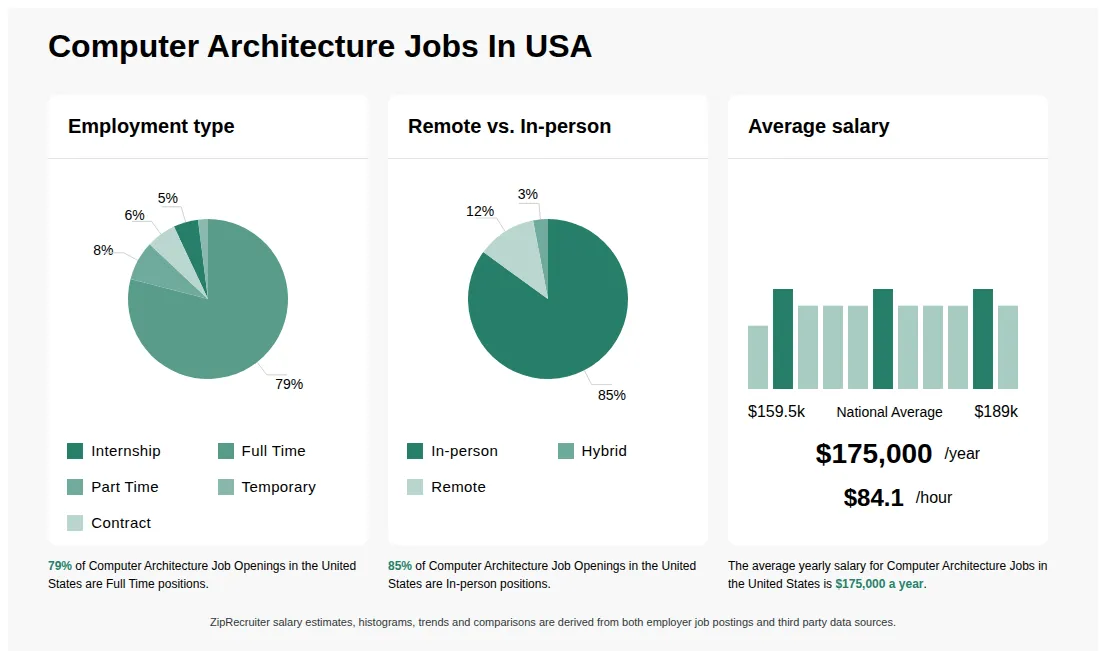
As of Sep 5, 2026, the average yearly pay for computer architecture in the United States is $175,000.00, according to ZipRecruiter salary data. Most workers in this role earn between $167,500.00 and $182,500.00 per year, depending on experience, location, and employer.
What is computer architecture?
Computer architecture refers to the design and organization of a computer's core components, including the central processing unit (CPU), memory systems, input/output controls, and data paths. It defines how these elements interact to execute instructions and perform tasks efficiently. Computer architects focus on optimizing performance, power consumption, and cost by making choices about hardware structure and instruction sets. Understanding computer architecture is crucial for developing faster, more reliable, and energy-efficient computing systems.
What are the key skills and qualifications needed to thrive in computer architecture, and why are they important?
To thrive in Computer Architecture, you need a solid background in computer engineering or computer science, with expertise in digital logic design, processor organization, and systems-level integration. Familiarity with hardware description languages (such as VHDL or Verilog), simulation tools, and industry-standard architectures (like x86, ARM, or RISC-V) is commonly required. Analytical thinking, problem-solving, and effective communication are essential soft skills for collaborating on complex hardware projects. These competencies ensure the development of efficient, reliable, and innovative computing systems that meet performance and power requirements.
What are some common challenges faced by professionals working in computer architecture roles?
Professionals in computer architecture often encounter challenges such as balancing performance improvements with power efficiency and cost constraints. They must stay up-to-date with rapidly evolving technologies and address compatibility issues when integrating new hardware or optimizing existing systems. Collaboration is crucial, as computer architects frequently work with software engineers, hardware designers, and verification teams to ensure cohesive system design and functionality. Managing tight project deadlines and complex system requirements can also be demanding, but these challenges foster continuous learning and innovation within the field.
What is the difference between Computer Architecture vs Computer Hardware Engineer?
| Aspect | Computer Architecture | Computer Hardware Engineer |
|---|---|---|
| Primary Focus | Designing and optimizing the overall structure and organization of computer systems | Designing, developing, and testing physical computer components and systems |
| Work Environment | Research labs, design firms, academia | Manufacturing facilities, hardware development companies |
| Required Credentials | Bachelor's or master's in Computer Engineering, Electrical Engineering, or related fields | Bachelor's or master's in Electrical Engineering, Computer Engineering, or related fields |
| Industry Usage | Used by system designers, researchers, and academia | Used by hardware manufacturers, product developers, and engineers |
While both roles involve working with computer systems, Computer Architecture focuses on designing the overall system structure and performance optimization, whereas Computer Hardware Engineers work on creating and testing physical components. Understanding these differences helps in choosing the right career path or job search focus.
How much do computer architects get paid?
Computer architects, also known as hardware engineers or system architects, typically earn a median annual salary of around $120,000, with salaries varying based on experience, education, and location. Entry-level positions may start lower, while experienced professionals or those with specialized skills in design and optimization can earn significantly more.
Is computer architecture in demand?
Computer architecture is a specialized field within computer engineering and is in steady demand due to the ongoing need for designing efficient processors, embedded systems, and hardware components. Professionals with skills in digital design, VHDL/Verilog, and knowledge of emerging technologies like quantum computing are sought after in industries such as technology, manufacturing, and research institutions.
What can you do with computer architecture?
Computer architecture professionals design, analyze, and optimize computer systems, including processors, memory, and input/output devices. They work on improving system performance, developing hardware components, and ensuring compatibility with software applications, often using tools like simulation software and hardware description languages. This field requires knowledge of digital logic, programming, and hardware design principles.
More about Computer Architecture jobs
What cities are hiring for Computer Architecture jobs?
Cities with the most Computer Architecture job openings:
What states have the most Computer Architecture jobs?
States with the most job openings for Computer Architecture jobs include:
What job categories do people searching Computer Architecture jobs look for?
The top searched job categories for Computer Architecture jobs are:

Full-time
Medical, Dental, Vision, Life, Retirement, PTO
Re-posted 22 days ago
Job description
We solve difficult business, IT, and analytic problems by addressing the whole problem - not just the symptoms - using interdisciplinary approaches that are both practical and innovative. We provide fresh alternatives to ordinary, mainstream consulting firms through small, highly skilled, and hand-picked teams that can meet clients' needs in any industry. Our broad interdisciplinary understanding allows us to provide the right solution, even if it is from outside the industry or traditionally defined problem space. We bring Public and Private, Civilian and Military expertise to every case.
We are hiring a Cryptologic Computer Scientist to work in Fort Meade, MD. Position location is subject to change based on central MD client's needs - will provide salary range proactively.
Required: TS/SCI with a Polygraph
Design, develop and operate solutions to hard cryptologic computer science problems within a scientific framework. The solutions may arise in the forms of forensics and attack attribution, protection of critical networks, active systems warnings and indicators, active penetration into target systems, knowledge of discovery of passive and active systems, or other cryptologic computer science mission support. Requisite computer science skills (operating systems, compiler theory, database theory, algorithm analysis, computer architecture, discrete math, programming language theory, and data structures) are applied to each problem to provide state-of-the-art techniques, tools, and approaches.
Individual Capabilities/Experience Required:
We have all the PERKS!
You are our most valuable resource - your ambition, your knowledge, your creativity. We offer an industry-leading set of benefits to supplement your normal salary compensation. We have you covered with flexible ways to balance work and home life, full health benefit premium coverage, and generous contributions toward your retirement.
We are an Equal Opportunity/Affirmative Action employer.
We provide equal employment opportunities to all employees and applicants for employment and prohibits discrimination and harassment of any type without regard to race, color, religion, age, sex, national origin, disability status, genetics, protected veteran status, sexual orientation, gender identity or expression, or any other characteristic protected by federal, state or local laws.
This policy applies to all terms and conditions of employment, including recruiting, hiring, placement, promotion, termination, layoff, recall, transfer, leaves of absence, compensation and training.
Power3 Solutions
Partnering with federal, state, and local organizations to bring the best talent to the right roles.
https://power3.com/
Talent@power3.com
https://www.linkedin.com/company/power3-solutions
We are hiring a Cryptologic Computer Scientist to work in Fort Meade, MD. Position location is subject to change based on central MD client's needs - will provide salary range proactively.
Required: TS/SCI with a Polygraph
Design, develop and operate solutions to hard cryptologic computer science problems within a scientific framework. The solutions may arise in the forms of forensics and attack attribution, protection of critical networks, active systems warnings and indicators, active penetration into target systems, knowledge of discovery of passive and active systems, or other cryptologic computer science mission support. Requisite computer science skills (operating systems, compiler theory, database theory, algorithm analysis, computer architecture, discrete math, programming language theory, and data structures) are applied to each problem to provide state-of-the-art techniques, tools, and approaches.
Individual Capabilities/Experience Required:
- Level 2 - Bachelor's degree plus 5 years of relevant experience or a Master's degree plus 3 years of relevant experience or a Doctoral degree and 2 years of relevant experience. An Associate's degree plus 7 years of relevant experience may be considered for individuals with in-depth experience that is clearly related to the position.
- Level 3 - Bachelor's degree plus 8 years of relevant experience or a Master's degree plus 6 years of relevant experience or a Doctoral degree plus 4 years of relevant experience. An Associate's degree plus 10 years of relevant experience may be considered for individuals with in-depth experience that is clearly related to the position.
- Level 4 - Bachelor's degree plus 11 years of relevant experience or a Master's degree plus 9 years of relevant experience or a Doctoral degree plus 7 years of relevant experience. An Associate's degree plus 13 years of relevant experience may be considered for individuals with in-depth experience that is clearly related to the position.
- Degree must be in Computer Science (CS). Related fields (e.g., Engineering, Mathematics) may be considered relevant if the programs contain, at minimum, a concentration of courses in the following foundational CS areas: algorithms; computer architecture (not network architecture); programming methodologies and languages; data structures; logic and computation; and advanced mathematics (for example, calculus, discrete mathematics). Information Technology (IT) or Information Systems (IS) degrees may be considered relevant if the programs contain the amount and type of coursework equivalent to a CS major.
- Relevant experience must be in computer systems research; simulation/model development and prototyping; software design; programming; computational science; algorithm analysis and design; reverse engineering; and/or designing/developing computer or information systems, including engineering hardware and/or software.
We have all the PERKS!
You are our most valuable resource - your ambition, your knowledge, your creativity. We offer an industry-leading set of benefits to supplement your normal salary compensation. We have you covered with flexible ways to balance work and home life, full health benefit premium coverage, and generous contributions toward your retirement.
- Competitive health, dental, and vision plans with 100% paid premiums.
- 401k: We contribute 6% even if you don't!
- Time Off: 11 standard holidays, and 25 days of PTO
- Career Development: Get career counseling and individualized career development plans, including education and training.
- Employee referral bonuses for successful hires
We are an Equal Opportunity/Affirmative Action employer.
We provide equal employment opportunities to all employees and applicants for employment and prohibits discrimination and harassment of any type without regard to race, color, religion, age, sex, national origin, disability status, genetics, protected veteran status, sexual orientation, gender identity or expression, or any other characteristic protected by federal, state or local laws.
This policy applies to all terms and conditions of employment, including recruiting, hiring, placement, promotion, termination, layoff, recall, transfer, leaves of absence, compensation and training.
Power3 Solutions
Partnering with federal, state, and local organizations to bring the best talent to the right roles.
https://power3.com/
Talent@power3.com
https://www.linkedin.com/company/power3-solutions

About Power3 Solutions
Sourced by ZipRecruiter
Industry
Executive offices
Company size
11 - 50 Employees
Headquarters location
Columbia, MD, US