1

Computer Architecture Jobs (NOW HIRING)

We are looking for talented software programmers who possess a strong interest in computer architecture, VLSI design, image processing, video compression, and computer vision. Architecture interns ...

next page

Showing results 1-20

Computer Architecture information

See salary details

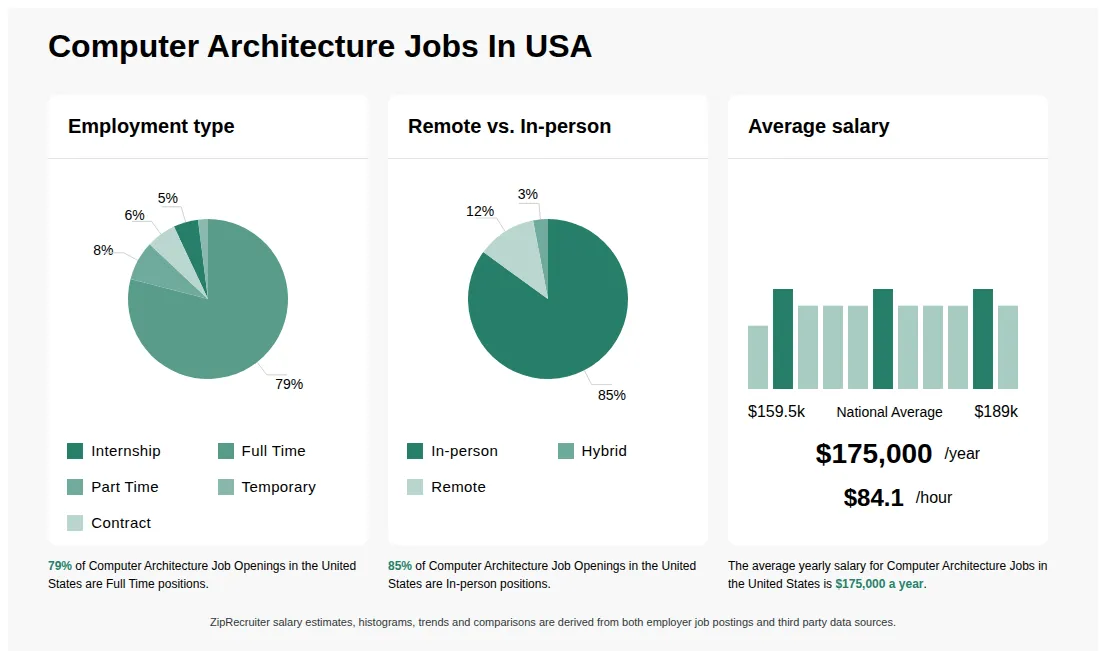
$159.5K

$175K

$189K

How much do computer architecture jobs pay per year?

As of Jul 26, 2026, the average yearly pay for computer architecture in the United States is $175,000.00, according to ZipRecruiter salary data. Most workers in this role earn between $167,500.00 and $182,500.00 per year, depending on experience, location, and employer.

Is computer architecture worth IT?

Computer architecture is a fundamental field within IT and computer engineering, focusing on designing and optimizing hardware systems. Careers in this area often require strong knowledge of digital logic, programming, and hardware description languages, and can lead to roles in hardware design, system optimization, and embedded systems development, which are in demand across various technology sectors.

What is the difference between Computer Architecture vs Computer Hardware Engineer?

AspectComputer ArchitectureComputer Hardware Engineer
Primary FocusDesigning and optimizing the overall structure and organization of computer systemsDesigning, developing, and testing physical computer components and systems
Work EnvironmentResearch labs, design firms, academiaManufacturing facilities, hardware development companies
Required CredentialsBachelor's or master's in Computer Engineering, Electrical Engineering, or related fieldsBachelor's or master's in Electrical Engineering, Computer Engineering, or related fields
Industry UsageUsed by system designers, researchers, and academiaUsed by hardware manufacturers, product developers, and engineers

While both roles involve working with computer systems, Computer Architecture focuses on designing the overall system structure and performance optimization, whereas Computer Hardware Engineers work on creating and testing physical components. Understanding these differences helps in choosing the right career path or job search focus.

What are the key skills and qualifications needed to thrive in Computer Architecture, and why are they important?

To thrive in Computer Architecture, you need a solid background in computer engineering or computer science, with expertise in digital logic design, processor organization, and systems-level integration. Familiarity with hardware description languages (such as VHDL or Verilog), simulation tools, and industry-standard architectures (like x86, ARM, or RISC-V) is commonly required. Analytical thinking, problem-solving, and effective communication are essential soft skills for collaborating on complex hardware projects. These competencies ensure the development of efficient, reliable, and innovative computing systems that meet performance and power requirements.

What are computer architecture jobs?

Computer architecture jobs involve designing, developing, and optimizing computer hardware systems, including processors, memory, and integrated circuits. These roles often require knowledge of digital design, hardware description languages, and experience with simulation tools, and may involve working in research and development or engineering teams. Professionals in this field typically hold degrees in computer engineering, electrical engineering, or related disciplines.

What is computer architecture?

Computer architecture refers to the design and organization of a computer's core components, including the central processing unit (CPU), memory systems, input/output controls, and data paths. It defines how these elements interact to execute instructions and perform tasks efficiently. Computer architects focus on optimizing performance, power consumption, and cost by making choices about hardware structure and instruction sets. Understanding computer architecture is crucial for developing faster, more reliable, and energy-efficient computing systems.

What are some common challenges faced by professionals working in computer architecture roles?

Professionals in computer architecture often encounter challenges such as balancing performance improvements with power efficiency and cost constraints. They must stay up-to-date with rapidly evolving technologies and address compatibility issues when integrating new hardware or optimizing existing systems. Collaboration is crucial, as computer architects frequently work with software engineers, hardware designers, and verification teams to ensure cohesive system design and functionality. Managing tight project deadlines and complex system requirements can also be demanding, but these challenges foster continuous learning and innovation within the field.

What do computer architecture do?

A computer architect designs and develops the structure of computer systems, including processors, memory, and input/output components. They analyze hardware performance, create specifications, and work with software teams to optimize system efficiency, often using tools like simulation software and hardware description languages.

How much do computer architects make?

Computer architects, also known as hardware architects or system architects, typically earn a median annual salary of around $120,000, with salaries varying based on experience, education, and location. Professionals in this field often have strong skills in digital design, computer architecture, and hardware description languages, and may work in research, development, or engineering environments.
More about Computer Architecture jobs
What cities are hiring for Computer Architecture jobs? Cities with the most Computer Architecture job openings:
What states have the most Computer Architecture jobs? States with the most job openings for Computer Architecture jobs include:
What job categories do people searching Computer Architecture jobs look for? The top searched job categories for Computer Architecture jobs are:
Infographic showing various Computer Architecture job openings in the United States as of July 2026, with employment types broken down into 91% Full Time, 5% Part Time, and 4% Contract. Highlights an 81% Physical, 5% Hybrid, and 14% Remote job distribution, with an average salary of $175,000 per year, or $84.1 per hour.

Cryptologic Computer Scientist with Security Clearance

The Swift Group

Laurel, MD • On-site

Other

Posted 6 days ago


Job description

For the OPS Consulting team, 'the power to help' means helping our clients, helping serve the mission, helping our employees and their families, and helping the community. Headquartered in Hanover, MD. OPS Consulting has over two decades of experience specializing in the most mission-critical operations. We are thought leaders and innovators. The ingenuity of our developers, engineers, cyber experts, linguists, and analysts are dedicated to empowering our clients, fulfilling The Mission, and remaining trusted leaders and advisers in national security and technology solutions. We are looking for a Cryptologic Computer Scientist to work in Annapolis Junction and/or Laurel, MD. Responsibilities: The Cryptologic Computer Scientist will design, develop, deliver, and operate solutions to hard cryptologic computer science problems within a scientific framework. This position will require computer science skills (operating systems, compiler theory, database theory, algorithm analysis, computer architecture, discrete math, programming language theory, and data structures). Required Qualifications: * Experience with Python, Spark, and working with large-scale data.
* Must have a strong background in network protocol analysis.
* The ideal candidate will be inquisitive and have a discovery-focused mindset.
* Level 2:
* 5 years of relevant experience in the following areas: computer system research, simulation/ model development and prototyping, software design, programming, computational science, algorithm analysis, design, and reverse engineering/ designing/ developing to include hardware and/ or software.
* A Bachelor's degree in Computer Science or related fields such as (Engineering, Mathematics, Information Technology, or Information Systems), only if the following foundational Computer Science areas are met: algorithms, computer architecture, programming methodologies, data structures, logic and computation, and advanced mathematics.
* Level 3:
* 8 years of relevant experience in the following areas: computer system research, simulation/ model development and prototyping, software design, programming, computational science, algorithm analysis, design, and reverse engineering/ designing/ developing to include hardware and/ or software.
* A Bachelor's degree in Computer Science or related fields such as (Engineering, Mathematics, Information Technology, or Information Systems), only if the following foundational Computer Science areas are met: algorithms, computer architecture, programming methodologies, data structures, logic and computation, and advanced mathematics.
* Level 4:
* 11 years of relevant experience in the following areas: computer system research, simulation/ model development and prototyping, software design, programming, computational science, algorithm analysis, design, and reverse engineering/ designing/ developing to include hardware and/ or software.
* A Bachelor's degree in Computer Science or related fields such as (Engineering, Mathematics, Information Technology, or Information Systems), only if the following foundational Computer Science areas are met: algorithms, computer architecture, programming methodologies, data structures, logic and computation, and advanced mathematics. Security Clearance: * A current government clearance, background investigation, and polygraph are required. #LI-JP1 #OpsConsulting