1

Computational Research Assistant Jobs (NOW HIRING)

The Research Assistant will work closely with the Principal Investigator and research collaborators to perform data-driven analysis, computational modeling, and literature reviews. This role provides ...

Research Assistant

Sidney, OH · On-site

$18 - $24.50/hr

... computational principles to better understand how their application in modular information ... Research Assistant Department: Department of Neuroscience Grade: Grade 7 Worker Type: Employee ...

Research Assistant

Providence, RI · On-site

$19.50 - $26.75/hr

... computational principles to better understand how their application in modular information ... Research Assistant Department: Department of Neuroscience Grade: Grade 7 Worker Type: Employee ...

Research Assistant

Washington, DC · On-site

$40K - $47K/yr

The role involves a combination of computational analysis and laboratory support to characterize ... The Research Assistant will work under the direct supervision of the Principal Investigator within ...

This position provides an early-career scholar with opportunities to conduct computational research, assist faculty projects, develop training programs, and contribute to curriculum innovation ...

Research Assistant

Blacksburg, VA

$17 - $23.25/hr

Research Assistant Apply now Back to search results Job no: 535375 Work type: Staff Senior ... The goal of our lab is to develop a computational framework for understanding the cognitive ...

next page

Showing results 1-20

Computational Research Assistant information

See salary details

$33.5K

$48.3K

$63.5K

How much do computational research assistant jobs pay per year?

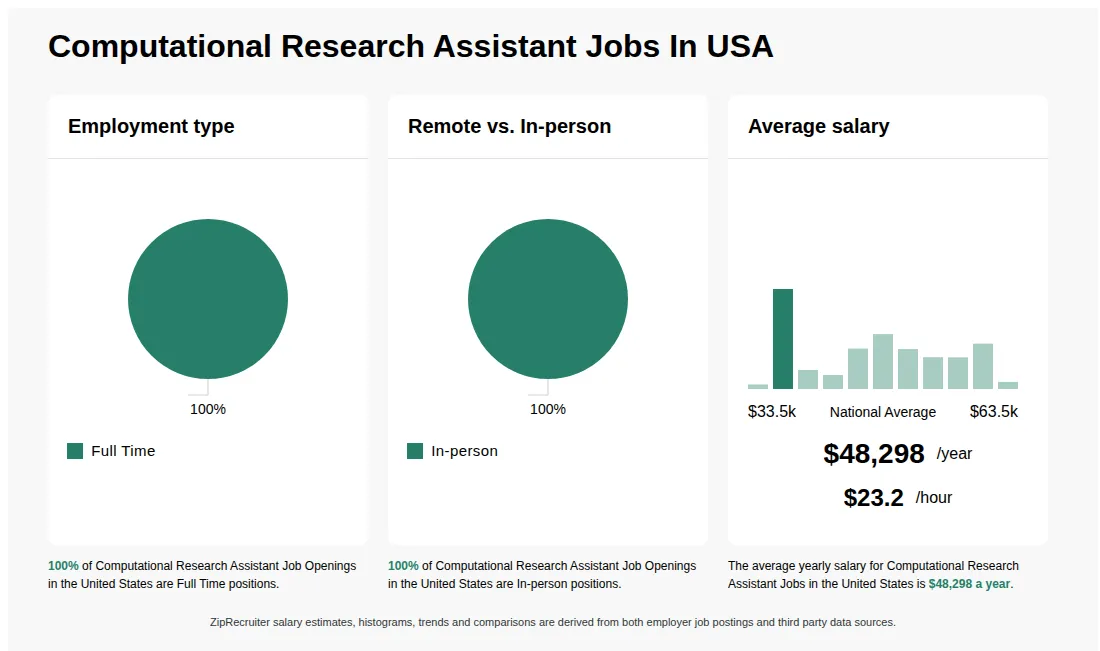
As of May 28, 2026, the average yearly pay for computational research assistant in the United States is $48,298.00, according to ZipRecruiter salary data. Most workers in this role earn between $38,000.00 and $55,500.00 per year, depending on experience, location, and employer.

What are the key skills and qualifications needed to thrive as a Computational Research Assistant, and why are they important?

To thrive as a Computational Research Assistant, you need strong analytical skills, proficiency in programming languages like Python or R, and a background in mathematics, statistics, or computer science. Familiarity with data analysis tools, version control systems (such as Git), and experience using high-performance computing environments or relevant software is typically required. Attention to detail, problem-solving ability, and effective communication help you collaborate with research teams and interpret complex results. These skills and qualities are crucial for producing accurate, reliable research outcomes and supporting innovative scientific investigations.

How does a Computational Research Assistant typically collaborate with principal investigators and other team members during a research project?

Computational Research Assistants often work closely with principal investigators (PIs), postdoctoral researchers, and other team members to design, implement, and analyze computational experiments. They are responsible for developing scripts, managing datasets, and ensuring the reproducibility of results. Regular meetings and progress updates are common, and assistants are expected to communicate findings clearly and troubleshoot technical issues collaboratively. This role requires both independent initiative and a strong team-oriented approach to meet research objectives efficiently.

What are Computational Research Assistants?

Computational Research Assistants are professionals who support scientific and academic research projects by applying computational methods, programming, and data analysis techniques. They often work with researchers to develop models, run simulations, analyze large datasets, and assist in the interpretation of results. Their work is essential in fields such as biology, physics, social sciences, and engineering, where complex data and computational tools are required to conduct research. Typically, they have strong skills in programming languages like Python, R, or MATLAB, and possess a background in the relevant scientific discipline.

What is the difference between Computational Research Assistant vs Data Analyst?

AspectComputational Research AssistantData Analyst
Required CredentialsBachelor's or Master's in Computer Science, Data Science, or related fieldsBachelor's or Master's in Statistics, Data Science, or related fields
Work EnvironmentResearch labs, academic institutions, or research-focused organizationsBusiness, finance, healthcare, or marketing sectors
Employer & Industry UsageAcademic and research institutions, government agenciesCorporations, consulting firms, government agencies
Common Search & ComparisonYesNo

The Computational Research Assistant and Data Analyst roles share similarities in data handling and analytical skills, but differ mainly in their focus. Computational Research Assistants typically work in research settings, supporting scientific projects with programming and modeling, while Data Analysts focus on interpreting data to inform business decisions. Both roles require strong technical skills and relevant education, but their work environments and primary objectives differ.

More about Computational Research Assistant jobs
What cities are hiring for Computational Research Assistant jobs? Cities with the most Computational Research Assistant job openings:
What are the most commonly searched types of Computational Research jobs? The most popular types of Computational Research jobs are:
What states have the most Computational Research Assistant jobs? States with the most job openings for Computational Research Assistant jobs include:
Infographic showing various Computational Research Assistant job openings in the United States as of May 2026, with employment types broken down into 100% Full Time. Highlights an 100% In-person job distribution, with an average salary of $48,298 per year, or $23.2 per hour.
Pro Tem Research Assistant/Associate/Postdoc - Institute for Fundamental Science - Open Pool

Pro Tem Research Assistant/Associate/Postdoc - Institute for Fundamental Science - Open Pool

University of Oregon

Eugene, OR

Full-time, Part-time

Medical, Retirement, PTO

Posted 11 days ago


University Of Oregon rating

7.2

Company rating: 7.2 out of 10

Based on 47 frontline employees who took The Breakroom Quiz

327th of 528 rated colleges and universities


Job description

Pro Tem Research Assistant/Associate/Postdoc - Institute for Fundamental Science - Open Pool
Job no: 536540
Work type: Faculty - Pro Tempore
Location: Eugene, OR
Categories: Research/Scientific/Grants, Chemistry, Physics, Math
Department: Inst. for Fundamental Science
Rank: Research Assistant, Research Associate, Postdoctoral Scholar
Annual Basis: 12 Month
Review of Applications Begins
Applications will be reviewed as needs arise
Special Instructions to Applicants
In addition to a completed application, please submit
• A current CV - must highlight research area of interest
• Names and contact information for three professional references
Department Summary
The Institute for Fundamental Science (IFS) at the University of Oregon is the home for research whose primary aim is to understand, explore, and extend the fundamental laws of nature, with an emphasis on the consequences for observable phenomena. The IFS brings together the UO's investigations in experimental and theoretical high energy particle physics, astrophysics and astronomy, and is complemented by a variety of inquiries into other foundational topics.
More information about the Institute for Fundamental Science at the University of Oregon may
be found by visiting the Institute's website at: http://ifs.uoregon.edu.
Position Summary
The Institute for Fundamental Science at the University of Oregon is seeking qualified applicants for its open research pool. Positions are limited-duration, funding-contingent research appointments that are full time, part-time or short term, contracts not to exceed one year. There is a possibility of renewal up to a total of three years, depending on program needs, funding, and performance. The successful candidate will have the ability to work effectively with faculty, staff, and students from a variety of diverse backgrounds.
Examples include research assistants, research associates, or postdoctoral scholars. Research assistants conduct research under the direction of a principal investigator; research associates conduct research with only general guidance; postdoctoral scholars conduct research under the direction of a faculty member for the purpose of acquiring research training.
Minimum Requirements
• RESEARCH ASSISTANT (TYPE B): Positions require a bachelor's degree in Physics, Chemistry, Math, Astronomy or related field. In rare occasions, positions in specialized fields may allow for a combination of education and equivalent experience prior to the time of hire to satisfy the bachelor's degree requirement.
• RESEARCH ASSISTANT (TYPE C): Positions require a master's degree in Physics, Chemistry, Math, Astronomy or related field. In rare occasions, positions in highly specialized fields may allow for a combination of education and exceptional equivalent experience prior to the time of hire to satisfy the master's degree requirement.
*Ranks for each research assistant type in ascending order are senior research assistant I and senior research assistant II.
Research Associate rank or Postdoctoral Scholar:
• Terminal degree in Physics, Chemistry, Math, Astronomy or related field.
• Professional experience conducting research in Physics, Chemistry, Math, Astronomy or related field.
Senior Research Associate I rank:
• Terminal degree in Physics, Chemistry, Math, Astronomy or related field, plus 6 years of applicable work experience post-degree.
Senior Research Associate II rank:
• Terminal degree in Physics, Chemistry, Math, Astronomy or related field, plus 12 years of applicable work experience post-degree.
Professional Competencies
• Ability to conduct research activities under appropriate supervision and follow established research protocols.
• Ability to work effectively with faculty, staff, and students from a variety of diverse backgrounds.
• Strong analytical, critical-thinking, and problem-solving skills.
• Ability to collect, manage, and analyze research data with accuracy and attention to detail.
• Effective written and oral communication skills appropriate for scholarly and research environments.
• Ability to work both independently and collaboratively as part of a research team.
• Ability to foster a professional, inclusive, and respectful research environment.
• Ability to comply with university policies, research compliance requirements, and applicable safety standards.
• Effective time-management and organizational skills to meet project goals and deadlines.
Preferred Qualifications
• Prior research experience in high energy particle physics, Astrophysics, Astronomy, Chemistry, Mathematics, or closely related fields.
• Experience conducting experimental, theoretical, or computational research.
• Familiarity with mathematical modeling, data analysis techniques, or computational tools relevant to fundamental science research.
• Experience contributing to scholarly publications, preprints, technical reports, or conference presentations.
• Experience working in a collaborative or interdisciplinary research environment.
• For research associates or postdoctoral scholars: evidence of increasing independence in research activities.
• Experience supporting grant-funded or contract-funded research projects.
• Experience participating in research seminars, workshops, or professional scientific meetings.
All offers of employment are contingent upon successful completion of a background check.
The University of Oregon is proud to offer a robust benefits package to eligible employees, including health insurance, retirement plans, and paid time off. For more information about benefits, visit our website.
The University of Oregon is an equal-opportunity institution committed to cultural diversity and compliance with the Americans with Disabilities Act. The University encourages all qualified individuals to apply and does not discriminate on the basis of any protected status, including veteran and disability status. The University is committed to providing reasonable accommodations to applicants and employees with disabilities. To request an accommodation in connection with the application process, please email us or call 541-346-5112.
UO prohibits discrimination on the basis of race, color, religion, national origin, sex, sexual orientation, gender identity, gender expression, pregnancy (including pregnancy-related conditions), age, physical or mental disability, genetic information (including family medical history), ancestry, familial status, citizenship, service in the uniformed services (as defined in federal and state law), veteran status, expunged juvenile record, and/or the use of leave protected by state or federal law in all programs, activities and employment practices as required by Title IX, other applicable laws, and policies. Retaliation is prohibited by UO policy. Questions may be referred to the Office of Equal Opportunity and Access. Contact information, related policies, and complaint procedures are listed here.
In compliance with federal law, the University of Oregon prepares an annual report on campus security and fire safety programs and services. The Annual Campus Security and Fire Safety Report is available online.
Advertised: April 8, 2026 Pacific Daylight Time

What University Of Oregon employees say

Pay

Benefits

Hours and flexibility

Workplace

Get the full story on Breakroom