Computational Research Interns will gain hands-on experience in a dynamic research environment ... Support bioinformatics work with genomic, transcriptomic, proteomic, or imaging data. * Assist with ...
Computational Research Interns will gain hands-on experience in a dynamic research environment ... Support bioinformatics work with genomic, transcriptomic, proteomic, or imaging data. * Assist with ...
Computational Research Associate
Boston, MA · On-site
$53K - $75K/yr
Job Summary Collaborates with team members to assist in collecting, analyzing, and interpreting ... Kenneth Westerman is recruiting a Computational Research Associate to join his interdisciplinary ...
Computational Research Associate
Boston, MA · On-site
$53K - $75K/yr
Job Summary Collaborates with team members to assist in collecting, analyzing, and interpreting ... Kenneth Westerman is recruiting a Computational Research Associate to join his interdisciplinary ...

Computational Research Associate
Boston, MA · On-site
$53K - $75K/yr
Collaborates with team members to assist in collecting, analyzing, and interpreting data sets ... Kenneth Westerman is recruiting a Computational Research Associate to join his interdisciplinary ...
Computational Research Associate
Boston, MA · On-site
$53K - $75K/yr
Collaborates with team members to assist in collecting, analyzing, and interpreting data sets ... Kenneth Westerman is recruiting a Computational Research Associate to join his interdisciplinary ...
Computational Research Associate
Boston, MA · On-site
$53K - $75K/yr
Job Summary Collaborates with team members to assist in collecting, analyzing, and interpreting ... Kenneth Westerman is recruiting a Computational Research Associate to join his interdisciplinary ...
Computational Research Associate
Boston, MA · On-site
$53K - $75K/yr
Job Summary Collaborates with team members to assist in collecting, analyzing, and interpreting ... Kenneth Westerman is recruiting a Computational Research Associate to join his interdisciplinary ...

Applied & Computational Research Scientists
Menlo Park, CA · On-site +1
$112K - $149K/yr
These positions will be in support of a new computational and mathematical sciences team at SRI ... The aim of the team is to conduct and publish research at top venues and assist SRI commercialize ...
Applied & Computational Research Scientists
Menlo Park, CA · On-site +1
$112K - $149K/yr
These positions will be in support of a new computational and mathematical sciences team at SRI ... The aim of the team is to conduct and publish research at top venues and assist SRI commercialize ...

Computational Research Associate
$53K - $75K/yr
Collaborates with team members to assist in collecting, analyzing, and interpreting data sets ... Kenneth Westerman is recruiting a Computational Research Associate to join his interdisciplinary ...
Computational Research Associate
$53K - $75K/yr
Collaborates with team members to assist in collecting, analyzing, and interpreting data sets ... Kenneth Westerman is recruiting a Computational Research Associate to join his interdisciplinary ...
... Moore Computational Research Scientist to evaluate and develop devices to hardware/circuit co ... Lead and assist in the preparation of proposals for funding. * Mentor graduate students and ...
... Moore Computational Research Scientist to evaluate and develop devices to hardware/circuit co ... Lead and assist in the preparation of proposals for funding. * Mentor graduate students and ...
Applied & Computational Research Scientists
Menlo Park, CA · On-site
$112K - $149K/yr
These positions will be in support of a new computational and mathematical sciences team at SRI ... The aim of the team is to conduct and publish research at top venues and assist SRI commercialize ...
Applied & Computational Research Scientists
Menlo Park, CA · On-site
$112K - $149K/yr
These positions will be in support of a new computational and mathematical sciences team at SRI ... The aim of the team is to conduct and publish research at top venues and assist SRI commercialize ...

Research Assistant, Research Associate, Postdoctoral Scholar Annual Basis: 12 Month Review of ... Experience conducting experimental, theoretical, or computational research. Familiarity with ...
Research Assistant, Research Associate, Postdoctoral Scholar Annual Basis: 12 Month Review of ... Experience conducting experimental, theoretical, or computational research. Familiarity with ...
Applied & Computational Research Scientists
Menlo Park, CA · Hybrid
$112K - $149K/yr
These positions will be in support of a new computational and mathematical sciences team at SRI ... The aim of the team is to conduct and publish research at top venues and assist SRI commercialize ...
Applied & Computational Research Scientists
Menlo Park, CA · Hybrid
$112K - $149K/yr
These positions will be in support of a new computational and mathematical sciences team at SRI ... The aim of the team is to conduct and publish research at top venues and assist SRI commercialize ...

Beyond Moore Computational Research Scientist (Berkeley)
Berkeley, CA · On-site
$227K/yr
Beyond Moore Computational Research Scientist Join to apply for the Beyond Moore Computational ... Lead and assist in the preparation of proposals for funding. * Mentor graduate students and ...
Beyond Moore Computational Research Scientist (Berkeley)
Berkeley, CA · On-site
$227K/yr
Beyond Moore Computational Research Scientist Join to apply for the Beyond Moore Computational ... Lead and assist in the preparation of proposals for funding. * Mentor graduate students and ...

Senior Computational Biologist / Non-Tenure-Track Assistant Professor / Faculty Research Scientist
New York, NY · On-site
Develop and pursue independent computational research directions. Appointment as a Non-Tenure-Track Assistant Professor or Senior Staff Scientist, commensurate with experience. The position is ...
Senior Computational Biologist / Non-Tenure-Track Assistant Professor / Faculty Research Scientist
New York, NY · On-site
Develop and pursue independent computational research directions. Appointment as a Non-Tenure-Track Assistant Professor or Senior Staff Scientist, commensurate with experience. The position is ...
The Wistar Institute has an opening for a Research Assistant to join Dr. Avi Srivastava's laboratory. The Srivastava Lab is a hybrid computational-experimental group developing novel single-cell ...
The Wistar Institute has an opening for a Research Assistant to join Dr. Avi Srivastava's laboratory. The Srivastava Lab is a hybrid computational-experimental group developing novel single-cell ...

Senior Computational Biologist / Non-Tenure-Track Assistant Professor / Faculty Research Scientist
Manhattan, NY · On-site
Develop and pursue independent computational research directions. Appointment as a Non-Tenure-Track Assistant Professor or Senior Staff Scientist, commensurate with experience. The position is ...
Senior Computational Biologist / Non-Tenure-Track Assistant Professor / Faculty Research Scientist
Manhattan, NY · On-site
Develop and pursue independent computational research directions. Appointment as a Non-Tenure-Track Assistant Professor or Senior Staff Scientist, commensurate with experience. The position is ...

Research Assistant
Providence, RI · On-site
$41K - $68K/mo
SUMMARY: The Research Assistant supports laboratory-based brain tumor research within the ... Apply statistical, computational and bioinformatic methods to analyze experimental and clinical ...
Research Assistant
Providence, RI · On-site
$41K - $68K/mo
SUMMARY: The Research Assistant supports laboratory-based brain tumor research within the ... Apply statistical, computational and bioinformatic methods to analyze experimental and clinical ...
Research Assistant
Providence, RI · On-site
$41K - $68K/yr
SUMMARY The Research Assistant supports laboratory-based brain tumor research within the Department ... Apply statistical, computational and bioinformatic methods to analyze experimental and clinical ...
Research Assistant
Providence, RI · On-site
$41K - $68K/yr
SUMMARY The Research Assistant supports laboratory-based brain tumor research within the Department ... Apply statistical, computational and bioinformatic methods to analyze experimental and clinical ...
Research Assistant
Providence, RI · On-site
$41K - $68K/yr
SUMMARY: The Research Assistant supports laboratory-based brain tumor research within the ... Apply statistical, computational and bioinformatic methods to analyze experimental and clinical ...
Research Assistant
Providence, RI · On-site
$41K - $68K/yr
SUMMARY: The Research Assistant supports laboratory-based brain tumor research within the ... Apply statistical, computational and bioinformatic methods to analyze experimental and clinical ...
Research Assistant / Plasma Physics
Palm Beach Gardens, FL · On-site
$18.25 - $25/hr
Research Assistant - Plasma Physics Position Summary Ampera is seeking a motivated full-time Research Assistant to support work in plasma physics, computational modeling, and related areas within the ...
Quick apply
Research Assistant / Plasma Physics
Palm Beach Gardens, FL · On-site
$18.25 - $25/hr
Research Assistant - Plasma Physics Position Summary Ampera is seeking a motivated full-time Research Assistant to support work in plasma physics, computational modeling, and related areas within the ...
Pro Tem Research Assistant/Associate/Postdoc - Institute for Fundamental Science - Open Pool
Eugene, OR · On-site
Research Assistant, Research Associate, Postdoctoral Scholar Annual Basis: 12 Month Review of ... computational tools relevant to fundamental science research. • Experience contributing to ...
Pro Tem Research Assistant/Associate/Postdoc - Institute for Fundamental Science - Open Pool
Eugene, OR · On-site
Research Assistant, Research Associate, Postdoctoral Scholar Annual Basis: 12 Month Review of ... computational tools relevant to fundamental science research. • Experience contributing to ...
Research Assistant / Plasma Physics
Palm Beach Gardens, FL · On-site
$18.25 - $25/hr
Research Assistant - Plasma Physics Position Summary Ampera is seeking a motivated full-time Research Assistant to support work in plasma physics, computational modeling, and related areas within the ...
Quick apply
Research Assistant / Plasma Physics
Palm Beach Gardens, FL · On-site
$18.25 - $25/hr
Research Assistant - Plasma Physics Position Summary Ampera is seeking a motivated full-time Research Assistant to support work in plasma physics, computational modeling, and related areas within the ...
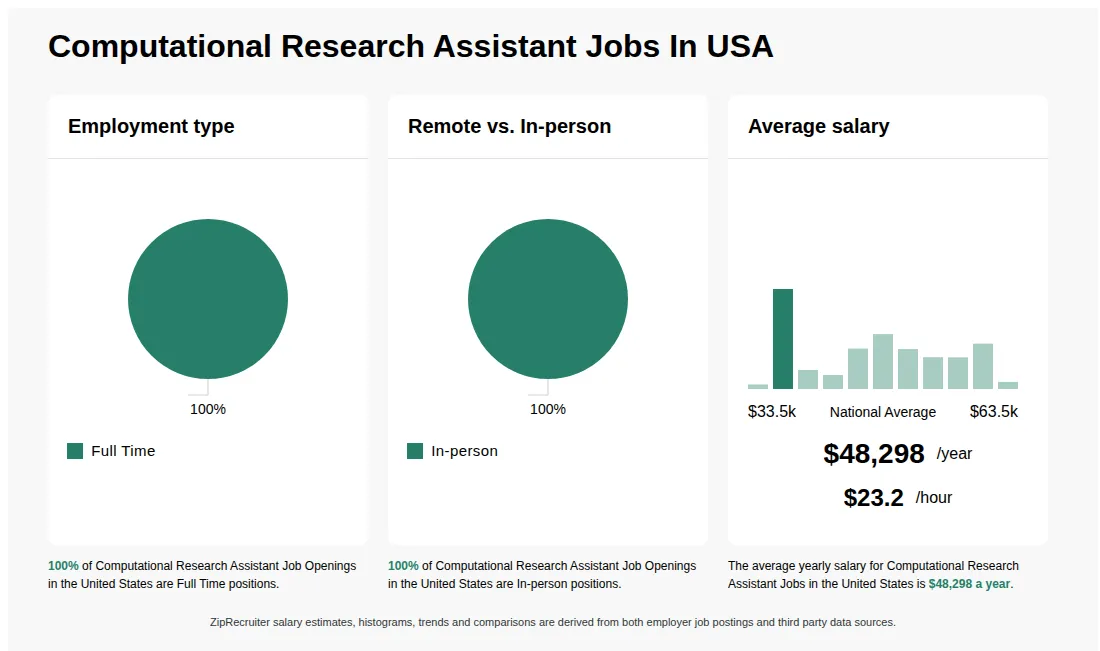
Computational Research Assistant information
See salary details
$33.5K - $36.2K
1% of jobs
$38.7K is the 25th percentile. Wages below this are outliers.
$36.2K - $39K
26% of jobs
$39K - $41.7K
4% of jobs
$41.7K - $44.4K
3% of jobs
$44.4K - $47.1K
11% of jobs
The median wage is $48K / yr.
$47.1K - $49.9K
15% of jobs
$49.9K - $52.6K
11% of jobs
$54K is the 75th percentile. Wages above this are outliers.
$52.6K - $55.3K
8% of jobs
$55.3K - $58K
8% of jobs
$58K - $60.8K
12% of jobs
$60.8K - $63.5K
1% of jobs
$33.5K
$48.3K
$63.5K
How much do computational research assistant jobs pay per year?
As of Sep 7, 2026, the average yearly pay for computational research assistant in the United States is $48,298.00, according to ZipRecruiter salary data. Most workers in this role earn between $38,000.00 and $55,500.00 per year, depending on experience, location, and employer.
What is a computational research assistant?
Computational Research Assistants are professionals who support scientific and academic research projects by applying computational methods, programming, and data analysis techniques. They often work with researchers to develop models, run simulations, analyze large datasets, and assist in the interpretation of results. Their work is essential in fields such as biology, physics, social sciences, and engineering, where complex data and computational tools are required to conduct research. Typically, they have strong skills in programming languages like Python, R, or MATLAB, and possess a background in the relevant scientific discipline.
How does a computational research assistant typically collaborate with principal investigators and other team members during a research project?
Computational Research Assistants often work closely with principal investigators (PIs), postdoctoral researchers, and other team members to design, implement, and analyze computational experiments. They are responsible for developing scripts, managing datasets, and ensuring the reproducibility of results. Regular meetings and progress updates are common, and assistants are expected to communicate findings clearly and troubleshoot technical issues collaboratively. This role requires both independent initiative and a strong team-oriented approach to meet research objectives efficiently.
What are the key skills and qualifications needed to thrive as a computational research assistant, and why are they important?
To thrive as a Computational Research Assistant, you need strong analytical skills, proficiency in programming languages like Python or R, and a background in mathematics, statistics, or computer science. Familiarity with data analysis tools, version control systems (such as Git), and experience using high-performance computing environments or relevant software is typically required. Attention to detail, problem-solving ability, and effective communication help you collaborate with research teams and interpret complex results. These skills and qualities are crucial for producing accurate, reliable research outcomes and supporting innovative scientific investigations.
What is the difference between Computational Research Assistant vs Data Analyst?
| Aspect | Computational Research Assistant | Data Analyst |
|---|---|---|
| Required Credentials | Bachelor's or Master's in Computer Science, Data Science, or related fields | Bachelor's or Master's in Statistics, Data Science, or related fields |
| Work Environment | Research labs, academic institutions, or research-focused organizations | Business, finance, healthcare, or marketing sectors |
| Employer & Industry Usage | Academic and research institutions, government agencies | Corporations, consulting firms, government agencies |
| Common Search & Comparison | Yes | No |
The Computational Research Assistant and Data Analyst roles share similarities in data handling and analytical skills, but differ mainly in their focus. Computational Research Assistants typically work in research settings, supporting scientific projects with programming and modeling, while Data Analysts focus on interpreting data to inform business decisions. Both roles require strong technical skills and relevant education, but their work environments and primary objectives differ.
More about Computational Research Assistant jobs
What cities are hiring for Computational Research Assistant jobs?
Cities with the most Computational Research Assistant job openings:
What are the most commonly searched types of Computational Research jobs?
The most popular types of Computational Research jobs are:
What states have the most Computational Research Assistant jobs?
States with the most job openings for Computational Research Assistant jobs include:
What job categories do people searching Computational Research Assistant jobs look for?
The top searched job categories for Computational Research Assistant jobs are:
- Undergrad Research Assistant
- Phenotype
- Entry Level Postdoctoral Research Computational Chemistry
- Volunteer Postdoctoral Research Computational Chemistry
- Single Cell Rna Sequencing Phd
- Freelance Biology Research Assistant
- Assistant Epigenetic
- Electrical Engineer Research Assistant
- Structural Biology Internship
- Neurobiology Research Assistant

Internship
Posted 9 days ago
Key responsibilities
Clean, organize, and analyze biomedical datasets using tools such as Python, R, or MATLAB.
Create graphs and summaries to make data easier to understand.
Support bioinformatics work with genomic, transcriptomic, proteomic, or imaging data.
Job description
IBRI is poised to transform life sciences-and for millions of people, even life itself.
The Opportunity:
The IBRI is seeking motivated undergraduate or graduate students for our Summer Internship Program. Computational Research Interns will gain hands-on experience in a dynamic research environment, contributing to data-driven projects that support translational science and biomedical innovation.
Program Dates: May 17, 2027 - August 6, 2027
Application Deadline: Applications will be accepted through November 30, 2026. For priority consideration, apply by October 15, 2026.
Schedule: 35 hours per week
Stipend: This internship includes a stipend of $9,650 for the full program, disbursed in bi-weekly installments on or before the 7th and 22nd of each month
Responsibilities:
- Clean, organize, and analyze biomedical datasets using tools such as Python, R, or MATLAB.
- Create graphs and summaries that make data easier to understand.
- Support bioinformatics work with genomic, transcriptomic, proteomic, or imaging data.
- Assist with modeling, machine learning, or workflow automation projects.
- Document code, methods, and results clearly for the team.
- Share progress in meetings and collaborate with experimental scientists.
Qualifications:
- Enrolled in (or recently graduated from) an Indiana university undergraduate and/or graduate program OR having graduated from an Indiana High School.
- Degree in a field related computational research and/or bioinformatics.
- Strong programming skills in Python, R, or similar languages.
- Familiarity with data analysis, statistics, or bioinformatics tools.
- Ability to work independently and collaboratively in a research environment.
- Interest in computational biology/chemistry, biomedical data science, or translational research.
- Commitment to the full duration of the internship.
- Excellent organizational and communication skills.
About Us:
The Indiana Biosciences Research Institute (IBRI) is a first-in-class translational medicine institute dedicated to advancing life sciences in the race to eliminate disease and improve human health and life.
By connecting early-stage biotech companies with cutting-edge life science discoveries -and backed by the mission and resources of industry leaders, investors, and philanthropic partners-IBRI is successfully evolving a new, independent model to conquer disease, uniting previously fragmented forces in the quest for cures.
Carefully curating and supporting early-stage companies with investment, talent, and space, IBRI strategically accelerates drug discovery. Our work benefits from the relatively low cost of living and doing business here, allowing more resources to be directed toward science.
Fueled by the same entrepreneurial creativity as the groundbreaking scientific work we support, IBRI's labs advance research across the frontiers of diabetes, metabolic disease, Alzheimer's disease, and rare pediatric diseases. Our ambitious public-private vision cultivates talent while efficiently bridging the gap between research-driven inquiry and profit-driven drug development.
At IBRI, cures are launched on a clear pathway to clinical trials, enabled by the combined resources and experience of our academic and industry partners, without the typical pressure to deliver rapid results for commercialization. IBRI labs pursue breakthroughs that might never happen elsewhere. Breakthroughs are happening here. Our novel financing model ensures that when discoveries are ready for clinical trials, the intellectual property is sold back to industry or spun off, creating a direct stream of revenue.
By every measure, the IBRI model demonstrates a novel approach that delivers rewards. Scientific bench work is nurtured, drug discovery is advanced, workforce development is continuous, investors see returns, and donors see impact. Most importantly, IBRI's structure and portfolio of accomplishments matter to the patients whose lives are improved-or even saved-by this forward-looking approach to life sciences.
IBRI is driven to bring next-generation therapies to market with an understanding of the complex pressures that often bind innovation to economics. After more than a decade, the evidence is clear: IBRI is poised to transform life sciences-and for millions of people, even life itself.
Equal Employment Opportunity:
The IBRI provides equal employment opportunities to all employees and applicants and does not discriminate based on age, race, color, religion, gender, sexual orientation, gender identity, gender expression, national origin, protected veteran status, disability, or any other legally protected status.

About Indiana Biosciences Research Institute
Sourced by ZipRecruiter
Industry
Scientific research and development services
Company size
11 - 50 Employees
Headquarters location
Indianapolis, IN, US
Year founded
2012