1

Computational Materials Science Jobs (NOW HIRING)

Technical Product Manager

Woburn, MA · On-site +1

$200K - $225K/yr

This role requires deep literacy in computational materials science and AI4Science to coordinate strategy across our research, engineering, and materials teams. As the Technical Product Manager, you ...

Senior Material Scientist

Cambridge, MA · On-site

$50K - $141K/yr

Expertise in one or more of these technical areas: powder metallurgy, sintering, alloy design, computational materials science, and/or relevant metallurgical characterization methods. Culture We do ...

next page

Showing results 1-20

Computational Materials Science information

See salary details

$142.5K

$168.8K

$192.5K

How much do computational materials science jobs pay per year?

As of Jun 12, 2026, the average yearly pay for computational materials science in the United States is $168,844.00, according to ZipRecruiter salary data. Most workers in this role earn between $155,500.00 and $182,000.00 per year, depending on experience, location, and employer.

What are the key skills and qualifications needed to thrive as a Computational Materials Scientist, and why are they important?

To thrive as a Computational Materials Scientist, you need a solid background in materials science, physics, or chemistry, often with a graduate degree and experience in scientific computing. Proficiency with simulation software (such as VASP, LAMMPS, or Quantum ESPRESSO), programming languages (like Python, C++, or Fortran), and familiarity with high-performance computing systems is typically required. Critical thinking, problem-solving abilities, and effective collaboration and communication skills set outstanding candidates apart. These competencies are crucial for designing, executing, and interpreting complex simulations and for translating computational insights into real-world materials innovations.

What is the difference between Computational Materials Science vs Materials Engineer?

AspectComputational Materials ScienceMaterials Engineer
Required CredentialsTypically requires a PhD or Master's in materials science, physics, or chemistryBachelor's or Master's in materials engineering or related field
Work EnvironmentResearch labs, universities, or R&D departments focusing on simulations and modelingManufacturing plants, design offices, or product development teams
Industry UsagePrimarily in research, academia, and advanced R&D projectsProduction, quality control, and product development in manufacturing industries
Common Search/ComparisonYesYes

Computational Materials Science focuses on using computer simulations and modeling to understand and predict material behavior, often requiring advanced degrees. Materials Engineers work on designing, testing, and improving materials in practical applications, usually with a bachelor's or master's degree. While both roles are integral to materials development, Computational Materials Science is more research-oriented, whereas Materials Engineering emphasizes application and production.

What are some common challenges faced by professionals in Computational Materials Science, and how can they be addressed?

Professionals in Computational Materials Science often encounter challenges such as dealing with large datasets, managing the complexity of multi-scale simulations, and ensuring the accuracy of computational models. Addressing these challenges typically involves staying updated on the latest simulation software, collaborating closely with experimental teams to validate results, and developing strong programming and data analysis skills. Effective communication and interdisciplinary teamwork are also key, as projects often require input from chemists, physicists, and engineers to achieve successful outcomes.

What Are Computational Materials Science Jobs?

Jobs in computational materials science include academic and research positions in university settings. You can also find positions in the manufacturing industry. As a research scientist in computational materials science, your duties are to develop hypotheses and test them using computational modeling software and a variety of investigatory tools, such as Monte Carlo algorithms, density function theory, phase field models, and finite element methods. Your responsibilities include gathering data, testing modeling software, collaborating with other researchers to develop tools that aid them in their research, and analyzing data to write reports, journal articles, or presentations for conferences.


What is computational materials science?

Computational materials science is a field that uses computer-based simulations and modeling to understand, predict, and design the properties and behaviors of materials. Researchers use mathematical models, algorithms, and high-performance computing to study materials at the atomic, molecular, or macroscopic level. This approach allows scientists to accelerate the discovery of new materials, optimize existing ones, and investigate phenomena that may be difficult or expensive to study experimentally.
What cities are hiring for Computational Materials Science jobs? Cities with the most Computational Materials Science job openings:
What are the most commonly searched types of Computational Materials Science jobs? The most popular types of Computational Materials Science jobs are:
What states have the most Computational Materials Science jobs? States with the most job openings for Computational Materials Science jobs include:
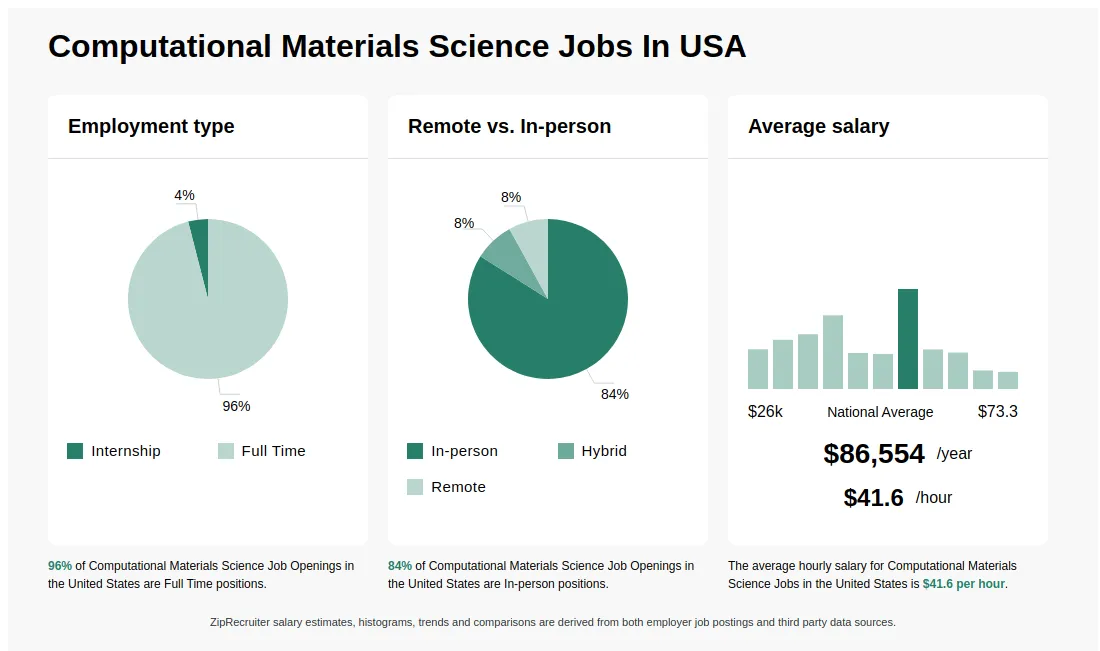
Infographic showing various Computational Materials Science job openings in the United States as of June 2026, with employment types broken down into 86% Full Time, and 14% Part Time. Highlights an 86% In-person, and 14% Hybrid job distribution, with an average salary of $168,844 per year, or $81.2 per hour.
2026 New College Grad - Computational Chemist / Materials Scientist (Machine Learning - Reactive ...

2026 New College Grad - Computational Chemist / Materials Scientist (Machine Learning - Reactive ...

Applied Materials

Santa Clara, CA • On-site

$138K - $190K/yr

Full-time

This job post has expired today. Applications are no longer accepted.


Applied Materials rating

8.6

Company rating: 8.6 out of 10

Based on 54 frontline employees who took The Breakroom Quiz

23rd of 518 rated manufacturers


Job description

Who We Are
Applied Materials is a global leader in materials engineering solutions used to produce virtually every new chip and advanced display in the world. We design, build and service cutting-edge equipment that helps our customers manufacture display and semiconductor chips - the brains of devices we use every day. As the foundation of the global electronics industry, Applied enables the exciting technologies that literally connect our world - like AI and IoT. If you want to push the boundaries of materials science and engineering to create next generation technology, join us to deliver material innovation that changes the world.
What We Offer
Salary:
$138,000.00 - $190,000.00
Location:
Santa Clara,CA
You'll benefit from a supportive work culture that encourages you to learn, develop, and grow your career as you take on challenges and drive innovative solutions for our customers. We empower our team to push the boundaries of what is possible-while learning every day in a supportive leading global company. Visit our Careers website to learn more.
At Applied Materials, we care about the health and wellbeing of our employees. We're committed to providing programs and support that encourage personal and professional growth and care for you at work, at home, or wherever you may go. Learn more about our benefits.
We are seeking a highly skilled Computational Materials Scientist with deep expertise in machine learning for atomistic modeling, specifically in reactive machine-learned interatomic potentials (MLIPs). This role focuses on developing and deploying ML-driven models capable of accurately capturing bond breaking, bond formation, and complex chemical reactions, enabling predictive simulations at near first-principles accuracy with significantly improved scalability.
The ideal candidate will combine physics-based understanding, advanced machine learning techniques, and strong analytical reasoning to solve challenging problems in materials design and process development.
Key Responsibilities
  • Develop, train, and deploy reactive MLIPs to model chemical reactions, interfacial processes, and dynamic material behavior.
  • Build ML models capable of predicting energies, forces, and reaction pathways with near DFT-level accuracy.
  • Generate and curate high-quality training datasets from DFT and other first-principles methods.
  • Design and implement active learning workflows to iteratively improve model robustness and coverage of configuration space.
  • Integrate MLIPs with molecular dynamics (MD) to simulate:
    • Reactive processes
    • Diffusion and transport
    • Oxidation/reduction
    • Surface and interface evolution
  • Apply enhanced sampling techniques (e.g., NEB, metadynamics) in combination with ML models for reaction pathway exploration.
  • Develop automated simulation pipelines and scalable workflows for high-throughput studies.
  • Analyze large datasets to extract structure-property and structure-reactivity relationships.
  • Collaborate cross-functionally with experimental, process, and device teams to guide materials and process optimization.

Required Qualifications
  • Ph.D. in Materials Science, Physics, Chemistry, or related field.
  • Demonstrated expertise in reactive machine-learned interatomic potentials (MLIPs) capable of modeling bond breaking and formation.
  • Hands-on experience with one or more MLIP frameworks:
    • MACE, NequIP, GAP, SNAP, DeepMD, or equivalent
  • Strong background in first-principles methods (DFT) and atomistic simulations (MD).
  • Proficiency in Python and ML frameworks (PyTorch, TensorFlow).
  • Experience working in HPC environments and handling large-scale simulations.
  • Proven ability in dataset generation, labeling strategies, and model validation for ML-based atomistic models.

Core Technical Competencies
  • Reactive MLIP development and deployment
  • Machine learning for atomistic simulations
  • Molecular dynamics and reaction modeling
  • Materials informatics and data pipelines
  • High-performance scientific computing

Analytical & Reasoning Requirements
  • Strong analytical, logical reasoning, and quantitative problem-solving skills.
  • Demonstrated ability to:
    • Diagnose and debug ML model failures and training instabilities
    • Critically evaluate model predictions against physical principles
    • Ensure physical consistency, transferability, and robustness of simulations
    • Identify gaps in training data and design targeted data acquisition strategies
  • Ability to translate complex physical phenomena into tractable computational models.

Preferred Qualifications
  • Experience in reactive systems, including:
    • Surface chemistry
    • Catalysis
    • Oxidation/reduction reactions
    • Semiconductor or interface materials
  • Familiarity with uncertainty quantification, Bayesian methods, and active learning.
  • Experience with:
    • ASE, LAMMPS, VASP, or similar tools
    • Workflow frameworks (FireWorks, AiiDA, etc.)
  • Exposure to graph neural networks (GNNs) and equivariant architectures.
  • Industry experience in materials development or process modeling.

Additional Information
Time Type:
Full time
Employee Type:
New College Grad
Travel:
Yes, 10% of the Time
Relocation Eligible:
Yes
The salary offered to a selected candidate will be based on multiple factors including location, hire grade, job-related knowledge, skills, experience, and with consideration of internal equity of our current team members. In addition to a comprehensive benefits package, candidates may be eligible for other forms of compensation such as participation in a bonus and a stock award program, as applicable.
For all sales roles, the posted salary range is the Target Total Cash (TTC) range for the role, which is the sum of base salary and target bonus amount at 100% goal achievement.
Applied Materials is an Equal Opportunity Employer. Qualified applicants will receive consideration for employment without regard to race, color, national origin, citizenship, ancestry, religion, creed, sex, sexual orientation, gender identity, age, disability, veteran or military status, or any other basis prohibited by law.
In addition, Applied endeavors to make our careers site accessible to all users. If you would like to contact us regarding accessibility of our website or need assistance completing the application process, please contact us via e-mail at Accommodations_Program@amat.com, or by calling our HR Direct Help Line at 877-612-7547, option 1, and following the prompts to speak to an HR Advisor. This contact is for accommodation requests only and cannot be used to inquire about the status of applications.

What Applied Materials employees say

Pay

Benefits

Hours and flexibility

Workplace

Get the full story on Breakroom


Applied Materials logo

About Applied Materials

Sourced by ZipRecruiter

Applied Materials is the global leader in materials engineering solutions used to produce virtually every new chip and advanced display in the world. We're the brain (and the brawn) behind every new technology development--whether it's building semiconductor chips for smartphones and computers, or the underpinnings for robotics, AI and even smart TV display screens. With 27,000 employees in 19 countries, we offer an exciting place to grow and learn alongside some of the best people you'll ever meet. We take deep pride in our Culture of Inclusion, and we celebrate the diverse backgrounds, perspectives and experiences that help us build stronger, more resilient teams. Join us as we innovate to Make Possible a Better Future!

Industry

Manufacturing

Company size

10,000+ Employees

Headquarters location

Santa Clara, CA, US

Year founded

1967