1

Computational Materials Science Jobs (NOW HIRING)

Computational Materials Scientist

Woburn, MA ยท On-site +1

$180K - $200K/yr

This powerful combination of "AI for science" and material engineering enables batteries that can ... As a Computational Materials Scientist, you will be a core data-driven modeler responsible for ...

Computational Materials Scientist

Walnut Creek, CA ยท On-site +1

$90K - $140K/yr

Overview We look for computational materials scientists excited about bridging the gap between ... science to help us develop a software framework for designing and discovering new advanced ...

Overview We look for computational materials scientists excited about bridging the gap between ... science to help us develop a software framework for designing and discovering new advanced ...

next page

Showing results 1-20

Computational Materials Science information

See salary details

$142.5K

$168.8K

$192.5K

How much do computational materials science jobs pay per year?

As of Jun 12, 2026, the average yearly pay for computational materials science in the United States is $168,844.00, according to ZipRecruiter salary data. Most workers in this role earn between $155,500.00 and $182,000.00 per year, depending on experience, location, and employer.

What are the key skills and qualifications needed to thrive as a Computational Materials Scientist, and why are they important?

To thrive as a Computational Materials Scientist, you need a solid background in materials science, physics, or chemistry, often with a graduate degree and experience in scientific computing. Proficiency with simulation software (such as VASP, LAMMPS, or Quantum ESPRESSO), programming languages (like Python, C++, or Fortran), and familiarity with high-performance computing systems is typically required. Critical thinking, problem-solving abilities, and effective collaboration and communication skills set outstanding candidates apart. These competencies are crucial for designing, executing, and interpreting complex simulations and for translating computational insights into real-world materials innovations.

What is the difference between Computational Materials Science vs Materials Engineer?

AspectComputational Materials ScienceMaterials Engineer
Required CredentialsTypically requires a PhD or Master's in materials science, physics, or chemistryBachelor's or Master's in materials engineering or related field
Work EnvironmentResearch labs, universities, or R&D departments focusing on simulations and modelingManufacturing plants, design offices, or product development teams
Industry UsagePrimarily in research, academia, and advanced R&D projectsProduction, quality control, and product development in manufacturing industries
Common Search/ComparisonYesYes

Computational Materials Science focuses on using computer simulations and modeling to understand and predict material behavior, often requiring advanced degrees. Materials Engineers work on designing, testing, and improving materials in practical applications, usually with a bachelor's or master's degree. While both roles are integral to materials development, Computational Materials Science is more research-oriented, whereas Materials Engineering emphasizes application and production.

What are some common challenges faced by professionals in Computational Materials Science, and how can they be addressed?

Professionals in Computational Materials Science often encounter challenges such as dealing with large datasets, managing the complexity of multi-scale simulations, and ensuring the accuracy of computational models. Addressing these challenges typically involves staying updated on the latest simulation software, collaborating closely with experimental teams to validate results, and developing strong programming and data analysis skills. Effective communication and interdisciplinary teamwork are also key, as projects often require input from chemists, physicists, and engineers to achieve successful outcomes.

What Are Computational Materials Science Jobs?

Jobs in computational materials science include academic and research positions in university settings. You can also find positions in the manufacturing industry. As a research scientist in computational materials science, your duties are to develop hypotheses and test them using computational modeling software and a variety of investigatory tools, such as Monte Carlo algorithms, density function theory, phase field models, and finite element methods. Your responsibilities include gathering data, testing modeling software, collaborating with other researchers to develop tools that aid them in their research, and analyzing data to write reports, journal articles, or presentations for conferences.

What is computational materials science?

Computational materials science is a field that uses computer-based simulations and modeling to understand, predict, and design the properties and behaviors of materials. Researchers use mathematical models, algorithms, and high-performance computing to study materials at the atomic, molecular, or macroscopic level. This approach allows scientists to accelerate the discovery of new materials, optimize existing ones, and investigate phenomena that may be difficult or expensive to study experimentally.
What cities are hiring for Computational Materials Science jobs? Cities with the most Computational Materials Science job openings:
What are the most commonly searched types of Computational Materials Science jobs? The most popular types of Computational Materials Science jobs are:
What states have the most Computational Materials Science jobs? States with the most job openings for Computational Materials Science jobs include:
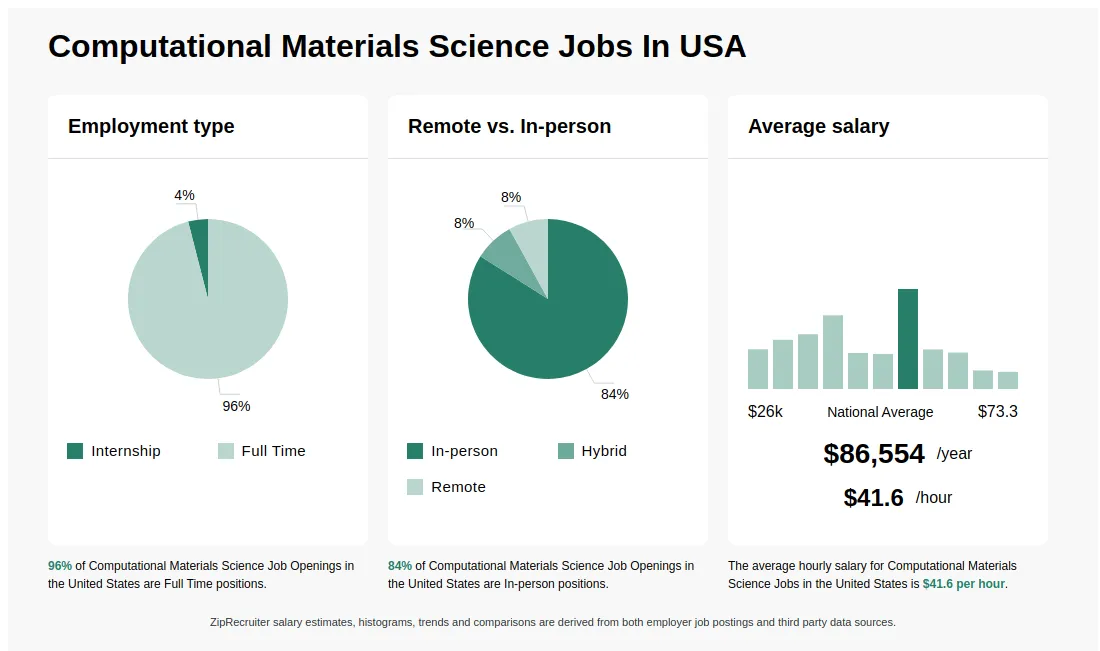
Infographic showing various Computational Materials Science job openings in the United States as of June 2026, with employment types broken down into 86% Full Time, and 14% Part Time. Highlights an 86% In-person, and 14% Hybrid job distribution, with an average salary of $168,844 per year, or $81.2 per hour.
Computational Materials Scientist

Computational Materials Scientist

SES

Woburn, MA โ€ข On-site, Remote

$180K - $200K/yr

Full-time

Medical

Posted 10 days ago


Job description

SES AI Corp. (NYSE: SES) is dedicated to accelerating the world's energy transition through groundbreaking material discovery and advanced battery management. We are at the forefront of revolutionizing battery creation, pioneering the integration of cutting-edge machine learning into our research and development. Our AI-enhanced, high-energy-density and high-power-density Li-Metal and Li-ion batteries are unique; they are the first in the world to utilize electrolyte materials discovered by AI. This powerful combination of "AI for science" and material engineering enables batteries that can be used across various applications, including transportation (land and air), energy storage, robotics, and drones.
To learn more about us, please visit: www.ses.ai
What We Offer:
  • A highly competitive salary and robust benefits package, including comprehensive health coverage and an attractive equity/stock options program within our NYSE-listed company.
  • The opportunity to contribute directly to a meaningful scientific project-accelerating the global energy transition-with a clear and broad public impact.
  • Work in a dynamic, collaborative, and innovative environment at the intersection of AI and material science, driving the next generation of battery technology.
  • Significant opportunities for professional growth and career development as you work alongside leading experts in AI, R&D, and engineering.
  • Access to state-of-the-art facilities and proprietary technologies are used to discover and deploy AI-enhanced battery solutions.

What we Need:
The SES AI Prometheus team isseeking an exceptional Computational Materials Scientist to combine physics-based simulation (DFT, MD, quantum modeling) with AI-assisted material prediction to generate high-quality training data and accelerate materials discovery. This role is crucial for advancing our understanding of electrochemical energy materials at the atomic level. As a Computational Materials Scientist, you will be a core data-driven modeler responsible for executing and automating complex simulations.
Essential Duties and Responsibilities:
  • Atomistic Modeling & Simulation
  • Conduct and oversee DFT (Density Functional Theory), MD (Molecular Dynamics), and QM (Quantum Mechanics) simulations of battery components, including electrolytes, coatings, and electrodes.
  • Develop and refine ML-enhanced force fields and surrogate models to accelerate simulation time scales and enable multi-scale simulation efforts.
  • Apply expertise in atomistic simulation and quantum modeling to solve key challenges in electrochemical energy materials (e.g., batteries/fuel cells).
  • AI Data Generation & Prediction
  • Generate high-quality, structured simulation data to serve as training sets for AI property prediction models and material screening modules.
  • Contribute to the development of battery domain LLM features and advanced property-prediction models.
  • Automate complex simulation workflows using strong coding practices to enhance efficiency and scalability.
  • Collaboration & Tooling
  • Collaborate with experimental teams, leveraging a hybrid computational + experimental literacy to validate models and drive design iteration.
  • Utilize advanced simulation tools (VASP, Quantum Espresso) and data science libraries (TensorFlow, Pandas) to manage and analyze large datasets.

Education and/or Experience:
  • Education: Ph.D. in Mechanical Engineering, Materials Science, Chemical Engineering, or a closely related computational/physics field.
  • Core Simulation Expertise: Deep and extensive experience in atomistic simulation and quantum modeling, including proficiency with key QM/DFT tools (VASP, Quantum Espresso) and MD simulations.
  • Domain Focus: Strong background in electrochemical energy materials and extensive computational work focused on batteries/fuel cells.
  • Coding Proficiency: Strong coding skills in Python (along with related libraries like Pandas and TensorFlow) for simulation workflow automation and data analysis.
  • ML Application: Experience in developing or utilizing ML-enhanced force fields and surrogate models for materials prediction., or equivalent practical experience.

Preferred Qualifications:
  • LLM Development: Experience in developing battery domain LLM features or property-prediction models.
  • Hybrid Skillset: Demonstrated experience working in a hybrid computational + experimental environment.
  • Tooling Diversity: Familiarity with additional data analysis tools like R, SQL, MATLAB, and time-series forecasting libraries like Prophet.
  • Target Background: Previous experience at national laboratories, XtalPi, Entalpic, or deep battery modeling groups.

The salary range for this position as required under applicable pay transparency laws.
Salary Range
$180,000-$200,000 USD