1

Theoretical Computational Chemistry Jobs (NOW HIRING)

Own computational chemistry programs across therapeutic modalities, disease targets, and ... Manage day-to-day operations of the Computational Theoretical Chemistry Team, mentor junior staff ...

Own computational theoretical chemistry programs across therapeutic modalities, disease targets, and indications * Ensure effective collaboration with the Biology, and Medicinal Chemistry teams by ...

Own computational theoretical chemistry programs across therapeutic modalities, disease targets, and indications * Ensure effective collaboration with the Biology, and Medicinal Chemistry teams by ...

Own computational theoretical chemistry programs across therapeutic modalities, disease targets, and indications * Ensure effective collaboration with the Biology, and Medicinal Chemistry teams by ...

Own computational chemistry programs across therapeutic modalities, disease targets, and ... theory (DFT) approaches, molecular dynamics (MD) simulations, including both standard MD and ...

next page

Showing results 1-20

Theoretical Computational Chemistry information

See salary details

$31K

$129.4K

$229K

How much do theoretical computational chemistry jobs pay per year?

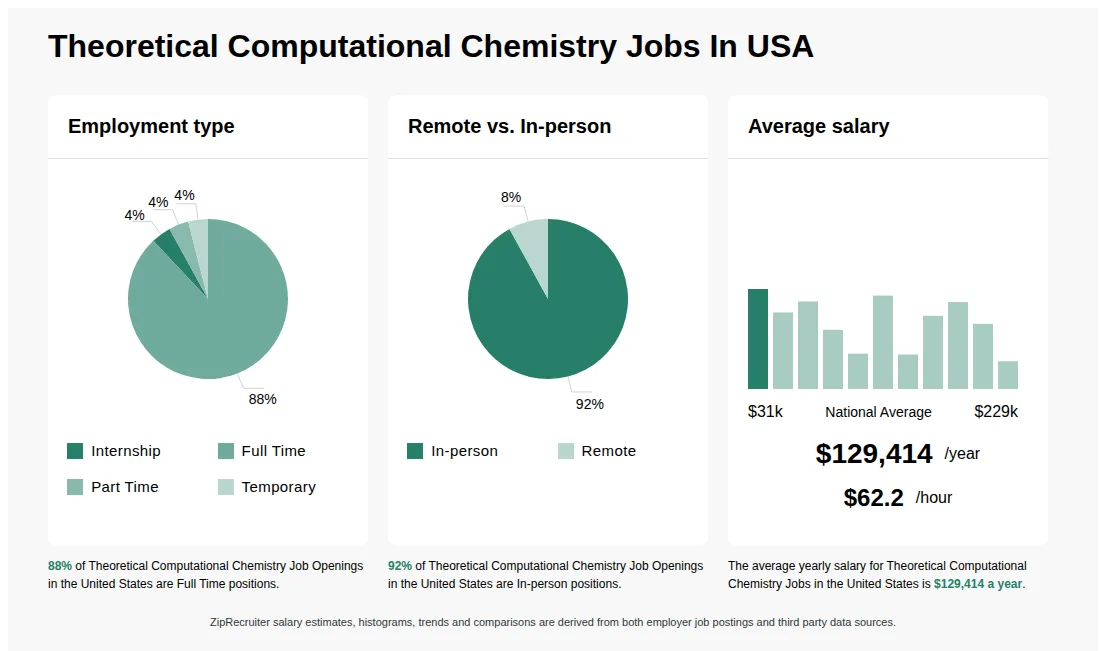
As of Aug 3, 2026, the average yearly pay for theoretical computational chemistry in the United States is $129,414.00, according to ZipRecruiter salary data. Most workers in this role earn between $74,500.00 and $182,000.00 per year, depending on experience, location, and employer.

What are the key skills and qualifications needed for theoretical computational chemistry?

To excel in Theoretical Computational Chemistry, a strong background in physical chemistry, quantum mechanics, mathematics, and programming—often validated by an advanced degree (PhD or MS)—is essential. Familiarity with computational chemistry software packages (such as Gaussian, VASP, or GAMESS), experience in high-performance computing environments, and knowledge of scripting languages like Python or Fortran are highly valued. Exceptional problem-solving abilities, effective communication, and teamwork skills distinguish top candidates. These competencies are vital for designing, executing, and interpreting complex simulations, as well as for collaborating on interdisciplinary research projects.

What are typical projects or responsibilities in theoretical computational chemistry?

Professionals in theoretical computational chemistry often engage in projects such as modeling molecular structures, simulating chemical reactions, and predicting the properties of novel materials using advanced computational techniques. Daily tasks may include developing or optimizing algorithms, running large-scale simulations, analyzing results, and preparing reports or publications to share findings. Collaboration is common, both with experimental chemists and researchers from related disciplines, to validate models or advance interdisciplinary studies. This role typically involves a combination of independent work and teamwork within academic, governmental, or industrial research environments.

What is theoretical computational chemistry?

A Theoretical Computational Chemistry job involves using mathematical models and computer simulations to study chemical systems at a fundamental level. Scientists in this field develop and apply computational methods to predict molecular properties, reaction mechanisms, and material behaviors. They work on problems ranging from drug design to catalysis, often collaborating with experimental chemists to interpret and guide experiments. These roles typically require expertise in quantum mechanics, statistical mechanics, and programming.

More about Theoretical Computational Chemistry jobs
What cities are hiring for Theoretical Computational Chemistry jobs? Cities with the most Theoretical Computational Chemistry job openings:
What are the most commonly searched types of Theoretical Computational Chemistry jobs? The most popular types of Theoretical Computational Chemistry jobs are:
What states have the most Theoretical Computational Chemistry jobs? States with the most job openings for Theoretical Computational Chemistry jobs include:
Infographic showing various Theoretical Computational Chemistry job openings in the United States as of July 2026, with employment types broken down into 1% As Needed, 78% Full Time, 18% Part Time, 1% Temporary, and 2% Contract. Highlights an 85% Physical, 1% Hybrid, and 14% Remote job distribution, with an average salary of $129,414 per year, or $62.2 per hour.

Computational Theoretical Chemist III

1910

Boston, MA

Other

Re-posted 9 days ago


Job description

Computation is revolutionizing drug discovery. Advances in big chemical data, massive computing power, artificial intelligence, and molecular dynamics simulation are changing the way we develop new drugs. At 1910 , we put computation at the heart of drug discovery, blending expertise in computational chemistry, structural biology, pharmacology, data science, and software engineering to develop drugs for previously undruggable targets. 

Role description  

  • Own computational chemistry programs across therapeutic modalities, disease targets, and indications 
  • Ensure effective collaboration with the Biology and Medicinal Chemistry teams by providing key computational chemistry insights to aid in the Hit-to-Lead and Lead Optimization phases of drug discovery operations  
  • Ensure effective collaboration with the ML Engineering and AI Research team by providing key computational chemistry insights to aid in the development of AI/ML models for drug discovery as well as the incorporation of those models into drug discovery operations 
  • Teach key computational chemistry principles to your cross-disciplinary colleagues from Medicinal Chemistry, AI Research, Machine Learning Engineering, Cell Biology, and Pharmacology 
  • Manage day-to-day operations of the Computational Theoretical Chemistry Team, mentor junior staff, and represent the team in senior leadership meetings 
  • Partner to improve 1910's existing process for progressing from computational hit to experimental hit to lead to drug candidate 
  • Co-author provisional patents and peer-reviewed research papers 
  • Progress a virtual hit to a biochemical/cellular hit 
  • Validate a cellular hit in a clinically relevant animal model of disease 
  • Update provisional patents with the animal model data 
  • Nominate a lead candidate for progression into IND-enabling studies 
  • Attend and present research at conferences and events related to computational modeling in drug discovery 

Qualifications  

  • Ph.D. in computational chemistry or related discipline 
  • 3+ years of relevant industry experience within drug discovery or biotechnology 
  • Played a key role in advancing a drug discovery program from early research phases to clinical development. 
  • In-depth knowledge and hands-on experience with quantum chemical (QC) methods, including semi-empirical and density functional theory (DFT) approaches, molecular dynamics (MD) simulations, including both standard MD and enhanced sampling techniques such as metadynamics, umbrella sampling, and replica exchange MD, free energy simulations such as FEP and TI, and QM/MM methodologies for small and large molecular systems 
  • Strong understanding of key concepts, including potential energy surfaces (PES), intermolecular and intramolecular forces/interactions, force fields, molecular properties, thermodynamic properties, solvation models (implicit/explicit), and conformational sampling 
  • Proficiency in analyzing molecular properties such as solvation free energy, dipole moments, vibrational frequencies, electrostatic potential, charge distribution, and more. 
  • Deep knowledge of implicit and explicit solvent models, with extensive experience modeling solvent effects on molecular systems and chemical reactions in various environments 
  • Extensive experience in using and troubleshooting software tools for QC calculations (e.g., ORCA, xTB, CREST, etc.), MD simulations (e.g., GROMACS, OpenMM, etc.), Drug Design Development Packages (e.g., EG, Schrodinger, MOE, CRESSET) 
  • Experience working with HPC Clusters and cloud-based services like (e.g., Microsoft AZURE, AWS) 
  • Ability to optimize computational simulation protocols for efficient resource usage 
  • Proven experience working with small organic molecules and large biomolecular systems (e.g., peptides, proteins, etc.) for property prediction, conformational analysis, and structure-activity relationships (SAR) 
  • Hands-on experience with Python and Bash scripting for automating workflows and data analysis 
  • Familiarity with cheminformatics toolkits such as RDKit for molecular property prediction and data management 
  • Basic knowledge of machine learning (ML) techniques applied to molecular property prediction, virtual screening, and related tasks 
  • Strong desire to collaborate with AI scientists, data scientists, medicinal chemists, and biologists to interpret computational results and guide experimental design 
  • Clear and effective communication of complex scientific ideas through reports, presentations, and publications 

Nice to Haves 

  • Publications in computational chemistry related to drug discovery 

 #LI-Onsite