1

Cloud Computing Jobs (NOW HIRING)

The Cloud Computing Specialist (CCS) - SME provides expert oversight of cloud cybersecurity, Certification & Accreditation (C&A), and Risk Management Framework (RMF) implementation for Defense ...

The Cloud Computing Specialist (CCS) - SME provides expert oversight of cloud cybersecurity, Certification & Accreditation (C&A), and Risk Management Framework (RMF) implementation for Defense ...

The Cloud Computing Specialist (CCS) - SME provides expert oversight of cloud cybersecurity, Certification & Accreditation (C&A), and Risk Management Framework (RMF) implementation for Defense ...

next page

Showing results 1-20

Cloud Computing information

See salary details

$10

$61

$84

How much do cloud computing jobs pay per hour?

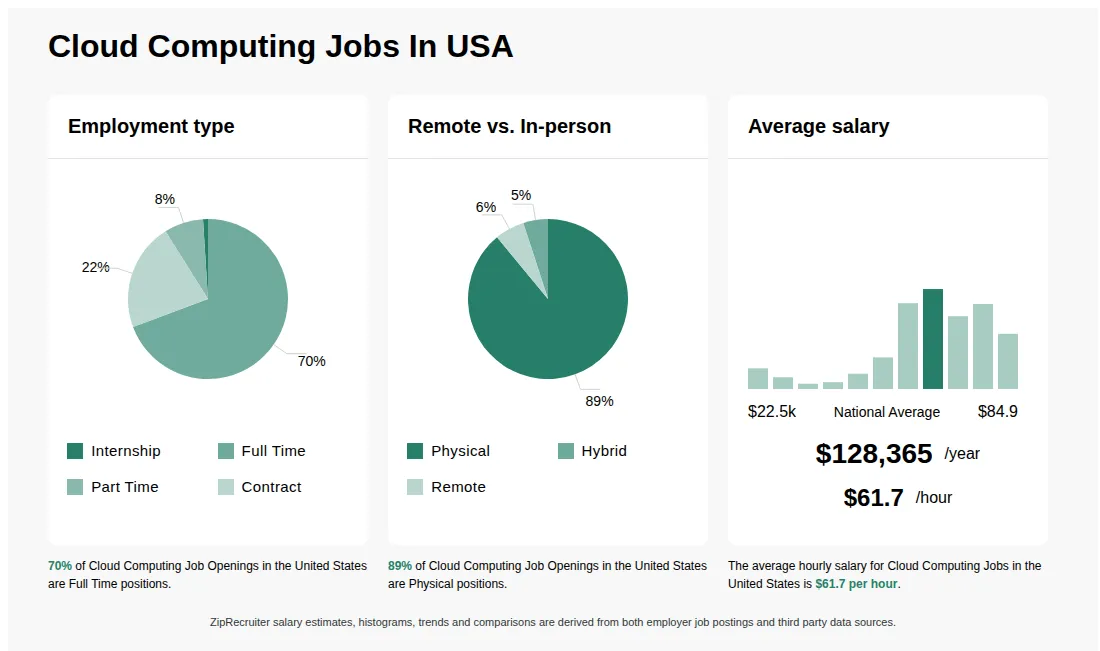
As of Jun 12, 2026, the average hourly pay for cloud computing in the United States is $61.71, according to ZipRecruiter salary data. Most workers in this role earn between $54.09 and $74.04 per hour, depending on experience, location, and employer.

What are cloud computing jobs?

Cloud computing jobs involve managing and maintaining cloud-based infrastructure, services, and applications. Roles such as cloud engineers, architects, and administrators require skills in platforms like AWS, Azure, or Google Cloud, along with knowledge of networking, security, and scripting. These jobs often require certifications and involve working in environments that support scalable, on-demand computing resources.

Is cloud computing a good career?

Cloud computing is a growing field with high demand for professionals skilled in platforms like AWS, Azure, and Google Cloud. It offers opportunities in roles such as cloud engineer, architect, and administrator, often requiring certifications and knowledge of networking, security, and scripting. The field provides competitive salaries and continuous learning opportunities due to rapid technological advancements.

What are some typical challenges faced by professionals working in cloud computing roles?

Professionals in cloud computing often navigate challenges such as ensuring data security and compliance, managing costs associated with cloud resources, and keeping up with rapidly evolving technologies. Collaborating effectively with cross-functional teams, such as developers, security analysts, and business stakeholders, is also crucial to successfully deploying and maintaining cloud solutions. Additionally, adapting to different cloud platforms (like AWS, Azure, or Google Cloud) and their unique services can require continuous learning and flexibility.

What Is Cloud Computing?

Cloud computing is the process of using remote resources to complete tasks that you would normally do on a local computer or server. This includes data storage, analytics, database management, software hosting, and many other services. The primary advantage of cloud computing is its ability to scale as customers need it. Most cloud computing takes place in large data centers, each of which has tens of thousands of servers for people to access. With cloud computing, it is possible to add and remove servers to a system as needed to handle the workload, thus freeing the user from needing to buy and maintain each of them separately. You can do cloud computing through private machines that run nothing else, but many operations use shared machines to help distribute the load more effectively.


What is the difference between Cloud Computing vs Cloud Engineer?

AspectCloud ComputingCloud Engineer
Primary FocusUtilizing cloud services and solutionsDesigning, building, and maintaining cloud infrastructure
Required SkillsKnowledge of cloud platforms, basic scripting, understanding of cloud servicesCloud platform expertise, scripting, infrastructure as code, networking
Work EnvironmentCloud service providers, enterprise IT teamsCloud development teams, IT departments, consulting firms
CertificationsAWS, Azure, Google Cloud certificationsAWS Certified Solutions Architect, Azure Solutions Architect, similar certifications

Cloud Computing refers to the use of cloud services and platforms to deliver computing resources, while a Cloud Engineer is a professional who designs, implements, and manages cloud infrastructure. The roles are interconnected, with Cloud Engineers applying their skills to enable effective cloud computing solutions for organizations.

Can I become a cloud engineer in 3 months?

Becoming a cloud engineer in three months is challenging because it typically requires foundational knowledge of cloud platforms like AWS, Azure, or Google Cloud, along with skills in networking, scripting, and system administration. While intensive training or bootcamps can accelerate learning, most professionals spend several months to years gaining the necessary experience and certifications such as the AWS Certified Solutions Architect or Microsoft Certified: Azure Solutions Architect.

What is cloud computing?

Cloud computing is the delivery of computing services such as servers, storage, databases, networking, software, analytics, and intelligence over the internet ('the cloud'). Instead of owning and maintaining physical data centers or servers, organizations can access these resources on-demand from cloud providers like Amazon Web Services (AWS), Microsoft Azure, or Google Cloud Platform. This approach allows for greater flexibility, scalability, and cost efficiency, as users only pay for the resources they use. Cloud computing also enables easier collaboration, backup, and disaster recovery.

What jobs are there in cloud computing?

Jobs in cloud computing include roles such as cloud engineer, cloud architect, cloud administrator, DevOps engineer, and cloud security specialist. These positions typically require knowledge of cloud platforms like AWS, Azure, or Google Cloud, along with skills in scripting, networking, and security. Certifications such as AWS Certified Solutions Architect or Microsoft Certified: Azure Solutions Architect are often valued.

What are the key skills and qualifications needed to thrive as a Cloud Computing professional, and why are they important?

To thrive in Cloud Computing, you need a strong understanding of networking, virtualization, cloud architecture, and security, often backed by a relevant degree or cloud certifications. Familiarity with platforms like AWS, Azure, or Google Cloud, as well as tools such as Docker and Kubernetes, is typically required. Problem-solving, adaptability, and effective communication are crucial soft skills for managing cloud-based projects and collaborating with teams. These competencies ensure the efficient design, deployment, and maintenance of scalable and secure cloud solutions in a rapidly evolving technology landscape.
What cities are hiring for Cloud Computing jobs? Cities with the most Cloud Computing job openings:
What are the most commonly searched types of Cloud Computing jobs? The most popular types of Cloud Computing jobs are:
What states have the most Cloud Computing jobs? States with the most job openings for Cloud Computing jobs include:
Infographic showing various Cloud Computing job openings in the United States as of June 2026, with employment types broken down into 33% Full Time, 33% Part Time, and 34% Contract. Highlights an 100% In-person job distribution, with an average salary of $128,365 per year, or $61.7 per hour.
Cloud Computing Specialist (CCS) - SME

Cloud Computing Specialist (CCS) - SME

Goldbelt, Inc.

Remote

$100K - $185K/yr

Full-time

Medical, Dental, Vision, Retirement, PTO

Posted 20 days ago


Job description

Overview

Please note that this position is contingent upon the successful award of a contract currently under bid.

Global in service but local in approach, Nisga'a Tek is committed to high-quality service to those who defend us. Nisga'a Tek ensures mission assurance and execution for customers and warfighters. Providing intelligence, IT, cyber security, training, logistics, administrative, acquisition, and background investigation services. 

Summary:

The Cloud Computing Specialist (CCS) – SME provides expert oversight of cloud cybersecurity, Certification & Accreditation (C&A), and Risk Management Framework (RMF) implementation for Defense Logistics Agency systems under the J6 Enterprise Technology Services (JETS) contract.


Responsibilities

Essential Job Functions:

  • Serve as the cloud cybersecurity and RMF Subject Matter Expert supporting DLA enterprise cloud initiatives
  • Lead and conduct Certification & Accreditation (C&A) activities for complex, large-scale information systems
  • Apply and interpret NIST RMF guidance, including SP 800-53 security controls and SP 800-37 RMF lifecycle requirements
  • Assess and validate implementation of cybersecurity controls in cloud environments
  • Evaluate security posture of modern computing environments, including hybrid computing, edge computing, containerized services, and IoT-enabled systems

Qualifications

Necessary Skills and Knowledge:

  • Ability to use plain language to communicate complex concepts to all levels of the organization
  • Excellent written and verbal communication skills
  • Ability to escalate issues quickly to enable rapid resolution
  • Ability to manage multiple tasks in a fast-paced environment

Minimum Qualifications:

  • Minimum 5 years of relevant C&A experience
  • Risk Management Framework (RMF) and NIST C&A experience
  • DOD Cybersecurity experience
  • Experience in assessing Cybersecurity Controls and conducting C&A reviews for large, complex Information systems.
  • Experience with modern and dynamic computing (e.g., hybrid computing, edge computing, cloud native microservices) and networking protocols or standard Internet of Things (IoT) protocols
  • Experience and well versed in FedRAMP assessment methodology of security and privacy controls deployed in cloud information systems to include six (6) domain areas which include: Architectural Concepts & Design Requirements, Cloud Data Security, Cloud Platform & Infrastructure Security, Cloud Application Security, Operations, Legal & Compliance
  • Certification as a Certified Cloud Security Professional
  • Clearance: Secret

Preferred Qualifications:

  • Bachelor’s degree in a related field

Pay and Benefits

The annual salary range for this position is $100,000 - $185,000.

At Goldbelt, we value and reward our team's dedication and hard work. We provide a competitive base salary commensurate with your qualifications and experience. As an employee, you'll enjoy a comprehensive benefits package, including medical, dental, and vision insurance, a 401(k) plan with company matching, tax-deferred savings options, supplementary benefits, paid time off, and professional development opportunities.

Qualifications:

Necessary Skills and Knowledge:

  • Ability to use plain language to communicate complex concepts to all levels of the organization
  • Excellent written and verbal communication skills
  • Ability to escalate issues quickly to enable rapid resolution
  • Ability to manage multiple tasks in a fast-paced environment

Minimum Qualifications:

  • Minimum 5 years of relevant C&A experience
  • Risk Management Framework (RMF) and NIST C&A experience
  • DOD Cybersecurity experience
  • Experience in assessing Cybersecurity Controls and conducting C&A reviews for large, complex Information systems.
  • Experience with modern and dynamic computing (e.g., hybrid computing, edge computing, cloud native microservices) and networking protocols or standard Internet of Things (IoT) protocols
  • Experience and well versed in FedRAMP assessment methodology of security and privacy controls deployed in cloud information systems to include six (6) domain areas which include: Architectural Concepts & Design Requirements, Cloud Data Security, Cloud Platform & Infrastructure Security, Cloud Application Security, Operations, Legal & Compliance
  • Certification as a Certified Cloud Security Professional
  • Clearance: Secret

Preferred Qualifications:

  • Bachelor’s degree in a related field

Pay and Benefits

The annual salary range for this position is $100,000 - $185,000.

At Goldbelt, we value and reward our team's dedication and hard work. We provide a competitive base salary commensurate with your qualifications and experience. As an employee, you'll enjoy a comprehensive benefits package, including medical, dental, and vision insurance, a 401(k) plan with company matching, tax-deferred savings options, supplementary benefits, paid time off, and professional development opportunities.

Education:UNAVAILABLEEmployment Type: FULL_TIME