Oncology Data Specialist
New Haven, CT · On-site
... Tumor Registry and data standards for the American College of Surgeons Commission on Cancer ... Abstractor or Manager * 1.1 At least five patient records per day must be abstracted and entered ...
New Haven, CT · On-site
... Tumor Registry and data standards for the American College of Surgeons Commission on Cancer ... Abstractor or Manager * 1.1 At least five patient records per day must be abstracted and entered ...
New Haven, CT · On-site
... Tumor Registry and data standards for the American College of Surgeons Commission on Cancer ... Abstractor or Manager * 1.1 At least five patient records per day must be abstracted and entered ...
$29 - $35/hr
... registry solutions that help control cost, improve margins and cash flow, increase ... Provide cancer incidence,treatmentand outcome information toappropriate databases. * Ensure that ...
$29 - $35/hr
... registry solutions that help control cost, improve margins and cash flow, increase ... Provide cancer incidence,treatmentand outcome information toappropriate databases. * Ensure that ...
Fremont, NE · On-site
$192.25/hr
Reports information for Survivorship. 2. Enters accurate information into the Tumor Registry database. * Collects and enters information on patients diagnosed with cancer. 3. Assigns appropriate ...
Fremont, NE · On-site
$192.25/hr
Reports information for Survivorship. 2. Enters accurate information into the Tumor Registry database. * Collects and enters information on patients diagnosed with cancer. 3. Assigns appropriate ...
$29 - $35/hr
... registry solutions that help control cost, improve margins and cash flow, increase ... Provide cancer incidence,treatmentand outcome information toappropriate databases. * Ensure that ...
$29 - $35/hr
... registry solutions that help control cost, improve margins and cash flow, increase ... Provide cancer incidence,treatmentand outcome information toappropriate databases. * Ensure that ...
Fremont, NE · On-site
$192.25/hr
Reports information for Survivorship. 2. Enters accurate information into the Tumor Registry database. * Collects and enters information on patients diagnosed with cancer. 3. Assigns appropriate ...
Fremont, NE · On-site
$192.25/hr
Reports information for Survivorship. 2. Enters accurate information into the Tumor Registry database. * Collects and enters information on patients diagnosed with cancer. 3. Assigns appropriate ...
Boston, MA · On-site +1
$53K - $58K/yr
... Cancer Disease Registries. Duties include the examination, synthesis, and evaluation of medical records; the abstraction and recording of pertinent medical information; and the monitoring of patient ...
Boston, MA · On-site +1
$53K - $58K/yr
... Cancer Disease Registries. Duties include the examination, synthesis, and evaluation of medical records; the abstraction and recording of pertinent medical information; and the monitoring of patient ...
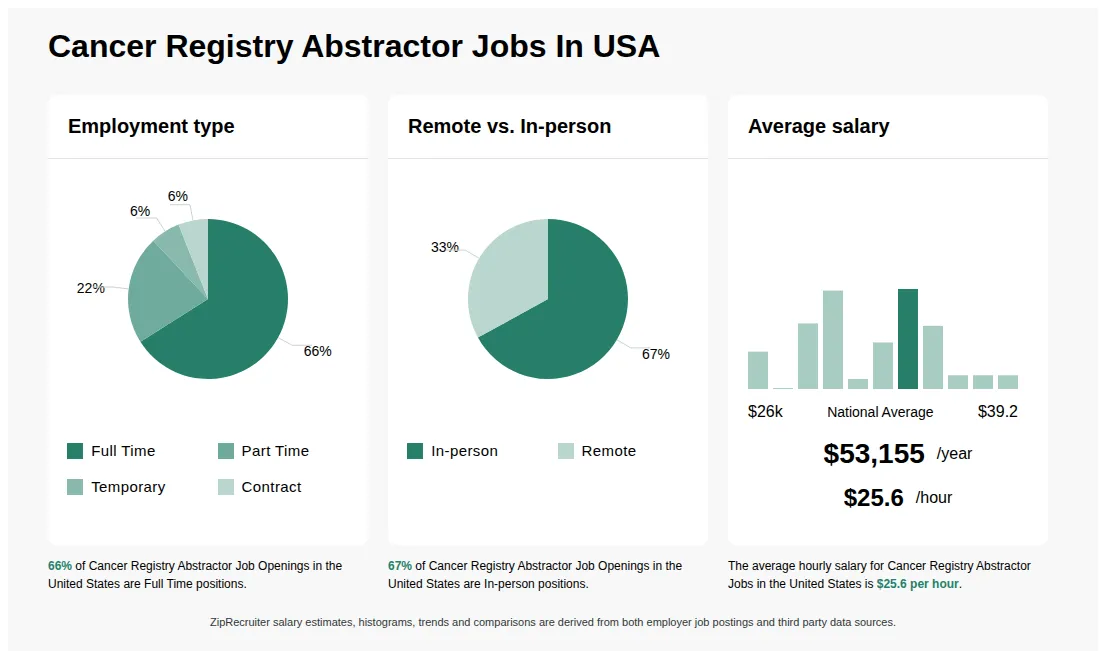
$12.50 - $14.93
8% of jobs
$14.93 - $17.35
0% of jobs
$17.35 - $19.78
15% of jobs
$19.98 is the 25th percentile. Wages below this are outliers.
$19.78 - $22.20
22% of jobs
$22.20 - $24.63
2% of jobs
The median wage is $25.23 / hr.
$24.63 - $27.05
11% of jobs
$28.93 is the 75th percentile. Wages above this are outliers.
$27.05 - $29.48
22% of jobs
$29.48 - $31.91
14% of jobs
$31.91 - $34.33
2% of jobs
$34.33 - $36.76
2% of jobs
$36.76 - $39.18
2% of jobs
$12
$25
$39
A Cancer Registry Abstractor is a healthcare professional who collects, analyzes, and maintains cancer patient data for research, treatment, and registry purposes. They review medical records, pathology reports, and other documents to ensure accurate coding and classification of cancer diagnoses and treatments. This data helps in understanding cancer trends, improving patient care, and meeting regulatory requirements. Abstractors typically work in hospitals, cancer centers, or public health organizations and must have knowledge of medical terminology, coding systems, and cancer treatment guidelines.
As a Cancer Registry Abstractor, your daily tasks generally involve reviewing patient medical records, accurately coding and abstracting cancer-related data, and entering this information into specialized registry databases. You will ensure data quality by adhering to strict collection guidelines and may participate in internal audits or serve as a resource for clinical staff regarding data collection standards. Collaboration with physicians, pathologists, and tumor board members is common, especially when clarifying or updating case information. This work is usually performed in a hospital, clinic, or remotely, depending on the employer's policies.
To excel as a Cancer Registry Abstractor, you need a deep understanding of medical terminology, oncology coding, and abstracting procedures, often backed by a health information management degree or Certified Tumor Registrar (CTR) credential. Experience with cancer registry software (such as METRIQ, OncoLog, or Registry Plus) and knowledge of standards set by organizations like the Commission on Cancer are highly beneficial. Strong attention to detail, analytical thinking, and effective written and verbal communication are standout soft skills in this role. These abilities are crucial for maintaining accurate, standardized data collection that supports cancer research, patient care, and regulatory compliance.
The most popular types of Cancer Registry Abstractor jobs are:
States with the most job openings for Cancer Registry Abstractor jobs include:
The top searched job categories for Cancer Registry Abstractor jobs are:
7.4
Based on 233 frontline employees who took The Breakroom Quiz
267th of 898 rated healthcare providers
To be part of our organization, every employee should understand and share in the YNHHS Vision, support our Mission, and live our Values. These values - integrity, patient-centered, respect, accountability, and compassion - must guide what we do, as individuals and professionals, every day.
Abstracts by collecting, summarizing, and coding detailed demographic and clinical oncology information from a variety of internal and external (paper and electronic) data sources in accordance with reporting requirements of the Connecticut Tumor Registry and data standards for the American College of Surgeons Commission on Cancer accreditation on all reportable cases. Performs other duties as requested by manager.
EEO/AA/Disability/Veteran
EDUCATION
Two (2) years of college or equivalent experience supplemented by courses in medical terminology and anatomy-physiology required. Certifed Tumor Registrar required.
EXPERIENCE
Two years experience in medical abstracting and/or experience in tumor registry or equivalent. Knowledge of oncology disease process, anatomy/physiology, pathology and medical terminology is required. Exeperience in using Elekta IMPAC's METRIQ or similiar tumor registry software system. Knwoledge of International Classification of Diseases for Oncology (ICD-O), American Joint Committee on Cancer (AJCC) Staging Manual, Surveillance, Epidemiology and End Results (SEER), and teh Facility Oncology Registry Data Standards (FORDS) of the Commission on Cancer is preferred.
SPECIAL SKILLS
Intermediate to advanced keyboarding/data entry skills; intermediate to advance skills using Windows-based software (e.g. Microsoft Office - Word, Excel, and Power Point preferred). Must have excellent organizational skills and investigative analytic skills with detail orientation.
PHYSICAL DEMAND
No special conditions
EDUCATION
Two (2) years of college or equivalent experience supplemented by courses in medical terminology and anatomy-physiology required. Certifed Tumor Registrar required.
EXPERIENCE
Two years experience in medical abstracting and/or experience in tumor registry or equivalent. Knowledge of oncology disease process, anatomy/physiology, pathology and medical terminology is required. Exeperience in using Elekta IMPAC's METRIQ or similiar tumor registry software system. Knwoledge of International Classification of Diseases for Oncology (ICD-O), American Joint Committee on Cancer (AJCC) Staging Manual, Surveillance, Epidemiology and End Results (SEER), and teh Facility Oncology Registry Data Standards (FORDS) of the Commission on Cancer is preferred.
SPECIAL SKILLS
Intermediate to advanced keyboarding/data entry skills; intermediate to advance skills using Windows-based software (e.g. Microsoft Office - Word, Excel, and Power Point preferred). Must have excellent organizational skills and investigative analytic skills with detail orientation.
PHYSICAL DEMAND
No special conditions
Education:UNAVAILABLEEmployment Type: UNAVAILABLEGet the full story on Breakroom

Sourced by ZipRecruiter
Health care and social assistance and hospitals
10,000+ Employees
New Haven, CT, US


