1

Camera Operator Jobs (NOW HIRING)

Live Action Camera Operator

Columbus, OH · On-site

$150 - $400/day

Sports (Dance) Videographer / Camera Operator Duration: February - June 2026 Location: Nationwide travel across the U.S. Compensation: $150-$400/Day + Travel Pay + All Expenses About DanceBUG ...

Setup and maintain operating use of multiple camera during games / events * Complete any sponsorship needs / obligations during pre-game, in-game and post-game, as needed * Ability to keep pace in an ...

Sports (Dance) Videographer / Camera Operator Duration: February - June 2026 Location: Nationwide travel across the U.S. Compensation: $150-$400/Day + Travel Pay + All Expenses About DanceBUG ...

next page

Showing results 1-20

Camera Operator information

See salary details

$13

$28

$62

How much do camera operator jobs pay per hour?

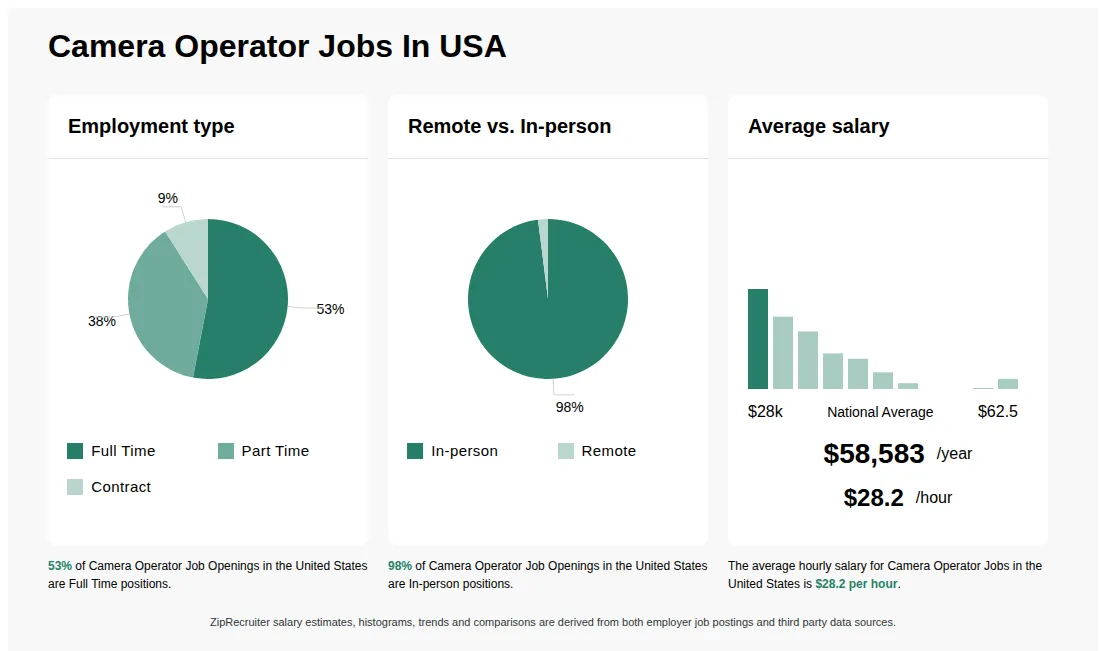
As of Jul 2, 2026, the average hourly pay for camera operator in the United States is $28.16, according to ZipRecruiter salary data. Most workers in this role earn between $17.31 and $30.53 per hour, depending on experience, location, and employer.

What are some common challenges a Camera Operator may face on set, and how can they be addressed?

Camera Operators often encounter challenges such as working in fast-paced environments, adapting to changing lighting conditions, and capturing shots as directed with precision. Effective communication with the director and crew is essential to ensure the vision is realized smoothly. Staying adaptable, proactively preparing equipment, and maintaining technical proficiency can help address these challenges and contribute to a successful shoot.

What are the key skills and qualifications needed to thrive as a Camera Operator, and why are they important?

To thrive as a Camera Operator, you need expertise in camera techniques, framing, and lighting, often developed through hands-on experience or a degree in film, broadcasting, or a related field. Familiarity with professional cameras, lenses, stabilizers, and editing software like Adobe Premiere Pro or Avid Media Composer is typically required. Strong attention to detail, teamwork, and the ability to follow creative direction help camera operators stand out. These skills ensure visually compelling footage and seamless collaboration, which are critical for producing high-quality visual content.

What does a Camera Operator do?

A Camera Operator is responsible for capturing video footage during film, television, or live event productions. They work closely with directors and cinematographers to ensure that the visual elements of a project are accurately and creatively recorded. Camera Operators set up and operate cameras, choose appropriate lenses, follow movement, and maintain shot composition. Their work is crucial in conveying the director’s vision and telling the story visually. They often collaborate with other crew members to ensure smooth production.

What is the difference between Camera Operator vs Video Technician?

AspectCamera OperatorVideo Technician
CredentialsOften requires a high school diploma, technical training, or certification in camera operationTypically needs technical certifications, troubleshooting skills, and sometimes a degree in video production or related fields
Work EnvironmentWorks on film sets, TV studios, live events, and production sitesWorks in broadcast stations, production facilities, or live event venues, handling equipment setup and maintenance
Industry UsageCommonly employed in film, television, and live event productionFound in broadcasting, live event production, and post-production facilities

While both roles involve working with video equipment, Camera Operators focus on capturing footage during productions, whereas Video Technicians handle technical setup, maintenance, and troubleshooting of video systems. Understanding these differences helps clarify career paths and job expectations in the video production industry.

What Do Camera Operators Do?

A camera operator operates cameras and related technical equipment for a TV show, motion picture, or special event. They typically follow instructions from a director, provide creative suggestions on the best way to film a shoot, and monitor the set for possible obstructions. A camera operator may work during live broadcasts, occasionally operate an audio console, manage studio lighting, and help prepare video recordings. In some parts of the industry, their duties require them to work early in the morning, at night, over the weekend, or on holidays. The qualifications to become a camera operator typically include a bachelor's degree in video production, film, or a relevant field and experience.

What is the work of camera operator?

A camera operator is responsible for operating cameras to capture footage for film, television, or live events. They work closely with directors and cinematographers to achieve the desired visual style, often using various camera equipment and techniques. The role requires technical skills, knowledge of camera systems, and attention to detail to ensure high-quality recordings.

Do camera operators make good money?

Camera operators typically earn a median annual salary that varies by industry and experience, with many earning between $40,000 and $80,000. Experienced professionals working on high-budget productions or in specialized fields can earn higher wages, especially with additional skills in editing or lighting. Salaries can also depend on location, union membership, and the complexity of the equipment used.

How much does a camera operator earn?

The average salary for a camera operator varies by experience and location but typically ranges from $30,000 to $80,000 per year. Entry-level operators may earn less, while experienced professionals working on major productions can earn higher wages, especially with specialized skills and certifications in equipment operation and cinematography.

How do I become a camera operator?

To become a camera operator, you typically need a high school diploma or equivalent, followed by relevant training or a degree in film, broadcasting, or a related field. Gaining experience through internships, apprenticeships, or entry-level positions, along with developing skills in operating cameras and understanding shot composition, is essential; proficiency with camera equipment and certifications can also improve job prospects.
What cities are hiring for Camera Operator jobs? Cities with the most Camera Operator job openings:
What are the most commonly searched types of Camera Operator jobs? The most popular types of Camera Operator jobs are:
Who are the top companies hiring for Camera Operator jobs? The top employers for Camera Operator jobs are:
What states have the most Camera Operator jobs? States with the most job openings for Camera Operator jobs include:
What are popular job titles related to Camera Operator jobs? For Camera Operator jobs, the most frequently searched job titles are:
Infographic showing various Camera Operator job openings in the United States as of June 2026, with employment types broken down into 93% Full Time, 3% Part Time, 2% Contract, and 2% Nights. Highlights an 99% Physical, and 1% Remote job distribution, with an average salary of $58,583 per year, or $28.2 per hour.

Live Action Camera Operator

DanceBUG Inc.

Philadelphia, PA • On-site

$150 - $400/day

Contractor

Posted 7 days ago


Job description

Sports (Dance) Videographer / Camera Operator
Duration: February - June 2026
Location: Nationwide travel across the U.S.
Compensation: $150-$400/Day + Travel Pay + All Expenses
About DanceBUG
DanceBUG is the industry leader in Dance Media and Software, with nearly 25 years of innovation serving the dance community. From groundbreaking products like Video Judge to our full suite of Registration, Scheduling, Tabulation, and Streaming tools, we're trusted nationwide as the gold standard for dance videography and photography.
🌐 Learn more about us here: What We Do at DanceBUG
The Role
We're looking for passionate and skilled Videographers/Camera Operators to join our seasonal team. In this role, you'll travel nationwide to capture and stream dance competitions, recitals, and workshops-helping us deliver high-quality media to studios and dancers across the country.
Key Responsibilities
  • Set up and operate video, audio, and streaming equipment on-site
  • Conduct daily video/audio checks to ensure broadcast quality
  • Film and log performances, manage live streams, and upload daily footage
  • Handle data transfers (FTP/shipping) after events
  • Travel nationwide by car or plane to assigned venues

Requirements
  • Experience filming live events, sports, or action performances
  • Strong technical skills with camera operation (exposure, white balance, audio
  • Able to lift 50 lbs, work 12-16-hour days, and travel Thurs-Mon as needed
  • Must live within 1 hour of an airport and hold a valid U.S. driver's license
  • Comfortable with loud music, flashing lights, and extended stationary periods
  • Must pass a Criminal Background and Vulnerable Sector check
Perks
  • Paid training in Jan/Feb 2026
  • All travel and hotel accommodations covered (single-occupancy rooms)
  • Travel time is paid
  • All equipment provided
Key Dates
Virtual Training: 1 day each week in January (4 days total)
Infield Training: 2 Training at actual events in January and February
Key Dates:
  • Feb 27-Mar 1, Mar 6-8, Mar 13-15, Mar 20-22, Mar 27-29
  • Apr 10-12, Apr 17-19, Apr 24-26
  • May 1-3, May 8-10, May 15-17, May 29-31
  • June 5-7
Additional Opportunities: There are events that run until the end of July.
Apply Now:
Become part of DanceBUG Inc. and help us set the standard in dance media!