A record of excellence teaching in biostatistics or related quantitative courses, including a clearly defined teaching philosophy and a record of participation on and as major professor for thesis ...
A record of excellence teaching in biostatistics or related quantitative courses, including a clearly defined teaching philosophy and a record of participation on and as major professor for thesis ...
A record of excellence teaching in biostatistics or related quantitative courses, including a clearly defined teaching philosophy and a record of participation on and as major professor for thesis ...
A record of excellence teaching in biostatistics or related quantitative courses, including a clearly defined teaching philosophy and a record of participation on and as major professor for thesis ...

UNC COM seeks a collaborative, service-oriented faculty Biostatistician at the rank of Assistant, Associate, or Full Professor to provide high-quality statistical and data-science expertise ...
UNC COM seeks a collaborative, service-oriented faculty Biostatistician at the rank of Assistant, Associate, or Full Professor to provide high-quality statistical and data-science expertise ...
UNC COM seeks a collaborative, service-oriented faculty Biostatistician at the rank of Assistant, Associate, or Full Professor to provide high-quality statistical and data-science expertise ...
UNC COM seeks a collaborative, service-oriented faculty Biostatistician at the rank of Assistant, Associate, or Full Professor to provide high-quality statistical and data-science expertise ...

Assistant/Associate Professor of Biostatistics, Department of Kinesiology and Nutrition Sciences,...
Campus, IL · On-site
The University of Nevada, Las Vegas invites applications for Assistant/Associate Professor of Biostatistics, Department of Kinesiology and Nutrition Sciences, School of Integrated Health Sciences ...
Assistant/Associate Professor of Biostatistics, Department of Kinesiology and Nutrition Sciences,...
Campus, IL · On-site
The University of Nevada, Las Vegas invites applications for Assistant/Associate Professor of Biostatistics, Department of Kinesiology and Nutrition Sciences, School of Integrated Health Sciences ...

Description The Department of Biostatistics, Epidemiology and Informatics (DBEI) at the Perelman School of Medicine at the University of Pennsylvania seeks candidates for several Assistant Professor ...
Description The Department of Biostatistics, Epidemiology and Informatics (DBEI) at the Perelman School of Medicine at the University of Pennsylvania seeks candidates for several Assistant Professor ...

Position Details Position Information Position Title Assistant/Associate Professor of Biostatistics Department Center for Animal Health/CAHA Position Category Faculty The faculty member in ...
Position Details Position Information Position Title Assistant/Associate Professor of Biostatistics Department Center for Animal Health/CAHA Position Category Faculty The faculty member in ...
Assistant/Associate Professor of Biostatistics, Department of Kinesiology and Nutrition Sciences, Sc
Las Vegas, NV · On-site
The University of Nevada, Las Vegas invites applications for Assistant/Associate Professor of Biostatistics, Department of Kinesiology and Nutrition Sciences, School of Integrated Health Sciences ...
Assistant/Associate Professor of Biostatistics, Department of Kinesiology and Nutrition Sciences, Sc
Las Vegas, NV · On-site
The University of Nevada, Las Vegas invites applications for Assistant/Associate Professor of Biostatistics, Department of Kinesiology and Nutrition Sciences, School of Integrated Health Sciences ...

TRIAD Director - Associate Professor or Full Professor
Salt Lake City, UT · On-site
$125 - $150/hr
TRIAD Director - Associate Professor or Full Professor We are seeking an Associate or Full ... D. trained biostatisticians and research methodologists. * Collaborate with biomedical researchers ...
TRIAD Director - Associate Professor or Full Professor
Salt Lake City, UT · On-site
$125 - $150/hr
TRIAD Director - Associate Professor or Full Professor We are seeking an Associate or Full ... D. trained biostatisticians and research methodologists. * Collaborate with biomedical researchers ...

Description The Yale Cancer Center at Yale University is seeking applicants for an open-rank position (Associate Professor or Professor) to be the lead Director of Cancer Biostatistics and ...
Description The Yale Cancer Center at Yale University is seeking applicants for an open-rank position (Associate Professor or Professor) to be the lead Director of Cancer Biostatistics and ...

$125 - $150/hr
... Professor of Biostatistics. We seek candidates with backgrounds in statistical theory and methods and AI/ML, with demonstrated expertise in the development of new methods as well as a record of ...
$125 - $150/hr
... Professor of Biostatistics. We seek candidates with backgrounds in statistical theory and methods and AI/ML, with demonstrated expertise in the development of new methods as well as a record of ...
Assistant/Associate Professor, Biostatistics, T/TE
Tucson, AZ · On-site
$125 - $150/hr
... Professor of Biostatistics. We seek candidates with backgrounds in statistical theory and methods and AI/ML, with demonstrated expertise in the development of new methods as well as a record of ...
Assistant/Associate Professor, Biostatistics, T/TE
Tucson, AZ · On-site
$125 - $150/hr
... Professor of Biostatistics. We seek candidates with backgrounds in statistical theory and methods and AI/ML, with demonstrated expertise in the development of new methods as well as a record of ...

Assistant Professor Position 2026
Baltimore, MD · On-site
$160K - $180K/yr
Description The Department of Biostatistics at the Johns Hopkins Bloomberg School of Public Health is seeking an outstanding colleague to join our tenure track faculty at the assistant professor ...
Assistant Professor Position 2026
Baltimore, MD · On-site
$160K - $180K/yr
Description The Department of Biostatistics at the Johns Hopkins Bloomberg School of Public Health is seeking an outstanding colleague to join our tenure track faculty at the assistant professor ...
Biostatistics - Associate or Full Professor, Tenure Track or Clinician-Educator
Philadelphia, PA · On-site
... Professor positions in either the non-tenure clinician educator track or the tenure track. Expertise is required in the specific area of biostatistical methods development and applications.
Biostatistics - Associate or Full Professor, Tenure Track or Clinician-Educator
Philadelphia, PA · On-site
... Professor positions in either the non-tenure clinician educator track or the tenure track. Expertise is required in the specific area of biostatistical methods development and applications.

Assistant or Associate Professor in Cancer Biostatistics
Baltimore, MD · On-site
$200K/yr
The University of Maryland Greenebaum Comprehensive Cancer Center (UMGCCC) is recruiting a full-time, tenure track Assistant or Associate Professor in Cancer Biostatistics to join our thriving cancer ...
Assistant or Associate Professor in Cancer Biostatistics
Baltimore, MD · On-site
$200K/yr
The University of Maryland Greenebaum Comprehensive Cancer Center (UMGCCC) is recruiting a full-time, tenure track Assistant or Associate Professor in Cancer Biostatistics to join our thriving cancer ...
Assistant or Associate Professor in Cancer Biostatistics
Baltimore, MD · On-site
$150 - $200/hr
The University of Maryland Greenebaum Comprehensive Cancer Center(UMGCCC) is recruiting a full-time, tenure track Assistant orAssociate Professor in Cancer Biostatistics to join our thrivingcancer ...
Assistant or Associate Professor in Cancer Biostatistics
Baltimore, MD · On-site
$150 - $200/hr
The University of Maryland Greenebaum Comprehensive Cancer Center(UMGCCC) is recruiting a full-time, tenure track Assistant orAssociate Professor in Cancer Biostatistics to join our thrivingcancer ...

The University of Tennessee Health Science Center, Department of Preventive Medicine, is seeking a tenure-track full-time Assistant Professor in Biostatistics. The successful candidate will be ...
The University of Tennessee Health Science Center, Department of Preventive Medicine, is seeking a tenure-track full-time Assistant Professor in Biostatistics. The successful candidate will be ...
Chair Department Of Biostatistics Mcv Main Campus
Virginia, MN · On-site
$200 - $250/hr
This is a 12-month tenure-track appointment at the rank of Associate Professor or Professor. Key qualifications * PhD in biostatistics, statistics, or related field * Academic rank of Associate ...
Chair Department Of Biostatistics Mcv Main Campus
Virginia, MN · On-site
$200 - $250/hr
This is a 12-month tenure-track appointment at the rank of Associate Professor or Professor. Key qualifications * PhD in biostatistics, statistics, or related field * Academic rank of Associate ...
The University of Tennessee Health Science Center, Department of Preventive Medicine, is seeking a tenure-track full-time Assistant Professor in Biostatistics. The successful candidate will be ...
The University of Tennessee Health Science Center, Department of Preventive Medicine, is seeking a tenure-track full-time Assistant Professor in Biostatistics. The successful candidate will be ...

Adjunct Professor/Instructor
New York, NY · On-site
$75 - $83/hr
... professor/instructor for the upcoming Fall 2024 semester, with opportunity for renewal ... The course is "Biostatistics" and is offered as part of the MS program in Clinical Research.
Adjunct Professor/Instructor
New York, NY · On-site
$75 - $83/hr
... professor/instructor for the upcoming Fall 2024 semester, with opportunity for renewal ... The course is "Biostatistics" and is offered as part of the MS program in Clinical Research.
Biostatistics Professor information
See salary details
$58K - $69.9K
6% of jobs
$69.9K - $81.8K
7% of jobs
$81.8K - $93.7K
11% of jobs
$94.2K is the 25th percentile. Wages below this are outliers.
$93.7K - $105.6K
20% of jobs
The median wage is $108.5K / yr.
$105.6K - $117.5K
24% of jobs
$121.7K is the 75th percentile. Wages above this are outliers.
$117.5K - $129.5K
19% of jobs
$129.5K - $141.4K
4% of jobs
$141.4K - $153.3K
0% of jobs
$153.3K - $165.2K
0% of jobs
$165.2K - $177.1K
4% of jobs
$177.1K - $189K
4% of jobs
$58K
$114.8K
$189K
How much do biostatistics professor jobs pay per year?
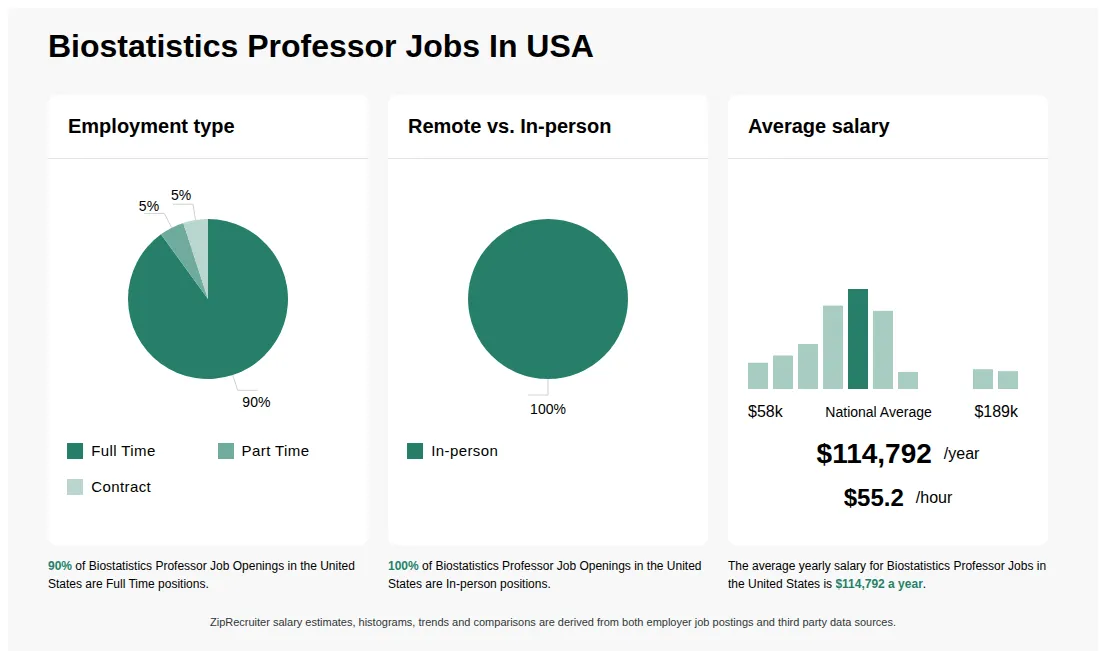
As of Sep 9, 2026, the average yearly pay for biostatistics professor in the United States is $114,792.00, according to ZipRecruiter salary data. Most workers in this role earn between $94,500.00 and $121,500.00 per year, depending on experience, location, and employer.
What is a biostatistics professor?
A Biostatistics Professor is an academic professional who teaches and conducts research in the field of biostatistics, which involves applying statistical methods to biological and health-related research. They typically work at universities or research institutions, teaching courses in biostatistics, mentoring students, and developing new statistical methods for analyzing medical and public health data. Their research may involve collaboration with scientists, healthcare professionals, and policymakers to improve study designs and data interpretation. Many also publish academic papers, apply for research grants, and contribute to the advancement of statistical methodologies in medicine and biology.
What are the common responsibilities of a biostatistics professor?
Biostatistics Professors are typically responsible for teaching undergraduate and graduate courses, mentoring students, and supervising thesis or dissertation research. They often lead or collaborate on biomedical and public health research projects, develop grant proposals, and publish scholarly articles. Additionally, they may serve on academic committees and participate in department and university service activities. This dynamic role usually involves a balance of teaching, research, and administrative duties, fostering opportunities for professional growth and meaningful collaboration with colleagues across disciplines.
What are the key skills and qualifications needed to thrive as a biostatistics professor?
A Biostatistics Professor should have expertise in statistical methods, data analysis, research design, and possess a doctoral degree in biostatistics or a closely related field. Familiarity with statistical software such as R, SAS, or SPSS, as well as experience with grant writing and research publication, is typically expected. Strong communication, mentorship, and organizational skills are crucial to effectively teach, advise students, and collaborate on interdisciplinary research. These competencies are essential for advancing both academic scholarship and student success in a university setting.
Is biostatistics in high demand?
Biostatistics is a growing field with strong demand due to its critical role in healthcare research, clinical trials, and public health. Biostatistics professors and professionals with expertise in statistical software and data analysis are increasingly sought after in academic, government, and industry settings.
What can I do with a PhD in biostatistics?
A PhD in biostatistics prepares individuals for roles such as biostatistics professor, research scientist, or data analyst in healthcare, academia, or government agencies. Graduates often work with statistical software, design clinical trials, analyze biomedical data, and contribute to public health research.
More about Biostatistics Professor jobs
What cities are hiring for Biostatistics Professor jobs?
Cities with the most Biostatistics Professor job openings:
What are the most commonly searched types of Biostatistics Professor jobs?
The most popular types of Biostatistics Professor jobs are:
What states have the most Biostatistics Professor jobs?
States with the most job openings for Biostatistics Professor jobs include:
What are popular job titles related to Biostatistics Professor jobs?
For Biostatistics Professor jobs, the most frequently searched job titles are:

Professor, Chair, Biostatistics and Data Science
Tampa, FL • On-site
University of South Florida •
Colleges, Universities, and Professional Schools • 10K+ employees10,000+ employees
Full-time
Medical, Dental, Life, Retirement
Re-posted 12 days ago
University Of South Florida rating

7.0
Based on 49 frontline employees who took The Breakroom Quiz
441st of 631 rated colleges and universities
Job description
The incumbent of this position serves as a senior-level faculty member in Biostatistics and Data Sciences. In addition, the incumbent serves as Chair of the Department. As a ranked professorial faculty position at USF, the incumbent will have teaching, research, scholarship, and service responsibilities. The Chair will provide strategic leadership to strengthen and expand the Department's research profile, educational excellence, collaborative engagement, and impact in biostatistics, data science, artificial intelligence, and quantitative population health." The successful candidate will play a central role in advancing the Department's visibility, faculty recruitment, interdisciplinary integration, and research competitiveness, while furthering the goals and mission of the College of Public Health. This position reports directly to the Dean who will meet with the incumbent annually to discuss the specific assignment for the upcoming academic year and evaluate performance for the previous year.
Working at USF
With approximately 16,000 employees, the University of South Florida is one of the largest employers in the Tampa Bay area. We are dedicated to cultivating a talented, engaged and driven workforce that strives to be bold. Employees excel in USF's rich academic environment, which fosters their development and advancement. In 2025, Forbes recognized USF as one of Florida's best large employers, ranked No. 1 among the state's 12 public universities. Our first-class benefits package includes medical, dental and life insurance plans, retirement plan options, employee and dependent tuition programs, generous leave, and hundreds of employee perks and discounts.
About USF
The University of South Florida is a top-ranked research university serving approximately 50,000 students from across the globe at campuses in Tampa, St. Petersburg, Sarasota-Manatee and USF Health. USF is recognized by U.S. News & World Report as a top 50 public university and the best value in Florida. U.S. News also ranks the USF Health Morsani College of Medicine as the No. 1 medical school in Florida and in the highest tier nationwide. USF is a member of the Association of American Universities (AAU), a group that includes only the top 3% of universities in the U.S. With an all-time high of $738 million in research funding in 2024 and as a top 20 public university for producing U.S. patents, USF uses innovation to transform lives and shape a better future. The university generates an annual economic impact of more than $6 billion. USF's Division I athletics teams compete in the American Athletic Conference. Learn more at www.usf.edu.
Compliance and Federal Notices
This position may be subject to a Level 1 or Level 2 criminal background check.
Applicants have rights under Federal Employment Laws:
The University of South Florida is an equal opportunity employer that does not discriminate against any employee or applicant for employment based on any characteristic protected by law. The University maintains programs for protected veterans and individuals with disabilities in accordance with all applicable federal and state laws.
Family and Medical Leave Act (FMLA)
Applicants for USF employment are entitled to request reasonable accommodation(s) in the application process. A request is to be made at least five (5) working days prior to the time the accommodation(s) is needed. Visit the Central Human Resources ADA Accommodations webpage for more information on requesting an accommodation during the application/interview process.
Equal Employment Opportunity
The University of South Florida is an equal opportunity employer that does not discriminate against any employee or applicant for employment based on any characteristic protected by law. The University maintains affirmative action programs for protected veterans and individuals with disabilities in accordance with all applicable federal and state laws. This job description does not constitute an employment contract.
Minimum Qualifications:
Doctoral degree from an accredited institution or the highest degree appropriate in the field of specialization with a demonstrated record of achievement in teaching, academic research, and service. Normally will have produced creative work, professional writing or research in referred and other professional journals, and be a recognized authority in the field of specialization. Must meet university criteria for appointment to the rank of Professor.
Additional Minimum Qualifications:
A minimum of two years of sustained accomplishment as an Associate Professor in a university or equivalent setting, including evidence of scholarly productivity, leadership, teaching effectiveness, and service.
A record of excellence teaching in biostatistics or related quantitative courses, including a clearly defined teaching philosophy and a record of participation on and as major professor for thesis and/or dissertation committees for master's and doctoral candidates where applicable.
A national and/or international record of excellence in independent and/or collaborative research and/or creative scholarly work in Biostatistics and Data Sciences or related discipline supported by substantial and sustained publications or their equivalent.
A record of substantive contribution of service to the University and to the field, profession, and community.
Compelling evidence of significant achievement among peers in one's discipline or professional field at the national or international level.
A record of collegiality and participation as a citizen of a university or other equivalent institution.
Preferred Qualifications:
Demonstrated commitment to faculty development, mentorship, retention, and advancement across career stages.
Demonstrated expertise in Biostatistics and Data Sciences or related discipline.
Administrative experience leading multidisciplinary teams.
Commitment to and experience in attracting, retaining, and graduating doctoral students.
Ability to create and support a collaborative research and learning community.
Extensive publication record in peer-reviewed journals relevant to the field of Biostatistics and Data Sciences.
Demonstrated record of securing and sustaining extramural funding appropriate to the discipline and career stage.
Commitment to faculty governance and collegiality.
Demonstrated expertise or leadership experience in emerging areas such as data science, machine learning, artificial intelligence, computational epidemiology, or health informatics.
Excellent oral and written communication skills.
Instructional Duties: 20% FTE
Teach graduate level public health and Biostatistics and Data Sciences related courses where interests and needs align. Collaborate in teaching with other faculty within the College and participate in college-wide teaching initiatives. Advise graduate students at both master's and doctoral levels, including serving on thesis and dissertation committees as needed.
Research Duties: 35% FTE
Collaborate with faculty across the Department, College, USF Health, and the broader university to advance innovative methodological, collaborative, and translational quantitative research. Apply for and obtain competitive extramural funding for research grants. Disseminate scholarly achievements through peer-reviewed publications, presentations, and active translation to the field.
Service Duties: 5% FTE
Participate in service activities at the university, professional, and community levels, including serving on special work groups and other university service roles. Participate at the local, state, and national level in professional organizations and activities. Serve on Department, College, and University committees; actively participate in local, state, and national public health organizations and professional associations; and contribute actively to community engagement.
Administrative Duties: 40% FTE
Specific responsibilities of the Department Chair include:
Exercising leadership by developing effective goals and plans for the department, representing the faculty and serving as a role model for faculty, staff, and students.
Managing Department staff and student employees, finances, and resources effectively and efficiently, in
accordance with College and University policies.
Practicing fair, balanced, and transparent leadership in managing the various constituencies within the Department and facilitating the work of faculty.
Fostering excellence in the education, research, and service programs of the Department, including collaboration with other department chairs, center directors, and designated mission leads.
Facilitating the recruitment and retention of a diverse and talented faculty, staff, and student body to fulfill the needs and missions of the Department and College.
Advocating for equitable salary and academic work conditions for Department faculty, staff, and student employees, facilitating their continuing academic and professional development.
Encouraging the development of research and teaching programs and fostering interdisciplinary activities.
Responsible for ensuring timely, fair, and equitable completion of the annual faculty assignment and evaluation processes. Responsible for ensuring completion of the staff evaluation process and that their students are evaluated consistently with the expectations of the Graduate Assistant Collective Bargaining Agreement.
Actively participating as a member of the College Leadership team, providing overall direction for the continued growth and improvement in quality of all College mission areas.
Contributing to the reputation and overall welfare of the College and University.
Facilitate meaningful engagement and integration of affiliated and jointly appointed quantitative faculty across the university to strengthen the Department's collaborative and educational mission.
Collaborating with other Department Chairs regarding the assignment and evaluation of faculty who have joint (secondary) appointments in their respective departments as well as College-wide program directors for shared teaching responsibilities necessary to meet the academic mission of the College.
Advance the national visibility and reputation of the Department through strategic partnerships, faculty success, innovative programming, and research leadership.
The Chair is also expected to maintain a record of personal success in his/her field and participate in the teaching, research, and service programs of the Department.
The Chair serves as an advisor to the Dean of the College of Public Health and as a member of the Executive Committee of the College.
What University Of South Florida employees say
Pay
Benefits
Hours and flexibility
Workplace
Get the full story on Breakroom

About University of South Florida
Sourced by ZipRecruiter
The University of South Florida (USF), located in Tampa, FL, US, is a highly respected, long-standing institution specializing in teaching, research, and public service. It operates within the higher education industry and offers over 180 undergraduate, graduate, specialist, and doctoral degree programs, across disciplines ranging from arts and sciences to business, engineering, and healthcare. Founded in the year 1956, USF has relentlessly strived to develop an environment conducive to learning and research, which over the years, has earned it a preeminent status among public universities across the globe. USF's mission is to foster a vibrant, student-centric learning environment that instills an expansive intellectual foundation to drive success. USF is known for its considerable impact on regional and state economies, contributing $5 billion annually.
Industry
Colleges, universities, and professional schools
Company size
10,000+ Employees
Headquarters location
Tampa, FL, US
Year founded
1956