1

Bioinformatics Machine Learning Internship Jobs (NOW HIRING)

Understands well the biology application domain, proficient in bioinformatics tools, databases, software development, general and numerical algorithms, statistics and machine learning. Capable of ...

As a member of our multidisciplinary team, you will collaborate with experts in machine learning, molecular simulation, optimization, and bioinformatics, and interface with experimentalists ...

As a member of our multidisciplinary team, you will collaborate with experts in machine learning, molecular simulation, optimization, and bioinformatics, and interface with experimentalists ...

They are seeking a Machine Learning Engineer to design and develop machine learning and AI ... Preferred : • Internship, research, or project experience applying ML to real-world or research ...

next page

Showing results 1-20

Bioinformatics Machine Learning Internship information

See salary details

$25.5K

$42.6K

$88K

How much do bioinformatics machine learning internship jobs pay per year?

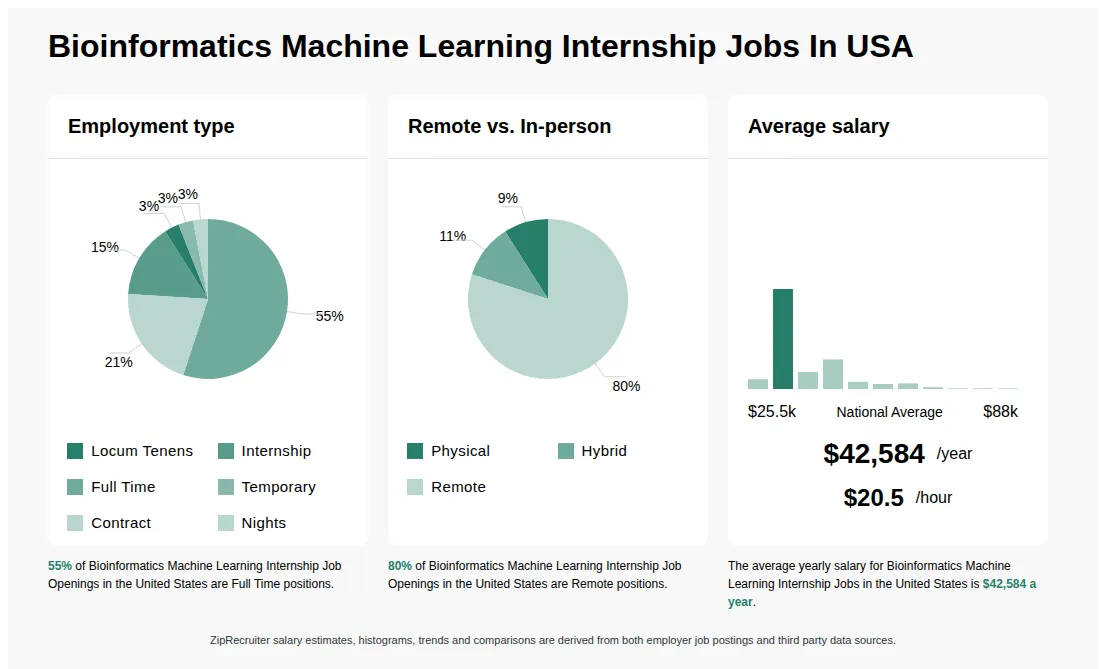
As of Jun 14, 2026, the average yearly pay for bioinformatics machine learning internship in the United States is $42,584.00, according to ZipRecruiter salary data. Most workers in this role earn between $32,500.00 and $46,000.00 per year, depending on experience, location, and employer.

What is a Bioinformatics Machine Learning Internship?

A Bioinformatics Machine Learning Internship is a temporary position, usually for students or recent graduates, where interns gain hands-on experience applying machine learning techniques to biological data. Interns may work on projects like analyzing genomic sequences, predicting protein structure, or developing algorithms for biomedical research. The role involves coding, data analysis, and collaborating with scientists to solve real-world biological problems. It offers exposure to both computational methods and biological sciences, preparing interns for careers in bioinformatics, data science, or research.

What are the key skills and qualifications needed to thrive as a Bioinformatics Machine Learning Intern, and why are they important?

To thrive as a Bioinformatics Machine Learning Intern, you need a solid background in biology, statistics, and computer science, typically supported by relevant coursework or a degree in bioinformatics, computational biology, or a related field. Familiarity with programming languages like Python or R, experience using bioinformatics tools (e.g., BLAST, Bioconductor), and knowledge of machine learning frameworks such as TensorFlow or scikit-learn are highly valued. Attention to detail, problem-solving skills, and effective communication help interns collaborate on interdisciplinary teams and interpret complex datasets. These skills ensure interns can contribute meaningfully to research projects, derive insights from biological data, and communicate findings clearly.

What are some typical projects or tasks a Bioinformatics Machine Learning Intern might work on during their internship?

As a Bioinformatics Machine Learning Intern, you'll often contribute to projects that involve developing and testing algorithms for analyzing biological data, such as genomic sequences or protein structures. Typical tasks may include preprocessing large datasets, implementing machine learning models to identify patterns or make predictions, and visualizing results for team discussions. Interns frequently collaborate with both computational scientists and experimental biologists, gaining exposure to interdisciplinary teamwork and real-world applications. This hands-on experience helps interns build both technical and domain-specific skills, preparing them for advanced roles in bioinformatics or data science.

What is the difference between Bioinformatics Machine Learning Internship vs Bioinformatics Data Analyst Internship?

AspectBioinformatics Machine Learning InternshipBioinformatics Data Analyst Internship
Required SkillsProgramming, machine learning, bioinformatics toolsData analysis, statistical skills, bioinformatics tools
Work EnvironmentResearch labs, biotech companies, academic institutionsResearch labs, healthcare, biotech firms
Industry UsageDeveloping algorithms, predictive models in bioinformaticsAnalyzing biological data, generating reports

While both internships involve bioinformatics, the Bioinformatics Machine Learning Internship focuses on developing machine learning models and algorithms, whereas the Bioinformatics Data Analyst Internship emphasizes analyzing biological data and generating insights. Both roles require programming and bioinformatics skills but differ in their core focus and application.


More about Bioinformatics Machine Learning Internship jobs
What cities are hiring for Bioinformatics Machine Learning Internship jobs? Cities with the most Bioinformatics Machine Learning Internship job openings:
What are the most commonly searched types of Bioinformatics Machine Learning jobs? The most popular types of Bioinformatics Machine Learning jobs are:
What states have the most Bioinformatics Machine Learning Internship jobs? States with the most job openings for Bioinformatics Machine Learning Internship jobs include:
Infographic showing various Bioinformatics Machine Learning Internship job openings in the United States as of June 2026, with employment types broken down into 100% Internship. Highlights an 100% In-person job distribution, with an average salary of $42,584 per year, or $20.5 per hour.
Machine Learning (ML) Bioengineer

Machine Learning (ML) Bioengineer

LLNL

Livermore, CA

Full-time

Retirement

Posted 7 days ago


Job description

Company Description

Join us and make YOUR mark on the World!

Lawrence Livermore National Laboratory (LLNL) has turned bold ideas into world-changing impact advancing science and technology to strengthen U.S. security and promote global stability. 

Our mission spans four critical national security areas nuclear deterrence, threat preparedness, energy security, and multi-domain defense empowering teams to take on the toughest challenges of today and tomorrow. With a culture built on innovation and operational excellence, LLNL is a place where your expertise can make a real impact.

Job Description

We have an opening for a Machine Learning (ML) Bioengineer to conduct research training and evaluating next-generation clinical, protein and genome language models. You will join the Bioresilience Incubator, a dynamic engineering center that integrates predictive computational modeling, machine learning, and experimental biology to advance national security and public health missions. This position will be in the Computational Engineering Division (CED), within the Engineering Directorate, matrixed to the Bioresilience Incubator.

As a member of our multidisciplinary team, you will collaborate with experts in machine learning, molecular simulation, optimization, and bioinformatics, and interface with experimentalists generating large datasets via novel high-throughput assays. You will leverage in-house computational tools and contribute to the design, training, and evaluation of new machine learning-based methods.

Depending on your assignment, this position may offer a hybrid schedule, blending in-person and virtual presence. You may have the flexibility to work from home one or more days per week. 

This position will be filled at either level based on knowledge and related experience as assessed by the responsibilities (outlined below) will be assigned if hired at the higher level.

You will

  • Collaborate with project scientists and engineers to develop, implement, and evaluate computational frameworks and models.
  • Contribute to the development and application of advanced analysis methodologies; analyze data; document research through presentations and peer-reviewed publications.
  • Support technical activities for new capability development and provide solutions to moderately complex to complex technical problems using established and innovative methods.
  • Contribute to the completion of project milestones, influencing the development of organizational goals and objectives. Establish, implement, and maintain quality standards for project deliverables.
  • Contribute to briefings and presentations documenting project activities and research results.
  • Routinely interact with technical contacts at sponsor and partner organizations; represent the organization on specific technical projects.
  • Participate in the development of future research directions and proposals to secure ongoing projects in computational protein design.
  • Balance multiple projects/tasks and priorities to ensure deadlines are met, working independently with minimal direction within the scope of assignments.
  • Perform other duties as assigned.

Additional job responsibilities, at the SES.3 level

  • Determine, propose, and implement advanced analysis methodologies and contribute to identifying future research directions and proposals that will secure future projects in the field.
  • Guide the completion of projects and influence the development of organizational goals and objectives.
  • Lead the development of briefings and presentations documenting to project activities and research results.
  • Represent the organization as the primary technical contact on tasks and projects, serving on internal technical/advisory committees and potentially on external committees.
  • Oversee the activities of other personnel, providing informal mentoring and guidance to less-experienced team members.
  • Contribute to and influence the development of innovative projects, principles, and ideas in computational protein design.
Qualifications
  • Ability to secure and maintain a U.S. DOE Q-level security clearance which requires U.S. citizenship.
  • Master's degree in Machine Learning, Computational Biology, Statistics, Computer Science, Mathematics, or a related field, or the equivalent combination of education and related experience.
  • Comprehensive knowledge and experience developing and applying algorithms in one or more of the following machine learning areas: deep learning, unsupervised feature learning, zero- or few-shot learning, active learning, transformer-based language modeling, multimodal learning.
  • Experience developing and implementing deep learning models and algorithms using modern software libraries such as PyTorch, TensorFlow, or similar, as evidenced by publications or software releases.
  • Experience with high-performance computing, multi-node, multi-GPU, distributed training.
  • Comprehensive knowledge in protein and genome language models sufficient to communicate effectively with team members and subject matter experts.
  • Proficient verbal and written communication skills necessary to collaborate within a team environment and present technical information to varied audiences.
  • Effective interpersonal skills and initiative necessary to interact with all levels of personnel and work independently in a collaborative, multidisciplinary team environment.
  • Demonstrated ability to balance multiple projects and prioritize competing demands while maintaining high-quality standards for deliverables.

Additional qualifications at the SES.3 level 

  • Advanced knowledge and experience in developing and applying algorithms in  machine learning areas.
  • Significant experience developing and implementing medium to large-scale deep learning models and algorithms using modern software libraries.
  • Demonstrated ability to provide guidance and informal mentoring to other personnel and junior team members.
  • Advanced verbal and written communication skills necessary to effectively collaborate in a multidisciplinary team and present technical information to a variety of audiences.
  • Demonstrated ability to represent the organization as a primary technical contact and to contribute to the development of innovative projects, principles, and ideas.

Qualifications We Desire

  • PhD in Computational Biology, Computational Bioengineering, Machine Learning, Statistics, Computer Science, Mathematics, or a related field.
  • Strong understanding of protein and genome language models and datasets.
  • Experience publishing research results in peer-reviewed scientific journals and presenting at conferences and workshops.
  • Experience with GPU programming and running complex workflows.

Pay Range

$146,340 - $222,564 Annually

$146,340 - $185,544 Annually for the SES.2 level

$175,530 - $222,564 Annually for the SES.3 level

This is the lowest to highest salary we in good faith believe we would pay for this role at the time of this posting.  An employee's position within the salary range will be based on several factors including, but not limited to, specific competencies, relevant education, qualifications, certifications, experience, skills, seniority, geographic location, performance, and business or organizational needs.

Additional Information

#LI-Hybrid

Position Information

This is a Career Indefinite position, open to Lab employees and external candidates.

Why Lawrence Livermore National Laboratory?

  • Included in 2026 Best Places to Work by Glassdoor!
  • Flexible Benefits Package
  • 401(k)
  • Relocation Assistance
  • Education Reimbursement Program
  • Flexible schedules (*depending on project needs)
  • Our values - visit https://www.llnl.gov/inclusion/our-values

Security Clearance

This position requires a Department of Energy (DOE) Q-level clearance.  If you are selected, we will initiate a Federal background investigation to determine if you meet eligibility requirements for access to classified information or matter. Also, all L or Q cleared employees are subject to random drug testing.  Q-level clearance requires U.S. citizenship. 

Pre-Employment Drug Test

External applicant(s) selected for this position must pass a post-offer, pre-employment drug test. This includes testing for use of marijuana as Federal Law applies to us as a Federal Contractor.

Wireless and Medical Devices

Per the Department of Energy (DOE), Lawrence Livermore National Laboratory must meet certain restrictions with the use and/or possession of mobile devices in Limited Areas. Depending on your job duties, you may be required to work in a Limited Area where you are not permitted to have a personal and/or laboratory mobile device in your possession.  This includes, but not limited to cell phones, tablets, fitness devices, wireless headphones, and other Bluetooth/wireless enabled devices.  

If you use a medical device, which pairs with a mobile device, you must still follow the rules concerning the mobile device in individual sections within Limited Areas.  Sensitive Compartmented Information Facilities require separate approval. Hearing aids without wireless capabilities or wireless that has been disabled are allowed in Limited Areas, Secure Space and Transit/Buffer Space within buildings.

How to identify fake job advertisements

Please be aware of recruitment scams where people or entities are misusing the name of Lawrence Livermore National Laboratory (LLNL) to post fake job advertisements. LLNL never extends an offer without a personal interview and will never charge a fee for joining our company. All current job openings are displayed on the Career Page under "Find Your Job" of our website. If you have encountered a job posting or have been approached with a job offer that you suspect may be fraudulent, we strongly recommend you do not respond.

To learn more about recruitment scams: https://www.llnl.gov/sites/www/files/2023-05/LLNL-Job-Fraud-Statement-Updated-4.26.23.pdf

Equal Employment Opportunity

We are an equal opportunity employer that is committed to providing all with a work environment free of discrimination and harassment. All qualified applicants will receive consideration for employment without regard to race, color, religion, marital status, national origin, ancestry, sex, sexual orientation, gender identity, disability, medical condition, pregnancy, protected veteran status, age, citizenship, or any other characteristic protected by applicable laws.

Reasonable Accommodation

Our goal is to create an accessible and inclusive experience for all candidates applying and interviewing at the Laboratory.  If you need a reasonable accommodation during the application or the recruiting process, please use our online form to submit a request. 

California Privacy Notice

The California Consumer Privacy Act (CCPA) grants privacy rights to all California residents. The law also entitles job applicants, employees, and non-employee workers to be notified of what personal information LLNL collects and for what purpose. The Employee Privacy Notice can be accessed here.