1

Bioinformatics Machine Learning Internship Jobs (NOW HIRING)

Analyze large-scale neural and behavioral datasets using machine learning and statistical ... Serve as a bioinformatics expert and coordinate with multidisciplinary teams including biologists ...

Apply machine learning approaches to analyze and integrate large-scale multi-omic datasets to ... Develop and maintain bioinformatics infrastructure, workflows, and reproducible analytical ...

Analyze large-scale neural and behavioral datasets using machine learning and statistical ... Serve as a bioinformatics expert and coordinate with multidisciplinary teams including biologists ...

We have an opening for a Bioinformatics Scientist to conduct research, training, and evaluating ... PhD in Computational Biology, Biophysics, Computational Bioengineering, Machine Learning ...

We have an opening for a Bioinformatics Scientist to conduct research, training, and evaluating ... PhD in Computational Biology, Biophysics, Computational Bioengineering, Machine Learning ...

We have an opening for a Bioinformatics Scientist to conduct research, training, and evaluating ... PhD in Computational Biology, Biophysics, Computational Bioengineering, Machine Learning ...

$28 - $45/hr

Machine Learning Engineer Intern United States Internship | Full-Time (40 hours/week) Pay Range: $28 - $45 per hour Visa: H1B Sponsorship Available | STEM OPT, OPT & CPT Candidates Welcome Position ...

As a member of our multidisciplinary team, you will collaborate with experts in machine learning, molecular simulation, optimization, and bioinformatics, and interface with experimentalists ...

next page

Showing results 1-20

Bioinformatics Machine Learning Internship information

See salary details

$25.5K

$42.6K

$88K

How much do bioinformatics machine learning internship jobs pay per year?

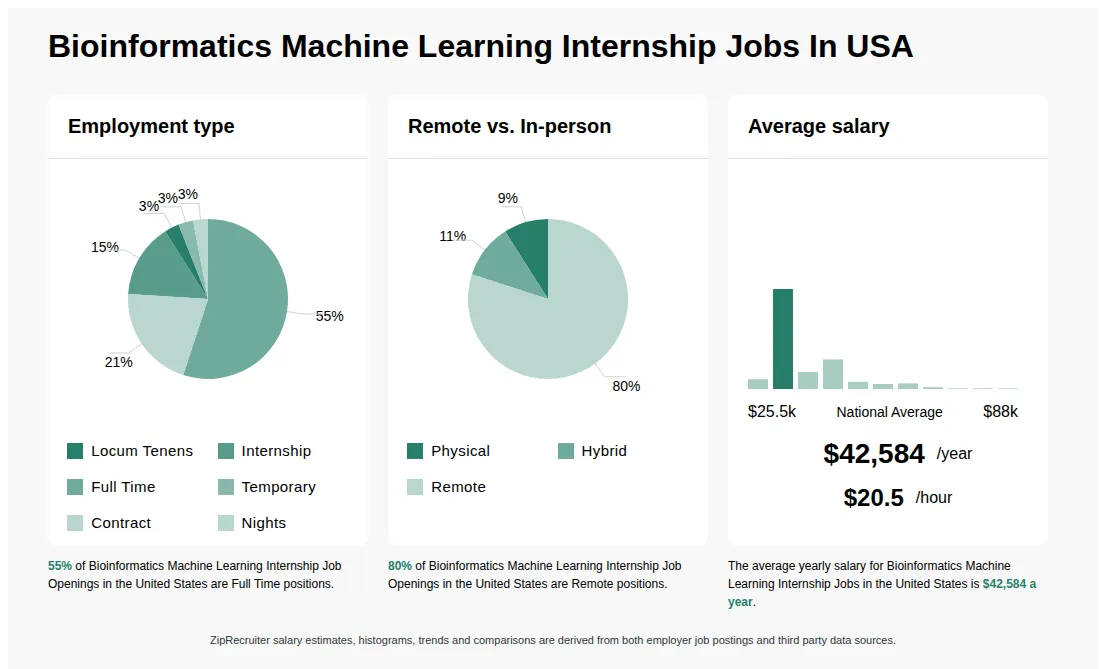
As of Jul 6, 2026, the average yearly pay for bioinformatics machine learning internship in the United States is $42,584.00, according to ZipRecruiter salary data. Most workers in this role earn between $32,500.00 and $46,000.00 per year, depending on experience, location, and employer.

What is a Bioinformatics Machine Learning Internship?

A Bioinformatics Machine Learning Internship is a temporary position, usually for students or recent graduates, where interns gain hands-on experience applying machine learning techniques to biological data. Interns may work on projects like analyzing genomic sequences, predicting protein structure, or developing algorithms for biomedical research. The role involves coding, data analysis, and collaborating with scientists to solve real-world biological problems. It offers exposure to both computational methods and biological sciences, preparing interns for careers in bioinformatics, data science, or research.

What are the key skills and qualifications needed to thrive as a Bioinformatics Machine Learning Intern, and why are they important?

To thrive as a Bioinformatics Machine Learning Intern, you need a solid background in biology, statistics, and computer science, typically supported by relevant coursework or a degree in bioinformatics, computational biology, or a related field. Familiarity with programming languages like Python or R, experience using bioinformatics tools (e.g., BLAST, Bioconductor), and knowledge of machine learning frameworks such as TensorFlow or scikit-learn are highly valued. Attention to detail, problem-solving skills, and effective communication help interns collaborate on interdisciplinary teams and interpret complex datasets. These skills ensure interns can contribute meaningfully to research projects, derive insights from biological data, and communicate findings clearly.

What are some typical projects or tasks a Bioinformatics Machine Learning Intern might work on during their internship?

As a Bioinformatics Machine Learning Intern, you'll often contribute to projects that involve developing and testing algorithms for analyzing biological data, such as genomic sequences or protein structures. Typical tasks may include preprocessing large datasets, implementing machine learning models to identify patterns or make predictions, and visualizing results for team discussions. Interns frequently collaborate with both computational scientists and experimental biologists, gaining exposure to interdisciplinary teamwork and real-world applications. This hands-on experience helps interns build both technical and domain-specific skills, preparing them for advanced roles in bioinformatics or data science.

What is the difference between Bioinformatics Machine Learning Internship vs Bioinformatics Data Analyst Internship?

AspectBioinformatics Machine Learning InternshipBioinformatics Data Analyst Internship
Required SkillsProgramming, machine learning, bioinformatics toolsData analysis, statistical skills, bioinformatics tools
Work EnvironmentResearch labs, biotech companies, academic institutionsResearch labs, healthcare, biotech firms
Industry UsageDeveloping algorithms, predictive models in bioinformaticsAnalyzing biological data, generating reports

While both internships involve bioinformatics, the Bioinformatics Machine Learning Internship focuses on developing machine learning models and algorithms, whereas the Bioinformatics Data Analyst Internship emphasizes analyzing biological data and generating insights. Both roles require programming and bioinformatics skills but differ in their core focus and application.

More about Bioinformatics Machine Learning Internship jobs
What cities are hiring for Bioinformatics Machine Learning Internship jobs? Cities with the most Bioinformatics Machine Learning Internship job openings:
What are the most commonly searched types of Bioinformatics Machine Learning jobs? The most popular types of Bioinformatics Machine Learning jobs are:
What states have the most Bioinformatics Machine Learning Internship jobs? States with the most job openings for Bioinformatics Machine Learning Internship jobs include:
Infographic showing various Bioinformatics Machine Learning Internship job openings in the United States as of June 2026, with employment types broken down into 2% As Needed, 71% Full Time, 20% Part Time, and 7% Nights. Highlights an 90% Physical, 1% Hybrid, and 9% Remote job distribution, with an average salary of $42,584 per year, or $20.5 per hour.
Director, Machine Learning, Virtual Cell Initiative

Director, Machine Learning, Virtual Cell Initiative

Arc Institute

Palo Alto, CA • On-site, Remote

$380K - $420K/yr

Full-time

Posted 9 days ago


Job description

About Arc Institute
Arc Institute is an independent nonprofit research organization at the interface of artificial intelligence and biology, working to accelerate scientific progress and understand the root causes of complex diseases. Founded in 2021 and based in Palo Alto, Arc partners with Stanford University, UC Berkeley, and UC San Francisco.
Unlike academia, our scientists have long-term funding and industry-like resources. Unlike industry, they're free to pursue high-risk, long-term research without commercial pressures. Arc's Technology Centers and Core Investigator labs work side by side, integrating experimental and computational biology under one roof to tackle problems neither could solve alone.
Our two Institute Initiatives reflect this model in action:
  • Virtual Cell Initiative: Building a full-stack virtual cell model to identify disease mechanisms and nominate drug targets, accelerating the path from biological insight to clinical trials.
  • Alzheimer's Disease Initiative: Mapping the genes, pathways, and environmental factors behind Alzheimer's disease to develop drug candidates that address root causes.

More than 300 Arconauts work together at our Palo Alto headquarters, backed by substantial long-term philanthropic funding.
Why this position could be the best job you've ever had?
  • Work at the center of AIxBio with the potential to revolutionize drug discovery for the world.
  • Work in a unique environment that incorporates both wet lab data generation and frontier AI modelling in an active learning loop.
  • Join a new type of research org that fuses high-velocity execution of a startup with the intellectual rigor of a world-class academic institute, with a long runway to tackle some of the hardest - and highest potential - challenges in science today.
  • Collaborate with some of the most accomplished scientists and entrepreneurs in the world.

About the position
We are searching for an innovative scientific leader experienced in building predictive models based on single-cell genomic data. The chosen candidate will spearhead the development and application of advanced machine learning models tailored for perturbative gene expression modeling, in the context of Arc's virtual cell initiative.
About you
  • You are passionate about machine learning, ideally with experience or strong interest in biology and single-cell genomics.
  • You want to develop highly innovative and accurate biology-inspired multimodal machine learning models.
  • You are excited about collaborating with a multidisciplinary team of computational and experimental biologists at Arc.
  • You are a strong communicator, capable of translating complex technical concepts at the intersection of machine learning and biology.
  • You are a continuous learner.
  • You are interested in recruiting and managing your own group of scientists and engineers as well as mentoring and training for other scientists.

In this position you will
  • Lead/build a team of 6 ML research scientists and engineers augmented with undergrad/masters/PhD students to contribute to the development of a state-of-the-art foundation model and agentic framework for understanding how cells respond to perturbations.
  • Work in an active learning loop with Arc's wet lab scientists to shape the world's largest and most diverse set of single cell training data across many cell contexts.
  • Collaborate closely with other research groups to integrate genomics, functional track,and omics data more broadly beyond scRNA-seq data and Perturb-seq
  • Stay up to date on the latest in frontier ML research and pioneer new architectures and approaches.
  • The ultimate goal is to build a high utility virtual cell model for use by biologists worldwide. We publish our breakthroughs to widely accelerate scientific progress and partner with some of the biggest names in AI.
  • Commit to a collaborative and inclusive team environment, sharing expertise and mentoring others.
  • Attract the very best talent in the world to support VCI initiative goals

Requirements
  • PhD in Computational Biology, Bioinformatics, Machine Learning, or a related field.
  • Minimum of 5 years of experience working in/with machine learning, well versed in frameworks such as Pytorch, TensorFlow, JAX, etc.
  • Proven experience leading research teams in a fast paced, multi-disciplinary environment.
  • Experience with or strong interest in biology with ability to communicate and collaborate successfully with biologists and pure ML engineers.
  • Excellent communication skills, both written and verbal, with a strong track record of presentations and publications.

The base salary range for this position is $380,000-$420,000. These amounts reflect the range of base salary that the Institute reasonably would expect to pay a new hire or internal candidate for this position. The actual base compensation paid to any individual for this position may vary depending on factors such as experience, market conditions, education/training, skill level, and whether the compensation is internally equitable, and does not include bonuses, commissions, differential pay, other forms of compensation, or benefits. This position is also eligible to receive an annual discretionary bonus, with the amount dependent on individual and institute performance factors.