1

Bioinformatics Internship Jobs (NOW HIRING)

Scientist, Probe Design

Newark, CA · On-site

$89K - $146K/yr

Familiarity with standard bioinformatics tools (Python, R, or equivalent), and a programming ... internship programs, and more. * We offer employee resource groups, volunteer paid time off ...

Familiarity with standard bioinformatics tools (Python, R, or equivalent), and a programming ... internship programs, and more. * We offer employee resource groups, volunteer paid time off ...

... and bioinformatics questions * Keep up-to-date on cutting-edge research in the AI for drug ... Relevant industry experience via internship and co-op (AI, Drug Discovery, etc.) #LI-Onsite

Showing results 41-60

Bioinformatics Internship information

See salary details

$8

$37

$82

How much do bioinformatics internship jobs pay per hour?

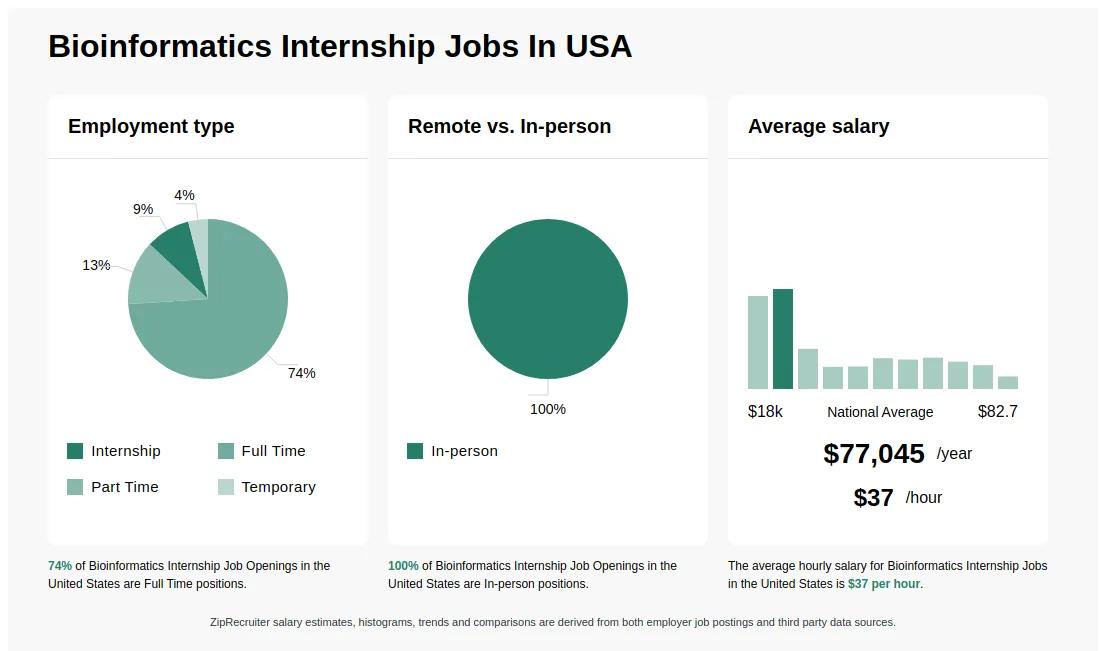
As of Sep 6, 2026, the average hourly pay for bioinformatics internship in the United States is $37.04, according to ZipRecruiter salary data. Most workers in this role earn between $16.11 and $56.25 per hour, depending on experience, location, and employer.

What is a bioinformatics internship?

A Bioinformatics Internship is a temporary position designed for students or recent graduates to gain hands-on experience in applying computational and statistical techniques to biological data. Interns typically work with large datasets, develop algorithms, analyze genomic sequences, and assist in research projects. They may use programming languages like Python or R and tools such as BLAST or Next-Generation Sequencing technologies. This internship provides valuable exposure to the intersection of biology, data science, and computer science, helping interns develop practical skills for careers in bioinformatics, biotechnology, or computational biology.

What are the typical responsibilities of a bioinformatics intern?

As a Bioinformatics Intern, you can expect to assist in analyzing large-scale biological datasets, support data management and curation efforts, and help maintain or develop computational pipelines. You may also contribute to writing reports, creating data visualizations, and presenting your findings to both technical and non-technical team members. Many internships offer opportunities to collaborate with scientists and researchers from different backgrounds, providing a well-rounded, hands-on learning experience. Your daily tasks will vary depending on the project, but there's a strong emphasis on problem-solving and applying computational methods to address biological questions.

What are the key skills and qualifications needed to thrive in a bioinformatics internship?

To thrive as a Bioinformatics Intern, you need a foundational understanding of biology, programming (often in Python or R), statistics, and data analysis, typically gained through coursework or related research experience. Familiarity with bioinformatics tools such as BLAST, genome browsers, and experience with databases like NCBI or Ensembl are commonly expected. Attention to detail, critical thinking, effective communication, and teamwork are valuable soft skills in this field. These qualities enable interns to interpret complex biological data accurately and collaborate efficiently within multidisciplinary research teams.

Is bioinformatics internship currently in demand?

Bioinformatics internships are in demand due to the growing need for data analysis in healthcare, genomics, and pharmaceutical research. Interns with skills in programming, data analysis, and familiarity with tools like Python, R, or Linux are sought after in research institutions and biotech companies.
More about Bioinformatics Internship jobs

What cities are hiring for Bioinformatics Internship jobs?

Cities with the most Bioinformatics Internship job openings:

What are the most commonly searched types of Bioinformatics jobs?

The most popular types of Bioinformatics jobs are:

What states have the most Bioinformatics Internship jobs?

States with the most job openings for Bioinformatics Internship jobs include:

Infographic showing various Bioinformatics Internship job openings in the United States as of August 2026, with employment types broken down into 80% Full Time, and 20% Part Time. Highlights an 80% In-person, and 20% Remote job distribution, with an average salary of $77,045 per year, or $37 per hour.

Industry Teaching Professor, Polymer Program

University of Oregon

Eugene, OR • On-site

$90 - $150/hr

Other

Medical, Retirement, PTO

Re-posted 9 days ago


University Of Oregon rating

7.4

Company rating: 7.4 out of 10

Based on 48 frontline employees who took The Breakroom Quiz

339th of 631 rated colleges and universities


Job description

Industry Teaching Professor, Polymer Program

Job no: 536872
Work type: Faculty - Career
Location: Eugene, OR
Categories: Research/Scientific/Grants

August 15, 2026; position open until filled

Department Summary

The Knight Campus for Accelerating Scientific Impact is an ambitious initiative designed to fast-track scientific discoveries into innovations that improve the quality of life for people in Oregon, the nation, and the world. The campus creates the intellectual infrastructure to establish Oregon as a center for both research and development, making Oregon a place where companies can start-up and grow. The Knight Campus is reshaping the higher education landscape in Oregon by training the next generations of scientists, forging tighter ties with industry and entrepreneurs, and creating new educational opportunities for graduate and undergraduate students. The Knight Campus supports a dynamic externally sponsored research portfolio, a diverse set of graduate academic programming, innovation and entrepreneurship initiatives and an active external affairs program.
The Knight Campus Graduate Internship Program trains students in the real-world knowledge and skills necessary to be successful in the industrial research laboratory - and at the interview table. We believe an advanced degree should help students land a job and prepare them for a successful career. The program currently has multiple tracks including Bioinformatics, Semiconductors, Optical Materials & Devices, Molecular Sensors and Biotechnology, and Polymer Science

Position Summary

A teaching professor in the Knight Campus Graduate Internship program teaches experiential courses with the goal of preparing students for entry-level positions in academic, industry, and government labs. Teaching professors teach students topics that span bioinformatics and genomics, materials science, statistics, chemistry, biochemistry, and chemical engineering in an experiential format.

  • PhD from an accredited higher education institution in Polymer science, chemical engineering, or related discipline.
  • Twelve years of industry experience in polymer science, materials science, chemical engineering, or related
  • Experience teaching and developing curriculum at the graduate level in industry applications in polymer science
  • Demonstrated strong interpersonal and communication skills.
  • Ability to implement active learning into teaching.
Preferred Qualifications
  • Experience with specialized approaches in materials science manufacturing
  • Publication record in materials science or related discipline

All offers of employment are contingent upon successful completion of a background check.

The University of Oregon is proud to offer a robust benefits package to eligible employees, including health insurance, retirement plans, and paid time off. For more information about benefits, visit our website .

The University of Oregon is an equal-opportunity institution committed to cultural diversity and compliance with the Americans with Disabilities Act. The University encourages all qualified individuals to apply and does not discriminate on the basis of any protected status, including veteran and disability status. The University is committed to providing reasonable accommodations to applicants and employees with disabilities. To request an accommodation in connection with the application process, please email us or call 541-346-5112.

UO prohibits discrimination on the basis of race, color, religion, national origin, sex, sexual orientation, gender identity, gender expression, pregnancy (including pregnancy-related conditions), age, physical or mental disability, genetic information (including family medical history), ancestry, familial status, citizenship, service in the uniformed services (as defined in federal and state law), veteran status, expunged juvenile record, and/or the use of leave protected by state or federal law in all programs, activities and employment practices as required by Title IX, other applicable laws, and policies. Retaliation is prohibited by UO policy. Questions may be referred to the Office of Equal Opportunity and Access. Contact information, related policies, and complaint procedures are listed here .

In compliance with federal law, the University of Oregon prepares an annual report on campus security and fire safety programs and services. The Annual Campus Security and Fire Safety Report is available online .

#J-18808-Ljbffr

What University Of Oregon employees say

Pay

Benefits

Hours and flexibility

Workplace

Get the full story on Breakroom