1

Bioinformatics Internship Jobs (NOW HIRING)

Duration of Internship: September 14, 2026 - December 14, 2026 Status: Non-benefited Hours: Less ... R&I Appl AI & Bioinformatics - 339 The Intern is utilized in various departments. ARUP's culture is ...

A link to code or a screenshot is welcome but not required. 5. Bioinformatics or data-science exposure Share any coursework, project, or internship where you worked with biological or clinical data ...

Science Intern

New York, NY ยท On-site

$17/hr

The Science Internship is a part-time and seasonal position that provides training opportunities ... or bioinformatics. This includes working in teams and participation in enrichment activities on ...

The Science Internship isa part-time and seasonal position that provides training opportunities for ... or bioinformatics. This includes working in teams and participation in enrichment activities on ...

$48K - $86K/yr

... bioinformatics approaches. * Prepares manuscripts for peer-reviewed publication and contributes to ... Trains and mentors undergraduate and graduate students, interns, and other research personnel in ...

Showing results 21-40

Bioinformatics Internship information

See salary details

$8

$37

$82

How much do bioinformatics internship jobs pay per hour?

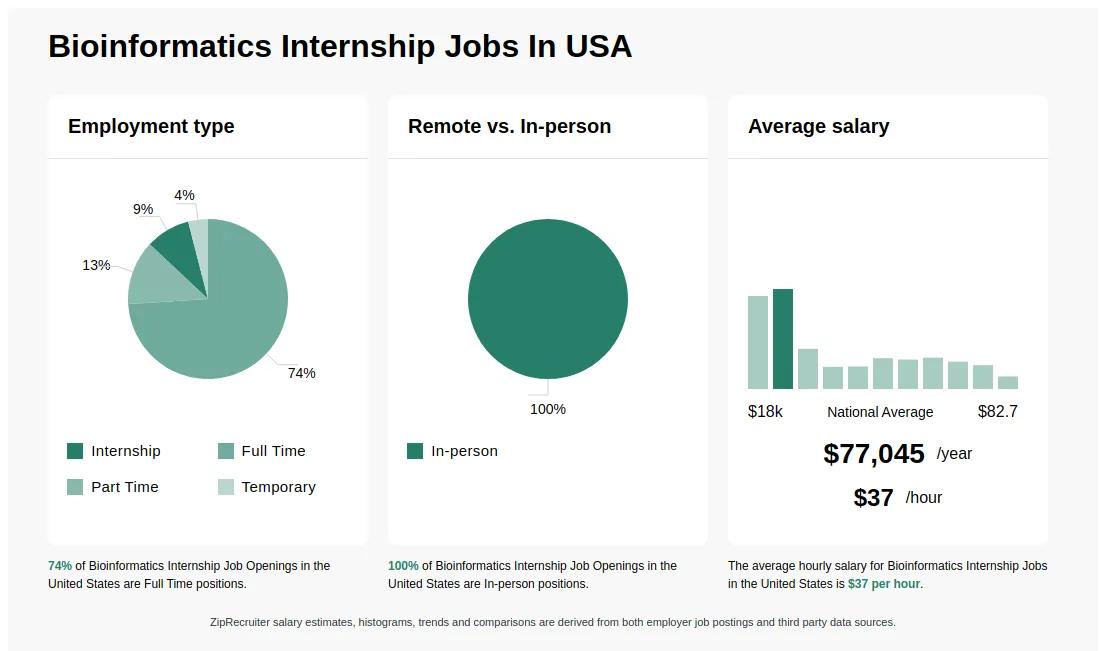
As of Sep 6, 2026, the average hourly pay for bioinformatics internship in the United States is $37.04, according to ZipRecruiter salary data. Most workers in this role earn between $16.11 and $56.25 per hour, depending on experience, location, and employer.

What is a bioinformatics internship?

A Bioinformatics Internship is a temporary position designed for students or recent graduates to gain hands-on experience in applying computational and statistical techniques to biological data. Interns typically work with large datasets, develop algorithms, analyze genomic sequences, and assist in research projects. They may use programming languages like Python or R and tools such as BLAST or Next-Generation Sequencing technologies. This internship provides valuable exposure to the intersection of biology, data science, and computer science, helping interns develop practical skills for careers in bioinformatics, biotechnology, or computational biology.

What are the typical responsibilities of a bioinformatics intern?

As a Bioinformatics Intern, you can expect to assist in analyzing large-scale biological datasets, support data management and curation efforts, and help maintain or develop computational pipelines. You may also contribute to writing reports, creating data visualizations, and presenting your findings to both technical and non-technical team members. Many internships offer opportunities to collaborate with scientists and researchers from different backgrounds, providing a well-rounded, hands-on learning experience. Your daily tasks will vary depending on the project, but there's a strong emphasis on problem-solving and applying computational methods to address biological questions.

What are the key skills and qualifications needed to thrive in a bioinformatics internship?

To thrive as a Bioinformatics Intern, you need a foundational understanding of biology, programming (often in Python or R), statistics, and data analysis, typically gained through coursework or related research experience. Familiarity with bioinformatics tools such as BLAST, genome browsers, and experience with databases like NCBI or Ensembl are commonly expected. Attention to detail, critical thinking, effective communication, and teamwork are valuable soft skills in this field. These qualities enable interns to interpret complex biological data accurately and collaborate efficiently within multidisciplinary research teams.

Is bioinformatics internship currently in demand?

Bioinformatics internships are in demand due to the growing need for data analysis in healthcare, genomics, and pharmaceutical research. Interns with skills in programming, data analysis, and familiarity with tools like Python, R, or Linux are sought after in research institutions and biotech companies.
More about Bioinformatics Internship jobs

What cities are hiring for Bioinformatics Internship jobs?

Cities with the most Bioinformatics Internship job openings:

What are the most commonly searched types of Bioinformatics jobs?

The most popular types of Bioinformatics jobs are:

What states have the most Bioinformatics Internship jobs?

States with the most job openings for Bioinformatics Internship jobs include:

Infographic showing various Bioinformatics Internship job openings in the United States as of August 2026, with employment types broken down into 80% Full Time, and 20% Part Time. Highlights an 80% In-person, and 20% Remote job distribution, with an average salary of $77,045 per year, or $37 per hour.

Intern - Applied AI & Data Science

ARUP

Salt Lake City, UT โ€ข On-site

$20/hr

Internship

Posted 10 days ago


Job description

Schedule:
Duration of Internship: September 14, 2026 - December 14, 2026
Status: Non-benefited
Hours: Less than 29 hours per week
Days: Monday - Friday, flexible based on intern availability

Department: R&I Appl AI & Bioinformatics - 339

The Intern is utilized in various departments. ARUP's culture is one of caring for both the patient and its employees.

About the Supervisor:

Brendan O’Fallon, PhD., is the Bioinformatics Director at ARUP, and oversees the Applied AI (AAI) team.  The team works on machine learning and AI projects in digital pathology, flow cytometry, next generation sequencing, and clinical lab informatics.

Internship Description:

Projects that fit the skills and goals of the intern will be identified at the beginning of the internship, but will likely include exploratory data analysis, training machine learning or deep learning algorithms, or developing AI agents. The intern will work closely with a senior data scientist mentor, and will attend weekly meetings and standups.  At the end of the internship the final product or analysis will be presented to other data scientists, medical directors, and scientists from across the company.

Internship Goals

  • Develop proficiency with python data analysis tools
  • Refine data visualization skills
  • Become familiar with development of AI (LLM-based) agents
  • Learn basic concepts of laboratory information science

Knowledge, Skills & Techniques Learned from Internship:

Agentic Workflows

Data Science in Laboratory Medicine

LLM validation and QC

Basics of genomics, hematopathology, and/or digital pathology

Data visualization and written communication of scientific concepts

Measurement of New Skills:

Intern will be asked to present project to suitable user group at the end of the internship, including data scientists, MDs, laboratory staff, or other groups as relevant to the project.

About ARUP:
ARUP Laboratories is a national clinical and anatomic pathology reference laboratory and an enterprise of the University of Utah and its Department of Pathology. Based in Salt Lake City, Utah.
ARUP proudly hires top talent to create a work environment of diversity, professional growth and continuous development. Our workforce is committed to the important service we provide to over one million patients each month. We always strive for excellence and have a strong desire to have involvement with the advances in medicine and the role laboratory services plays within each patient’s life. We never forget that there is a patient behind every specimen we receive.
We are looking for individuals who want to contribute to ARUP's culture of accountability, integrity, service, and excellence. Consider joining our dynamic team.

Physical and Other Requirements:
Stooping: Bending body downward and forward by bending spine at the waist.
Reaching: Extending hand(s) and arm(s) in any direction.
Mobility: The person in this position needs to occasionally move between work sites and inside the office to access file cabinets, office machinery, etc.
Communicate: Frequently and effectively communicate with others.
PPE: Biohazard laboratory environment that requires use of personal protective equipment in accordance with CDC and OSHA regulations and company policies.
ARUP Policies and Procedures: To conduct self in compliance with all ARUP Policies and Procedures.
Sedentary Work: Exerting up to 10 pounds of force occasionally and/or negligible amount of force frequently or constantly to lift, carry, push, pull or otherwise move objects, including the human body.
Fine Motor Control: Picking, pinching, typing or otherwise working, primarily with fingers rather than with the whole hand as in handling.
Vision: Having close, far, and peripheral visual acuity to perform a variety of tasks such as make general observations of depth and distance.