BCBA
$65 - $85/hr
... with autism spectrum disorder. Join us and become part of a supportive team that values ... We focus on your journey as a BCBA, not just your caseload. * Mentorship Programs : Tailored ...
Quick apply
$65 - $85/hr
... with autism spectrum disorder. Join us and become part of a supportive team that values ... We focus on your journey as a BCBA, not just your caseload. * Mentorship Programs : Tailored ...
Quick apply
$65 - $85/hr
... with autism spectrum disorder. Join us and become part of a supportive team that values ... We focus on your journey as a BCBA, not just your caseload. * Mentorship Programs : Tailored ...
$65 - $85/hr
... with autism spectrum disorder. Join us and become part of a supportive team that values ... We focus on your journey as a BCBA, not just your caseload. * Mentorship Programs : Tailored ...
Quick apply
$65 - $85/hr
... with autism spectrum disorder. Join us and become part of a supportive team that values ... We focus on your journey as a BCBA, not just your caseload. * Mentorship Programs : Tailored ...
Denver, CO · On-site +1
$65 - $85/hr
... with autism spectrum disorder. Join us and become part of a supportive team that values ... We focus on your journey as a BCBA, not just your caseload. * Mentorship Programs : Tailored ...
Quick apply
Denver, CO · On-site +1
$65 - $85/hr
... with autism spectrum disorder. Join us and become part of a supportive team that values ... We focus on your journey as a BCBA, not just your caseload. * Mentorship Programs : Tailored ...
Manhattan, NY · On-site +1
$75 - $100/hr
... with autism spectrum disorder. Join us and become part of a supportive team that values ... We focus on your journey as a BCBA, not just your caseload. * Mentorship Programs : Tailored ...
Quick apply
Manhattan, NY · On-site +1
$75 - $100/hr
... with autism spectrum disorder. Join us and become part of a supportive team that values ... We focus on your journey as a BCBA, not just your caseload. * Mentorship Programs : Tailored ...
Westchester, NY · On-site +1
$75 - $100/hr
... with autism spectrum disorder. Join us and become part of a supportive team that values ... We focus on your journey as a BCBA, not just your caseload. * Mentorship Programs : Tailored ...
Quick apply
Westchester, NY · On-site +1
$75 - $100/hr
... with autism spectrum disorder. Join us and become part of a supportive team that values ... We focus on your journey as a BCBA, not just your caseload. * Mentorship Programs : Tailored ...
Staten Island, NY · On-site +1
$75 - $100/hr
... with autism spectrum disorder. Join us and become part of a supportive team that values ... We focus on your journey as a BCBA, not just your caseload. * Mentorship Programs : Tailored ...
Quick apply
Staten Island, NY · On-site +1
$75 - $100/hr
... with autism spectrum disorder. Join us and become part of a supportive team that values ... We focus on your journey as a BCBA, not just your caseload. * Mentorship Programs : Tailored ...
Brooklyn, NY · On-site +1
$75 - $100/hr
... with autism spectrum disorder. Join us and become part of a supportive team that values ... We focus on your journey as a BCBA, not just your caseload. * Mentorship Programs : Tailored ...
Quick apply
Brooklyn, NY · On-site +1
$75 - $100/hr
... with autism spectrum disorder. Join us and become part of a supportive team that values ... We focus on your journey as a BCBA, not just your caseload. * Mentorship Programs : Tailored ...
Queens, NY · On-site +1
$75 - $100/hr
... with autism spectrum disorder. Join us and become part of a supportive team that values ... We focus on your journey as a BCBA, not just your caseload. * Mentorship Programs : Tailored ...
Quick apply
Queens, NY · On-site +1
$75 - $100/hr
... with autism spectrum disorder. Join us and become part of a supportive team that values ... We focus on your journey as a BCBA, not just your caseload. * Mentorship Programs : Tailored ...
Saint Louis, MO · On-site
$75K - $85K/yr
This includes, but is not limited to, monthly summaries, progress notes, data collection ... Requirements Requirements We are looking for a BCBA - Autism Services who: * Has experience and ...
Saint Louis, MO · On-site
$75K - $85K/yr
This includes, but is not limited to, monthly summaries, progress notes, data collection ... Requirements Requirements We are looking for a BCBA - Autism Services who: * Has experience and ...
Saint Louis, MO · On-site
$75K - $85K/yr
This includes, but is not limited to, monthly summaries, progress notes, data collection ... Requirements Requirements We are looking for a BCBA - Autism Services who: * Has experience and ...
Saint Louis, MO · On-site
$75K - $85K/yr
This includes, but is not limited to, monthly summaries, progress notes, data collection ... Requirements Requirements We are looking for a BCBA - Autism Services who: * Has experience and ...
Staten Island, NY · On-site +1
$75 - $100/hr
... with autism spectrum disorder. Join us and become part of a supportive team that values ... We focus on your journey as a BCBA, not just your caseload. * Mentorship Programs : Tailored ...
Quick apply
Staten Island, NY · On-site +1
$75 - $100/hr
... with autism spectrum disorder. Join us and become part of a supportive team that values ... We focus on your journey as a BCBA, not just your caseload. * Mentorship Programs : Tailored ...
New York, NY · On-site +1
$75 - $100/hr
... with autism spectrum disorder. Join us and become part of a supportive team that values ... We focus on your journey as a BCBA, not just your caseload. * Mentorship Programs : Tailored ...
Quick apply
New York, NY · On-site +1
$75 - $100/hr
... with autism spectrum disorder. Join us and become part of a supportive team that values ... We focus on your journey as a BCBA, not just your caseload. * Mentorship Programs : Tailored ...
Manhattan, NY · On-site
$110.21 - $137.76/hr
... with autism spectrum disorder. Join us and become part of a supportive team that values ... We focus on your journey as a BCBA, not just your caseload. * Mentorship Programs : Tailored ...
Manhattan, NY · On-site
$110.21 - $137.76/hr
... with autism spectrum disorder. Join us and become part of a supportive team that values ... We focus on your journey as a BCBA, not just your caseload. * Mentorship Programs : Tailored ...
Far Rockaway, NY · On-site +1
$75 - $100/hr
... with autism spectrum disorder. Join us and become part of a supportive team that values ... We focus on your journey as a BCBA, not just your caseload. * Mentorship Programs : Tailored ...
Quick apply
Far Rockaway, NY · On-site +1
$75 - $100/hr
... with autism spectrum disorder. Join us and become part of a supportive team that values ... We focus on your journey as a BCBA, not just your caseload. * Mentorship Programs : Tailored ...
Bronx, NY · On-site +1
$75 - $100/hr
... with autism spectrum disorder. Join us and become part of a supportive team that values ... We focus on your journey as a BCBA, not just your caseload. * Mentorship Programs : Tailored ...
Quick apply
Bronx, NY · On-site +1
$75 - $100/hr
... with autism spectrum disorder. Join us and become part of a supportive team that values ... We focus on your journey as a BCBA, not just your caseload. * Mentorship Programs : Tailored ...
Raleigh, NC · On-site
$85 - $115/hr
Your forever BCBA career begins now at Bloomwell Autism Therapy. We're not just shaping behavior; we're nurturing potential for everyone involved. Join us as we focus on the whole-human experience ...
Raleigh, NC · On-site
$85 - $115/hr
Your forever BCBA career begins now at Bloomwell Autism Therapy. We're not just shaping behavior; we're nurturing potential for everyone involved. Join us as we focus on the whole-human experience ...
New York, NY · On-site +1
$75 - $90/hr
... with autism spectrum disorder. Join us and become part of a supportive team that values ... We focus on your journey as a BCBA, not just your caseload. * Mentorship Programs : Tailored ...
Quick apply
New York, NY · On-site +1
$75 - $90/hr
... with autism spectrum disorder. Join us and become part of a supportive team that values ... We focus on your journey as a BCBA, not just your caseload. * Mentorship Programs : Tailored ...
Atlanta, GA · On-site
$85K - $110K/yr
At Atlanta Autism Center (AAC), we provide 100% center-based, early diagnostic and therapy services ... BCBAs performance based on Clinical Quality, not billable hours * POD based, with scheduled ...
Atlanta, GA · On-site
$85K - $110K/yr
At Atlanta Autism Center (AAC), we provide 100% center-based, early diagnostic and therapy services ... BCBAs performance based on Clinical Quality, not billable hours * POD based, with scheduled ...
$85K - $122K/yr
At Atlanta Autism Center (AAC), we provide 100% center-based, early diagnostic and therapy services ... BCBAs performance based on Clinical Quality, not billable hours * POD based, with scheduled ...
$85K - $122K/yr
At Atlanta Autism Center (AAC), we provide 100% center-based, early diagnostic and therapy services ... BCBAs performance based on Clinical Quality, not billable hours * POD based, with scheduled ...
Phoenix, AZ · On-site
$73K - $89K/yr
Early Intervention BCBA - Life Skills Autism Academy (Center-Based) Arizona, United States; Phoenix ... Clinical Quality First - We prioritize outcomes, not billables. Our proprietary CareConnect ...
Phoenix, AZ · On-site
$73K - $89K/yr
Early Intervention BCBA - Life Skills Autism Academy (Center-Based) Arizona, United States; Phoenix ... Clinical Quality First - We prioritize outcomes, not billables. Our proprietary CareConnect ...
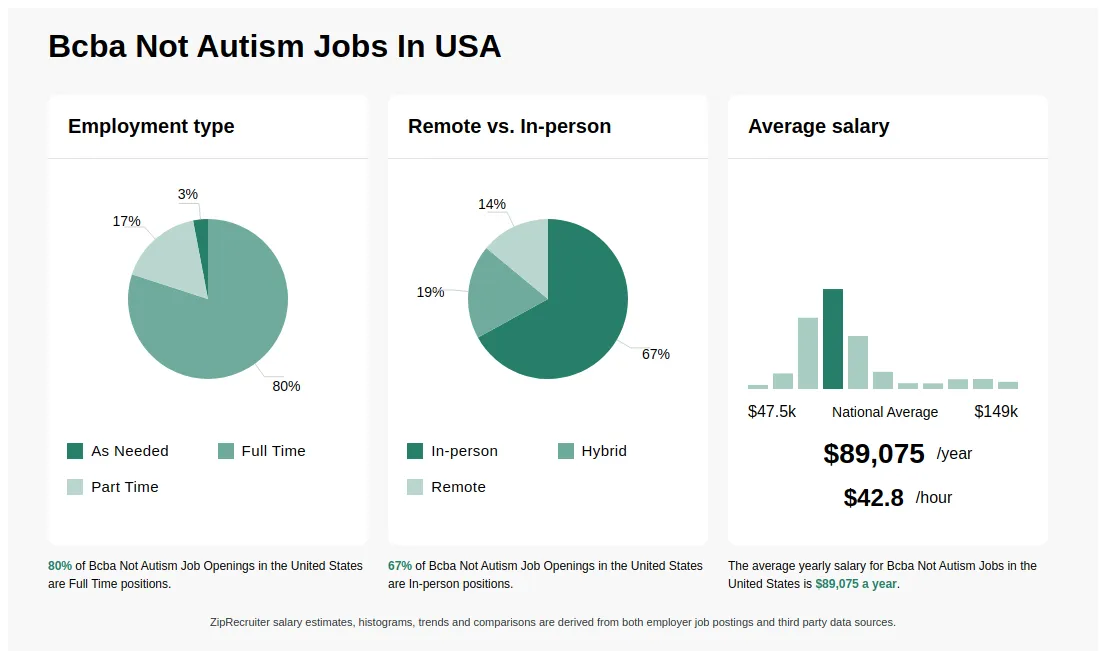
$47.5K - $56.7K
1% of jobs
$56.7K - $66K
5% of jobs
$73K is the 25th percentile. Wages below this are outliers.
$66K - $75.2K
24% of jobs
The median wage is $80.2K / yr.
$75.2K - $84.4K
35% of jobs
$89K is the 75th percentile. Wages above this are outliers.
$84.4K - $93.6K
18% of jobs
$93.6K - $102.9K
5% of jobs
$102.9K - $112.1K
1% of jobs
$112.1K - $121.3K
1% of jobs
$121.3K - $130.5K
3% of jobs
$130.5K - $139.8K
3% of jobs
$139.8K - $149K
2% of jobs
$47.5K
$89.1K
$149K
A BCBA (Board Certified Behavior Analyst) not focused on autism applies behavioral principles in various settings beyond autism therapy. They may work in schools, mental health facilities, businesses, sports psychology, or with individuals with developmental disabilities, brain injuries, or behavioral challenges. These professionals design and implement behavior intervention plans to improve skills, increase independence, and enhance overall quality of life. Their work can include organizational behavior management, addiction treatment, rehabilitation, and social skills training.
BCBAs can apply their skills in a variety of environments beyond autism services, including mental health facilities, schools with students who have behavioral or emotional challenges, organizations focusing on substance abuse treatment, and workplaces aiming to improve employee performance and safety. In these roles, BCBAs may work with individuals or groups to assess behaviors, develop intervention plans, and train staff or caregivers. The daily responsibilities often involve conducting behavioral assessments, analyzing data, implementing customized behavior intervention plans, and monitoring progress. Collaboration with psychologists, educators, social workers, and other professionals is common, allowing BCBAs to provide holistic support tailored to diverse client needs.
To thrive as a BCBA in non-autism settings, you need expertise in applied behavior analysis (ABA), data-driven decision making, and relevant licensure or certification as a Board Certified Behavior Analyst. Familiarity with behavior assessment tools, treatment planning software, and documentation systems is crucial. Strong interpersonal skills, problem-solving ability, and flexibility help you collaborate effectively with clients and multidisciplinary teams. These competencies enable BCBAs to address complex behavioral challenges and drive positive outcomes across diverse populations and environments.
Cities with the most Bcba Not Autism job openings:
The most popular types of Bcba Not Autism jobs are:
States with the most job openings for Bcba Not Autism jobs include:
The top searched job categories for Bcba Not Autism jobs are:
$65 - $85/hr
Other
Medical, Dental, Vision, Retirement, PTO
Re-posted 2 days ago
Board Certified Behavior Analyst (BCBA) Opportunity - In Person
Join Our Growing Team at United Care ABA!
At United Care ABA, we’re more than just a company—we’re a community. We are actively seeking Board Certified Behavior Analysts (BCBA) to join our expanding team. As a new and innovative company, we focus on providing exceptional ABA services for children with autism spectrum disorder. Join us and become part of a supportive team that values collaboration, professional development, and high-quality, ethical care for both clients and providers.
Why United Care ABA?
At United Care ABA, you’ll feel seen and heard. We’re building a workplace where your insights and ideas as a BCBA are valued, in an environment that fosters professional growth. Here’s what we offer:
Ongoing BCBA Cafés: Connect with colleagues, decompress, and share insights.
BCBA Spotlights: We focus on your journey as a BCBA, not just your caseload.
Mentorship Programs: Tailored support to help you grow, with guidance from experienced BCBAs.
Ongoing Training & Support: From onboarding to regular check-ins, we’re committed to your success.
What We Offer to Board Certified Behavior Analysts (BCBA):
Flexible Scheduling & Work Locations: Choose a schedule that works for you, with part-time, full-time, hybrid, and remote positions. Work remotely, in clients' homes, or in center-based locations.
Competitive Compensation: Pay ranging from $65 - $85 per hour depending on experience, with bonus opportunities.
Comprehensive Benefits: Medical, dental, vision, and 401(k) (for full-time employees).
Bonuses: Annual and quarterly bonuses based on time spent servicing clients.
Paid Time Off: Vacation and sick leave to recharge.
Professional Development: Free CEUs and opportunities to grow with a supportive, innovative team.
Ongoing Support: Mentorship and regular check-ins to ensure you’re always supported in your role.
What We’re Looking for in a Board Certified Behavior Analyst (BCBA):
BCBA certification (required in your state, or you must be sitting for your exam within the next 3 months).
Master’s degree in Applied Behavior Analysis or related field (e.g., psychology, education, social work).
Experience in ABA (1+ years preferred, but we welcome those just starting out as a BCBA).
Strong leadership and communication skills, with a passion for making a meaningful difference in children's lives.
A collaborative mindset—excited to be part of a growing team and value professional support and connection.
Board Certified Behavior Analyst (BCBA) Duties and Responsibilities:
Develop, implement, and oversee individualized ABA treatment plans for clients.
Supervise RBTs and other support staff, providing them with the tools and training they need.
Conduct assessments (e.g., Functional Behavior Assessments, preference assessments) and update treatment goals.
Collaborate with parents to provide training and integrate goals into daily routines.
Coordinate care with other professionals to ensure maximum progress for our clients.
Ensure ethical and regulatory compliance in all service delivery aspects.
Work with both remote and in-home/center-based service delivery options.
Participate in clinical quality assurance reviews and regular check-ins with clinical supervisors.
Why You Should Join Us:
As a rapidly growing company expanding across multiple states, we’re focused on creating a supportive, connected environment for BCBAs. We understand the challenges in this field and are committed to doing things the right way—with high standards for care, respect for our team, and a focus on professional growth. Whether you’re an experienced BCBA or a recent graduate, we offer a unique opportunity to be part of something bigger—a place where your skills will be respected, your growth nurtured, and your voice heard.
Ready to Make a Difference?
Take the next step and make a meaningful difference as a Board Certified Behavior Analyst (BCBA)—apply today!
Work Available In: Denver, Boulder, Colorado Springs
https://unitedcareaba.com/
https://www.linkedin.com/company/united-care-aba/?