1

Baseball Data Analyst Jobs (NOW HIRING)

Intern, Data Science

Seattle, WA ยท On-site

$23/hr

... baseball-related data science, including statistical modeling, research, visualizations, and other projects. Essential Functions: โ€ข Statistical modeling and analysis of a variety of data sources ...

Analyze video and tag relevant data utilizing internal systems. Qualifications and Experience: * Proficiency in Microsoft Office. * Strong foundational knowledge of baseball. * Availability to work a ...

JV Baseball Coach

New Kent, VA ยท On-site

$3.5K/wk

The primary function of the JV Baseball Coach is to assist in developing and implementing an ... analyzing written or computer data and observing general surroundings and activities; work ...

New

Assistant Baseball Coach

Orange, NJ ยท On-site

$40K - $55K/yr

Assistant Baseball Coach Job no: 497484 Full time/Part time: Full-time Location: South Orange ... analyze complex data for recruiting purposes from databases such as the student data warehouse ...

Support video, data, and technology management and operation. * Provide strategic and logistical ... Analytical Thinking: Develop a strong knowledge of modern baseball metrics, development practices ...

New

Showing results 21-40

Baseball Data Analyst information

See salary details

$34K

$82.6K

$136K

How much do baseball data analyst jobs pay per year?

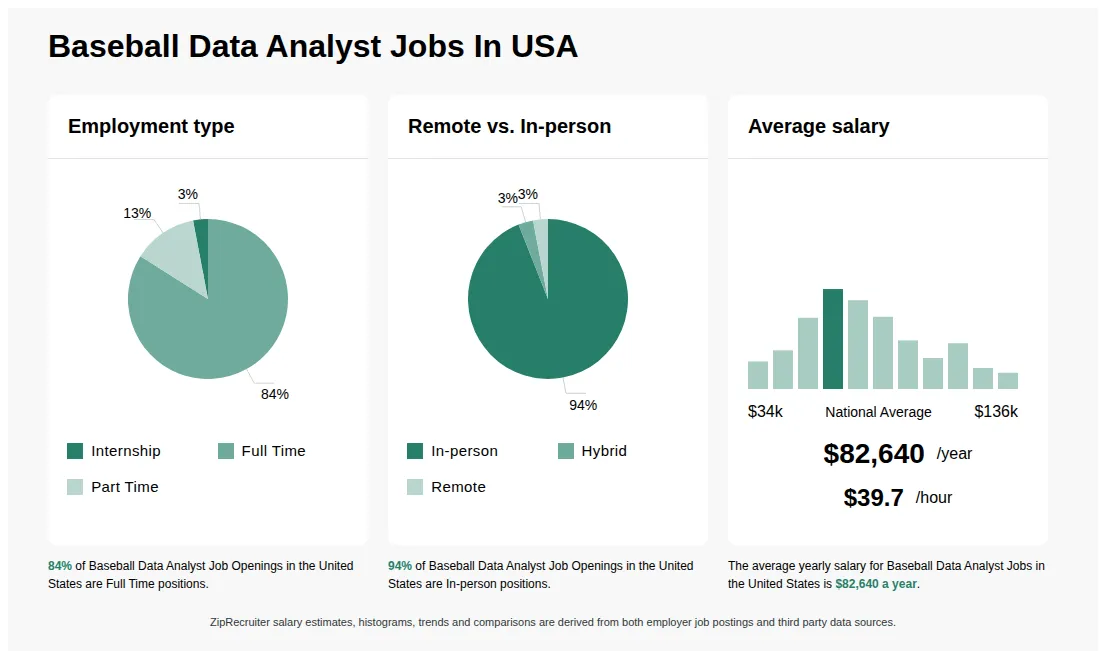
As of Sep 4, 2026, the average yearly pay for baseball data analyst in the United States is $82,640.00, according to ZipRecruiter salary data. Most workers in this role earn between $62,500.00 and $97,000.00 per year, depending on experience, location, and employer.

What is a baseball data analyst?

A Baseball Data Analyst is a professional who uses statistical methods and data modeling to evaluate player performance, team strategies, and game outcomes in baseball. They collect and analyze data from games, practices, and scouting reports to provide insights that can help teams make informed decisions. Their work might include creating predictive models, visualizing trends, and presenting findings to coaches, managers, or front office staff. Baseball Data Analysts play a key role in player recruitment, development, and in-game strategy. They typically have a background in statistics, mathematics, or computer science, often paired with a deep understanding of baseball.

What does a baseball data analyst do?

As a baseball data analyst, your primary responsibilities are to gather baseball statistics, provide analysis, and report the results to understand frameworks for players and develop a model. Your duties may involve using advanced statistical methods, completing data mining, designing and testing predictive models, creating tools, integrating data, and executing SQL databases. You work with sabermetrics and other analytical software to evaluate the performance of players during games throughout the season and interpret that information to assist teams with player decisions. Baseball data analysts work for the MLB as well as collegiate teams.

What are the key skills and qualifications needed to thrive as a baseball data analyst, and why are they important?

To thrive as a Baseball Data Analyst, you need strong quantitative analysis skills, a background in statistics or mathematics, and a solid understanding of baseball fundamentals. Proficiency with data analysis tools such as R, Python, SQL, and experience using baseball-specific data platforms like TrackMan or Statcast are typically required. Exceptional attention to detail, effective communication, and the ability to work collaboratively with coaches and players make someone stand out in this role. These skills and qualities are crucial for accurately interpreting data, informing strategic decisions, and maximizing team performance.

How does a baseball data analyst typically collaborate with coaches and players to improve team performance?

Baseball Data Analysts work closely with coaches and players by translating complex data into actionable insights that can impact game strategy and player development. They often present statistical findings in clear, visual formats to help coaches make informed decisions about lineups, defensive positioning, and in-game tactics. Regular meetings and open communication ensure that data-driven recommendations are understood and integrated into training sessions and game plans. This collaboration fosters a culture of continuous improvement and innovation within the team.

What cities are hiring for Baseball Data Analyst jobs?

Cities with the most Baseball Data Analyst job openings:

What are the most commonly searched types of Baseball Data Analyst jobs?

The most popular types of Baseball Data Analyst jobs are:

Who are the top companies hiring for Baseball Data Analyst jobs?

The top employers for Baseball Data Analyst jobs are:

What states have the most Baseball Data Analyst jobs?

States with the most job openings for Baseball Data Analyst jobs include:

Infographic showing various Baseball Data Analyst job openings in the United States as of August 2026, with employment types broken down into 1% As Needed, 85% Full Time, 11% Part Time, and 3% Contract. Highlights an 86% Physical, 3% Hybrid, and 11% Remote job distribution, with an average salary of $82,640 per year, or $39.7 per hour.

Senior Software Engineer, Research & Development

Houston Astros

Houston, TX โ€ข On-site

$116K - $154K/yr

Full-time

Re-posted 2 days ago


Job description

Department: Research & Development
Reports to: Assistant Director of Development, Research & Development
Classification: Full-Time/Exempt
Location: Houston, TX
Summary/Objective:
The Houston Astros are seeking a Senior Software Engineer to join our Software Development team within the Research and Development department. This role is ideal for a seasoned developer who thrives in a collaborative, fast-paced environment and is interested in building scalable, maintainable systems that directly impact baseball decision-making.
You'll work across the full stack-from ingesting and transforming data to building intuitive front-end applications and compelling data visualizations. You'll help shape frontend architecture decisions, modernize legacy systems, and champion engineering excellence across the department.
Essential Functions & Responsibilities:
Reasonable accommodations may be made to enable individuals with disabilities to perform the essential functions.
  • Design, build, and maintain full-stack applications that support Baseball Operations, with an emphasis on responsive and intuitive frontend experiences.
    • Architect and implement scalable frontend systems, establishing patterns, component libraries, and standards that support long-term maintainability.
    • Design and develop interactive data visualizations and dashboards that translate complex baseball data into clear, actionable insights for decision-makers.
    • Build scalable, automated systems with longevity and maintainability in mind.
  • Modernize legacy codebases and frontend interfaces while ensuring continuity of critical systems.
  • Ensure adherence to best practices in software development, including code reviews, testing, continuous integration, and documentation.
  • Serve as a technical leader and mentor in frontend and data visualization best practices, while remaining hands-on as an individual contributor.
  • Collaborate closely with analysts, data scientists, and baseball operations staff to understand data needs and deliver effective visualization solutions.
  • Participate in a rotating on-call schedule to address any urgent issues with our software systems.
  • Perform other duties as assigned.

Qualifications:
  • 5+ years of professional software engineering experience.
  • Strong proficiency in at least one modern frontend framework (e.g. React, Vue, Svelte).
  • Experience building data visualizations using libraries such as D3.js, Layer Cake, or Plotly.
  • Solid understanding of frontend architecture patterns, including component design and state management.
  • Experience with relational databases and writing complex SQL queries.
  • Proven experience maintaining, refactoring, and modernizing legacy codebases.
  • Familiarity with CI/CD pipelines and version control (Git).
  • Strong communication skills with the ability to translate technical concepts for non-technical stakeholders.
  • Experience working with sports data is a plus.

Work Environment
This position operates primarily in an office and stadium environment. The noise level is generally moderate but can increase significantly during events, ranging from low to very loud depending on crowd size and stadium activity. This role routinely uses standard office equipment such as computers, phones, and printers.
Physical Demands
While performing the duties of this job, the employee is occasionally required to stand; walk; sit (for long periods of time); use hands to handle or feel objects, tools or controls; reach with hands and arms; climb stairs; talk or hear. The employee may occasionally lift or move equipment, up to 20 pounds. Specific vision abilities required by this job include close and focused vision.
Position Type and Expected Hours of Work
Ability to work a flexible schedule, including; extended hours, evenings, weekends, and holidays.
Travel
Some travel may be expected in this role.
Other Duties
Please note this job description is not designed to cover or contain a comprehensive listing of activities, duties or responsibilities that are required of the employee for this job. Duties, responsibilities and activities may change at any time with or without notice.
We are an equal opportunity employer and all qualified applicants will receive consideration for employment without regard to race, color, religion, sex, national origin, disability status, protected veteran status, or any other characteristic protected by law.
EOE/M/F/Vet/Disability
Equal Opportunity Employer
This employer is required to notify all applicants of their rights pursuant to federal employment laws.
For further information, please review the Know Your Rights notice from the Department of Labor.