Fraud Investigator
Boston, MA · On-site
$52K - $90K/yr
Fraud Investigations Manager Status: Exempt Grade: 9E Pay Range: $52,000-$90,498 Actual ... Beacon Bank is an Equal Opportunity Employer - all qualified applicants will receive consideration ...
Boston, MA · On-site
$52K - $90K/yr
Fraud Investigations Manager Status: Exempt Grade: 9E Pay Range: $52,000-$90,498 Actual ... Beacon Bank is an Equal Opportunity Employer - all qualified applicants will receive consideration ...
Boston, MA · On-site
$52K - $90K/yr
Fraud Investigations Manager Status: Exempt Grade: 9E Pay Range: $52,000-$90,498 Actual ... Beacon Bank is an Equal Opportunity Employer - all qualified applicants will receive consideration ...
Boston, MA · On-site
$52K - $90K/yr
Fraud Investigations Manager Status: Exempt Grade: 9E Pay Range: $52,000-$90,498 Actual ... Beacon Bank is an Equal Opportunity Employer - all qualified applicants will receive consideration ...
Boston, MA · On-site
$52K - $90K/yr
Fraud Investigations Manager Status: Exempt Grade: 9E Pay Range: $52,000-$90,498 Actual ... Beacon Bank is an Equal Opportunity Employer - all qualified applicants will receive consideration ...
L1 - Fraud Investigator Experience Required: 3+ years Descriptions: Location: Milford, Ohio - Need ... Compliance & Risk Management • Ensure compliance with: o Bank Secrecy Act (BSA) o Anti-Money ...
L1 - Fraud Investigator Experience Required: 3+ years Descriptions: Location: Milford, Ohio - Need ... Compliance & Risk Management • Ensure compliance with: o Bank Secrecy Act (BSA) o Anti-Money ...
Greenville, SC · On-site
$19.10/hr
The Fraud Investigator I plays a key role in protecting the bank and its customers from financial loss by investigating fraud claims and suspicious activity across deposit, payment, card, and digital ...
Greenville, SC · On-site
$19.10/hr
The Fraud Investigator I plays a key role in protecting the bank and its customers from financial loss by investigating fraud claims and suspicious activity across deposit, payment, card, and digital ...
Greenville, SC · On-site
Overview The Fraud Investigator I plays a key role in protecting the bank and its customers from financial loss by investigating fraud claims and suspicious activity across deposit, payment, card ...
Greenville, SC · On-site
Overview The Fraud Investigator I plays a key role in protecting the bank and its customers from financial loss by investigating fraud claims and suspicious activity across deposit, payment, card ...
Greenville, SC · On-site
$19.10 - $28.52/hr
Overview The Fraud Investigator I plays a key role in protecting the bank and its customers from financial loss by investigating fraud claims and suspicious activity across deposit, payment, card ...
Greenville, SC · On-site
$19.10 - $28.52/hr
Overview The Fraud Investigator I plays a key role in protecting the bank and its customers from financial loss by investigating fraud claims and suspicious activity across deposit, payment, card ...
Education and/or Experience * BS/BA Degree (4 year) from an accredited university /college * 5+ years' experience in bank fraud management * 2+ years of experience conducting internal investigations ...
Education and/or Experience * BS/BA Degree (4 year) from an accredited university /college * 5+ years' experience in bank fraud management * 2+ years of experience conducting internal investigations ...
Nashville, TN · On-site
$19 - $24/hr
Experience working in a bank, credit union, or financial institution * Knowledge of fraud prevention and loss mitigation practices * Familiarity with debit card disputes and fraud investigations
Nashville, TN · On-site
$19 - $24/hr
Experience working in a bank, credit union, or financial institution * Knowledge of fraud prevention and loss mitigation practices * Familiarity with debit card disputes and fraud investigations
Nashville, TN · On-site
Experience working in a bank, credit union, or financial institution * Knowledge of fraud prevention and loss mitigation practices * Familiarity with debit card disputes and fraud investigations
Nashville, TN · On-site
Experience working in a bank, credit union, or financial institution * Knowledge of fraud prevention and loss mitigation practices * Familiarity with debit card disputes and fraud investigations
Education and/or Experience * BS/BA Degree (4 year) from an accredited university /college * 5+ years' experience in bank fraud management * 2+ years of experience conducting internal investigations ...
Education and/or Experience * BS/BA Degree (4 year) from an accredited university /college * 5+ years' experience in bank fraud management * 2+ years of experience conducting internal investigations ...
Silver Spring, MD · Hybrid
$69K - $108K/yr
Responsibilities The Fraud Investigator develops and conducts fraud investigations, monitors and ... Working knowledge of banking products such as checking accounts, wire transfer, ACH, credit/debit ...
Silver Spring, MD · Hybrid
$69K - $108K/yr
Responsibilities The Fraud Investigator develops and conducts fraud investigations, monitors and ... Working knowledge of banking products such as checking accounts, wire transfer, ACH, credit/debit ...
Silver Spring, MD · On-site
$69K - $108K/yr
Responsibilities The Fraud Investigator develops and conducts fraud investigations, monitors and ... Working knowledge of banking products such as checking accounts, wire transfer, ACH, credit/debit ...
Silver Spring, MD · On-site
$69K - $108K/yr
Responsibilities The Fraud Investigator develops and conducts fraud investigations, monitors and ... Working knowledge of banking products such as checking accounts, wire transfer, ACH, credit/debit ...
Rocky Mount, NC · On-site
Our Fraud Investigators play a critical role in identifying suspicious activity, investigating ... You'll have opportunities to develop your expertise within a growing fintech and banking ...
Rocky Mount, NC · On-site
Our Fraud Investigators play a critical role in identifying suspicious activity, investigating ... You'll have opportunities to develop your expertise within a growing fintech and banking ...
Nashville, TN · On-site
$19 - $24/hr
... bank, credit union, or financial institutionKnowledge of fraud prevention and loss mitigation practicesFamiliarity with debit card disputes and fraud investigationsUnderstanding of financial ...
Quick apply
Nashville, TN · On-site
$19 - $24/hr
... bank, credit union, or financial institutionKnowledge of fraud prevention and loss mitigation practicesFamiliarity with debit card disputes and fraud investigationsUnderstanding of financial ...
Milford, OH · On-site
PROLIM Global Corporation (www.prolim.com) is currently seeking Fraud Investigator (L1) for ... Knowledge of banking systems and payment networks. * Understanding of ACH/NACHA, Visa, and ...
Milford, OH · On-site
PROLIM Global Corporation (www.prolim.com) is currently seeking Fraud Investigator (L1) for ... Knowledge of banking systems and payment networks. * Understanding of ACH/NACHA, Visa, and ...
Milford, OH · On-site
PROLIM Global Corporation (www.prolim.com) is currently seeking Fraud Investigator (L1) for ... Knowledge of banking systems and payment networks. * Understanding of ACH/NACHA, Visa, and ...
Quick apply
Milford, OH · On-site
PROLIM Global Corporation (www.prolim.com) is currently seeking Fraud Investigator (L1) for ... Knowledge of banking systems and payment networks. * Understanding of ACH/NACHA, Visa, and ...
Edgewood, MD · On-site
Where Banking Feels Like Belonging At APGFCU, our values are at the heart of everything we do ... As a Fraud Investigator, you'll play a critical role in protecting APGFCU, our members, and our ...
Edgewood, MD · On-site
Where Banking Feels Like Belonging At APGFCU, our values are at the heart of everything we do ... As a Fraud Investigator, you'll play a critical role in protecting APGFCU, our members, and our ...
Tampa, FL · Hybrid
$65K - $80K/yr
The Investigator will complete fraud investigations to ensure that potentially suspicious ... and Bank regulations and standards including Suspicious Activity Reports. * Excellent oral and ...
Tampa, FL · Hybrid
$65K - $80K/yr
The Investigator will complete fraud investigations to ensure that potentially suspicious ... and Bank regulations and standards including Suspicious Activity Reports. * Excellent oral and ...
Rocky Mount, NC · On-site
$60 - $90/hr
Experience in banking, fintech, financial services, or another regulated industry. * Knowledge of banking systems, fraud detection tools, and case management platforms. * Experience with fraud ...
Rocky Mount, NC · On-site
$60 - $90/hr
Experience in banking, fintech, financial services, or another regulated industry. * Knowledge of banking systems, fraud detection tools, and case management platforms. * Experience with fraud ...
Deer Park, TX · On-site
$55 - $90/hr
Banking Schedule Hours: * M - F: 10:00 AM - 7:00 PM * Saturday's: 9:00 AM - 3:00 PM (Minimum two ... Tracks and documents investigations in Verafin case management system. * Refers more complex fraud ...
Deer Park, TX · On-site
$55 - $90/hr
Banking Schedule Hours: * M - F: 10:00 AM - 7:00 PM * Saturday's: 9:00 AM - 3:00 PM (Minimum two ... Tracks and documents investigations in Verafin case management system. * Refers more complex fraud ...
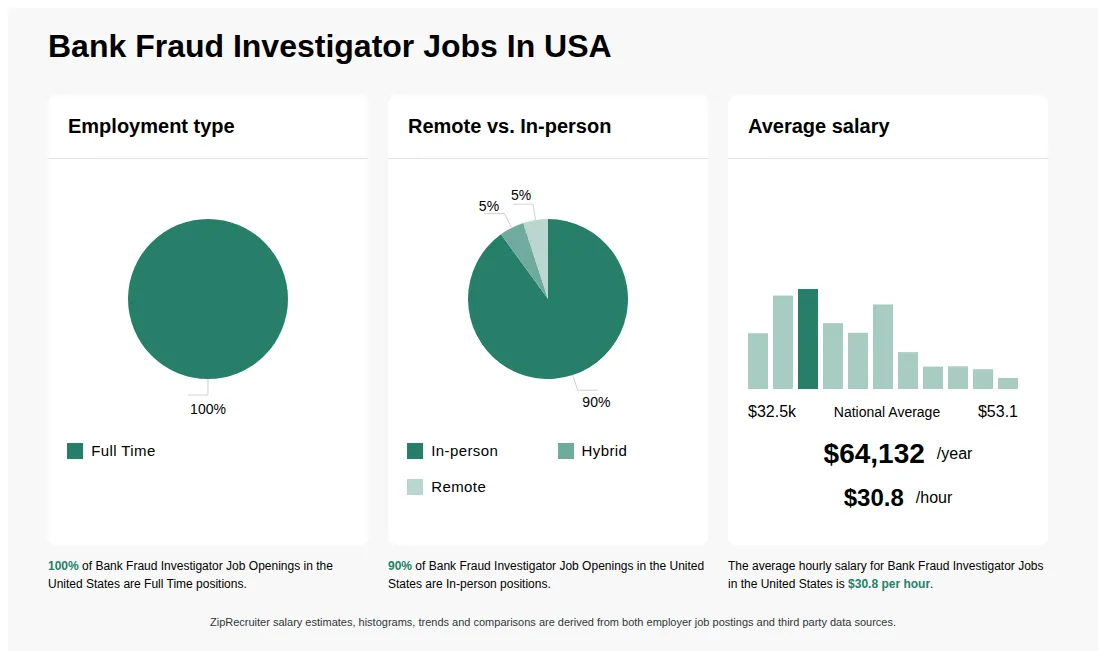
$15.63 - $19.03
10% of jobs
$22.02 is the 25th percentile. Wages below this are outliers.
$19.03 - $22.44
17% of jobs
$22.44 - $25.85
18% of jobs
The median wage is $27.09 / hr.
$25.85 - $29.26
12% of jobs
$29.26 - $32.67
10% of jobs
$34.38 is the 75th percentile. Wages above this are outliers.
$32.67 - $36.08
15% of jobs
$36.08 - $39.49
7% of jobs
$39.49 - $42.90
3% of jobs
$42.90 - $46.31
3% of jobs
$46.31 - $49.72
3% of jobs
$49.72 - $53.13
1% of jobs
$15
$30
$53
A Bank Fraud Investigator is responsible for detecting, analyzing, and preventing fraudulent activities within financial institutions. They review transactions, investigate suspicious account activities, and collaborate with law enforcement or internal teams to mitigate financial risks. Using financial data, security measures, and fraud detection tools, they help protect customers and the bank from financial losses. Additionally, they may recommend improvements to fraud prevention strategies and educate bank staff on fraud-related risks.
To thrive as a Bank Fraud Investigator, a strong background in financial regulations, analytical thinking, and knowledge of anti-fraud procedures is essential, often supported by a degree in finance, criminal justice, or a related field. Familiarity with fraud detection software, case management systems, and certifications such as CFE (Certified Fraud Examiner) are commonly required. Strong attention to detail, excellent communication skills, and the ability to make sound judgments under pressure are vital soft skills. These competencies enable investigators to efficiently identify fraudulent activities, protect bank assets, and maintain regulatory compliance.
Bank Fraud Investigators often face the challenge of staying ahead of constantly evolving fraud schemes and adapting quickly to new tactics used by criminals. Their work typically involves analyzing large volumes of data, conducting in-depth interviews, and preparing detailed reports, which can be both time-sensitive and complex. Collaboration with law enforcement, legal departments, and other financial institutions is common, requiring strong teamwork and communication skills. Balancing the need for thorough investigations while minimizing disruption for legitimate customers is a key part of the role.
Cities with the most Bank Fraud Investigator job openings:
The most popular types of Bank Fraud Investigator jobs are:
States with the most job openings for Bank Fraud Investigator jobs include:
The top searched job categories for Bank Fraud Investigator jobs are:
6.7
Based on 17 frontline employees who took The Breakroom Quiz
138th of 175 rated banks
Get the full story on Breakroom